
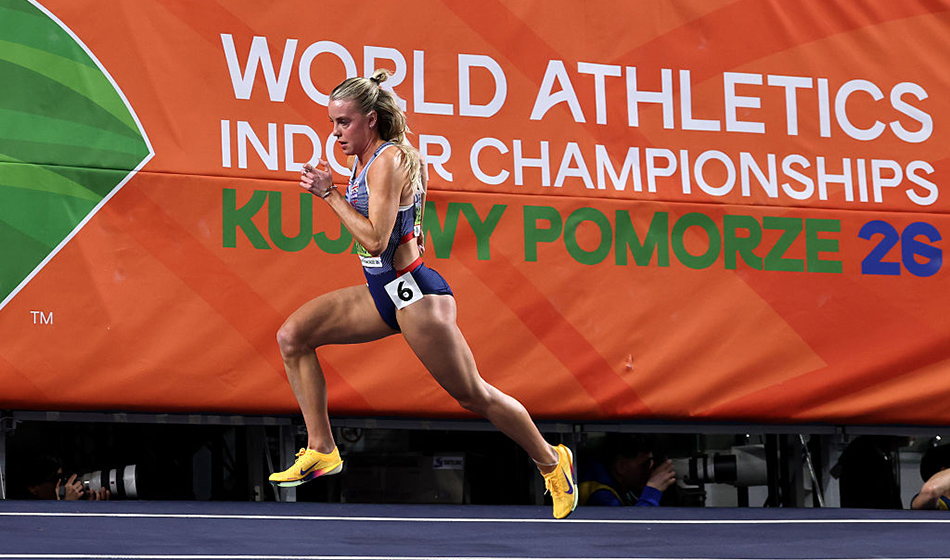
Jenny Meadows on having her faith in athletics restored, finding the joy in coaching and what lies ahead this summer for Britain’s 800m star.
If, as the saying goes, “a happy athlete is a fast athlete”, then it’s no coincidence that Keely Hodgkinson has been grinning from ear to ear for so much of 2026. Capturing the first world indoor title of her career last month brought the curtain down on an exceptional – and eventful – winter that could barely have gone any better.
The 24-year-old’s exploits have also brought a smile to the faces of her coaching team, the husband and wife duo of Trevor Painter and Jenny Meadows whose approach is making a real mark on the sport. In fact, for Meadows, seeing the Manchester-based M11 training group going about their business has not only helped to restore her faith in athletics, it has also “healed her heart”.
It’s 10 years since the now 44-year-old hung up her spikes after an international 800m career that featured four international medals but could have included more, given that she missed out to athletes who subsequently tested positive for doping.
“It means a lot,” she says, speaking to AW at the Emirates Arena in Glasgow at the beginning of March where Hodgkinson and training partner Georgia Hunter Bell were tuning up for Toruń. “I never wanted to get involved in coaching, but being married to Trevor [who coached Meadows] he was always going to carry on and he got me involved about six weeks after I retired, mentoring some athletes.
“I think sometimes you don’t realise how much you know. I do absolutely love it now and I think it’s healed my heart a little bit, because I was quite dubious towards the end of my career. Things looked too good to be true. Quite often [it was] ‘Can you see amazing performances and can you actually believe it?’ So I’d rather be involved on the inside knowing that you can.
“You can only vouch for the athletes that you’re involved with. These guys train really, really hard and I know you can be the best in the world by doing it clean. It has been a 180 [degree change] for me. I do feel like I have a lot to give the sport. [The athletes] tell me I make a difference, so that’s always good. I can’t imagine doing anything else now.”
If there is one thing that Meadows is still trying to comprehend about her old event, it’s how rapidly things have moved on since she stepped off the track. She coaches the current indoor world record-holder, of course, and admits to having been taken aback by the nature of the modern-day 800m.
“I have to pinch myself when I think about these times that are being run now,” she says. “I am an old school athlete. I’ve never run in the super shoes, they’ve 1775126486 got pacemakers and wave lights, the recovery now is so much better. If I look at the whole team behind Keely and Georgia, for example, they’ve got full-time staff, therapists, physiologists.
“I used to wait to train with lots of people who were working or at college and Trevor was working full-time, so I used to train during club evenings. I look now at what these guys have got, and I can understand why there’s advancements in the sport, but they work so, so hard.
“It’s only 10 years since I retired, and it is almost like a completely different sport. But they work so hard, and I’m not resentful in any way. They deserve these opportunities.”
And the athletes are taking them. Hodgkinson and Hunter Bell will now head into a summer that features the Commonwealth Games, European Championships and Ultimate Championship with world indoor titles and gold medals to their name.
For the Olympic champion, “domination” has been her word for 2026 and it would seem she is fully intent on producing just that on the track, fuelled by the thought of making up for the time she lost in 2025 due to injury.
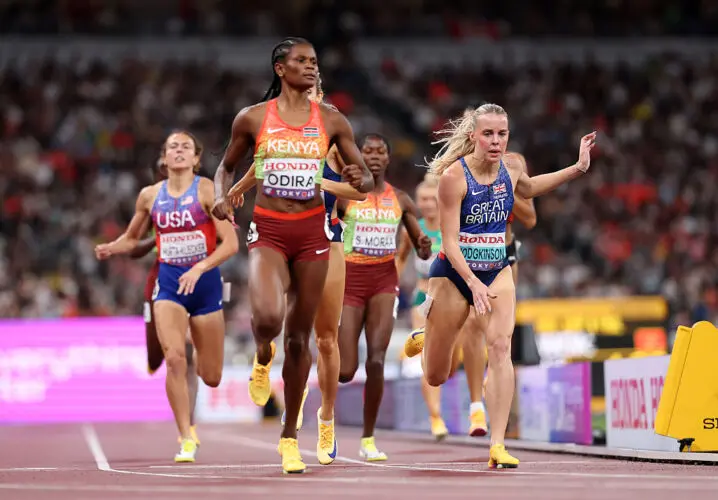
“It really hurt her last year, not being able to compete until August,” says Meadows. “This winter has been the first proper winter Keely’s had in three years. So we really have to look back to the end of 2022 as the last time we’ve gone through all the phases of the training.
“And she wasn’t happy with that [world] bronze in Tokyo. She won a medal, she never stopped training, but it was almost like she was in base training for a whole year. Imagine just having to do the endurance for a whole year with no kind of phases of training, no rewards. It was pretty tough, but still to run 1:54 twice shows what an incredible athlete she is.
“But because she has those months now of consistent training this winter, she’s hitting outdoor times indoors, and it just makes me really excited. I think she will be running those 1:53s that she’s so desperate to run. Whether it’s [the world record of] 1:53.28, we’ll see but it was in London in 2024 that she saw 1:54 on the clock for the first time and now she’s really looking forward to that moment when she sees 1:53 on the clock.”
Hodgkinson has been open about targeting Jarmila Kratochvílová’s world record and also recently took to social media to gauge opinion on the potential use of male pacemakers in women’s races – an approach that goes against current rules. The challenge is finding female pacemakers who can hit those speeds, Hodgkinson’s argument being that any woman in a position to pace such an attempt at the moment would be potentially looking to either win the race or break the record themselves.
Meadows believes it’s an interesting discussion point and argues that, in the same vein as Faith Kipyegon’s Breaking4 project last year, even a showpiece that didn’t conform to the rules could be a very worthwhile exercise.

“Faith Kipyegon had an array of pacers doing different things, and it was a test and it was a challenge, rather than it was going to be a legitimate record,” she says. “I think, as an athlete, you always want to challenge yourself, and I think it would be good to have conversations with someone, even if it’s not a valid world record, just for Keely to know she’s done that, and then maybe if she goes back to a female paced race, she’ll then think ‘I’ve shown myself I can do that and, actually, I just need to take control of the race’. So maybe it is a conversation that will help push the event forward.”
Hodgkinson’s performances have certainly taken a step forward, too – her World Indoor Championships record coming five years after she won her first title at the European Indoor Championships, also in Toruń, as a 19-year-old. How has Meadows seen her change in that time?
“She’s more in tune with her body now,” she says. “I think her goals are very self-driven, and Trevor and I always go along with those goals. She used to listen to us a lot for reassurance and she still does. [For the world record In Lievin] she specifically asked: ‘Jen, do you think I can do this?’ And it wasn’t the world indoor record [she was talking about]. It was 1:53.
“It’s great that she still wants that opinion but she also has self assurance now. Now she knows the numbers, she understands how the sport works, how our training works, and she’s very challenge driven, like: ‘This is what I want to get out of the session’. So I think we’re learning from her as much as she’s learned from us, and we’re going through this almost like a partnership now.”
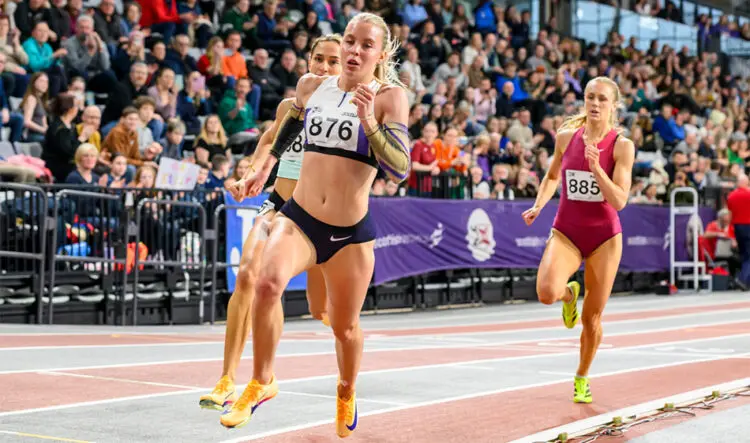
In working to get stronger, to make herself more robust, the European champion has also cut a noticeably different figure this year – a topic that she hasn’t shied away from discussing in public. In doing so, Meadows argues that Hodgkinson has only enhanced her credentials as a role model.
“I’m glad that she’s put that out there recently about her being heavier when she goes on the scales,” she says. “Females think that’s a negative thing but it is just a product of her growing and where her body should be. If I look back at how she looks in Paris, she was 54kg and she actually looks quite skinny to me, but she’s developing into her own adult woman’s body now. She’s 60kg, but doing it for the event, not the image or for what someone thinks she should be.
“I really respect Keely for that because, even now, I still look on the scales at what I weigh and I get emotional from it, but Keely’s looking at it from a performance point of view. I respect her so much that she just knows what she wants from the sport and she’s prepared to do it.”