
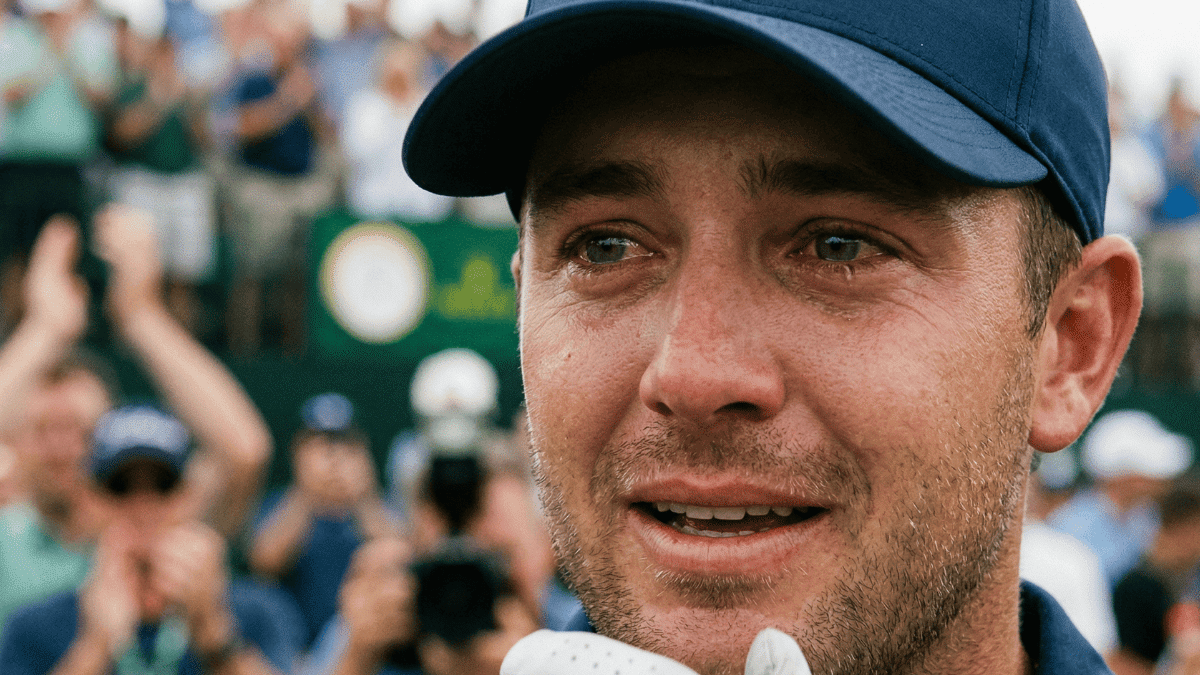
Gary Woodland won the Houston Open by five shots, shot a final round 67, and then stood in front of a camera and wept.
Nobody changed the channel. Nobody cringed. Golf fans watched it and nodded, because somewhere in the back of every golfer’s mind, they understood exactly what they were seeing.
Why do golfers cry after winning more than athletes in any other sport? Woodland is not an outlier. He is the latest entry in a list that keeps growing.
Bubba Watson cried after almost every win he ever had. Rory McIlroy broke down after his Masters victory last year. Bryson DeChambeau, Chris Kirk, Alex Fitzpatrick, all recent criers, all standing on a golf course, all unable to hold it together after the final putt dropped.
Now think about the last time you saw a hockey player cry after winning the Stanley Cup. They hoot. They holler. They hoist the trophy and skate in circles. An F1 driver wins a race and sprays champagne with a grin that could light up a stadium.
The tears in other sports exist, but they are the exception. In golf, they are starting to feel like the rule.
What golf does to the human mind that other sports don’t
Every sport is mentally demanding. Do not mistake this for an argument that golfers are tougher than other athletes.
But golf has a specific kind of mental architecture that sets it apart. You are alone out there. No teammates to absorb a bad moment. No timeout to stop the bleeding. No coach can sub you out when your head starts spinning on the back nine.
Every shot is a decision you make alone, execute alone, and live with alone. And you do that for four days straight, across 72 holes, while the leaderboard shifts around you and the pressure compounds with every step toward the final green.
By the time a golfer taps in that last putt to win, the mind has been holding back a tidal wave for days. Sometimes years. When the job is finally done, the release is not optional. The body just goes.
That is not weakness. That is what happens when elite mental control finally gets permission to let go. Sports psychologists describe this as the parasympathetic nervous system reasserting itself after sustained high-stress suppression. Golf forces that suppression longer, across more decisions, than virtually any other individual sport.
Why Woodland’s tears hit differently
For most winners, the crying makes sense once you understand the sport. For Gary Woodland, it makes sense before you even get to the golf.
Thirty months ago, he needed advanced brain surgery to remove a lesion from his skull. The piece of bone they removed was the size of a baseball. He did not know if he would ever be the same person after that procedure, let alone compete at the highest level of professional golf.
The road back from that kind of surgery is not just physical. It reshapes your entire relationship with the game. To understand what prolonged injury and recovery does to a professional golfer’s career and identity, you only need to look at how many elite players never fully return after major procedures. The game does not wait for you. The field keeps moving. And when you come back, you have to prove everything all over again.
Woodland did that on Sunday in Houston. Five shots. Final round 67. No drama at the end. Just a clean, dominant win by a man who had every reason to never be standing there again.
If that does not make you emotional as a golf fan, check your pulse.
The generation gap nobody talks about
Here is the part of this conversation that tends to make people uncomfortable.
Jack Nicklaus did not cry after winning. Arnold Palmer did not cry. Ben Hogan did not cry. That entire post-war generation of champions went through a culture that treated visible emotion in men, especially in public, as something to be suppressed rather than expressed.
They won majors in near silence and shook hands and moved on. That was the standard, and for decades nobody questioned it.
What has changed is not that today’s golfers are softer. What has changed is the culture around what it means to be a competitor and a man in public life. The athletes who grew up watching their sport evolve through the mental health conversations of the last decade came out the other side with a different relationship to their own emotions.
Crying after a win is not a sign that the moment overwhelmed them. It is a sign that they were fully present for it. Golf’s crying generation is not a trend. It is a shift in what elite competitors are willing to show the world.
What the tears actually tell you about the mental game of golf
As a golf coach, the post-round breakdown is one of the most revealing things I watch in professional golf.
The players who cry are almost always the ones who were carrying the most internal pressure during the round. They were not carefree out there. They were grinding, managing, suppressing, and competing at a level of mental output that most people will never experience.
The release at the end is proportional to the effort that went in. A big cry usually means a genuinely hard fight, even when the scorecard makes it look clean.
Golf psychology research consistently points to the same pattern: the longer a player sustains focus under competitive pressure without an outlet, the more pronounced the emotional release once that pressure lifts. Four days. Seventy-two holes. Hundreds of individual decisions made alone. That is an enormous amount of mental energy to hold without release.
What Woodland showed in Houston, both during the round and after it, is a player who understood exactly what he had overcome to be standing there. The tears were not about the trophy. They were about the thirty months that came before it.
Does crying after a win hurt or help a golfer going forward
This is a question worth asking directly, because the answer matters for how we understand what the tears mean.
In my experience coaching competitive golfers, a full emotional release after a major win is almost always healthy. It clears the system. Players who suppress that release entirely often carry residual tension into their next event without realizing it.
The ones who cry, reset, and move forward tend to show up the following week with a cleaner mental slate. The release is not a sign that they are fragile. It is a sign that they competed fully, and now they are done competing for the week.
Woodland’s ability to win cleanly, five shots clear, suggests a player in strong mental shape. The tears after are consistent with that, not contradictory to it.
So is golf different or are other sports just less honest
My honest take is that golf surfaces emotion in a way other sports genuinely do not, because the sport is built on individual accountability in a way team sports are not.
But other sports produce the same depth of feeling. They just have different release valves. The chest bump, the scream into the crowd, the champagne spray. Those are emotional releases too. Golf sits in silence long enough that when the wall comes down, there is nowhere for it to go except straight to the surface.
Woodland’s win in Houston is a reminder of why this sport gets under people’s skin in a way that is hard to explain to someone who has never played it. The mental side of competitive golf produces something in players that does not exist in the same form anywhere else in sport.
Do you think golfers cry more because the sport demands more mentally, or do you think other athletes are just less willing to show it? Let me know below, because this one is worth the conversation.
Frequently Asked Questions
Why do golfers cry after winning more than athletes in other sports?
Golf demands sustained individual focus across four days and 72 holes with no teammates, timeouts, or substitutions. By the time a golfer wins, the mind has been suppressing pressure for days. The emotional release after the final putt is a natural physiological response to that sustained mental effort finally being allowed to let go.
Did Gary Woodland have health issues before winning the Houston Open?
Yes. Approximately 30 months before his Houston Open victory, Woodland underwent advanced brain surgery to remove a lesion from his skull. Surgeons removed a piece of bone roughly the size of a baseball. His recovery and return to elite competition make his win one of the most emotionally significant on the PGA Tour in recent memory.
Has Bubba Watson cried after every win?
Not every win, but Bubba Watson became well known for breaking down in tears after victories throughout his career. His emotional post-win reactions were among the most visible in modern professional golf and helped normalize emotional expression among PGA Tour players.
What does crying after a golf round reveal about a player’s mental state?
From a coaching perspective, a strong emotional release after a win usually signals that the player was carrying significant internal pressure during the round. The size of the release tends to reflect the amount of mental effort suppressed during competition. It is a sign of full competitive engagement, not fragility.
Did Jack Nicklaus or Arnold Palmer ever cry after winning?
Neither Nicklaus nor Palmer were known for visible emotional breakdowns after victories. That generation of champions played through a cultural norm that discouraged public displays of emotion from men. Their composure reflected that era’s standards, not necessarily a different emotional experience of winning.
Is crying after a golf win a sign of weakness or mental strength?
Mental strength, not weakness. Players who cry after winning have typically just completed an extraordinary feat of sustained focus and pressure management. The emotional release is the body’s natural response once that pressure lifts. Coaches and sports psychologists generally view it as a healthy reset, not a performance concern.