
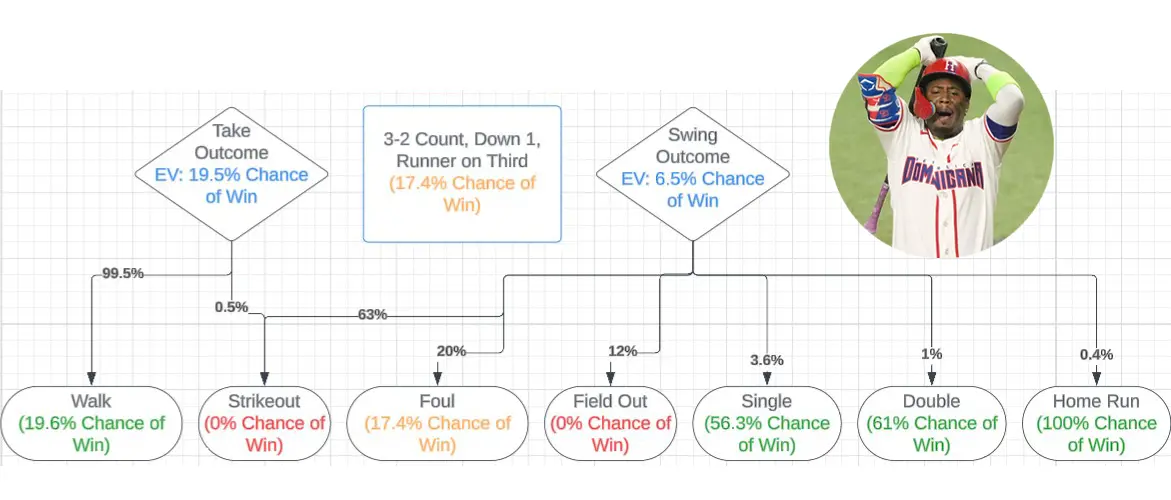
Perhaps the focus on the swing-or-to-not-swing question regarding Perdomo should not have been tied to the full count pitch but, rather, the third pitch of the at bat when Perdomo watched a fastball split the center of the plate.
Granted that offering was 100.7 mph out of Miller’s hand – not the easiest pitch to turn around – but by not swinging at a center-cut fastball, the count leverage went from neutral to a 1-2 count, and severely in favor of Miller. That was also his best pitch to hit.
Hitters should all be more aggressive when they have leverage but they also ought to have individualized approaches.
For instance, Aaron Judge and Luis Arráez ought to have much different approaches.
“If you take Judge versus Arráez and they swing at a slider on the black, down and away, the chances of an Arráez doing anything good with that pitch when he puts it in play is very slim,” Stokey said. “The chances of Judge doing something productive is significantly higher because he has so much bat speed, he has so much ability to create velocity and impact on baseball.
“Low-power guys should be even more selectively aggressive. When they are swinging early, they should really be leaning into getting that ‘A swing’ off. “
This was even an issue for Mookie Betts in working with Stokey back in 2023. Betts was too worried about making contact, and having the lowest K rate possible, and it was sapping his power. One aspect tied to his rebound season is he became more selective about when he swung. Betts added bat speed but there was also a mindset change, Stokey told me for this piece last fall.
“The thing with (Betts) was ‘Man, your bat-to-ball skills are so good,’” Stokey said. “A lot of times you see players with very good bat-to-ball skills, they don’t want to swing and miss. So, while Mookie didn’t have poor chase rates he would expand on the edges and swing on balls in the shadow zones and slow himself down for the sake of putting the ball in play. He’d slow himself down and make poor, unproductive contact.”
Even the best hitters in the game might not have quite the right mindset regarding where they belong on the power-contact spectrum.
The good news? There are ways to improve. But there is the question of training economy.
There are only so many hours in the day, only so many reps a hitter can take. How much of those should be geared toward a regime that focuses on decisions over, say, bat-speed training?
“If you want to look at it through the lens of the big three: power, contact, and swing decisions… good, a good training program, a good training environment, is going to take into account all those things,” Stokey said. “You can very easily train your power, your bat speed, and your contact skills, and your swing decisions in the same environment.
“Now, you need really awesome technology, like Trajekt, or you need a pitcher that can mix pitches to you in batting practice, things like that… Say a hitter gets a 50-50 (mix of pitches) off a Trajekt, or an iPitch something like that. (The athlete) is figuring out how to get their best swing off and make quality contact in an ‘A-swing’ situation, or finding a way to hit a line drive ball flight in a two-strike situation.”
A core principle of Driveline coaching is to embrace and create environments that force athletes to adapt through implicit learning.
For example, a specific two-strike protection drill is probably a suboptimal use of time, Stokey says. Rather, we want to create difficult, game-like environments.
Beginning this season in the majors, ABS technology will begin to protect a hitter like Perdomo from the unfortunate outcome of having made a correct decision in a high-leverage spot hurt by umpire error. Perhaps someday 99.9% of ball-strike calls will be made correctly. Perhaps one day the technology will trickle down to amateur games, too.
Still, even if rogue umpire calls decided fewer fates, the art and science of swing decisions and approaches will always be important.
Not all strikes are created equal. The optimal areas to attack differ for hitters. It’s a game of probability as Perdomo found out in the WBC. There is no certainty involving any one swing decision, but we want to place our athletes in a position to succeed as often as possible.