
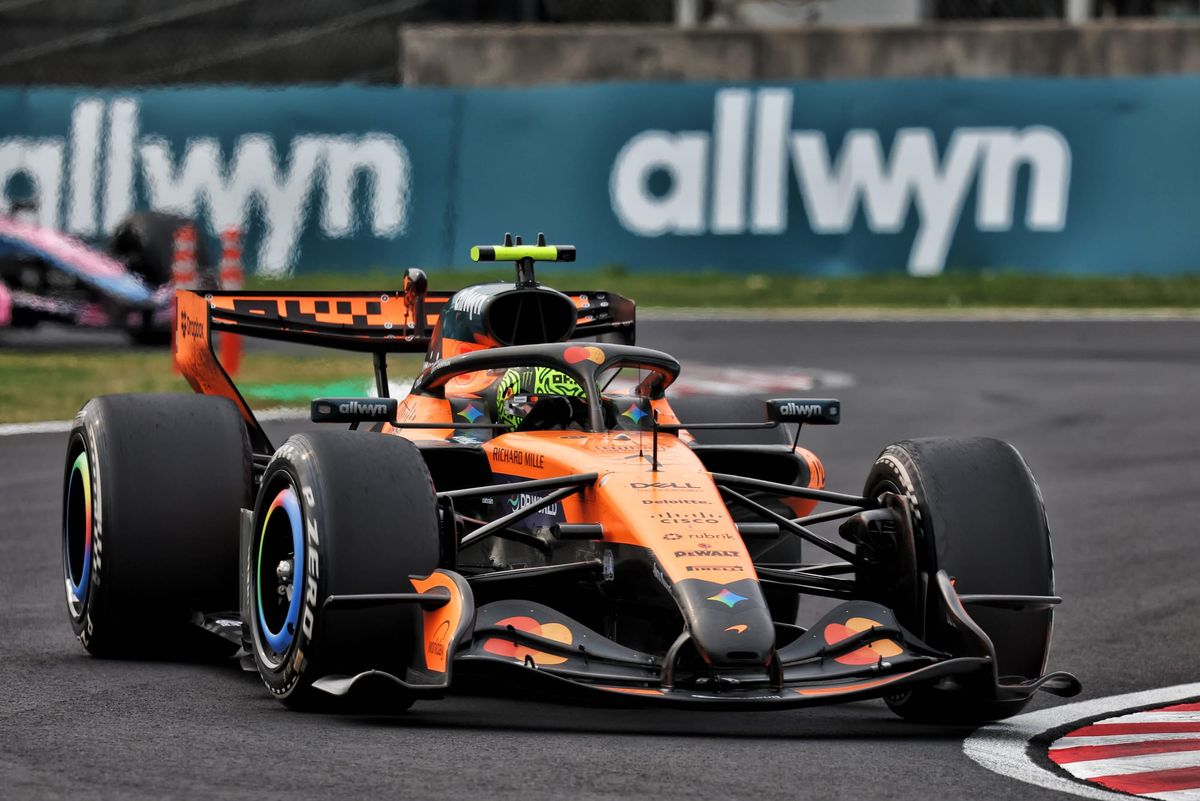
There is a worst-case scenario with Formula 1’s complicated rules that can leave drivers at the “mercy” of their engines completing accidental overtakes or finding it “basically impossible” to use their battery to pass properly.
While F1’s 2026 cars and engines have increased the frequency of overtakes, the nature of the racing – and its authenticity – has been a huge topic of debate between drivers, in the F1 paddock, and among fans.
So-called yo-yo racing has been a feature of all three grands prix at some stage as swings in battery level and MGU-K usage lead to drivers trading where they drive past one another on straights.
In the most recent grand prix in Japan, an often stagnant race was mainly broken up by drivers briefly overtaking the car ahead into the final chicane only to (usually) be blitzed back past on the long run to the first corner.
And sometimes – according to world champion Lando Norris – those passes were not even intentional. They were driven by a quirk of the engine rules.
“Honestly, some of the racing…I didn’t even want to overtake Lewis,” the McLaren driver said of his fight against Ferrari driver Lewis Hamilton.
“It’s just my battery deploys, I don’t want it to deploy, but I can’t control it. So I overtake him and then I have no battery, so he just flies past [on the next straight].
“This is not racing, this is yo-yoing.
“And when you’re just at the mercy of whatever the power unit delivers…the driver should be in control of it at least, and we’re not.
“Yes, the racing can look great on TV, but the racing inside the car is certainly not as authentic as it needs to be.”
The Norris-Hamilton fight reached its crescendo late on. In simple terms, Norris passed Hamilton into the final chicane on lap 50, Hamilton re-passed him on the straight immediately, but Norris then got ahead for good into the chicane the next time by and Hamilton was actually unable to retaliate.
It looked like a reasonable conclusion to a battle that had been brewing for much of the final stint. But as Norris said, there was an oddity involved that is jarring.
“The problem is it [the battery] deploys into 130R – I have to lift, otherwise I’ll drive into him, and I’m not allowed to go back on throttle,” Norris said when asked by The Race to explain what he meant by not being in control.
“If I go on throttle, my battery deploys, and I don’t want it to deploy because it should have come.
“But because you lift, you have to go back on [throttle], it re-deploys. There’s nothing I can do about it.
“So, there’s just not enough control for a driver, and that’s why you’re just too much at the mercy of what’s behind you. It’s just not how it should be.”
What Norris describes is a function of the complex relationship between F1’s new overtake mode, the general problem of having a battery that cannot sustain the deployment of the MGU-K, and complex rules that demand what the engine does in certain situations.
The best overtaking spots are the straight to Turn 1, and at the end of the lap into the chicane. When behind Hamilton, Norris had overtake mode to use – giving him a little more charging allowance and the MGU-K’s full 350kW power for slightly longer when normally deployment tapers off.
We can take the (brief) overtake on lap 50 as an example. As Norris used overtake mode behind Hamilton on the straight towards 130R, that extra MGU-K usage took a lot out of the battery. But it also brought Norris very close to the back of the Ferrari, at high speed – close to 340km/h through 130R, which actually makes that easy flat-out kink into more of a corner.
So Norris – who had no MGU-K use by that point – lifted not just to avoid contact but because of the grip demands. By lifting significantly, though, Norris fell into the problem of F1’s overly complicated ‘power limited pending’ rules.
The simple version of this is that when throttle application dips below 98%, accelerating again will automatically cause the MGU-K to deploy briefly at 200kW, which eats into the battery when it should be being saved.
This uses up a vital bit of the remaining energy and therefore reduces what is left to be used on the exit of the final chicane and down the start-finish straight. So if an overtake is completed into the chicane, the driver is vulnerable right after. And if the overtake is not completed, there is no chance of getting ahead into Turn 1.
Norris’s state of near-confusion over what to do in a situation like this was highlighted by his throttle usage mid-overtake. He did squeeze the throttle again, but not back to 100%, and then reduced it immediately, hovering around 50% as he passed the Ferrari. It was an almost apologetic overtake.
It turned out to be futile anyway, at least for that lap. Norris did make a pass work properly a lap later, although this was also a little odd as Hamilton seemed to lift off in the middle of 130R. Perhaps it was an attempt at strategically letting Norris through to then repass into Turn 1 again, fearing he would be vulnerable otherwise.
But it ended up being a slightly odd end to a battle that did not seem very satisfying to the driver who eventually won it. And the problem is, if drivers did not want to engage in that battery-dictated back and forth they can find themselves stuck in position, like Max Verstappen.
He trailed Alpine driver Pierre Gasly for much of the grand prix and felt there was little to be done given the demands of a circuit like Suzuka – and with its particular layout – which also highlights the problem F1 can get into with racing in certain circumstances with these engines.
“You have a little bit more [energy] usage, of course, when you’re within one second, and especially on a track where it’s quite poor, the energy management that you can use in a lap, you just need to be very careful with how you use your battery,” said Verstappen.
“It’s a bit tricky. The problem is you have a long straight and then only like a little chicane, and then a long straight again. So if you deploy in one straight, you have nothing on the other.
“On some other tracks, you have a long straight then maybe a few corners and you have time to charge, here you don’t.
“In a lot of places where you want to go for an overtake, then there’s only one corner to charge, and then a long straight again – so that makes it basically impossible to use the battery, because it’s completely inefficient to do that.”
As F1 approaches a crunch meeting between stakeholders to discuss what could and should change to address problem areas within the rules, the complexity of the engine demands and what is and is not in the control of the drivers and teams is a less obvious discussion point.
It falls behind things like the qualifying spectacle and, of course, safety in the priority order. But it will likely be something that certain voices make sure is at least heard.
“This is something that from a regulatory point of view is probably avoidable,” said McLaren team principal Andrea Stella.
“You can let the engineers select themselves sections of the circuit in which after you have lifted, if you go on power, you may actually have no electrical engine deployment and you have more freedom in the way you use the battery.
“Otherwise you find that Lando a couple of times has overtaken Hamilton and has been overtaken back.
“I think there’s a possibility to allow drivers and engineers to have more freedom.”