
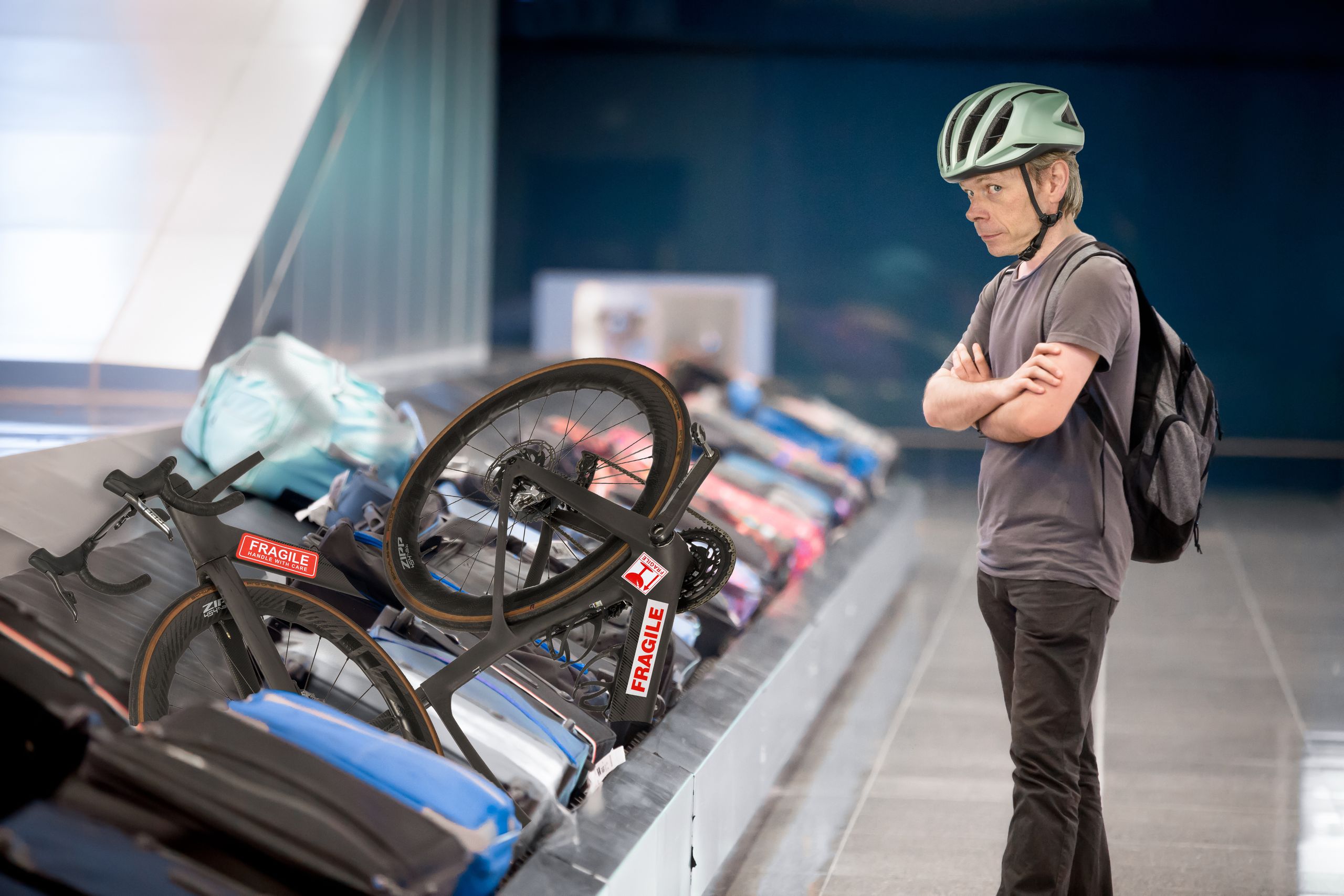
I flew to Spain recently with a bike. A few days before the trip, I was out for a ride with my friend Bernard and mentioned my plans.
“I suppose you’re going to pack it into one of those posho boxes or bags,” he said. I told him I certainly was, what with not wanting my bike reduced to more parts that it had been assembled out of in the first place, and all that.
“They’re a con,” he said. “It’s just a swindle invented by the industry to make money out of idiots like you.” He told me that he insists on handing the bike over at the check in desk as it is: “If you do that, it’s obvious that it’s fragile. Only a psychopathically violent baggage handler would do it any damage. If you pack it, it’s more likely to get chucked about.”
Article continues below
I admired his casual confidence in the non-existence of psychopathically violent baggage handlers. But it’s also possible that he might be on to something – a “naked” bike might well get treated with more respect. Also, if one of his bikes had ever been damaged travelling this way, I guarantee I’d have heard about it at length.
Multiple national champion on the bike and award-winning author Michael Hutchinson writes for CW every week
I still won’t change my approach, though. How you fly with a bike isn’t a question of logic. It’s religion multiplied by superstition. People who believe in no higher power, who dismiss astrology and who pin a race number “13” on the right way up with a merry laugh, will cling to any belief system at all when it comes to combining bicycles and airports. This is because the one thing we think we know is that an airport is essentially a giant bike-crushing machine.
We’ve heard the horror stories. We’ve seen the social media posts about bike frames snapped in ways mere science cannot explain. So if you ever, even once, transport a bike by air and get it back unharmed, you will stick to the method you used. You will tell others their method is as good as driving a baggage truck over the bike themselves. Your faith in your method will never be shaken.
Until of course, your bike is damaged. But that doesn’t happen as often as you think. Bike survival has usually got very little to do with your packing choices, it’s just that in practice most bikes make it. Survival has nothing to do with us, we just think it does. It’s the equivalent of sacrificing a virgin for a good harvest because of that one time you sacrificed a virgin as an experiment, and the crops flourished.
My bike made it to Spain and back inside my usual soft bag, with an internal frame. So did that of my travelling companion (not Bernard)in its solid box. He was amazed mine survived, just as he is every single time we travel together. I know riders who swear by the cardboard boxes used for shipping bikes to shops. I know riders who dismantle their bike into as many parts as possible, on the basis that the more bits it is in already, and the more rattly noises the box makes, the more likely the baggage handlers are to assume it’s already smashed.
But my favourite bike mover is an ex-pro, who never packs a separate bag for his clothes. Instead inside his box, he protects every tube of the bike with t-shirts, jeans, and jumpers, wrapped around and held on with zip ties. It looks like someone has knitted him a bike. But, give him credit, he’s never had a bike mashed. Even if every item of clothing he owns, including his underpants, has chainring marks on it.
He is, obviously, convinced he’s right. And, equally obviously, there is not the slightest point in arguing about it.
Acts of Cycling Stupidity
A colleague told me about a friend of his who recently borrowed a set of very lovely ENVE carbon wheels from a local shop-owner to test ride for a few days before deciding if it was worth the upgrade.
“I just hope the hell I can tell the difference between them and my current wheels,” the rider in question said, arriving for a group spin.
Why was this? Was it because he felt his finely tuned sense of ride and handling was in question? No.
“I need to be able to tell the difference because I know I’m going to buy them whatever, and I’ll feel like a lot less of a fool if I can at least tell that they’re better before I hand over £4000.”

(Image credit: Shutterstock)
How to… remember selectively
Someone with a selective memory can, after an event or an experience, only recall certain parts of it. Cyclists, for example, are excellent at remembering the glorious part of a ride where they sashayed down an Alpine descent, but sometimes much less detailed in their recall of how exactly they ended up in hospital.
Similarly, the cold and the wet. The way water can penetrate any glove. The day they ran out of energy 40 miles from home and cried for the three hours it took to finish the ride. Without the ability to forget these things there would be no repeat cycling.
With experience, though, comes the ability to remember more. Except in the selective memory of a more experienced rider, misery crystalises as comedy. All of the above is hilarious, if you remember it the right way, and tell the tale to an audience similarly divorced from any concept of “having a good time”.
Further experience produces, eventually, the ability to remember properly. Dimly at first, as if recalling a past life. Then more vividly. Then, at last, with a yelp of pain and anguish and terrifying self-awareness. This is usually the point at which people give up cycling. It’s not that 90-year-olds are too infirm to ride. It’s that they’ve finally begun to remember