
[Editor’s Note: This article originally appeared in the February 2001 issue of Grassroots Motorsports.]
Welcome to the third and final installment in our series detailing the race preparation of our 1957 Triumph TR3. Our two previous articles have included a primer on the sport of vintage racing (April 2000 issue). and a discussion of how …
What Was Original
There are a few decisions that must be made before you undertake the process of prepping a vintage race car. First, you have to decide how original you want to keep the car. Then you have to decide how fast you want to go. Naturally, you’ll also have to determine how much money you want to spend to accommodate the first two decisions.
The type of car you’re preparing must also come into play. If you are running a Le Mans-winning Porsche prototype, then you would be a fool to make many modifications to this fine piece of history. If you’re building up an old MG Midget that you found in your uncle’s barn, then anything from color scheme to engine mods are strictly up to you, your budget and the rules set forth by the sanctioning body of your choice.
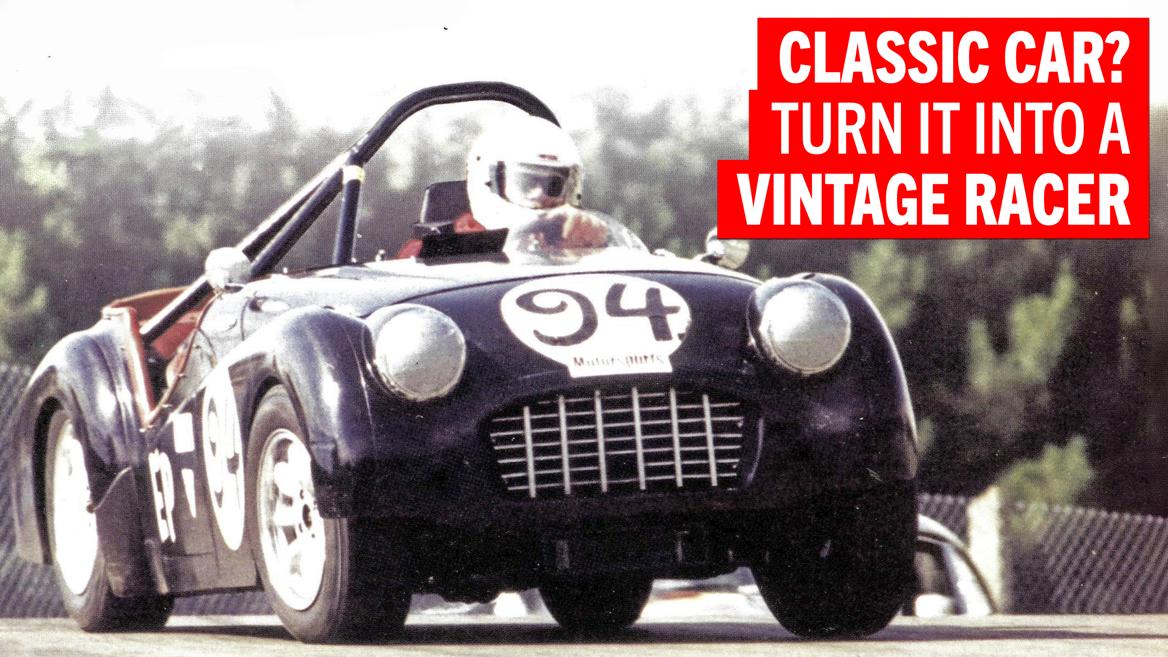
Our particular racer fell somewhere between these two extremes, since our 1957 Triumph TR3 has been driven competitively since two years after its birth. Raced in both Wisconsin and Florida (when its original owners moved south), the car was then put into storage for more than a generation.
While it’s no Le Mans winner, our car did claim its class in the 1965 Paul Whiteman race at Daytona, and either won or placed well at several other races in the Southeast during the early ’60s. When we found it, it was in pristine, unmolested condition, and had not been raced or modified since 1966. This was a fantastic example of a club racer from the early ’60s. right clown to the tech stickers. hand-cut numbers and authentic speed equipment from the clay. Former owners John and Millie Taylor had prepped the car to the nth degree.
We decided to leave the car looking as it had in the ’60s. keeping in mind that it could be improved with the help of a few modern tricks. (After all, we are racers.) Unfortunately, due to the way that racing rules and racing technology have progressed. going fast and staying original are pretty much mutually exclusive. Perhaps that’s why, at some of the recent vintage events we have attended, we’ve seen modifications that were blatantly illegal–as well as of questionable safety and even performance value.
The general rule or spirit in most vintage racing circles is that the car should be raced as originally campaigned. with exceptions made for safety and reliability. Taken loosely, this means that the safety modifications detailed in our last installment are legal. Installing our one-piece aluminum race seat could be called unoriginal, but it’s way safer than the lowrise, stock TR3 seat previously used in the car.
Tires and Wheels
When you’re preparing an older car for today’s vintage racing scene, switching tires is a must. We still have the 30-year-old Goodyear Blue Streak Specials that came with our car, but it would be suicidal to run them today, as age and technology have caught up with these once-cutting-edge tires.
We still have our TR3’s wire wheels, as well. A common item back in the ’50s and ’60s, wire wheels were favored because they were lighter and easier to change than steel disc wheels, while offering better brake cooling. Some drivers still run them today, but they are widely considered somewhat dangerous and heavy because they require an inner tube. These tubes add rotating mass to the car and can produce additional friction inside the tire, leading to a buildup of additional heat.
If you do want to run wire wheels, we strongly suggest that you have them rebuilt and trued by a company like Dayton Wire Wheels. They can even modify the wheels so modern, tubeless tires can be used, while upgrading the spokes to heavy-duty pieces. Dayton can also sell you brand-new wire wheels in stock or wider sizes through their dealer network.
Most vintage racing organizations allow wheels one inch wider than stock. For a Triumph TR3, this means that a 5.5-inch-wide wheel is the legal max. In other words, all of you TR owners running six-inch-wide wheels may be violating the rules.
As for tires, there was a major battle in the vintage racing world about 10 years ago to keep racing rubber out. The thinking was that racing tires would add expense and overstress the older chassis.
Despite the controversy, a few tire companies, led by Hoosier, developed a wonderful line of vintage racing tires that fit most cars currently competing. These new tires are offered at reasonable prices and have good durability.
On our TR3, we are running Hoosier’s Vintage TD in a 5.50x 15 size and have been truly impressed with the vintage look and amazed by the modern performance. Sliding around on poor tires might have been the way it was done during the ’60s, but for our team, we’ll take the Hoosier Vintage TDs any day.
Suspension of Disbelief
Smart racers know that at most tracks the race is won or lost in the turns, yet vintage rules do not allow radical chassis modifications. Outright redesign of the chassis is verboten. However, tweaking spring rates, shock absorber valving or anti-roll bars rates is allowed. Modifying mounting parts is also allowed in some classes. Surprisingly, radical suspension modifications in vintage racing are not as prevalent as extreme engine modifications.
On our TR3, we first looked over what we had. Back in the early ’60s, our car had been equipped with modified front A-arms that increased negative camber. The trick was to actually cut down the upper A-arm, thus making it shorter, which would bring the top of the front wheel in toward the rest of the car and increase negative camber. A factory TR4 anti-roll bar (a rare piece today) had also been installed, while front coil spring rates had been stiffened. Brakes were all stock.
At the rear, everything was pretty much stock except for the lever shocks, which had been tweaked a bit. A rare Detroit Locker limited-slip differential had also been fitted. As we mentioned, the tires and wheels were 5.00x 15-inch Goodyear Blue Streak Specials on 64-spoke, 5.5-inch-wide TR4 wire wheels. (Original TR3 wheels were 4.5 inches wide and had only 48 spokes, while the TR6 came with 72-spoke wire wheels that were also 5.5 inches wide.)
We decided to completely ditch the wire wheels, replacing them with some vintage-looking Panasports in a 15×5.5-inch size. While actual 30-year-old wheels may look cool, it’s often prudent to doubt their integrity. The Panasports, which we got through KSpeed, are built to modern standards, meaning they’re up to the challenge of racing on today’s stickier tires.
The suspension modifications were a little more challenging, since the Triumph TR3 does not have the finest chassis ever engineered. At the rear, the car has a primitive live axle with lever shocks, while the front suspension uses a rather crude double A-arm setup. Believe it or not, though, with the right pieces and the right guy turning the wrenches (in our case. J.K. Jackson of English Auto Services), you can make an old vintage race cal’ handle pretty darn well.
Unfortunately, there was not much we could do at the rear. We simply rebuilt the leaf springs and added a leaf, replaced the shock oil with 30-weight, and changed the damping to increase resistance to compression and rebound.
Up front, we had major problems. We could not get the negative camber or the positive caster that we needed to make the car handle worth a hoot, because the TR3 ball joints mount in such a way that they cannot be slotted for negative camber. To solve the problem, we replaced the upper A-arms with TR4/TR250/TR6 units. These later Aarms take a ball joint that has bolts that are parallel to the wheels, not perpendicular like the TR3 A-arms. This allows you to slot the holes the ball joints go into and thus gain negative camber.
Caster is also traditionally not adjustable on a TR3, but J.K. Jackson had one· more trick up his sleeve: He found some Jaguar XJ6 Series III ball joints that are physically narrower (by .150 inch) than the TR4-TR6 units. Once we shimmed these new ball joints in the A-arms, we were able to obtain the positive caster we felt we needed to get proper steering feel back into the antiquated TR3 cog and peg steering.
Our front shock choice was Koni, as they make a line of Classic-badged units that fit most popular vintage race cars. Available from Truechoice (part number 80-1005) for $95.55 each, these shocks feature a lifetime warranty (street use only) as well as adjustability for rebound. These shocks are rebuildable and can be revalved, which is great should our needs change in the future. (We may increase spring rates substantially.) We set our shocks one turn away from full soft, which works well with our spring and anti-roll bar combination.
Next, we called John Carlson of Saner Performance. John, a longtime employee of Addeo sway bars, has sort of taken over for Addco’s competition department. It seems that when Addeo moved from Florida to North Carolina, John chose not to move his family from their South Florida home. At the same time, Addeo was thinking that they would rather not mess with one-off custom anti-roll bars anymore. Since that was John’s favorite part of his old job, he readily agreed to stay in Florida. start his new company–Saner Performance–and take over most (if not all) of Addco’s custom racing requests.
Naturally, if you want an off-the-shelf piece, an Addeo bar will cost less. However, for around $250, John will make any bar to fit my application.
We wanted a one-inch front bar, which John made in just a couple of days. As it turned out, however, the one-inch bar made the car push too much, so we went back to a 7/8-inch bar which worked perfectly.
This front anti-roll bar, revised front A-arms, new Koni Classic front shocks and reworked rear lever shocks just transformed the handling of our TR3. It is close to amazing how nicely this car handles, even compared to many modern cars.
Upgrading the Brakes
Back in the early ’60s when our TR3 was originally raced, there were only TR3s and the very first TR4s in existence. That’s too bad for those early racers, because the later TR6 model is perhaps the best donor car for building a fast early TR.
When preparing our car for its return to the track, we decided to continue the development its previous owner had begun by using some 1ewer, better Triumph parts.
Specifically, we found the original TR3 braking system to be somewhere between inadequate and downright dangerous. After a more nan exciting test session at Road Atlanta last spring, we faced the fact that we would need more modern brakes.
First to go were the original TR3 10-inch rear drums, replaced by newer nine-inch TR4 rear brakes. Normally, bigger brakes are better, but the TR3 parts are very heavy and hard to find. Additionally, the nine-inch rear brakes allow the use of lightweight, finned aluminum Datsun 240Z rear drums. In addition to lightening things up a bit, the finned 240Z drums will help keep the rear brakes cooler.
This conversion is easy. If you have nine-inch rear drums to start with (some TR3s had nine-inch drums, some had 10-inch units), you need only to get the 240Z rear drums from English Automotive or another source. Then cut .060-inch out of the center; drill out the wheel stud holes if you wish to use 1/2-inch wheel studs for added safety, as we did. (English Automotive does this for you before shipping the pieces.) The best wheel cylinder to use is the standard 3/4-inch piece from a TR4.
If your car originally had the 10-inch brakes, you’ll need most of the “nine-inch'” hardware: backing plates, shoes and wheel cylinders. A TR4, TR250 or TR6 could also supply these parts.
Improving the front brakes was just as straightforward. The TR4-6 brakes are lighter, smaller, more modern and work better than the earlier TR3-style calipers. We chose TR6 brake calipers because finding pads for them is easy. These calipers and caliper mounts bolt right onto the TR3 front hubs. Where they get you is in the rotors: A TR6 rotor is about 1 /8-inch smaller than a TR3 rotor, so you must use the TR6 rotor to clear the TR6 caliper.
We finished off our conversion with braided stainless steel lines and quality racing pads. Up front we used Hawk Blues, and at the rear we installed Carbotech Kelated Metallic shoes. We can’t say enough about this combination for track use. The car stops well, brake modulation is nearly flawless and pad and rotor wear is at a very acceptable level.
Building a Vintage Engine
Vintage racers as a group are not poor people, and many of them express their lack of poverty by stroking checks to their engine builders. Many vintage racing engines are as trick as most anything found in top-notch SCCA Production race cars. As Peter Marcovicci of famed engine builders Marcovicci-Wenz Engineering explains. “Many of [our] vintage Formula Ford engines could still win the SCCA Runoffs in Formula Ford.”
Carrillo rods, high-compression forged pistons and serious head work are commonplace in vintage racing today. A top vintage engine in most classes costs upwards of $5000 or even $ 10,000, and receives hours and hours of expertise and dyno time.
“Porsche engines. like most others. make power in the cylinder heads,” explains Phil Bagley of Klub Sport. a well-known South Florida Porsche vintage racing prep shop. “Most engines see $2000 to $4000 just in flowing the heads properly.”
As for us, since it is our first season, we thought it more important to test the waters. rather than go all out (okay, we’re cheapskates too). So we took the original engine that came with our car and disassembled it for a thorough examination.
We found some interesting stuff. Back in 1966, when this car last raced and was still winning regularly, it used a simple, yet effective setup: stock lower end with stock pistons. shaved cylinder head, Kastner G3 cam. a lot of head work, porting on the intake manifold, and little else. At the time, this was enough to win Regional SCCA races.
As we quickly found out, this minimalist style of engine combined with our lack of experience and sorting time yielded middle- to rear-of-the-pack performance. A bit dismal, perhaps, but at least in our first outing we were a ways from last place. As we develop our skills and sort our car, we will most likely develop a stronger engine, too.
Other Modifications
Naturally, there are a bunch of other modifications that we have made and are still making to improve safety, drivability and/or durability. These mods can make any vintage race car. Triumph or not, more enjoyable to run.
Among the most notable of these modifications was the installation of a Perma-Cool electric cooling fan. which replaced the stock engine-driven mechanical unit that came on our car. Quite honestly, while the original cooling fan is said to rob a few horsepower, we made the switch because we wanted to get our TR3 to run cooler. (Penna-Cool makes a full line of cooling products for almost any car or truck.)
We simply installed our fan on the back of the radiator. Although this fan can be thermostatically controlled. we use a simple switch on the dash. This piece, combined with Red Line’s Water Wetter, has solved our cooling problems both on the street and on the track. Installation was simple and the cost was about $100.
Another very valuable modification we made was the installation of a lightweight, Hi-Torque starter from TS Imported Automotive. This starter is based on a modern Japanese starter motor (with enough changes that it received a U.S. patent). combined with the correct acceptance plate and drive gear to fit an early Triumph. Models are also available for other applications, including MG, Datsun, Morgan, as well as many other Triumph cars.
This starter weighs 9.4 pounds, roughly half as ·much as the stock unit. It also hasn’t failed (unlike the stock starter) and has much more torque. making the car way easier to start both hot and cold. Unlike the original Lucas starter, which had a solenoid encased in steel that led to hot-start problems, the Hi-Torque solenoid is encapsulated in aluminum and features a vent hole for cooling.
Triumph used two different starters during TR3 model production, so make sure you discuss your setup with TS Imported so you order the right piece. A starter like ours carries a $225 price tag.
With the help of J.K. Jackson, we also installed a new wiring harness-a very good idea on a 40-year-old car to prevent DNFs and electrical fires. We also went through the lights, making sure everything was· working properly.
Our twin SU carburetors were a little gummed up from sitting so long, but Ric Lovecchio at RML Automotive rebuilt them just in time for our first vintage race. SUs are simple by design, but like any other carburetor, dirt and wear can play havoc with their operation. (Since SU carbs are so prevalent on older cars, look for more on this topic in the future.) Once the carbs were ready to go, Stu Brumer at BSI Racing helped sort them out. After the carbs were rebuilt and mounted on the engine, we added TWM velocity stacks and ITG air filters for better airflow and protection from debris entering the engine.
Another popular modification on vintage cars is the addition of an Accusump oil accumulator. Marketed by Canton Racing Products, this device stores engine oil under pressure in a remote reservoir, providing continuous oil pressure even during hard cornering and cold startup. This helps prevent oil starvation problems.
Installation is quite straightforward. You just run a line after your externally-mounted oil cooler to the Accusump unit, which is generally mounted in the cockpit of the car. You will need to use braided stainless steel line. The Accusump system starts at about $150.
Success On Track
Our first race with our Vintage TR3 unleashed a car that is a lot of fun, not very expensive and quite reliable. Look for us at vintage races throughout the year: updates on the car and our efforts are scheduled to appear in both the magazine and on GRM Online (www.grassrootsmotorsports.com).