
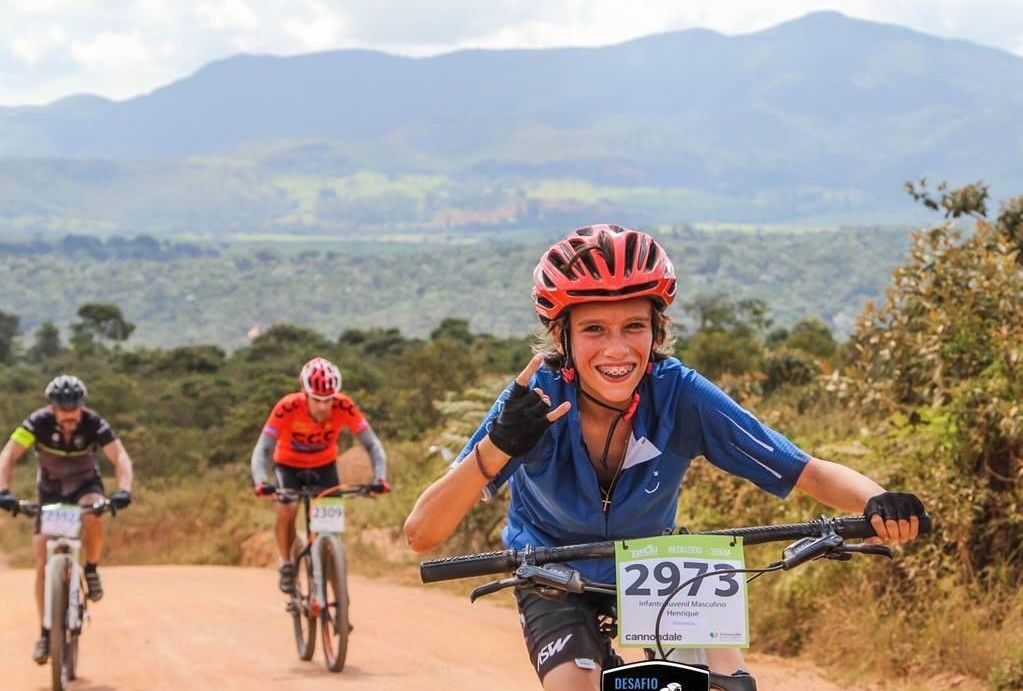
Don’t be surprised if you hear more shouts of ‘Bravo’ at bike races, with a capital ‘B’. While the chant is a common exclamation to praise skill and courage, it’s also the surname of Brazil’s latest sports personality, 19-year-old cyclist Henrique Bravo. He’s on an upward trajectory far away from his Brazilian roots, now making noise in Europe with Soudal-QuickStep Development.
There was another Enrique who became a role model in Brazil for a rising generation of cyclists: Enrique Avancini, who won World Cups, stages at Cape Epic and world titles with his mountain bike skills. Rather than a Kaká, Neymar, Rinaldo, or Rinaldinho, it was this athlete with two names and two world championships in marathon MTB who caught the attention of Bravo, carving a passion for the mountain bike and a path to a pro career on the road bike.
Article continues below
To start this year, Bravo won a stage at his first UCI 2.1 stage race, Tour du Rwanda, and then won the first GC title of his young career at Tour of Antalya. In less than two weeks, one day before his 20th birthday, Bravo will take the start of the U23 Liège-Bastogne-Liège for a second time, landing 21st in his debut.
Cyclingnews: Tell us about growing up in Nova Lima, a large town in the mountainous region of south-east Brazil. How did you got involved with cycling?
Enrique Bravo: I always had a lot of energy, so I did all the sports first, playing football, as almost all the kids in Brazil. I did swimming, cycling, judo, skateboarding and many more sports. My childhood in Brazil was amazing. I studied at an Italian school in the town while I did a bunch of sports (to try to spend my infinite energy) and had a lot of fun with friends playing football. For sure, my favourite subject was physical education, also I was interested in geography.
But then, close to 11 years old, I decided to try a mountain bike class, close to where I live, and then I had a love [for cycling] from the first time on the two wheels.
CN: Did you have a role model for cycling as a young rider, either in your family or from a professional athlete?
HB: To be honest, when I was younger, I didn’t watch cycling. The culture in Brazil was much more around football. An example, in my family, there is nobody who does cycling. But then, when I started mountain biking, I became a big fan of Henrique Avancini.
CN: What do you remember about your first bike?
HB: My first bike was very simple, which my family gave to me. It was like a supermarket bike with a collaboration with ‘Hot Wheels’. I had some extra wheels to help get the balance, and then after some time, I took [the training wheels] off. Since then, it was just fun.

CN: What was your first race on a bike outside Brazil? It was mountain biking, so how did that go?
HB: My first race outside Brazil was when I was a junior in 2023. The race was close to Aosta in Italy. It was unbelievable to ride for the first time in Europe; all the views and the trails were incredible. I got top five in my first race in Europe, also got second in a race in Switzerland, so overall it was nice to see that I had a good level, compared to the European level.
CN: Your first full season with Soudal-QuickStep Devo was in Europe last year. What were three things that you learned from the year?
HB: In Brazil, I basically did a couple of races on the road, before it was just MTB. So then last year with Soudal was one of my first real road races. It’s a new world of experience and it was basically a school, I learned every day – how to position, to race as a team – and basically everything that in Brazil you don’t have.
CN: It was a big change to go from Brazil to Spain at the age of 18. Tell us about the adjustments you needed and what skills you had that made it comfortable, too.
HB: For sure, it’s a big move coming from Brazil to live in Spain, but I adapted quite fast! I have some friends from Brazil who also live here, so this helped a lot to get more social and talk my language, like I do at home in Brazil. I speak Portuguese, English, Spanish, Italian, and am now learning French.
Sometimes you miss Brazil but I really love the life here in Girona, from the security of training without trucks but also the lifestyle of the city.
CN: So, are there busy roads where you lived in Brazil, and the roads are better in Spain?
HB: Yes, to go to the small roads without so many cars, you need to take the big road in Brazil. So I take the train. On the highway, there are a lot of cars and trucks passing at 120 kph, but I am already used to it.
For some people from Europe, it would be quite scary to see how busy it is. So then I appreciate it a lot here in Girona where the cars respect the cyclists.

CN: How much faster has the peloton been on the road than what you were used to in South America?
HB: For sure, much faster. Everyone here is so incredibly strong and also they grew up racing on the road since they were young. Sometimes, when you come from another continent, it takes a bit more time to adapt to the racing style and all that stuff, but it is possible to follow them when you train hard, get some racing in the legs and gain experience.
CN: You had a diverse schedule in 2025 – Liège-Bastogne-Liège, stage races in France and Italy, plus Worlds in Rwanda. What type of race suits you best?
HB: I really love the climbing races, for example, like Giro Valle D’Aosta suits me quite well with the long climbs! The experience in Rwanda was amazing, racing with the Brazil colours is something unique. Nonetheless, I enjoyed a lot the more punchy races like Liège and races in Ardennes.
CN: You spoke to Phil Lowe, team communications director, on The WolfPack Howls podcast in January about learning to suffer with climbing. What do you like the most about climbing? And what bike do you prefer to ride more, road or MTB?
HB: Since I started in cycling, I was good in the mountains. I basically love how much you can push on a climb. It is hard but amazing at the same time.
Where I Iive in Brazil, I have a good climb, 5k from my home, it’s quite hard. I have a lot of big climbs to discover in Europe, so I’m excited to one day do these mythical climbs like Alpe D’Huez.
Everybody asks me that question [about a favourite bike]. I would say road bike for climbing. And then when I arrive at the top, I switch, and then I go on the trails [with mountain bike].
CN: In the next few years, what are the top races you look forward to racing the most?
HB: For this year, I have some top U23 races like Giro Next Gen and Tour de L’Avenir. My goal for the next few years is to keep living my dream and never stop improving.
I hope to be at the WorldTour level. To go to the Olympics in L.A. is a big goal. We’ll see in two years what is possible.