
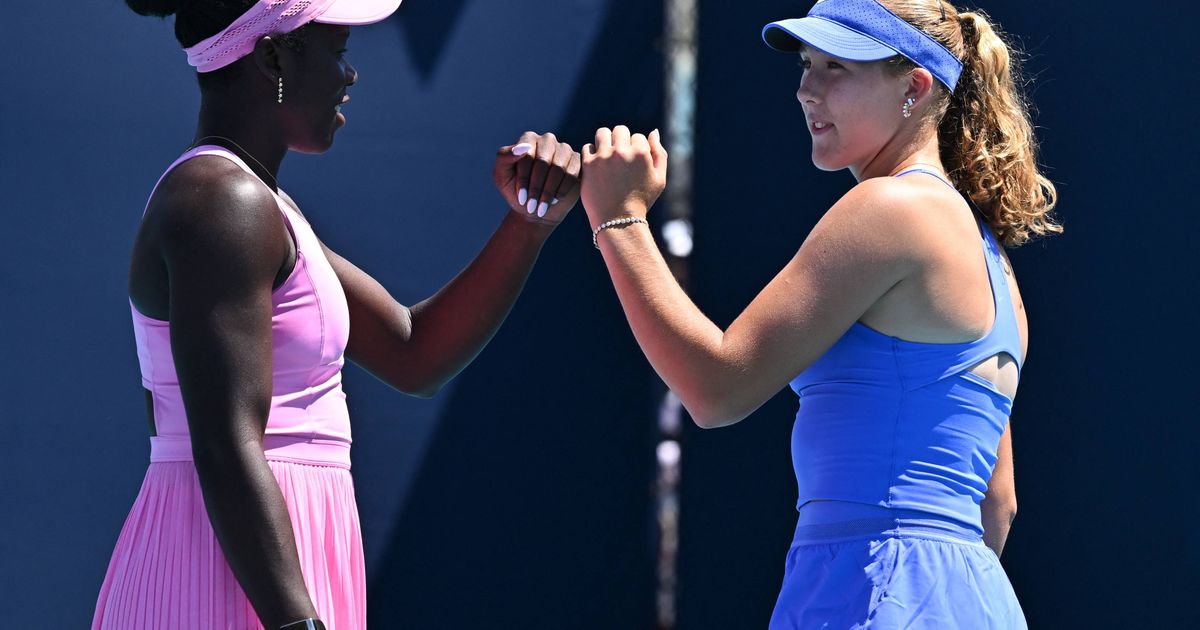
Her progression has been defined by consistency rather than isolated results. Mboko reached the fourth round of the Australian Open earlier this season and added a final in Doha, reinforcing her ability to navigate deep draws across different conditions. While she has yet to secure a title in 2026, her level has remained stable, with multiple wins over Top 10 opponents confirming her competitiveness against the tour’s elite.
Mboko frames that relationship with clarity: familiarity off court, direct competition on it. The balance between both elements reflects their current status—not prospects, but established players competing within the same bracket of the tour.
Shared background, parallel progression
Mboko and Andreeva’s connection dates back to the junior circuit, where repeated encounters and practice sessions established a foundation that remains relevant today. Their early interactions were limited, but a single moment following a junior match shaped Mboko’s perception.
“I remember since I was like 14. She came to juniors a bit later than everyone else. She’s a year younger than me,” Mboko explained in The Changeover Podcast. “I played her in one junior match and I lost in straight sets. The next day was my birthday, and I was on the plane home when she sent me a really sweet birthday message.
I had never talked to her before, and she sent me this really nice message. I was like, she just beat me so badly, and I couldn’t help it, I was like, she’s a sweet girl.”
That initial contact developed into a consistent on-court partnership during junior tournaments, where both players regularly trained together. As Andreeva transitioned earlier into strong results at professional level, Mboko was able to track that progression closely, using it as a reference point rather than a comparison.
“Every tournament after that, we started hitting together a lot more. At some point, I was only hitting with her in junior tournaments. Seeing her, she also had a really insane rise, I think in 2023, where she was winning a lot. Seeing that was really nice and very motivating. To see her now and having someone I can relate to is pretty comforting.”
The relevance of that shared pathway is now clearer. Both players have moved beyond early breakthroughs and are operating within the same ranking range, where direct encounters influence seeding, draw positioning and progression in major events.
Contrast in profile, alignment in results
Mboko identifies a clear contrast in Andreeva’s personality, particularly between her off-court demeanor and competitive identity. That distinction, however, does not extend to results, where both players have established similar levels of performance across the 2026 season. “She’s super playful, very childlike humor, and she’s really sweet. But on court, she’s super tough. The contrast is pretty big. The way she is on court is nothing like how she is off court.”
Mboko describes herself differently, particularly in terms of emotional expression during matches. While she maintains a more contained presence on court, she acknowledges a more outgoing personality away from competition. The contrast exists in both cases, but is expressed through different behaviours. “I feel like I’m also the opposite. On court, I’m not very out there. But off court, I feel like I’m pretty extroverted.”
Their similarities are more evident in performance patterns. Both have recorded consistent results across major tournaments this season, with repeated second-week appearances and wins over high-ranked opponents. Neither has yet converted that consistency into multiple titles in 2026, but both remain positioned within the same competitive tier heading into the clay swing.
Process-driven approach behind consistent results
A central element in Mboko’s progression has been her approach to expectations. Unlike many players at a similar ranking level, she does not structure her season around defined targets, instead prioritising adaptability across different phases of the calendar.
Her reluctance to set goals is based on the variability inherent in the tour, where fluctuations in form are inevitable. By avoiding fixed benchmarks, Mboko reduces the impact of short-term setbacks while maintaining long-term consistency. “I don’t like to set goals at all. Last year, I was surprising myself a lot. I would never expect myself to be in the Top 10 today.”
“You can have great times where everything feels easy, but there are also times where things don’t go your way. That’s part of the process. If I set expectations and things are not going right, I might feel down on myself.”
That approach aligns with her current position. Mboko has not relied on a single standout run to reach the Top 10, but rather on sustained performance across multiple tournaments. With the clay season approaching, the next phase of her season will test whether that consistency can translate into deeper runs on a surface that traditionally demands a different tactical profile.
“You still have to go down a little bit sometimes to go up. Everyone is different, but I feel like I’m the kind of person who just likes to go with the flow.”