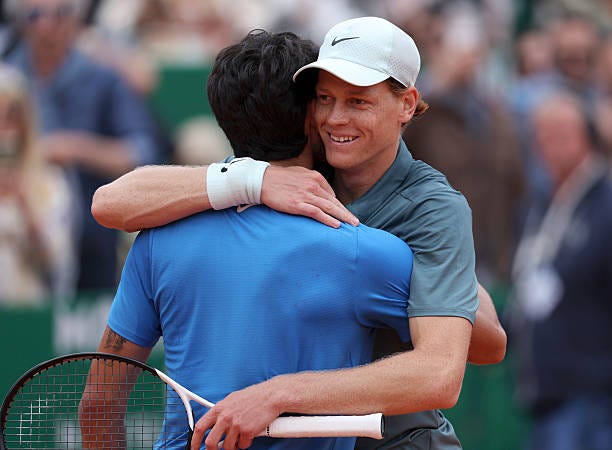
We were ready and eager again after a surprisingly long break, but Carlos Alcaraz versus Jannik Sinner did not quite deliver.
Blame it on the swirling wind that contributed to a surplus of errors in a Monte Carlo final that was not postcard ready on this overcast Sunday despite all the beauty shots of club and sea coming from the drones.
Blame it on the surely unreasonable expectations that build before any Sincaraz rematch at this stage.
The outcome was no doubt tennis newsworthy: Sinner extending his Masters 1000 streak and reclaiming the No. 1 ranking by winning his first top-drawer clay-court title with a 7-6 (5) 6-3 victory over the reigning champ.
But these two have hit such heights – the middle-of-the-night US Open duel; last year’s edge-of-our-seats French Open five setter – that lower altitudes seem like a letdown.
The school of thought is that if Sinner and Alcaraz are going to lock out the rest of the tour from big trophies for years at a time, they better make it worth it by being scintillating when they inevitably do meet again.
But tennis, even for the new-age greats, can be a confounding business.
Sinner, the game’s dominant server, was below 40 percent on first serves for nearly all of the opening set on Sunday. Alcaraz, master of the drop shot on any surface, barely reached the bottom of the net with one of his early attempts.
There were still a few bedazzling glimpses of what these two can inspire in each other: a spectacular wrist-snapping backhand smash winner from Sinner off a smart lob; a defense-to-offense masterclass from Alcaraz as he sprinted, or rather flew, corner to corner and converted a break point with a passing-shot combination capped with a forehand winner off the slide and down the line.
More please, always more please.
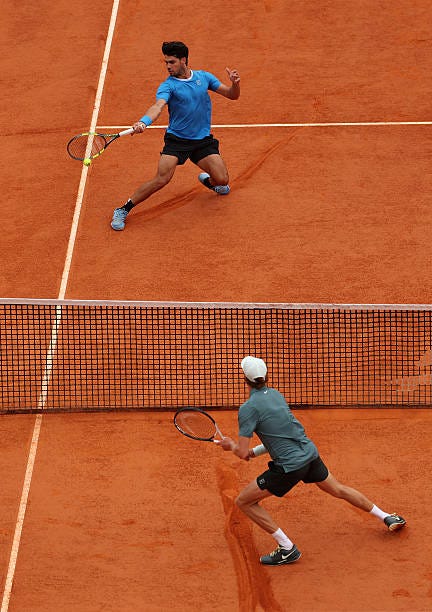
And yet the defining moments on Sunday were less poetic in motion. Consider the end of the grueling, 75-minute first set when Sinner finally found his first serve in the tiebreaker, going six for six. But at 6-4, having earned a very short ball on his first set point, he swooped in and smacked a forehand sitter into the tape.
Alcaraz, no stranger to resurrection, had new life, and he marked the moment by…..double faulting away the set.
It is, of course, compelling in a different way that Sinner and Alcaraz can also inspire these sorts of gaffes from each other. They are clearly just as aware as everybody else of the stakes and the expectations; of how their duels can swing on a few big points; of how much tennis weaponry each young champion possesses.
The intrigue is in how it all plays out on any given Sunday. And how it played out this time, in their first match since November, was that Sinner effectively and repeatedly targeted the Alcaraz backhand, which was often the weak link in the extended rallies.
Meanwhile, Sinner found a way, despite his own struggles with consistency, to nimbly put himself in position to hit more forehands than usual and to be the aggressor in return games by attacking second serves from inside the baseline. That is risky indeed because any return that floats or fails to penetrate leaves Alcaraz with so much red canvas to work with.
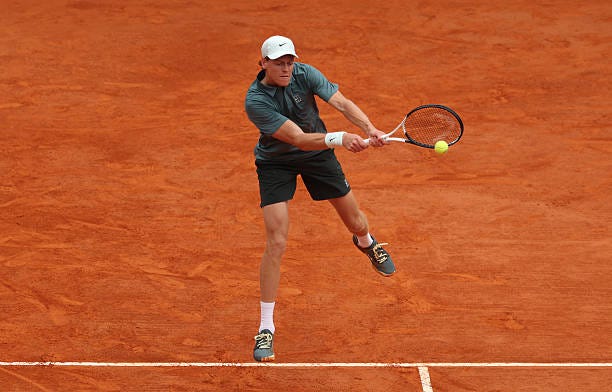
But it paid off for the most part on a day of heavy conditions, and Sinner’s short-hop second-serve returning was quite a contrast with Alcaraz’s positioning, which usually had him camped way back in Medvedev and Nadal territory, just in front of the rolled-up tarp. That sometimes left Alcaraz out of the classic aerial television angle, which made it look like Sinner was serving to an empty court instead of his archrival.
No such luck, but the deep position was ultimately not the solution. Alcaraz managed to break Sinner twice, but the bigger problem was holding a lead. Up 2-0 in the first set, Alcaraz immediately surrendered the break. Up 3-1 in the second set, he dropped the next five games and the match, double-faulting again at 4-3, 40-30 to keep Sinner’s spirits high.
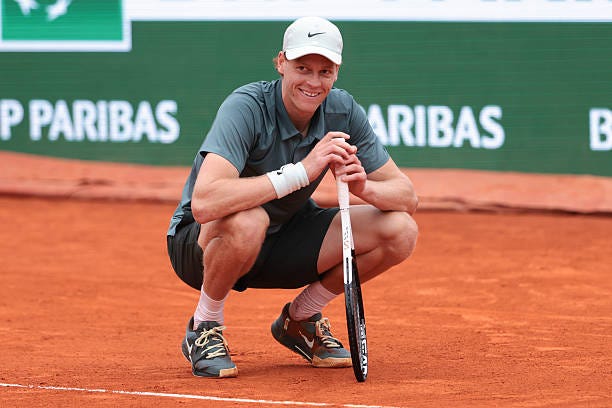
Or maybe I presume too much. It’s quite a challenge to parse the inner state of Sinner. He gives away very little under his ballcap; plays so quietly in contrast with Alcaraz’s two-toned grunts, roars of self-encouragement, and frequent chatter/banter with coach Samuel Lopez.
The redhead is no hot head. Sinner is even-keel tennis played at a ferocious pace and after committing himself to bridging the versatility gap with Alcaraz after losing last year’s US Open final, it looks like the commitment is paying off.
Exhibit A: Sinner’s better use of the dropshot, which won him plenty of points in Monte Carlo even if it’s not going to win him many style points just yet.
He also seemed quicker to react to Alcaraz’s drops, even if the Spaniard still sliced a few winners that no sinner or saint could reach.
For now, however, the tide has turned. Alcaraz still leads the head-to-head 10-7 but has lost the last two without winning a set.

Alcaraz roared out of the gates this season to 16-0 but Sinner is the steamroller at this stage. After a halting start, including that surprise semifinal loss to Novak Djokovic at the Australian Open, Sinner is 17-0 and has become the first man since Djokovic in 2015 to triumph back-to-back-to-back in Indian Wells, Miami and Monte Carlo.
Djokovic lost five sets along the way to his Sunshine Triple. Sinner, astonishingly, lost just one: to Tomas Machac in the round of 16 in Monte Carlo.
But just as for Djokovic in 2015, the bigger goal for Sinner is winning his first French Open. Djokovic demolished Nadal in the 2015 quarterfinals at Roland Garros only to lose the final to Stan Wawrinka.
Let’s see how Sinner fares after failing to convert those three match points against Alcaraz in last year’s French Open final. He has had his best career results on hardcourts, but he grew up playing on clay, as well. His first deep run at a major came at Roland Garros, where he reached the quarterfinals in 2020 during the pandemic before losing to Nadal, who was full of encouragement.
“Since the beginning, I’ve always said he was nearly better on clay than on hard because there are little things that help him, like having a bit more time to hit his forehand,” said Simone Vagnozzi, his co-coach in an interview with L’Équipe.
The question is how much claycourt tennis to play. Alcaraz has committed to a full schedule and is the No. 1 seed in Barcelona this week. Sinner is taking a break and is still considering whether he will play in Madrid before the Italian Open in Rome.
What matters most to Sinner is arriving fresh and healthy to chase the only Grand Slam singles title he lacks. Alcaraz already has them all and may soon have the No. 1 ranking again if he wins in Barcelona.
The Spaniard can play quite a bit better than he played on this blustery Sunday. But the wind, make no mistake, is at Sinner’s back.
CC
P.S. Netflix has announced that the four-part Nadal documentary series “Rafa” will be released worldwide on May 29. I look forward to watching it and was happy to play a small part in it, sitting for interviews as I wrote THE WARRIOR, my book on Nadal that goes deep on his career and the tournament and surface where he reigned supreme.