

Unique cycling tools from nine small makers.

There’s no denying that modern technology has greatly reduced the barriers to making things, and one great example can be seen in the world of 3D printing. Indeed, there’s been a lot of progress since we saw the technology applied to just plastic computer mounts.
Today, you can buy a filament-based 3D printer with same-day delivery for the cost of a nice meal. Or, spend the equivalent of a budget wheelset, and you could be printing commercial-quality products in under an hour.
I’ve previously covered how I use a 3D printer to help organise and improve efficiency in the workshop. However, I thought it was time to return to the topic of 3D-printed cycling tools, focusing on a handful of useful and creative products from small, start-up creators.
Threaded #11: 3D printing your own tools
A shallow dive into the world of 3D printers for home and workshop use.

Momentum is a relatively young Canadian-based 3D printing company specialising in suspension and bearing service tooling that’s priced for home mechanics. While many commercial 3D-printed products can feel a little homemade, Momentum gives true polished and professional vibes, including some products that come in matching printed safe cases.
More important than the packaging are the well-refined products that often combine two different materials in a single print or product. Here, Momentum often pairs an impact-resistant, soft-to-touch, and flexible TPU with a harder and rigid material (PETG, PETG-CF, or other).

My favourite product in the range is the Dummy Fork (US$34). I’ve been using tools like this ever since EVT was the only option, and have even designed and printed my own in the past. The Momentum has a lot to like, starting with a design that inserts from the top to save you fumbling with spacers and headset pieces, all while keeping that pesky headset cable routing (if present) in order.
The design uses soft-touch TPU at the points of contact, while a hollow-filled TPU print provides a fast and effective way to keep the tool in place should you want to store the bike without its fork – something commonly done when sending a fork away to a specialist repairer.


Similarly, the use of dual materials is seen in the Hub Axle Removal and Freehub Support kit (US$56), which again offers non-marring materials at points of contact. This kit is quite nice and replicates the purpose of what I’d previously achieved by piecing together a Hope hub support tool (with custom-machined flats for use in a bench vise), a BSC axle driver, and my own 3D-printed freehub insert.
I will say that having precisely fitting splines for the freehub body inserts feels fancy, but is quite unnecessary and adds little to the functionality of the tool – the same could be achieved with two inserts instead of four. Plus, such freehub-holding tools are unlikely to be needed if you’ve bought a blind bearing removal tool.


Familiar indeed, but it’s nice to see such a hub service kit all together and at a good price.


Soft contact faces and a design that can be used on a bench or in a vise.
Then there are the soft vise jaw inserts (available in 133 and 152 mm widths, US$26). I’ve tried dozens of such things over the years and they were even some of the first things I printed for myself. Momentum’s once again offer a dual-material construction, offering a textured surface for grip, integrated magnets, and independently replaceable pads. These are a professional-feeling product, and functionally, I think they’re the best I’ve used to date.

All told, Momentum Cycle is striking an impressive balance between quality and price. The tools are really accessible for home mechanics, while still feeling suitable for professionals. Better yet, there is free shipping to many parts of the world for orders over a certain value.


Lower leg suspension service tools. Here are Momentum’s well-priced versions pictured alongside the offical Fox tooling.
More info: Momenumcycletools.com
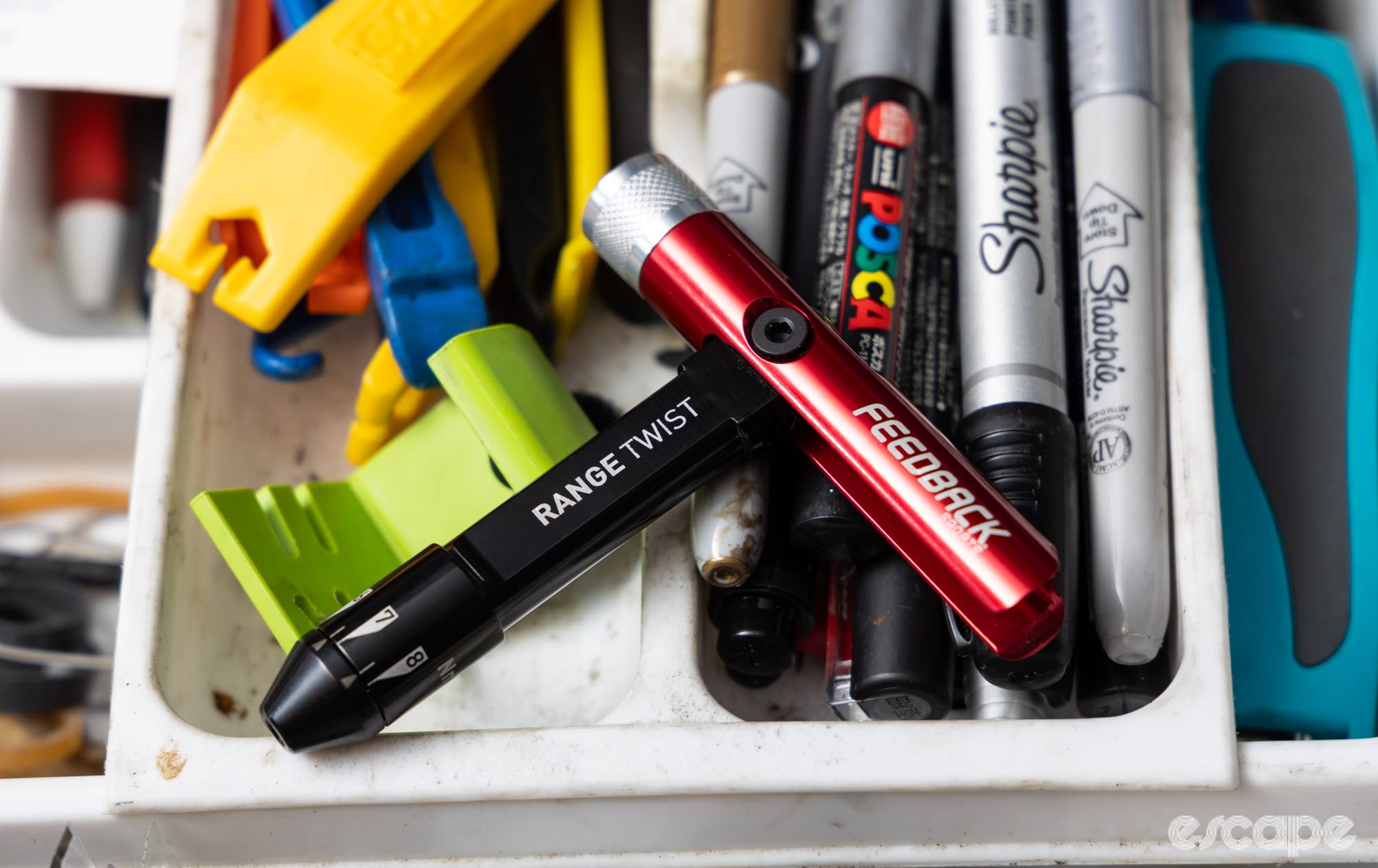
Threaded is an ongoing series created for professional mechanics and enthusiast home mechanics in search of continuous improvement, or at least ways to bring more efficiency, precision, or joy to the work.
It’s photographed, written, and created exclusively by me, Dave Rome. With approximately 20 years of experience on the tools, and more than a decade of documenting other mechanics’ work, I aim to share my passion for finding quality tools and tips on how best to use them.
You wouldn’t expect to give away your professional experience for free, and that’s why this article is paywalled. It’s merely through the support of our members (readers) that this content exists.
Below that paywall, you’ll learn and get my opinions on creative tools from a number of brands you may otherwise never learn about.
Professional mechanics are the lifeblood of the bike industry. If your career is fixing bikes, exclusive membership rates are available.
Learn more
VeloTechnics
Based near Geelong, Victoria, Chris Fry of VeloTechnics spent years building bikes for Baum Cycles, and is likely a familiar mechanic for many in the WorldTour who visit Australia each January.
Soft-launched this year, VeloTechnics’ first product is a handlebar alignment tool that uses the fork dropout as the base. It’s a sensible place to do the alignment from, but it’s not the simplest thing to design for.
Did we do a good job with this story?