

What do Minor League Baseball and Goats have to do with each other? Besides having a team named Yard Goats and people talk about players being the GOAT, there is one Minor League club that has a strong link to goats. Read on and you will learn.
The Asheville Tourists, Single A affiliate of the Colorado Rockies are this club with a strong link to goats. The team is playing at McCormick Field. Even though the City of Asheville is the owner of the ballpark, the Tourists are responsible for the maintenance of the playing surface and the area behind the outfield wall. And this blog post is exactly about the latter area.

We all know the view of McCormick Field as shown on the photo on the right. One of the oldest active ballparks in Minor League Baseball, well maintained and spotless. But the area behind the outfield wall is overgrown with lush vegetation that arises on an upward slope just beyond the outfield, resulting in an idyllic backdrop and, for the Tourists’ front office, a challenging landscaping task.
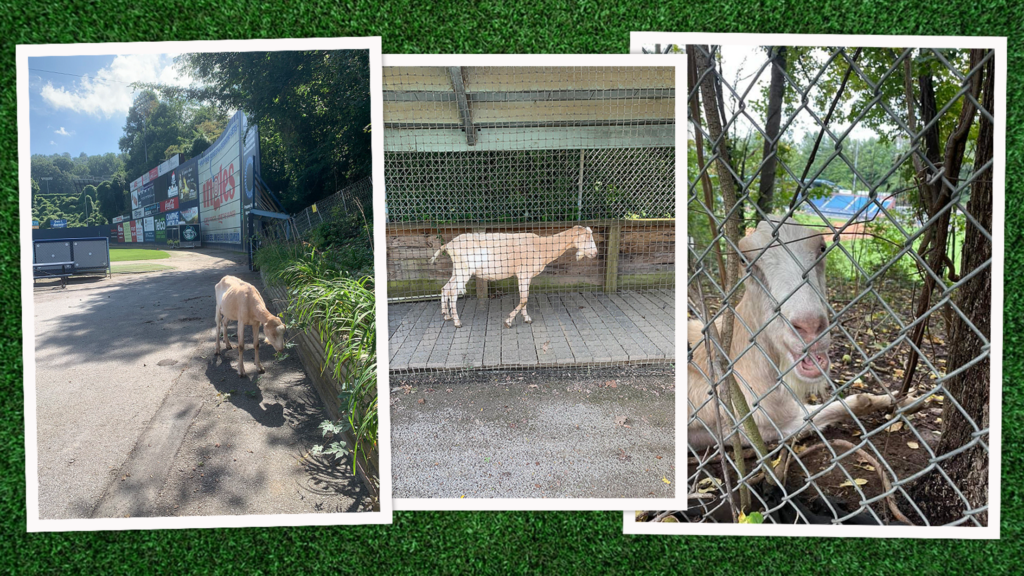
This lush vegetation swallowed hundreds if not thousands of homerun balls in the past decade. To get rid of that vegetation, the Tourists do not use a landscaping crew with climbing gear, but rather a herd of goats to clear more than 10 year’s worth of vegetation behind the Asheville Tourists outfield wall during baseball’s off-season.
Since the area behind the outfield wall is very steep, “It was just a logical option as far as trying to underbrush that area behind the outfield wall as efficiently as possible and as safely as possible,” said Tourists General Manager Larry Hawkins. “Because that bank is so steep it really doesn’t make sense to put people on it from safety side.”

The goats have been living in shelters behind the outfield as they worked, gradually moving from foul territory and across the hill from right to left field. Hawkins said they’ve become fixture, and workers have learned their names and habits.
The owner of the goats said the price of renting these goats varies widely depending on terrain and thickness of vegetation, but an acre starts “at about $1,100.” Some of that cost is for the people who have to scout the area for plants poisonous to goats and set the animals’ fencing.
So baseball clubs located at the outskirts of a city, may take refuge in goats if their facility is overgrown with weeds, rather than turning to poisonous herbicides.
Post Views: 3