
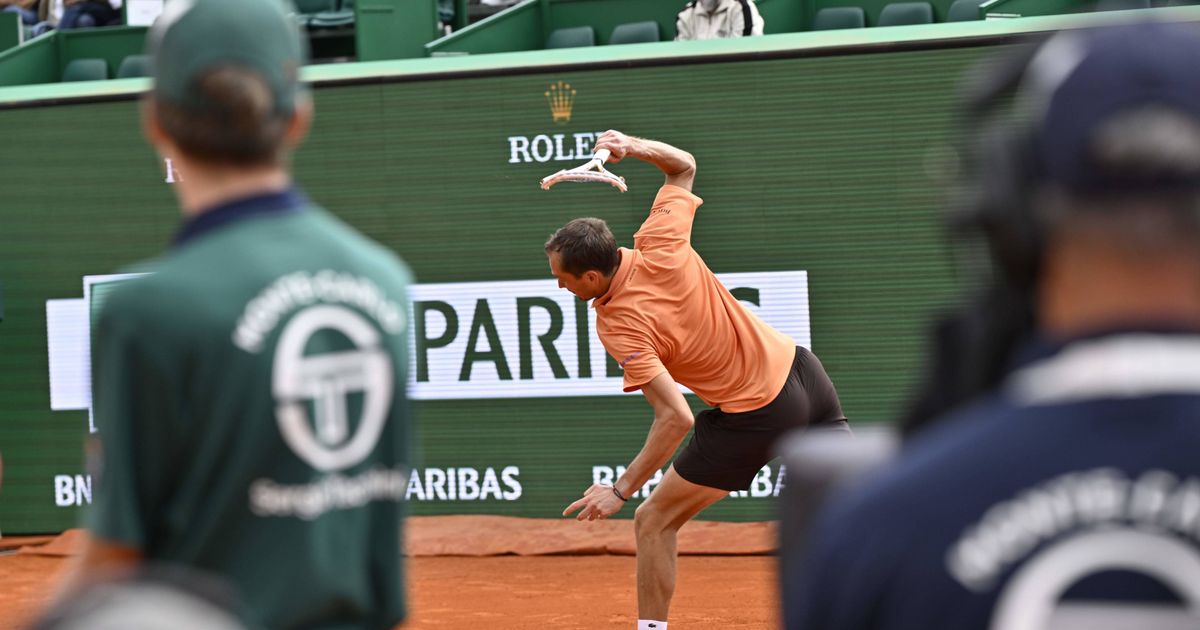
The scoreline, completed in just 49 minutes, stood in sharp contrast to Medvedev’s recent form, having reached a final less than a month earlier. Despite clay being considered his least effective surface, Roddick dismissed that explanation as insufficient to justify the scale of the defeat.
Roddick repeatedly returned to the psychological impact of both the scoreline and the on-court reaction, suggesting that the combination of a double bagel and visible frustration—marked by repeated racket smashes—makes it a particularly difficult defeat to process at elite level.
“That would hurt my ego so bad,” he added. “I don’t think I would have done it, but it 100 percent would have crossed my mind. I’m just thinking, can I convincingly turn my ankle and fall over? That would be really hard for me to get over.”
Zverev’s admission exposes deeper matchup imbalance
While Medvedev’s meltdown dominated the discussion, Roddick pointed to a parallel issue affecting Alexander Zverev—his persistent struggles against Jannik Sinner. The German was defeated by Sinner in the Monte-Carlo Masters semifinals, in straight sets, extending a one-sided trend that has become increasingly difficult to ignore at the top level.
Sinner now leads the head-to-head 9–4, having won their last eight consecutive meetings since early 2024. The dominance is even more pronounced in set patterns: the Italian has claimed 17 of the last 19 sets played between them and has won the last five matches in straight sets, underlining the lack of tactical answers available to Zverev. “I don’t know how to play him. I just can’t figure this guy out,” he said in press conference at Monte-Carlo.
Roddick explained that when players reach this point, standard adjustments become ineffective, as Sinner’s baseline pace and control limit the range of viable tactical solutions. The issue is not simply execution, but the absence of a reliable pattern to build around.
“When a matchup is bad, people go to these lazy things—‘you just have to want it more,’ or ‘you have to step in and hit the ball harder.’ Off Sinner’s ball, that doesn’t make any sense.”
He further compared the situation to his own experiences on tour, noting that certain matchups require near-perfect execution combined with favourable conditions, a combination that is difficult to sustain consistently at the highest level. “I probably know what I have to do—not even to win, but to give myself a chance. I have to execute it perfectly, and I need him to give a little. That’s a depressing way to go about business.”
Sinner-Alcaraz dominance reshaping the ATP hierarchy
Roddick’s broader conclusion centred on the sustained dominance of Jannik Sinner and Carlos Alcaraz, whose results across Indian Wells, Miami and Monte-Carlo have widened the gap to the rest of the field. Both players now sit above 13,000 ranking points, while the rest of the top 10 trails significantly behind, including world No. 3 Alexander Zverev.
“We’re running out of things to say. You put these guys on anything—Indian Wells, Miami, Monte-Carlo—and they just keep proving it harder.”
Roddick pointed to the scale of that gap as historically unusual, comparing it directly to previous eras and highlighting how current point totals far exceed what was once required to reach the top ranking. “I think I finished No. 1 in the world with around 4,500 points. They have 13,000. They’ve tripled that. I think they have more points than the next six players combined. That’s a super messed up stat.”
Beyond the numbers, he suggested that the dominance is not simply a product of form, but of a structural imbalance where rivals are struggling to find viable ways to challenge consistently across surfaces. “The way this monopoly gets broken up is injury or self-sabotage. It wasn’t like someone is going to mount a charge. That’s where we are. It’s extraordinary.”
Roddick also addressed how expectations around Sinner, in particular, have shifted rapidly, noting how even minor setbacks are now framed as anomalies due to the level he has established over the past year. “Sinner lost one match and we were like, ‘What’s going on?’ That’s an expectation that’s created by your own shadow.”