
Despite turning 15 less than three weeks ago, Vaibhav Sooryavanshi’s records have already been upgraded from “youngest-ever” to “best-ever”.
Even after his golden duck against SRH, the batter has 452 runs in 12 innings at an average of 37.66 and a staggering strike rate of 228.28. What makes this evolution even better for the Rajasthan Royals is that Sooryavanshi is employed on an INR 1.1 Crore deal, or about 0.92% of their purse from the 2025 Mega Auction.
As I detailed last week, part of RR’s jump from 2025 to 2026 is their re-jigged bowling – which was only possible because Sooryavanshi’s improvement meant moving on from Sanju Samson was a viable option.

ANALYSIS: The most intriguing tactical choices from IPL Week 1
Which brings up a more interesting question than whether he’s the best young player to ever grace the IPL (he obviously is) – is he the best bargain player in the history of the league? Low-price players are usually young talent who are a window away from superstardom (think Abhishek Sharma in 2019) or over-the-hill stars who can’t thrive at their peak anymore.
With that in mind, I wanted to look at the best bargain players who made an instant impact for their IPL teams.
Couple of quick rules; the impact has to come in Year 1 of a contract, and the player has to have been signed in an auction (i.e. cheap injury replacements like Chris Gayle in 2011 don’t count – their value is deflated because there weren’t multiple bidders).
Notable mentions who just missed the cut: Sohail Tanvir (2008), Shakib Al Hasan (2014), Mitchell McClenghen (2015), Mustafizur Rahman (2016), Johnny Bairstow (2019), Venkatesh Iyer (2021), Tristan Stubbs (2024), & Digvesh Rathi (2025).
Jump to a player;
-
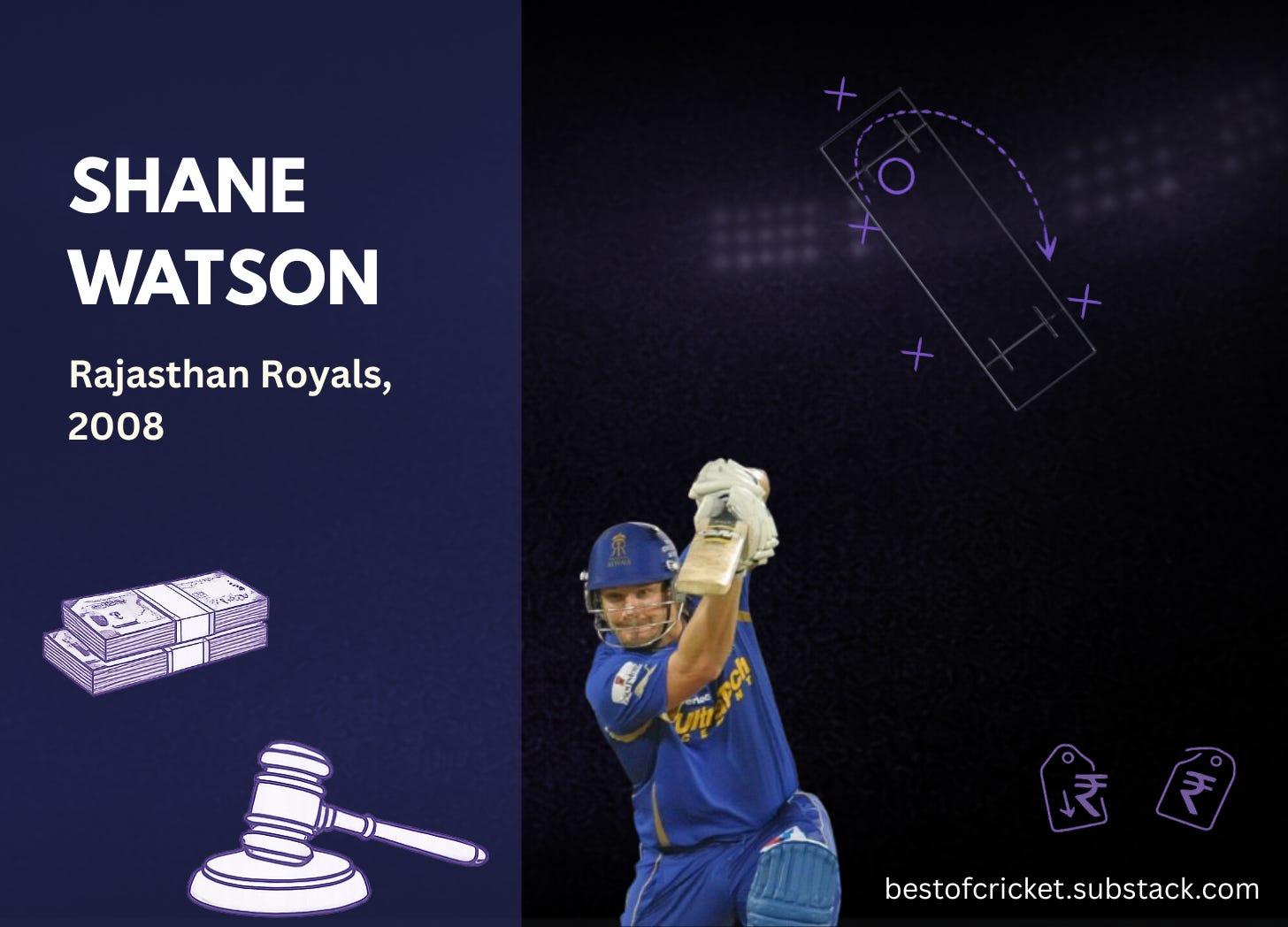
Year: 2008
-
Team: Rajasthan Royals
-
Price: $125,000
-
Percentage of Auction Purse: 2.5%
-
2008 Batting Stats: 15 Innings, 472 Runs, 47.2 Average, 151.76 Strike Rate
-
2008 Bowling Stats: 15 Innings, 17 wickets, 22.52 Average, 7.07 Economy Rate
-
Tatenda Taibu ($125,000): 3 Innings, 31 Runs, 10.33 Avg, 119.23 SR
-
Misbah-ul-Haq ($125,000): 8 Innings, 117 Runs, 16.71 Avg, 144.44 SR
-
Wasim Jaffer ($150,000): 6 Innings, 115 Runs, 19.16 Avg, 110.57 SR
When the IPL kicked off in 2008, T20s were still a young and unproven medium. Brendon McCullum, the most experienced T20 player in the world, had played just 15 T20Is by the time of the first auction. With hundreds of millions of dollars on the line for the IPL experiment, building a good team was as important as it was difficult.
The initial player purchase was split into two auctions, plus an U19 draft. Every team had a maximum purse of $5 million, and a minimum of $3 million. After the first auction – which saw 75 players sold – every team had comfortably crossed the minimum mark by more than a million dollars barring the Rajasthan Royals.
Despite being a highly rated young all-rounder who had won multiple trophies for Australia, Shane Watson was not nominated in the first auction because of his injury worries. He hadn’t played for Australia since the 2007 World Cup, which was 9 months before the IPL player auction. His injuries were so notable that Watson’s former coach John Buchanan had suggested that the all-rounder quit bowling to get consistent injury-free game time.
Going into the second auction, the seven other teams had less than $400,000 remaining, while CSK had just $23,750. Combined with Watson’s injury concerns, RR was able to pick him up for just $125,000 of their remaining two-million-dollar budget. Among the 89 players sold through the first two auctions (excluding the U19 draft), Watson’s salary would rank joint-76th.
From Game 2 against PBKS – then known as Kings XI Punjab – Watson delivered on his promise. Walking in at 19/2, the Aussie scored 76 (49) – at a very futuristic SR of 155 – to help his team successfully chase down 167. This would kick off a fairytale run of form with both bat and ball – across multiple phases of every game – that would propel RR to the first IPL title.
In the league stage against RCB, Watson dismissed both openers within the first 14 balls then walked in at 26/2 and scored an unbeaten 61 to knock off the 135-run target. Against DC – then known as the Delhi Daredevils – he bowled three overs in the PP and one at the death, taking the dangerous wickets of Virender Sehwag and Farveez Mahroof (39 off 16 on the night). Oh, and he pulled off another successful rescue by scoring 74 (40) after RR found themselves at 15/2 after 5 (!) overs.
In the semifinal, he scored 52 (29) in the first innings before effectively ending the game with three wickets in the powerplay as he reduced them to 24/3 in 5.2 overs. In the final, he flipped his impact by taking on two death overs against CSK’s set pair of MS Dhoni and Suresh Raina. He dismissed Raina on second ball, and didn’t concede a single boundary in either over to help RR hold their opponents to just 163/5.
The Aussie’s job wasn’t over though. CSK reduced RR to 42/3 in 6.4 overs, and the game hung in the balance. Watson’s 19-ball 28 – and 65-run stand alongside Yusuf Pathan – would bring glory to the IPL’s ultimate underdogs. As RR were crowned the first champions, Watson deservedly won the Player of the Tournament award.
Over the course of the season, the IPL’s 76th best paid player scored 472 runs (Ave: 47.2, SR: 151.76), and took 17 wickets (Ave: 22.52, Econ: 7.07). Watson’s combination of runs, average and SR wouldn’t be topped for another three seasons, while his wicket tally and economy were only topped by teammate Sohail Tanvir across the entire league. His three games with 2+ wickets, <7 economy rate, and a half century remains a single season record 19 years later.
Most impressively, Watson delivered the fourth-most overs in the entire tournament (54.1). Not bad for a player that was advised to give up bowling altogether just to stay fit.
-
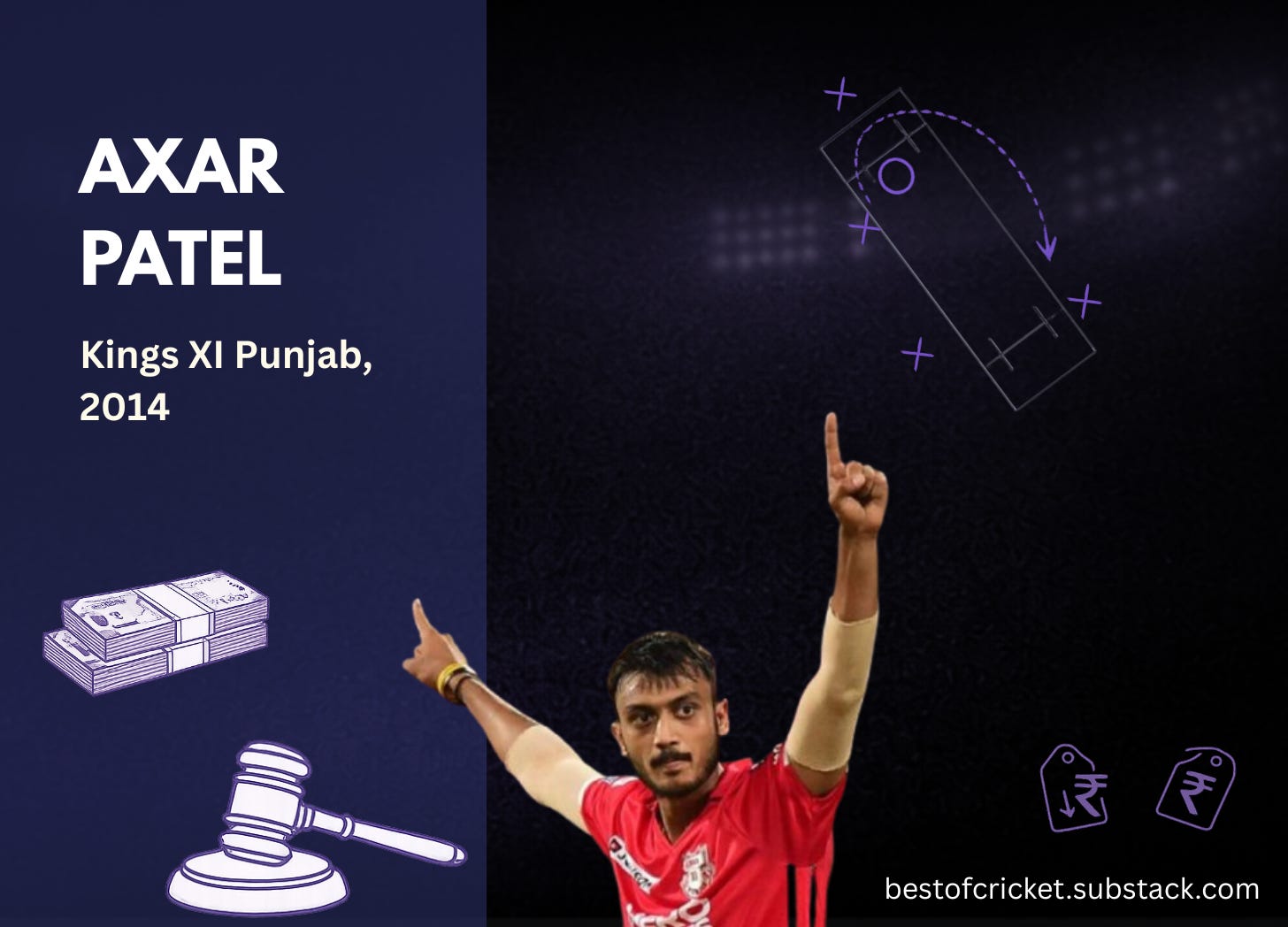
Year: 2014
-
Team: Kings XI Punjab (referred to as PBKS henceforth)
-
Price: ₹75 Lakh (IPL auctions switched over to INR from USD in 2014)
-
Percentage of Auction Purse: 1.25%
-
2014 Bowling Stats: 17 Innings, 17 Wickets, 23.82 Average, 6.13 Economy Rate
-
Mandeep Singh (₹80 Lakh): 3 innings, 24 runs, 8 Avg, 92.3 SR
-
Shahbaz Nadeem (₹85 Lakh): 11 innings, 8 wickets, 38.87 Avg, 8.18 Econ
-
Parvez Rasool (₹95 Lakh): 3 innings, 1 wicket, 83 Avg, 9.22 Econ
Kings XI Punjab headed into the 2014 Mega Auction prioritising batting quality and pace bowling. Most of their budget was spent on the recruitment of Mitchell Johnson, Glenn Maxwell, and George Bailey, while the biggest local buys included Virender Sehwag, Wriddhiman Saha, Cheteshwar Pujara, and L Balaji.
Axar Patel was an unproven commodity at this point. His impressive youth career had prompted the Mumbai Indians to acquire him in 2013, but he came back into the auction pool the following year having not played a single IPL game. While Axar had impressed with consistent domestic performances across formats, that wasn’t necessarily an indicator of IPL success.
And so, PBKS were able to buy the future World Cup winner for just 75 lakhs.
Patel wasn’t a guaranteed PBKS starter, with left-arm spinner Murali Kartik a strong competitor amidst the team’s host of bowling options. However, the young spinner was trusted early on, and he delivered immediately. In PBKS’ first two games, 795 runs were scored in 77.3 overs. Meanwhile, Patel conceded just 2/56 in his 8 overs, at an economy of under 7 RPO.
PBKS’ 11-win campaign is most fondly remembered for Maxwell’s middle-over rampages, as the Aussie ensured they had the highest strike in over 7-16. But on the other end, it was Axar whose bowling ensured that PBKS were the second-best bowling side in the same phase, helping the team create a significant advantage in the 10-over period.
Axar delivered 49 overs in the middle phase, going at less than a run-a-ball (Econ: 5.9) and taking the fourth-most wickets in the phase across all bowlers in 2014 (12).
Patel saved his best for last in the 2014 season. With PBKS making their first playoff appearance ever, the SLA would deliver figures of 2/11 in 4 overs against KKR in Qualifier 1. He broke up a 65-run stand from Robin Uthappa and Manish Pandey by dismissing both batters, and bowled three boundary-less middle overs (including a maiden!).
In Qualifier 2 v CSK, Patel was brought on in the 10th over with the opposition cruising at 118/3 in a 227-run chase. He didn’t concede a single boundary in his first 20 deliveries (picking up 1/13 in that 3.2 over span). His spell killed the game by the 19th over, and took PBKS to their first final.
Playing KKR again in the final, PBKS had to defend 200. However, every bowler in the side went at 10.25 RPO or above except one. Patel conceded just 21 runs in his 4 overs (5.25 RPO), and drastically slowed down a KKR chase that had hit 89/0 by the 9th over – he conceded just 5 runs across his first two-over spell, and had the eventual match winner, Manish Pandey, dropped. He pulled out another rabbit in the 18th over – conceding just 6 runs as KKR needed 21 to win – but it wasn’t enough to make up for his teammates’ profligacy.
Patel ended the season with 17 wickets at a league-best economy of 6.17. He won the IPL’s Emerging Player of the Season award, and is ranked as the 9th most valuable player in the league in 2014 according to ESPNcricinfo.
While the all-rounder has fulfilled his potential to become a franchise cornerstone and captain at DC – and has played a key role in multiple Indian World Cup wins – he’s yet to win an IPL title.
-
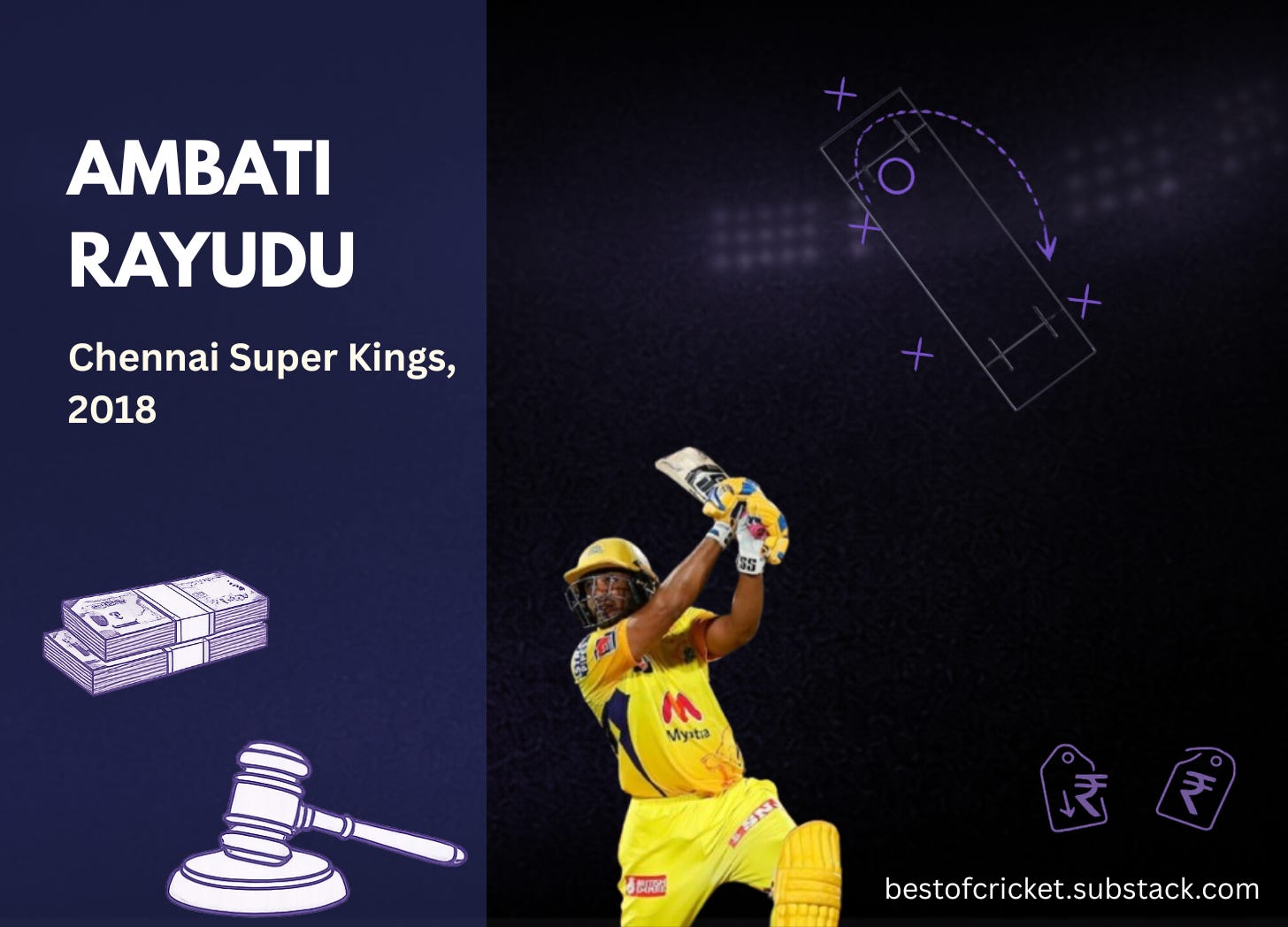
Year: 2018
-
Team: Chennai Super Kings
-
Price: ₹2.2 Crore
-
Percentage of Auction Purse: 2.75%
-
2018 Batting Stats: 16 Innings, 602 Runs, 43 Average, 149.75 Strike Rate
-
Gautam Gambhir (₹2.8 Cr): 5 Innings, 85 Runs, 17 Avg, 96.59 SR
-
Yuvraj Singh (₹2 Cr): 6 Innings, 65 Runs, 10.83 Avg, 89.04 SR
-
Barindar Sran (₹2.2 Cr): 6 Innings, 4 Wickets, 57.25 Avg, 10.4 Econ
CSK was back in the IPL after their two-year suspension, and was keen to get the band back together. They re-hired their core of title-winning players: MS Dhoni, Suresh Raina, Dwayne Bravo (RTM), and Faf Du Plessis (RTM). But around this core, CSK needed to reinvent and revamp a team that hadn’t won an IPL title since 2011, and hadn’t existed since 2015.
Amongst their various needs, CSK needed a dynamic batter who could connect the Raina-led top-order and the Dhoni/Bravo-led lower-middle order. To do so, the franchise took a gamble on a man that played – and beat – them in the 2013 and 2015 finals.
Despite sustained success in the IPL, including 4 finals and 3 wins, the 32-year old Ambati Rayudu looked to be in the final stages of his career. He hadn’t played for India in two years, and had played just 5 games in the 2017 season. Despite being fit for the knockout games, he could only score 18 runs in 3 games despite his team winning it all.
At his best, Rayudu was a solid and reliable middle-order run scorer, without being remarkable. However, it looked like even that solidity had become a question mark, which allowed CSK to pick him up for just 2.75% of their auction purse.
If being a bridge to the top and lower order was the requirement before the season, things would get a lot trickier when the season started. Each of CSK’s first-choice top order options faced injury problems throughout the season, and Rayudu had to deputise as an opener, a number three, and a number four. He passed each challenge with flying colours.
This was best displayed in the two games CSK played against the most potent bowling attack in 2018; Sunrisers Hyderabad. SRH were conceding less than 8 RPO for the season, but Rayudu managed to score 179 off 99 across two innings against them. Most impressively, he played as an opener in one game and a No. 4 in the other as CSK beat the table-toppers both times.
Rayudu, who had never scored more than 400 runs, averaged more than 40 or had a strike rate above 146 in a single season, breached all three marks in 2018. He put up a career-best season with 602 runs at an average of 43 and a strike rate of 149.75 to propel CSK to their first title in the 7 years, and a run of 3 titles in 6 years for the franchise.
Rayudu would retire after that final title in 2023, six seasons after CSK were able to pick him up at a cut-rate price because everyone else thought his best years were behind him. He remains the equal most successful player in IPL history with 6 titles to his name.
-
Year: 2022
-
Team: Gujarat Titans
-
Price: ₹3 Crore
-
Percentage of Auction Purse: 3.3%
-
2022 Batting Stats: 16 Innings, 481 Runs, 68.71 Average, 142.72 Strike Rate
-
Anuj Rawat (₹3.4 Cr): 8 Innings, 129 Runs, 16.12 Avg, 109.32 SR
-
Chris Jordan (₹3.6 Cr): 4 Innings, 2 Wickets, 67.5 Avg, 10.51 Econ
-
Daniel Sams (₹2.6 Cr): 11 matches, 38 Runs, 5.42 Avg, 105.55 SR, 13 Wickets, 28.46 Avg, 8.8 Econ
The IPL had tried expanding before, in 2011. The Kochi Tuskers lasted just one season, while the Pune Warriors India lasted three before folding. Neither made the playoffs in their combined four years in the league. The Gujarat Titans aimed to knock off that target within their first Mega Auction cycle in 2022-25.
Having acquired Rashid Khan and Hardik Pandya for a combined 30 Crore (33% of their budget) before the auction, GT’s bowling-oriented identity was further solidified after spending another 18% of their budget (16.25 Cr/90 Cr) on Lockie Ferguson & Mohmmad Shami. GT’s plan was simple; restrict opponents via their bowling, and hope their middle-to-lower order batters could make up the slack.
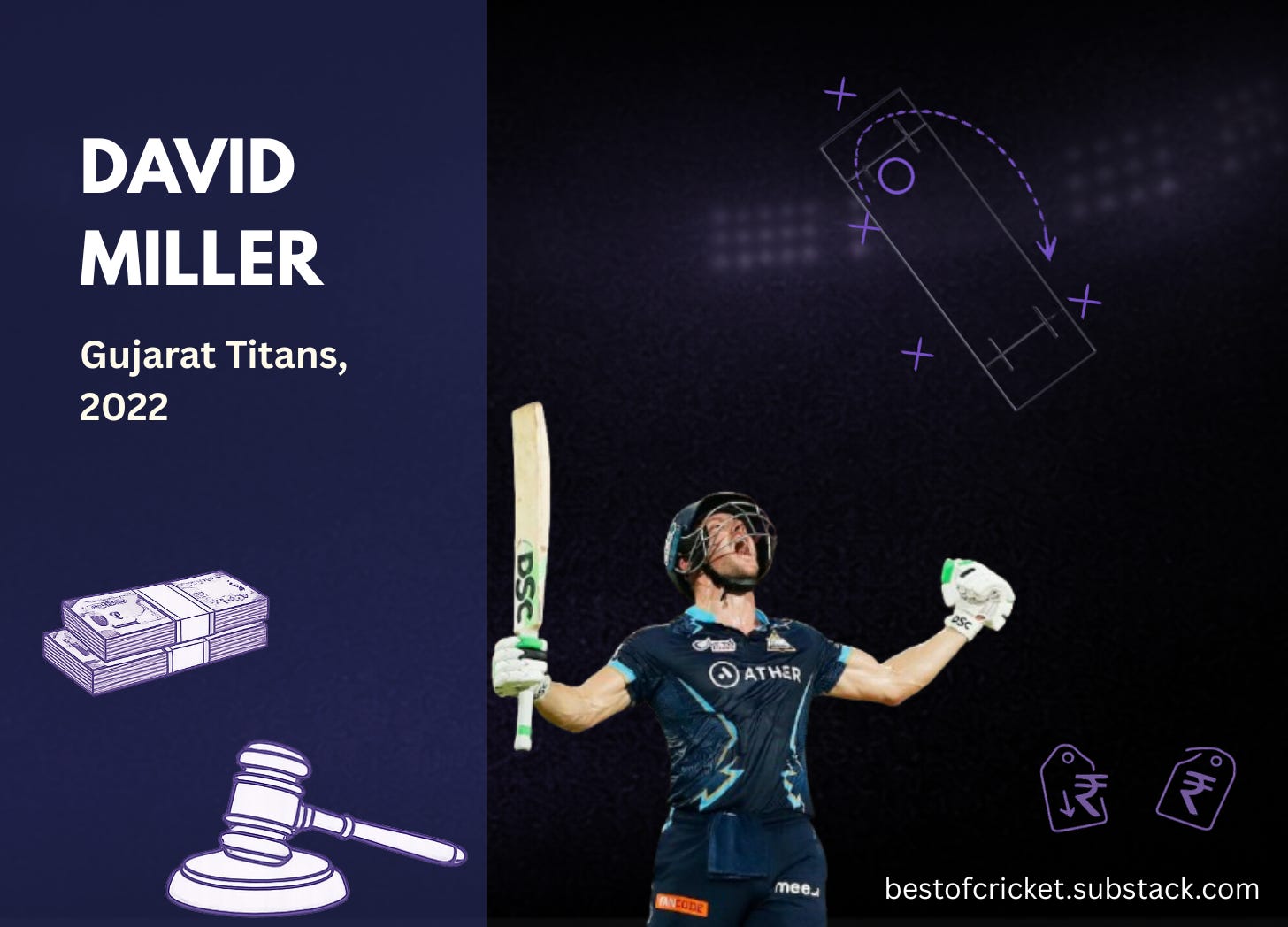
David Miller would make up a key part of this risky batting strategy.
The South African had burst onto the scene for PBKS between 2012-15, scoring 1,319 runs (Ave: 43.5, SR: 147.5) to become one of their cornerstone players. However, after being handed the captaincy in 2016, Miller crumbled. He scored just 122 runs that year, at an average of 16.1 and a SR of 122. It kickstarted a terrible half-decade of IPL performances, as he scored at a SR of just 118.65 between 2016-21 – the second lowest rate of any batter who faced at least 500 balls in the period.
During the 2016 IPL, Miller had commanded 18% of his team’s budget, but his spiralling form let GT pick him up for just 3.3% of their purse for the 2022 season. However, it wasn’t all upside; as GT’s No.5, Miller would be asked to play a lot of spin. Between 2016-21, he had scored at a strike rate of just 98.7 against the bowling type.
In 2022, Miller developed into the most well-rounded version of himself in a role that saw him bat across a variety of different phases and situations.
This improvement was most evident when Miller recorded the highest IPL score of his last eight IPL seasons against CSK. Chasing 170, Miller entered the crease with GT in a hapless position of 16/3.
With his first two partners adding 13 off 24 collectively, Miller had to take charge in the middle overs against the defending champions’ potent spin trio of Mahesh Theekshana, Ravindra Jadeja, and Moeen Ali. The southpaw showed off his new spin proficiency by hitting each bowler for multiple boundaries each to keep GT in the game. With 13 required of the final over and GT’s tail exposed, Miller finished the game with a ball to spare and ending just short of a century (94 off 51).
While GT’s bowling did the heavy lifting to win the IPL final against RR, Miller’s contribution was vital in the first qualifier against their eventual title challenging opponents. The power hitter took Prasidh Krishna for three 6s in the final over en route to a game-winning 32 (19).
In all, Miller scored 481 runs for the season, a career high for him. Most impressive was his improvement against spin, where he scored 206 runs (Ave: 103, SR: 145.07) to decisively close the door on his glaring weakness from the past half decade.
-
Year: 2025
-
Team: Rajasthan Royals
-
Price: ₹1.1 Crore
-
Percentage of Auction Purse: 0.92%
-
2025 Batting: 7 Innings, 252 Runs, 40 Average, 228.28 Strike Rate
-
Vijay Shankar (₹1.2 Cr): 5 Innings, 118 Runs, 39.33 Avg, 129.67 SR
-
Akash Madhwal (₹1.2 Cr): 4 Innings, 4 Wickets, 41.5 Avg, 11.06 Econ
-
Yash Thakur (₹1.6 Cr): 2 Innings, 1 Wicket, 79 Avg, 12.15 Econ
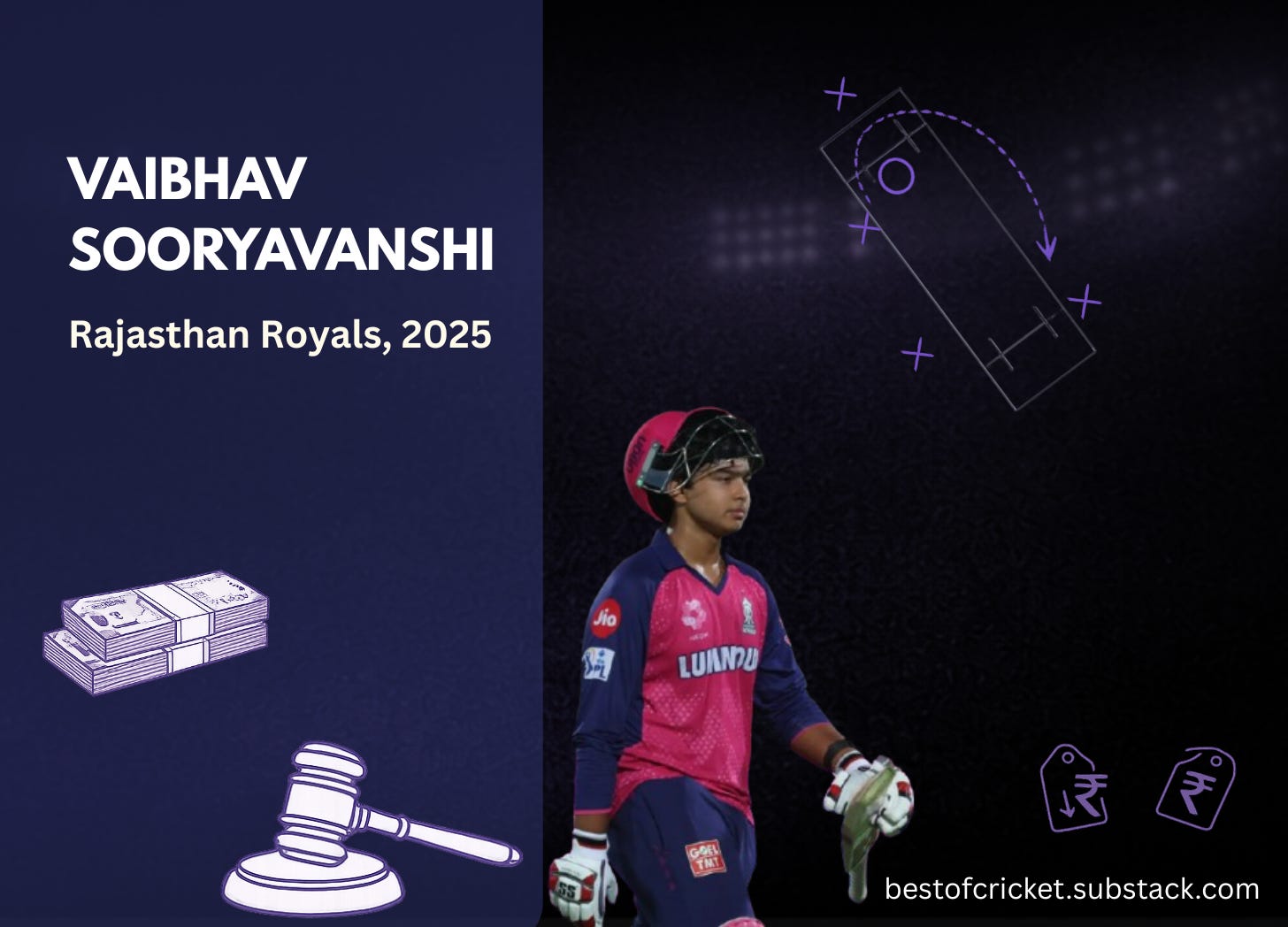
Despite his seeming overnight success, Vaibhav Sooryavanshi’s success has been years in the making. He’s been playing first class cricket since he was 12 (another ‘youngest-ever’ record), and he had scored a 58-ball century against Australia U19 when he was still just 13. The question on his career was when he would become a great player rather than if it would happen.
RR, as is their norm, went the extra mile in evaluating him by conducting an extensive pre-Auction trial. Sooryavanshi reportedly dominated it, and RR Director of Cricket Zubin Bharucha called the youngster for a separate session against sidearm throwers who could throw at speeds of 155+ KPH. Sooryavanshi hit them down the ground too.
RR were probably delighted to get the prodigy at a price of 1.1 Crore, but they already employed a world class opening pair in Yashasvi Jaiswal & Sanju Samson. The franchise probably saw it as a potential play, a chance to see his unique talent up close ahead of a retention before the next Mega Auction.
Then Samson went down with a freak injury halfway through the 2025 season.
From Sooryavanshi’s first ball, the signs of something special were present. The audacity, the power, and the six-hitting skill were all evident as Sooryavanshi dispatched his first IPL delivery against LSG’s Shardul Thakur for 6 over covers. Nine days later – in his third ever IPL game – Sooryavanshi scored the second-fastest IPL century of all-time against GT.
The combination of intent, elite power, and hand-eye coordination was on display as Sooryavanshi raced to 50 off just 17 balls (which is now his third fastest IPL innings to 50). He scored 28 runs in a single Ishant Sharma over, 30 runs in a single Karim Janat over, and got to the half century via a 6 against Rashid Khan. He scored eleven 6s in the innings.
While Sooryavanshi would only score one other half century in 2025 (he only played 5 innings), his rate of run scoring was what stood out. Against PBKS, he scored 40 (15), and was able to pick the fuller and shorter length. Arshdeep Singh and Marco Jansen, their left-arm pace pairing that troubled so much of the league, were dispatched for four 6s in the innings, and RR had raced to 76 in 4.5 overs.
And, so we reach his final half century of the season against CSK. It was a relatively slow start – 12 off 10 in the powerplay – before he exploded in the middle overs. The combination of his ruthlessness against bad balls and his outlier skill to hit good balls meant he finished on 57 (33), and helped RR end the season on a win.
Sooryavanshi’s debut season was an unqualified success, even if RR had struggled all year. The then-14-year-old played just 5 innings, but ended up with 252 runs at an average of 36. More impressively – and ominously for everyone else – he had scored it at a SR of 206.52, the highest rate of any batter with at least 4 innings under their belt in 2025.
At this point, it’s worth making another point. Sooryavanshi hasn’t technically played a full season’s worth of games yet. He’s only played 12 innings across two years at the time of publication, and has scored 452 runs (Ave: 37.66, SR: 228.28). In other words – he’s getting better.
This is a really important note. Of all the players detailed in this piece, none had better figures in their second season. Watson’s best single season was his first, while Miller and Rayudu never topped their 2018 and 2022 seasons. Patel has obviously gone on to greater heights – and cemented himself as an elite T20 allrounder – but his second season saw his economy jump from 6.13 to 8.4.
This is the expected response. Opposition teams figure out what makes you good, the expectations start weighing heavier on your shoulders, and life becomes tougher (at least for a bit). Sooryavanshi is improving faster than the opposition can keep up with. He was vulnerable to short balls last year, and he’s putting them away for 6s this year.
Not only is Sooryavanshi the best young player to ever grace the IPL – and on course to be the best batter this year – he’s also probably the most valuable player in the history of the IPL.