
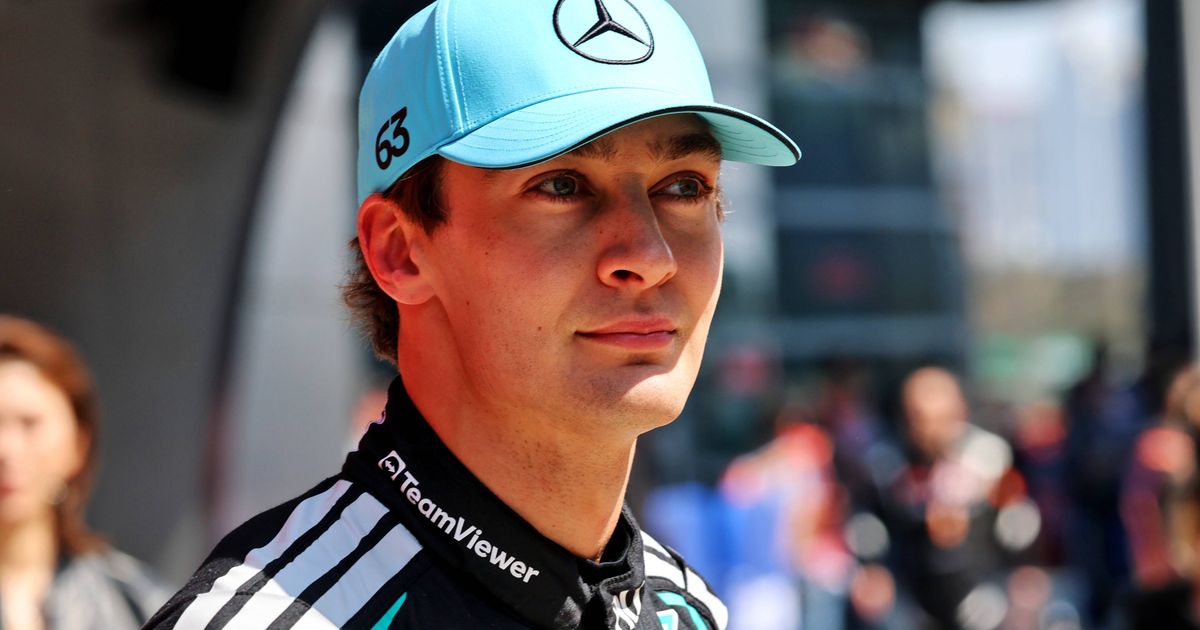
F1 drivers are aligned according to Russell
According to the Briton, the focus is on a few clear points. “Of course, there are things that we want to improve in, like qualifying, flat-out qualifying, and not having to do the lift and coast.
“I think there’s been some very positive conversations with the FIA, and everybody’s aligned on what’s we’re trying to achieve. So I’m looking forward to seeing that come to fruition from Miami onwards.”
Photo: Race Pictures
He says those speed differences were painfully evident in the incident between Bearman and Franco Colapinto. “The closing speed of the Bearman-Colapinto crash was twofold. One, it was, of course, Bearman was on his boost button and giving himself 350 kilowatts, so he had an abundance of power in an abnormal part of the track, and on the flip side Colopinto used his boost on the main straights to half a lap before and was low in his battery so he had a lack of power. So that is, at least in my eyes, where these closing speed differences are coming from,” he continues.
That, according to Russell, is the problem. “From the driver’s perspective, just looking to reduce that closing speed in abnormal ways, and especially in non-SM modes. If there’s a straight that isn’t an SM mode, that means it’s because it’s a corner. Of course, the Bearman crash was in a non-SM part of the track,” the Mercedes driver states.
Russell refers to the so-called Straight Mode, a component of active aerodynamics in 2026 Formula 1 cars. In that mode, the wings are flattened to reduce drag, allowing the car to reach higher top speeds on the straights. Outside those zones, such as in fast cornering sections, that effect is absent, making differences in power and energy usage more noticeable.
Russell sees need for technical adjustments
Russell also sees relatively simple solutions on the technical side. “There’s a lot of low hanging fruit. For example, the minus 350 kilowatts super clip is a no brainer. And that already in itself is going to avoid a lot of lift and coast.
“There’s other small parts of the regulation that say you can only derate the engine at a certain rate. So on a very short straight, there isn’t enough time to go from 350 kilowatts to a super clip because the straight is too short.”
He believes the sport can take a big step with small tweaks. “Some small changes around these regulations will have a major improvement for the overall sort of driving experience. So as I said, this break has offered a good opportunity for everyone to go around that loop.
“The FIA have been in a lot of comms with a handful of drivers. That’s been effective. And at least from the FIA technical standpoint, it’s probably the closest relationship we’ve had with them in numerous years,” he says.