
Note: all data courtesy of TennisViz and Courtside Advantage.
Ben Shelton won the Munich 500 on Sunday, defeating Flavio Cobolli 6/2 7/5. Shelton is the first American to win a clay court title above the ATP 250 level since Agassi won in Rome in 2002.
Last time I wrote about Ben Shelton (after he won Toronto) I was questioning whether his patient return strategy was really where he was going to close the Sinner/Alcaraz gap (emphasis added):
While it clearly worked this week, I think Shelton needs to get more offensive on returns against the top guys, not less. Developing a crush-and-rush, or returning deep on second serves with the intent of hitting an aggressive ball like Alcaraz does with his North-South game. He needs to find more ways to move forwards, not sideways.
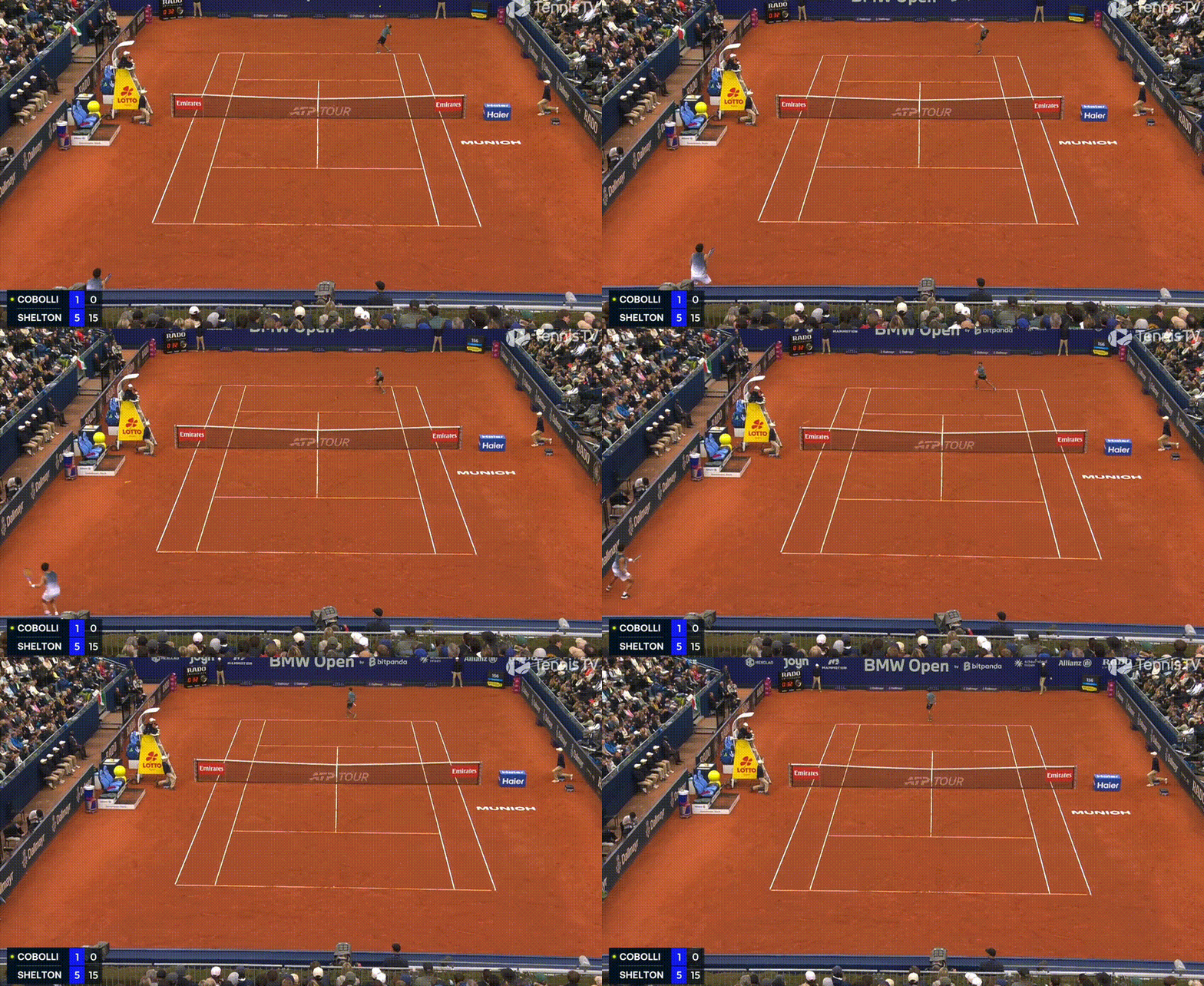
This week in Munich, we got a taste of a more aggressive Shelton on return. Compared to his 2025 run (where he lost to Zverev in the final), the American’s return averaged 6 mph faster — up at 82 mph. It didn’t take long to get an example in today’s final:
Shelton’s more aggressive returning strategy registered a 7.2 return-rating for the week — even better than his more consistent Toronto run — and it surely contributed to his whopping “in attack” rating of 34%. That number would lead the tour if he kept it up.
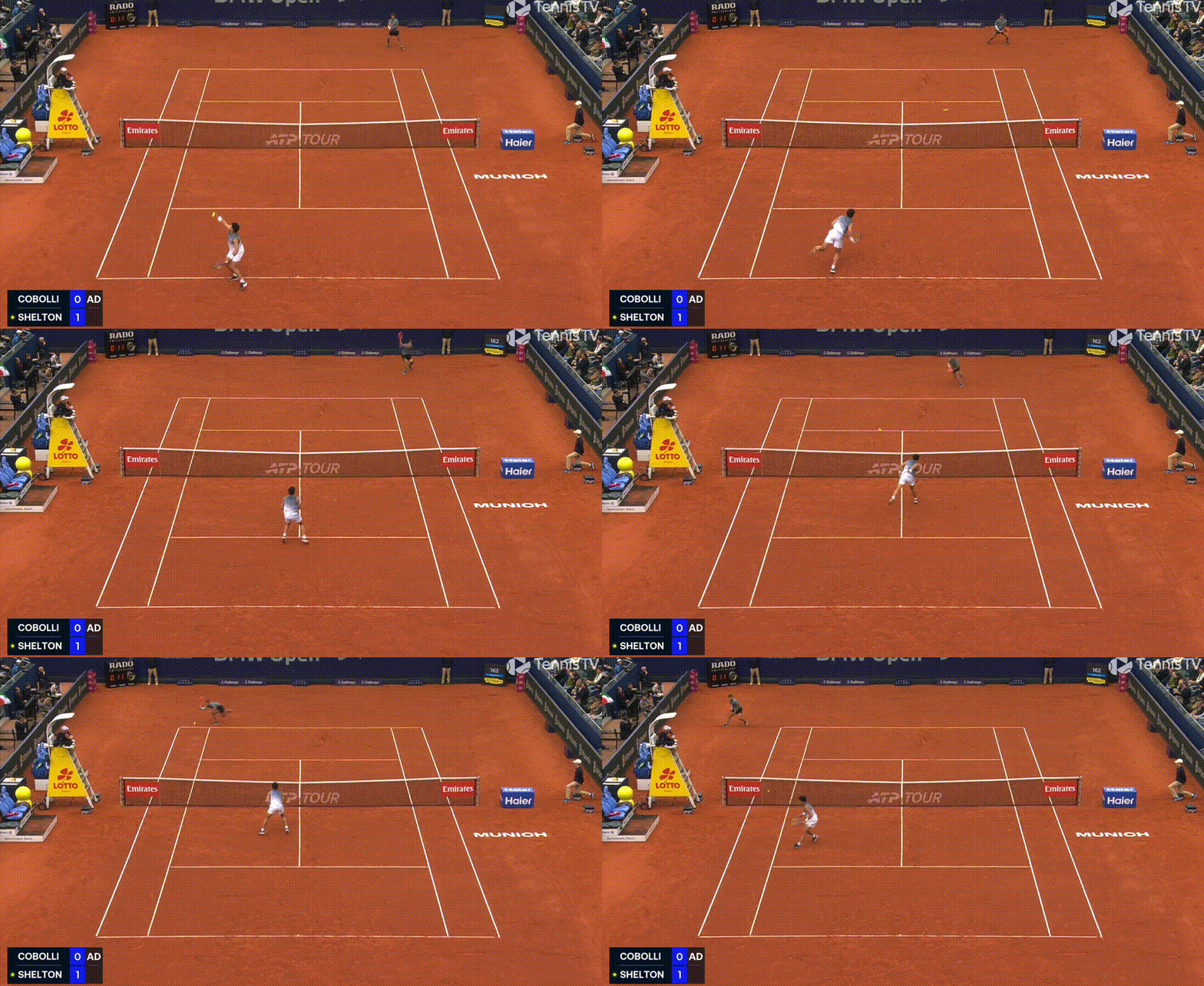
It must be said that Cobolli was out of sorts today compared to his flawless semifinal match, and after navigating a tricky opening service game, Shelton took advantage, going up a double break to ensure the first set. Here’s another example of Cobolli’s preferred serve getting absolutely minced.
The second set was more competitive, because Cobolli’s baseline game lifted as Shelton’s faded somewhat. But I want to shelve that entirely and focus on another area of Shelton’s game that I think needs to improve if he’s to be a bonafide top-5 guy: his net game.
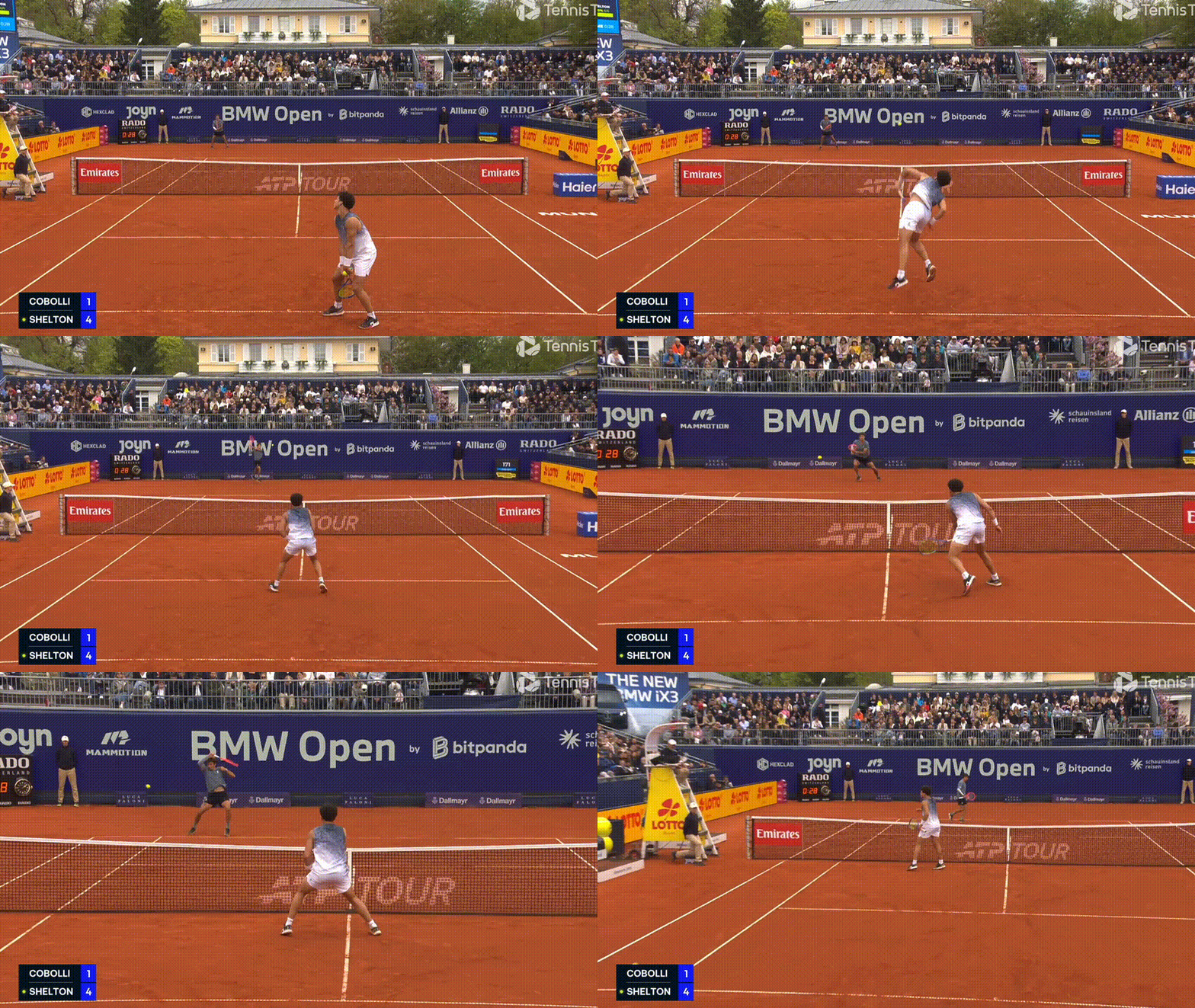
Shelton’s nasty lefty serve is the perfect delivery to follow forward, especially on clay; opponents are positioned deep, and are often off-balance dealing with an uncomfortably kicking ball. The second serve kicker is also hit with less velocity, meaning Shelton can get closer to the net to play his first volley. Here he plays it well inside the service line:
Yet, so often in this match I felt Shelton volleyed too deep and too straight against one of the fastest players on tour.
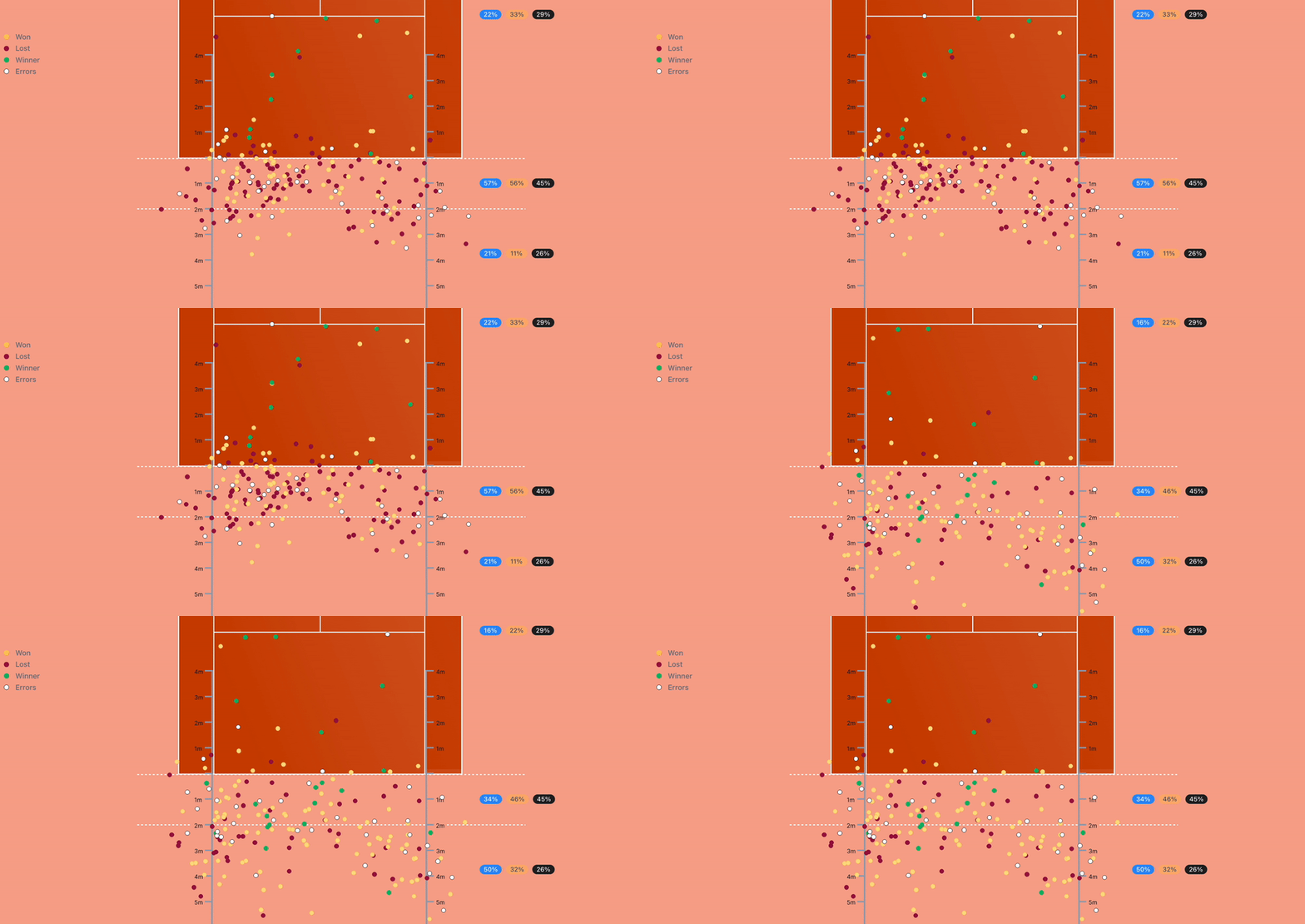
If you watch someone like Alcaraz volley on clay, look how often they are played short. Here’s a collection of his volley charts from his recent Monte Carlo campaign (note: these aren’t serve-and-volley only, they are all volleys):
Now compare to Shelton’s this week:


Shelton’s chart against Fonseca (bottom left) could pass for an Alcaraz, but the others are works of heavier hands. Here are some visualised:
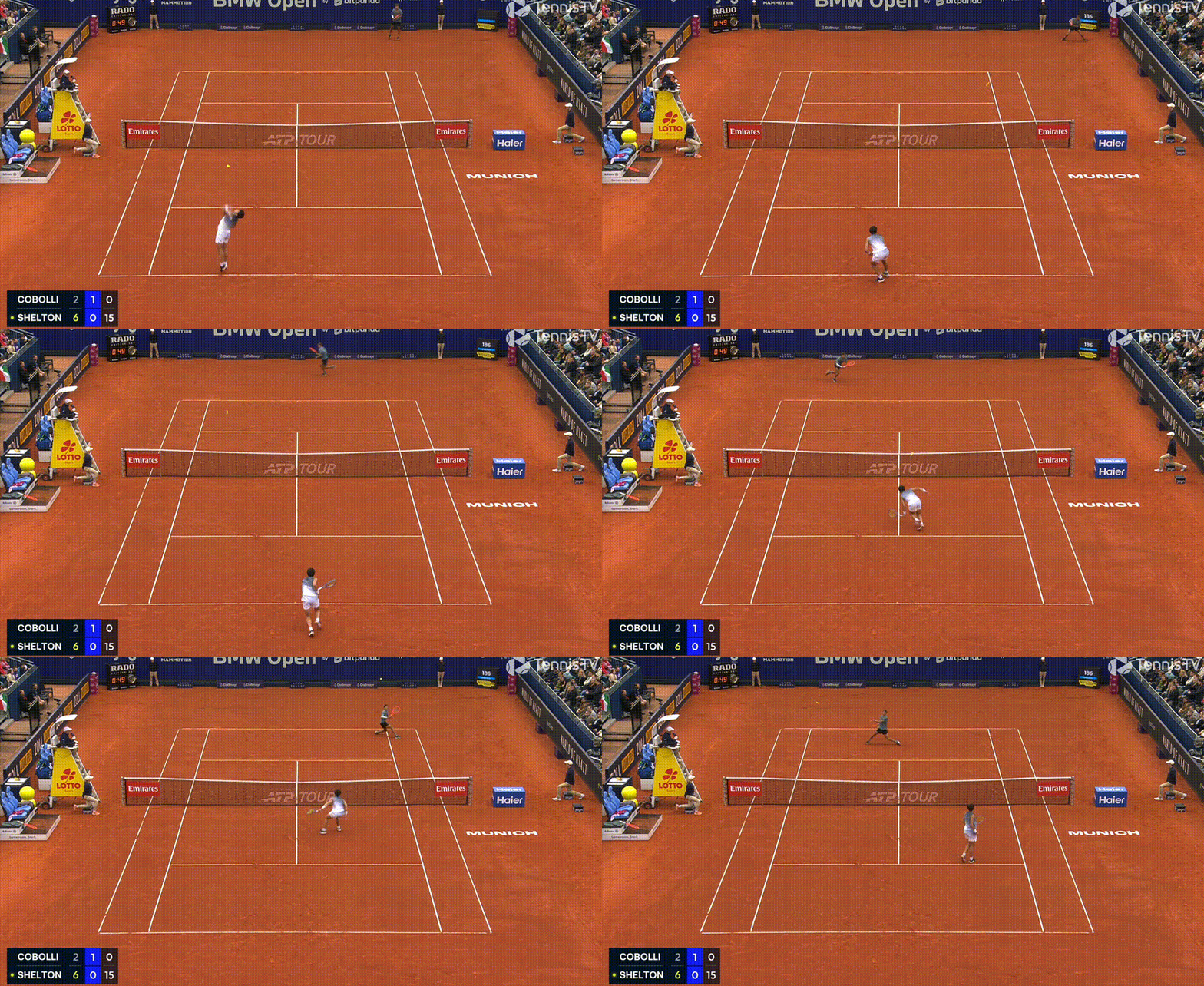
I’m being critical here because he’s top 10, but we know Alcaraz is cutting the outside of this one for a shorter, more angled stretch volley that ends up rolling over ‘MUNICH’:
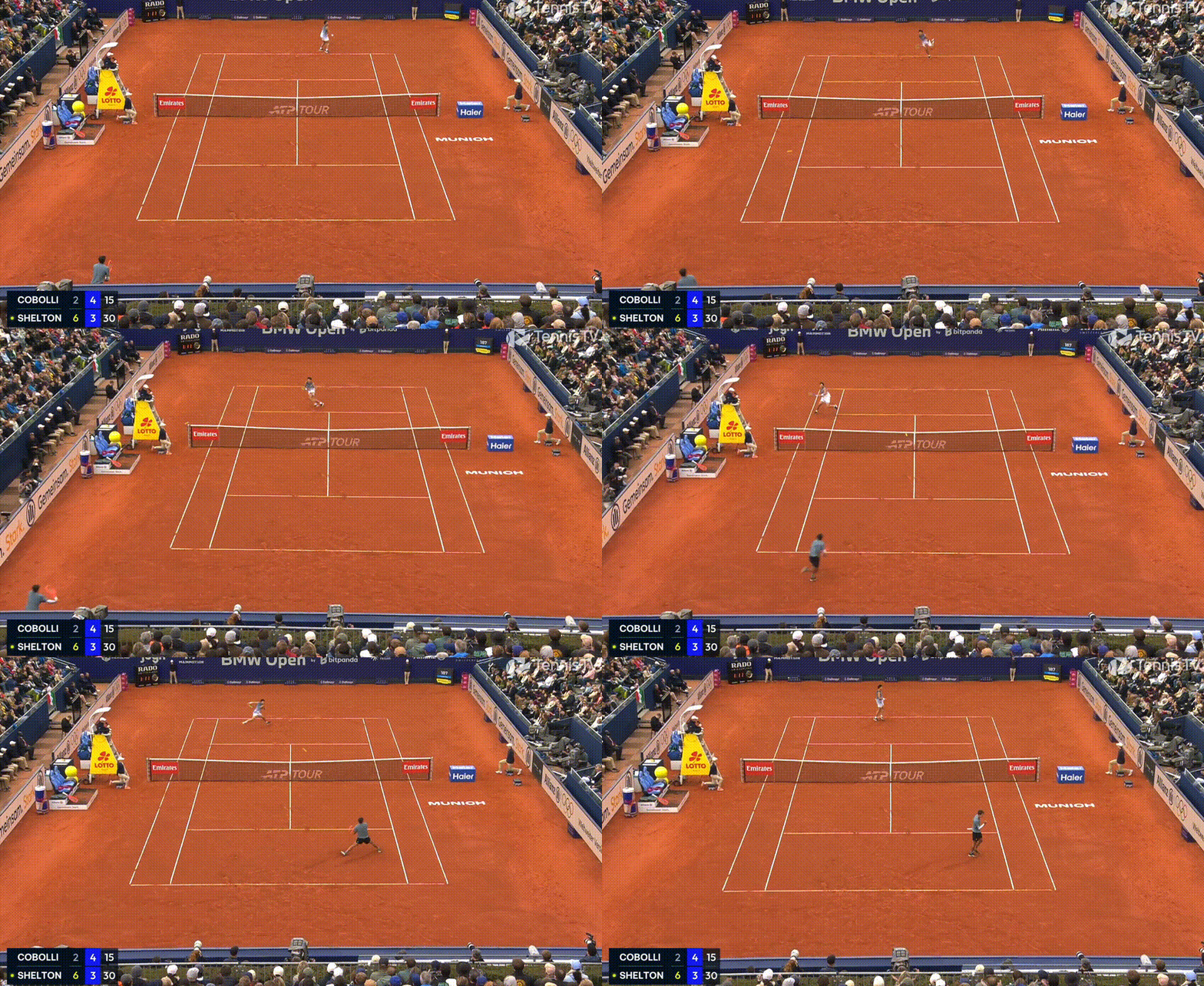
First one could have been short, second one could have been short angled:
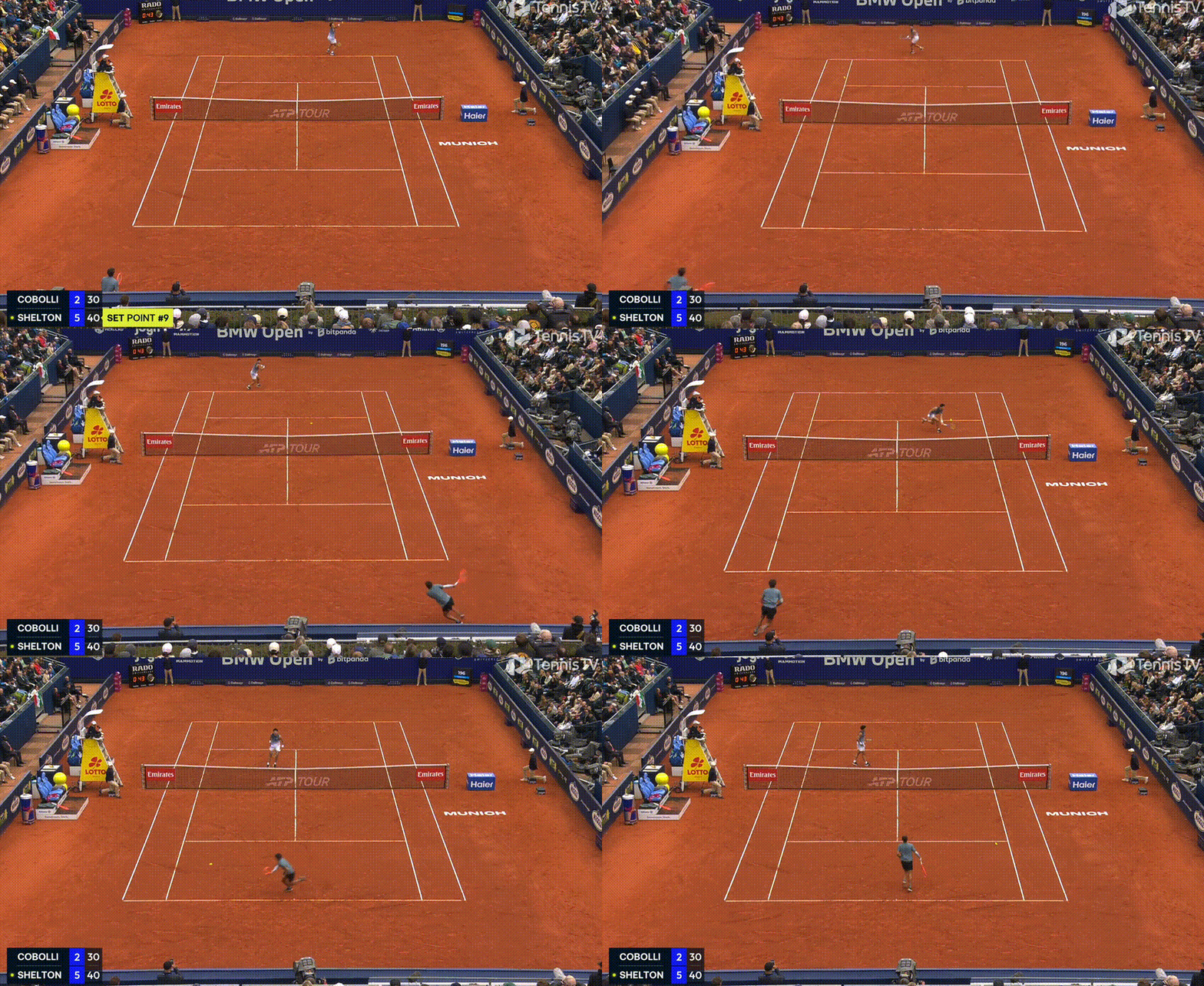
Shelton is currently below tour average for net points won (61% versus tour average 65%). That’s got to get better if he’s going to threaten the top brass, because I don’t see a world where he beats these guys from the back of the court.
The good news is that Shelton isn’t one to shy away from the net. He’s going to get better at this the more he does it, and when he does, that’s when I think genuine upsets could be on the cards.
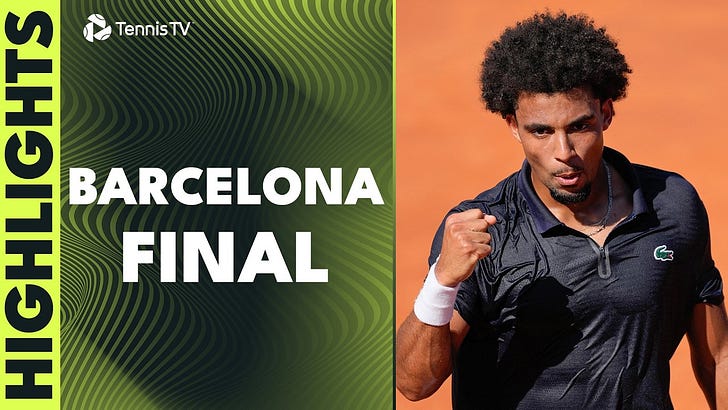
Arthur Fils defeated Andrey Rublev 6/2 7/6 in the final of the Barcelona ATP 500 on Sunday to clinch his first title since returning to the tour in February, having been sidelined for eight months with a back stress-fracture. Despite missing the Australian Open, Fils is now 6th in the race to Turin.
Arthur Fils has the biggest forehand on tour in terms of speed and spin averages. The Frenchman used to own a backswing that matched those numbers, but in 2026 Fils returned with a shaved backswing that didn’t harm his ability to inject pace:
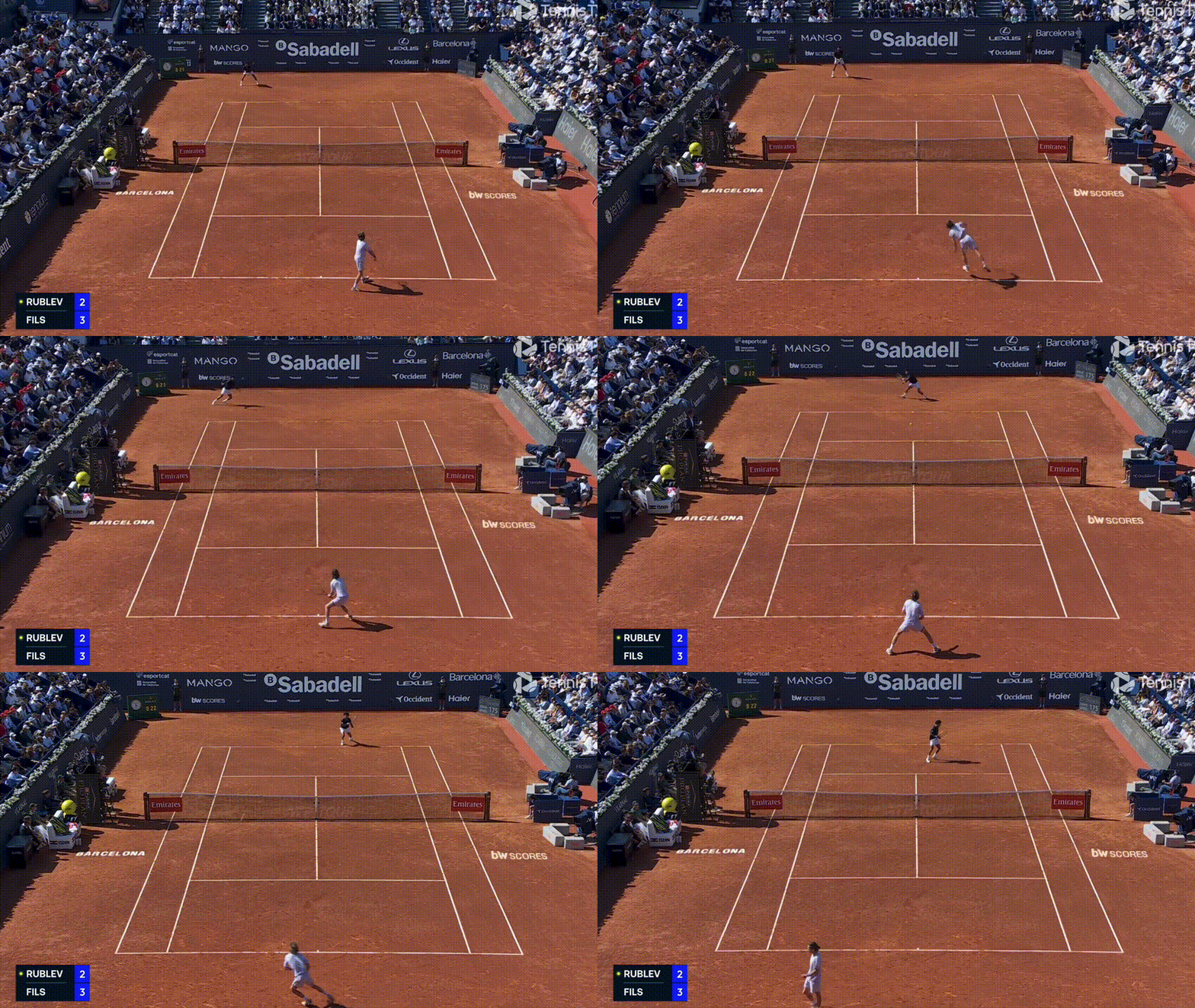
Rublev’s forehand is also a gem, and he doesn’t shy away from going toe-to-toe with anyone on that side, but what really separated these two in terms of baseline shot-making was their backhands. Long time readers may be familiar with Rublev/Sinner swing comparison:
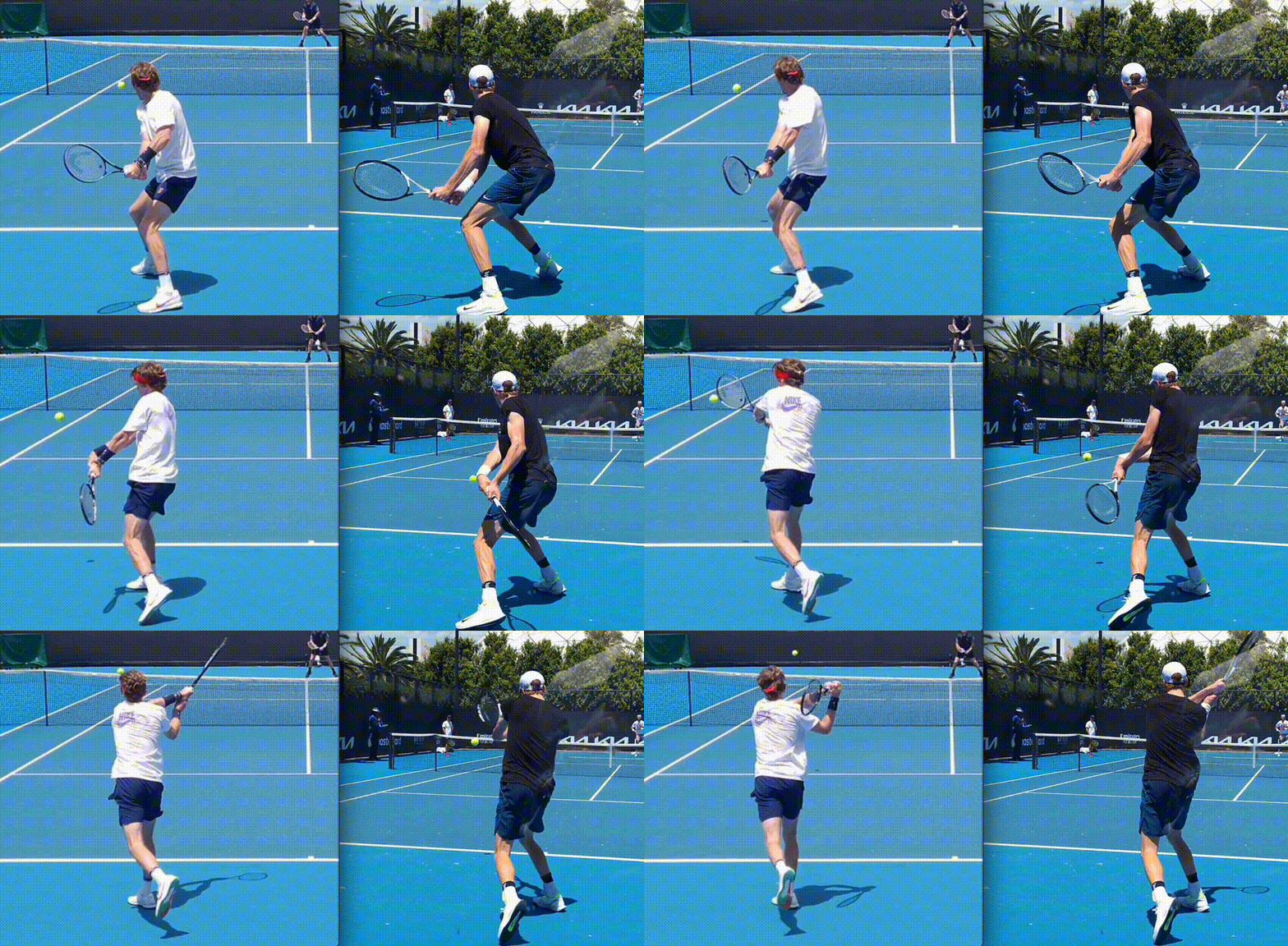
An excerpt:
Look how deep Sinner’s racquet tip gets behind him, as well as how much closer the Italian’s hands pass near his right pocket. He has a bigger flip and more length to accelerate the racquet head, as well as a more in-to-out path to aid with topspin (you can see how much more closed Sinner’s strings are as well). Nadal was very similar to Sinner in this style (and was also incredible from deep positions, unsurprisingly).
Well look at Fils in a similar comparison. Not quite as slinky and slingshotted as Sinner, but the Frenchman owns an enviable slot position:
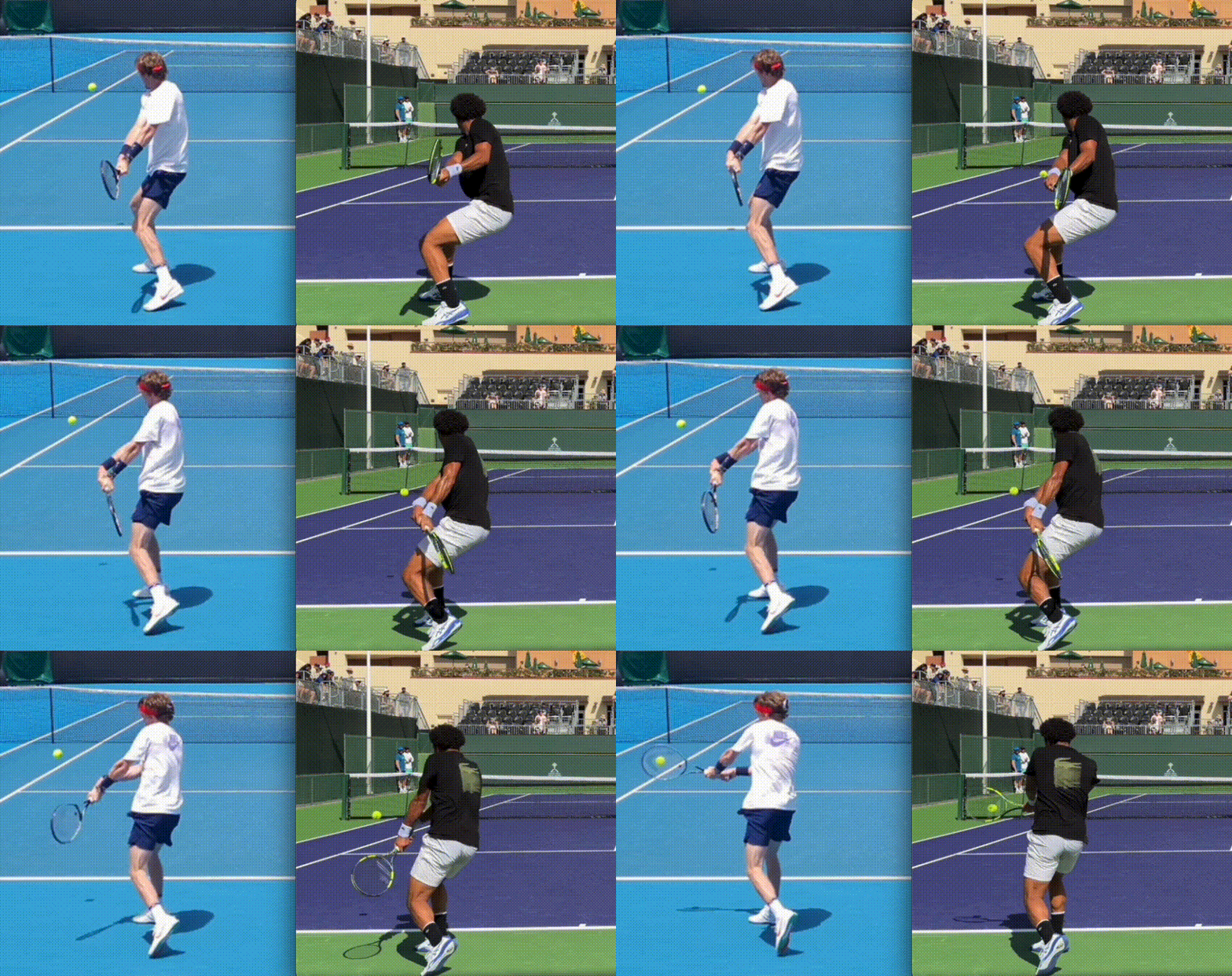
These technical differences may seem inconsequential on first viewing, but they have downstream tactical consequences. Fils is going to generate more racquet head speed more easily. Their 2025 speed and spin averages:
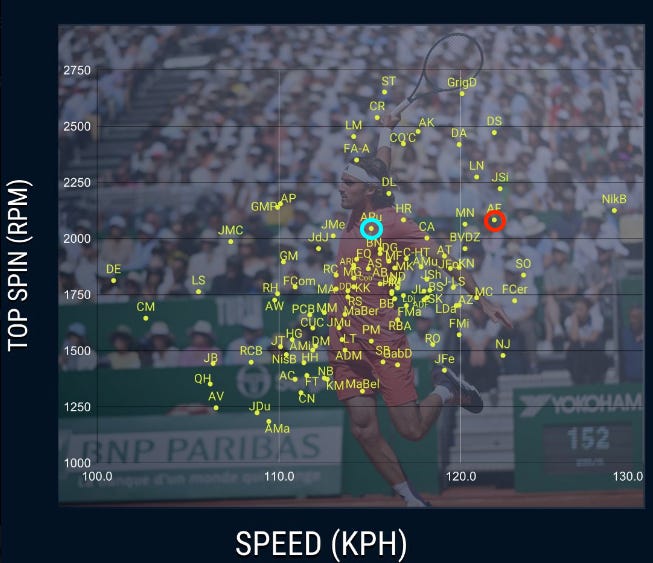
And more racquet head speed on tap means that the Frenchman can be strong off that wing from wider and deeper positions.
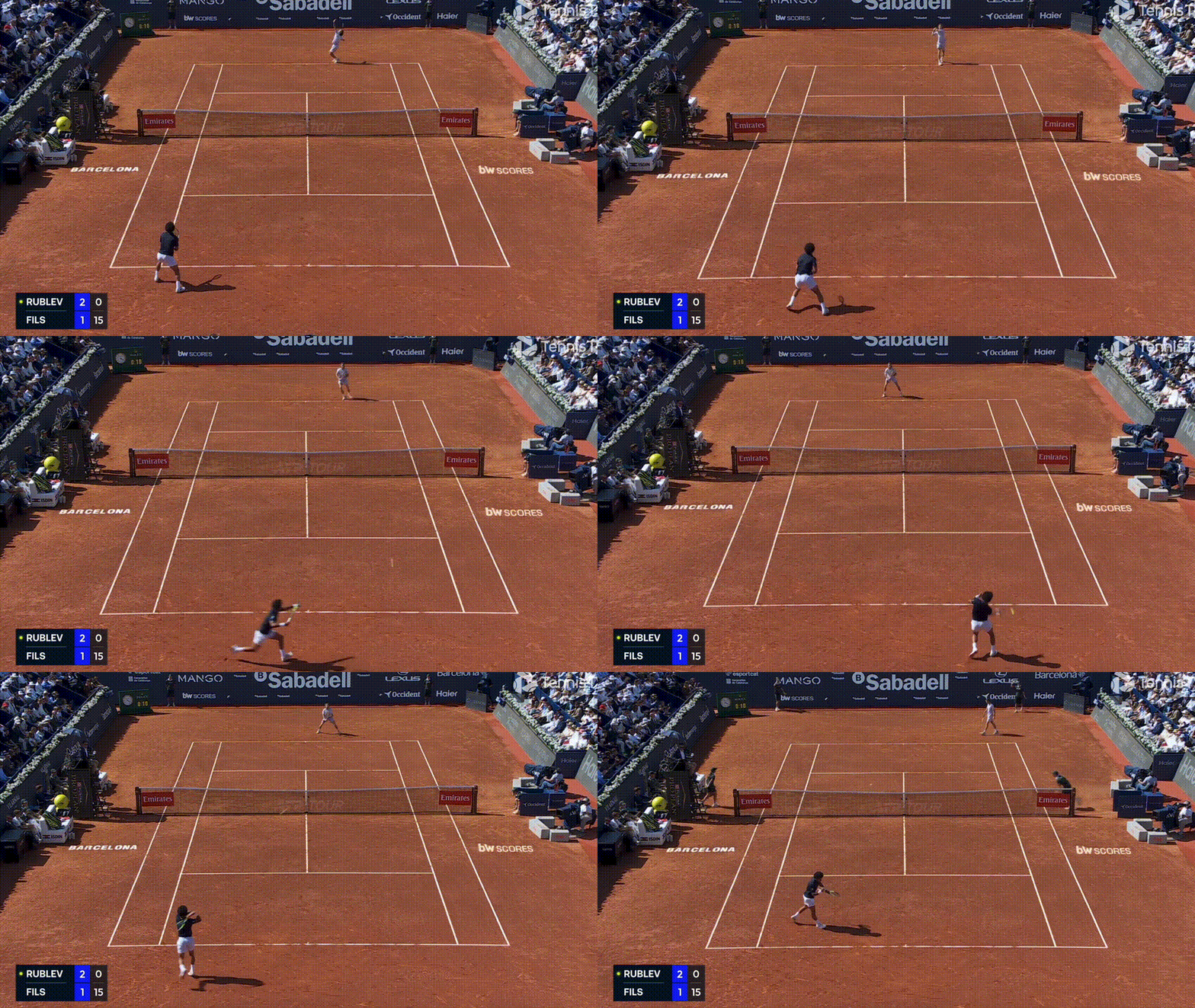
It was a decisive factor in the hard-fought opening game of the second set, where Fils escaped from 0-40, wrestling control through the backhand channel a couple of times:
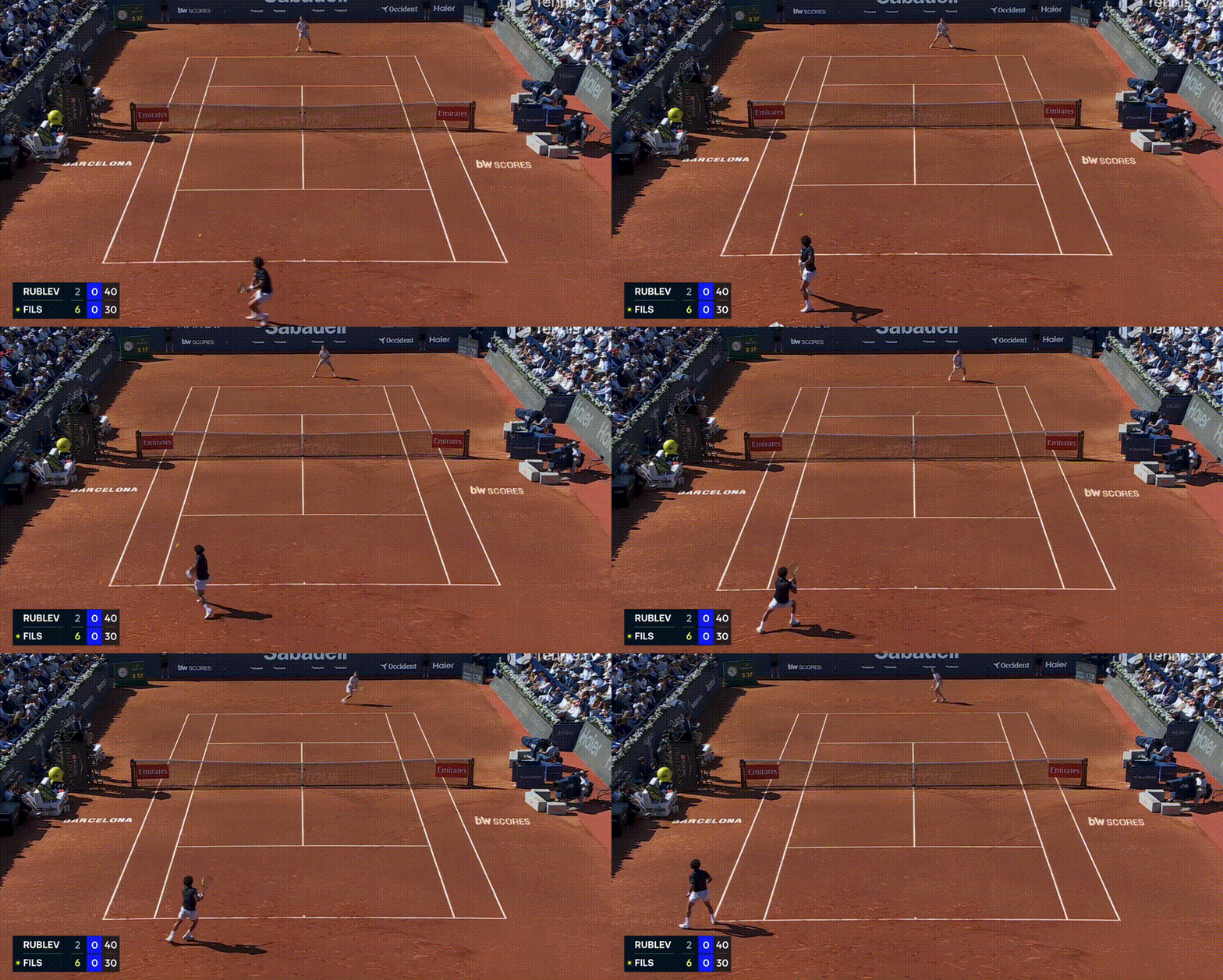
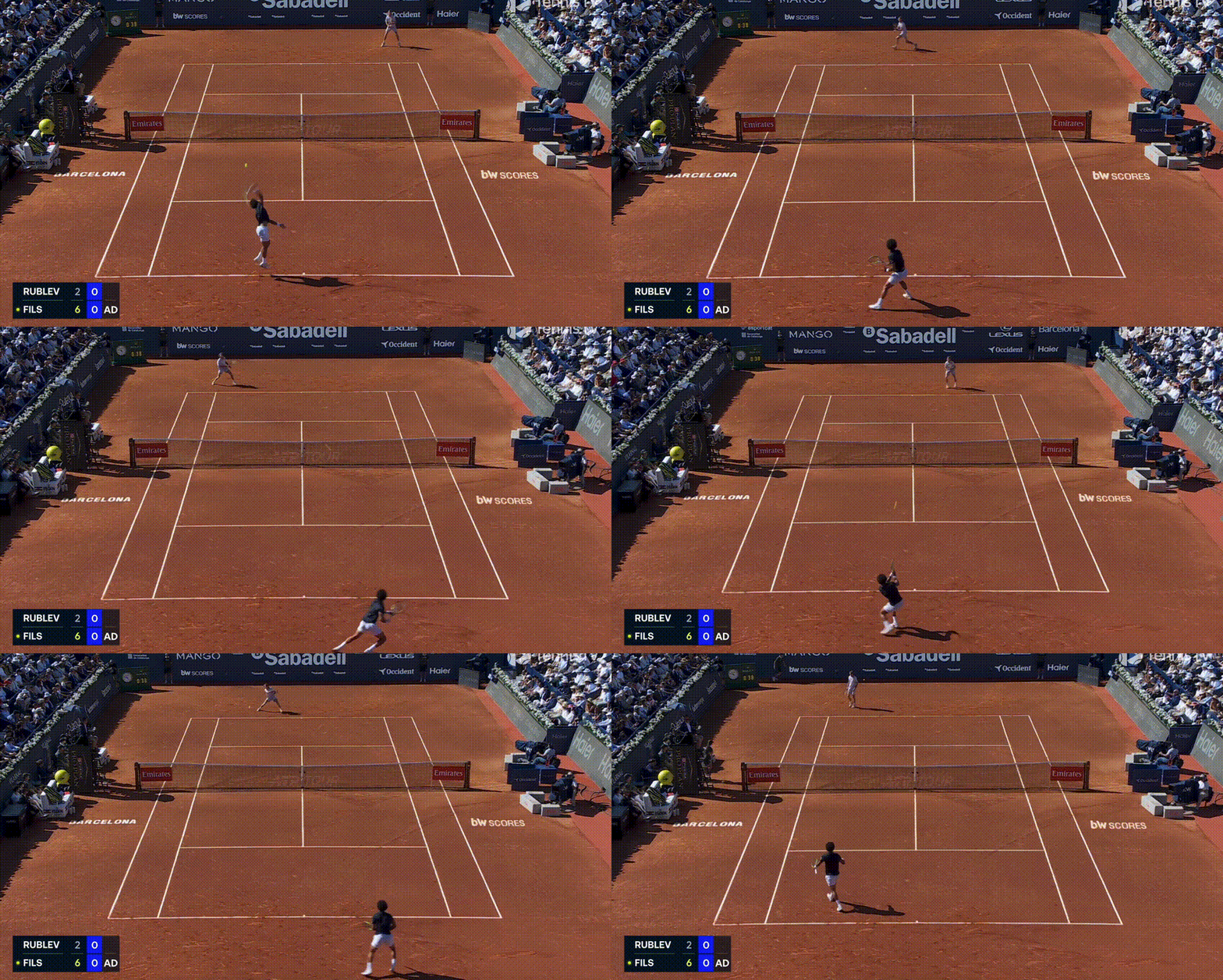
There’s a perk of being able to play from farther behind the baseline on this surface. Your opponent’s great shots — deep, hard, spinning up at unpredictable angles off pocked clay — don’t kill your ability to reply with a great shot, because the venom dissipates out of the ball after the bounce, and you give yourself a chance to adjust to the post-bounce trajectory. That was the difference often in this match. Fils operated from well behind the baseline, but still had the firepower to dictate his fate:
“It’s almost like they are hitting exactly the same level, but Fils can defend better. He’s moving around the court faster, and he can get to balls that Rublev can hit big. Rublev can’t get to the same balls when Fils hits big.”
— Tennis TV
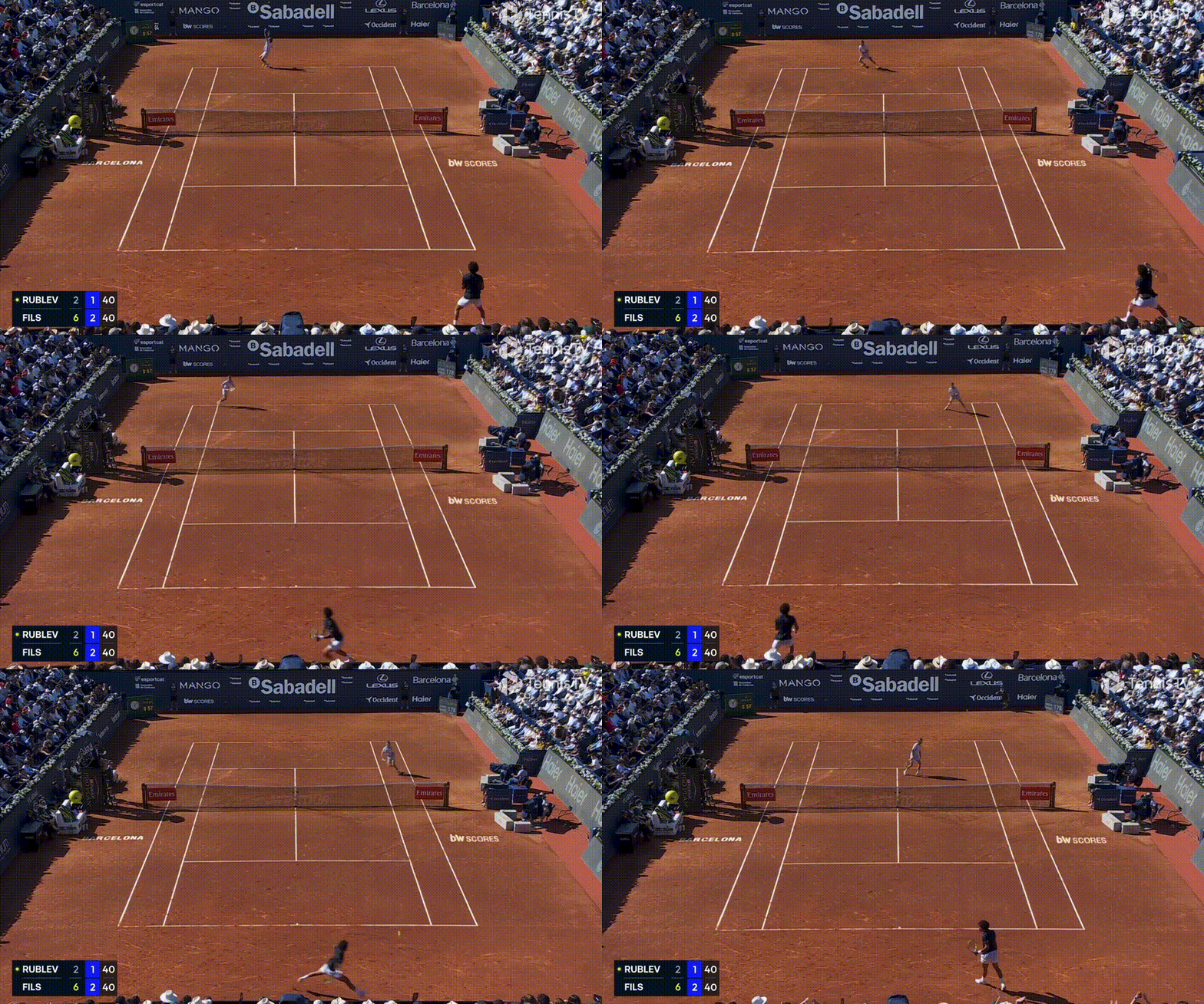
As the commentators mentioned, it’s also important to have the movement ability to play from far back: you have to be able to cover more real estate. Rublev ha never had that elite end-range ability to defend from the corners, and it’s probably why he’s leaned in to his baseline hugging style. Here Fils showcases modern tennis movement, hitting that open-stanced lunge forehand before the right leg even posts.
Here’s Djoker perfecting it eons ago:
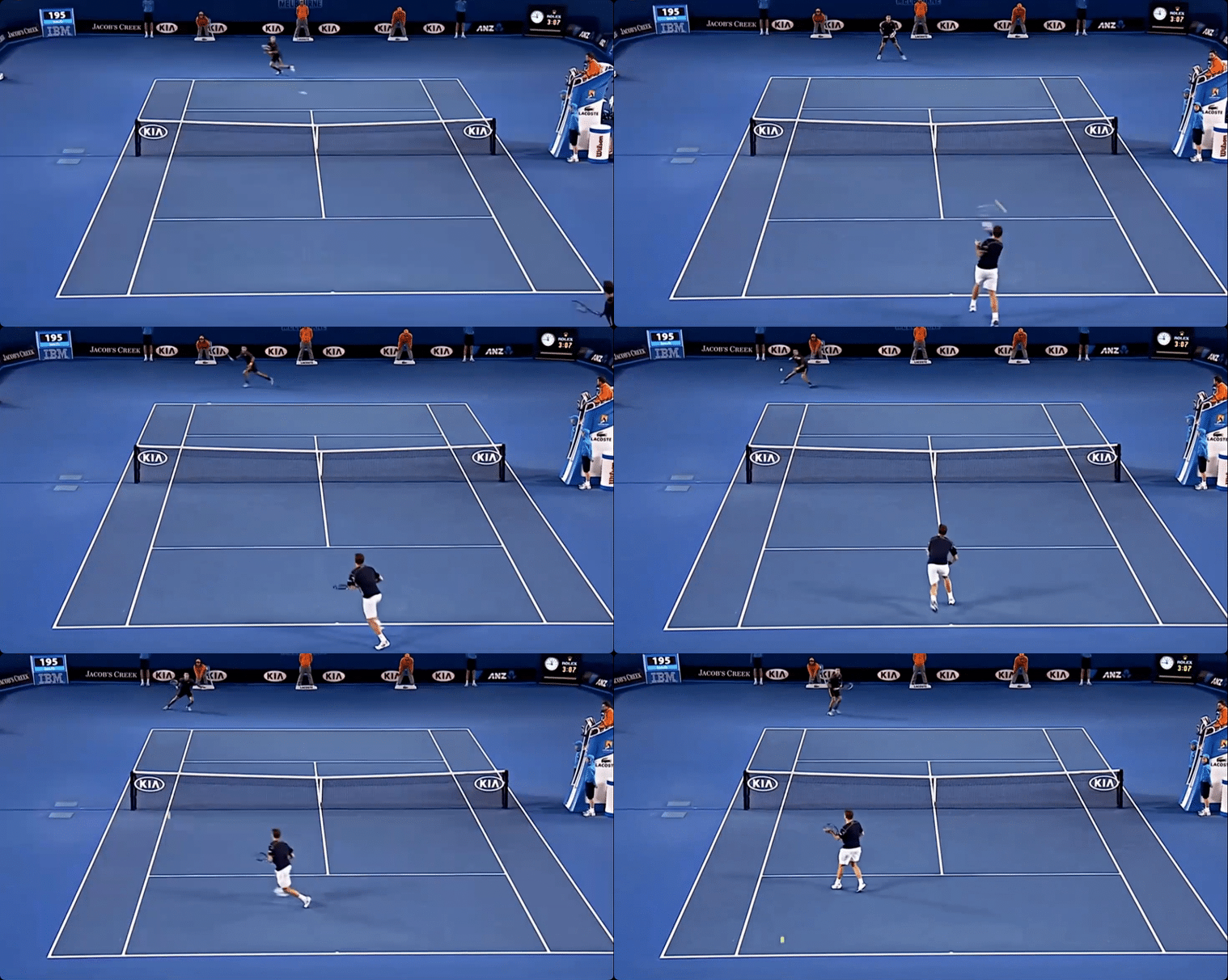
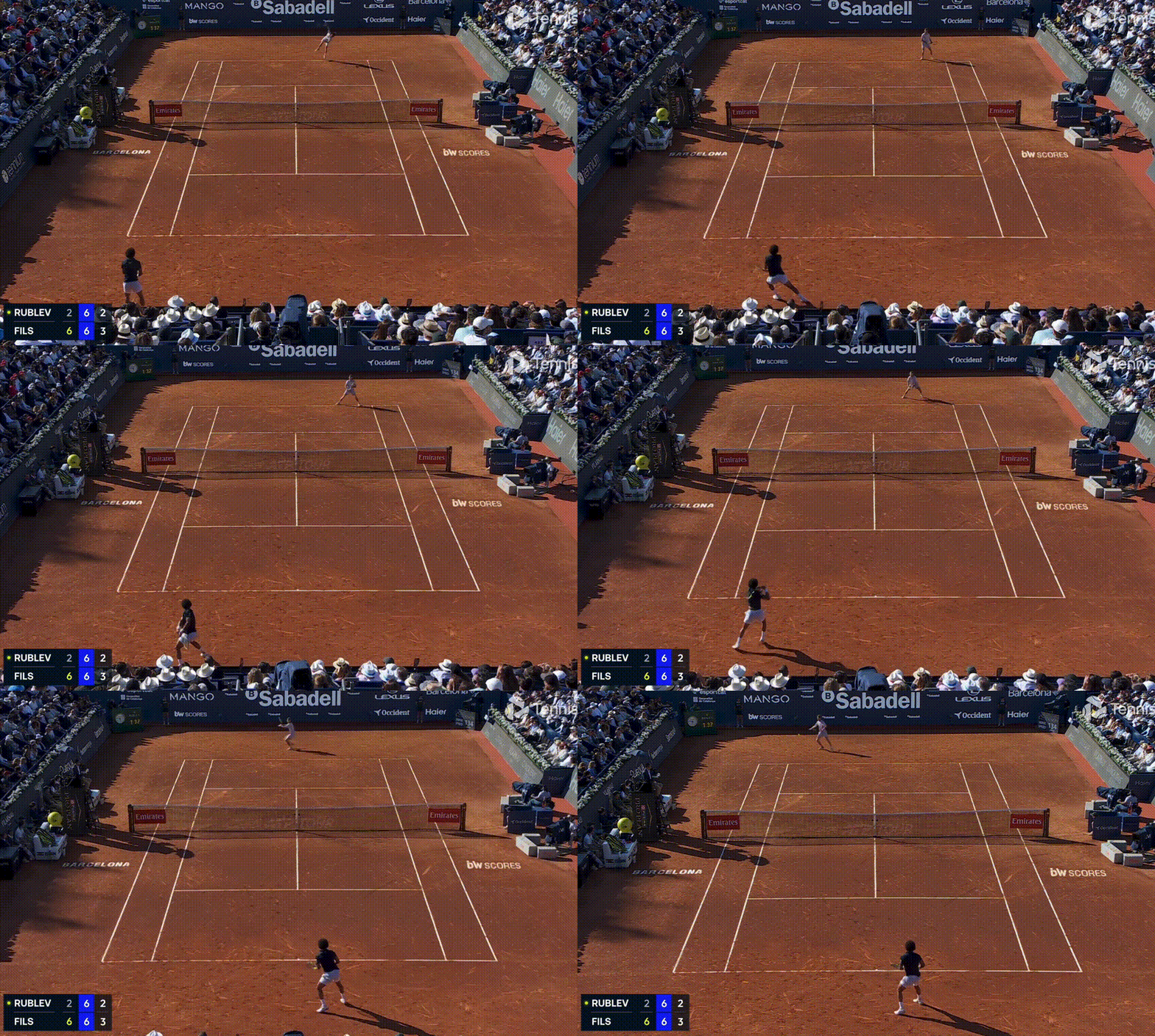
Fils did blow a lead in the second. He completely lost his range when serving for it a 5-3, and then had triple match point on Rublev’s serve at 5-4, which he was unable to convert, and then got broken again to hand Rublev a chance to serve out the second set. There were clearly some finish line nerves here, but he did well to regather and get himself in a tiebreaker, where again the backhand was able to wrestle with Rublev’s forehand from deep positions:
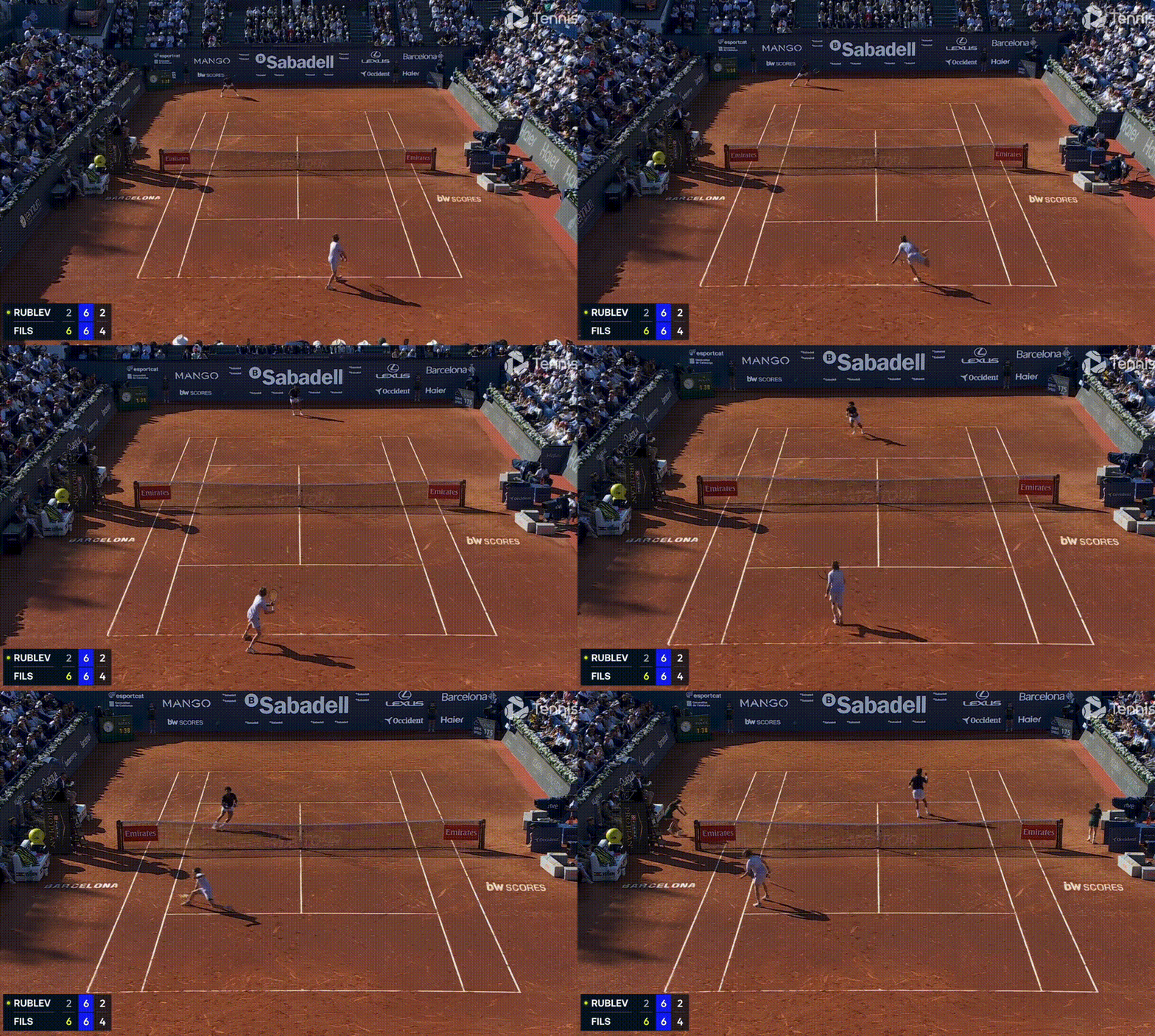
Rublev had struck a couple of good forehand drop shots in this second set in response to the impenetrable wall that was the Fils baseline game, and the Russian tried it again off the back of that 3-2 point:
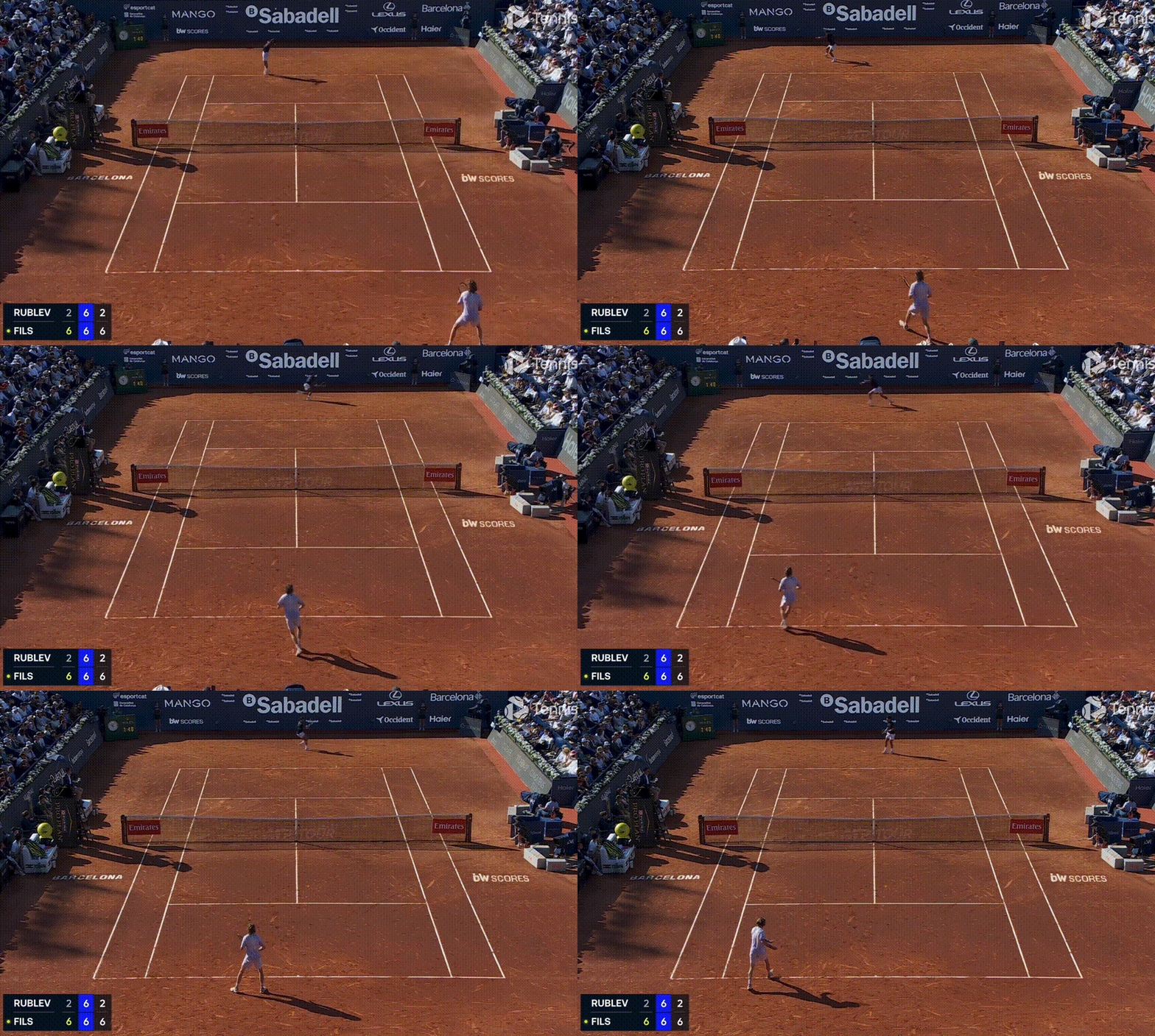
And the match point was a perfect encapsulation of how this whole thing unfolded. Fils weathering, then overwhelming, the Rublev baseline game from the shadows, the Russian’s backhand unspooling on a ball he attempted hugging the baseline.
“It was terrible,” Fils said about the end of the match. “The end of the second set was just about the mental [pressure]. The whole match was a bit tough because I was a bit tight. I played well for a set and a half, but when I had to close, I started to think a little. But I’m very happy with the way I played the tie-break.”
— Arthur Fils for atptour.com
Last year it was Lorenzo Musetti who was the young challenger to Sincaraz for Roland Garros. Right now I say that Arthur Fils is that man. There’s still plenty of clay court tennis before we arrive in Paris, but the physicality and firepower has been awesome to watch. His win over Jodar in the semis was an example of his fitness and movement separating himself from another young massive hitter, and I remember last year what a great match he played against Alcaraz in Monte Carlo.
Let’s hope he stays healthy. I’ll see you in the comments. HC