
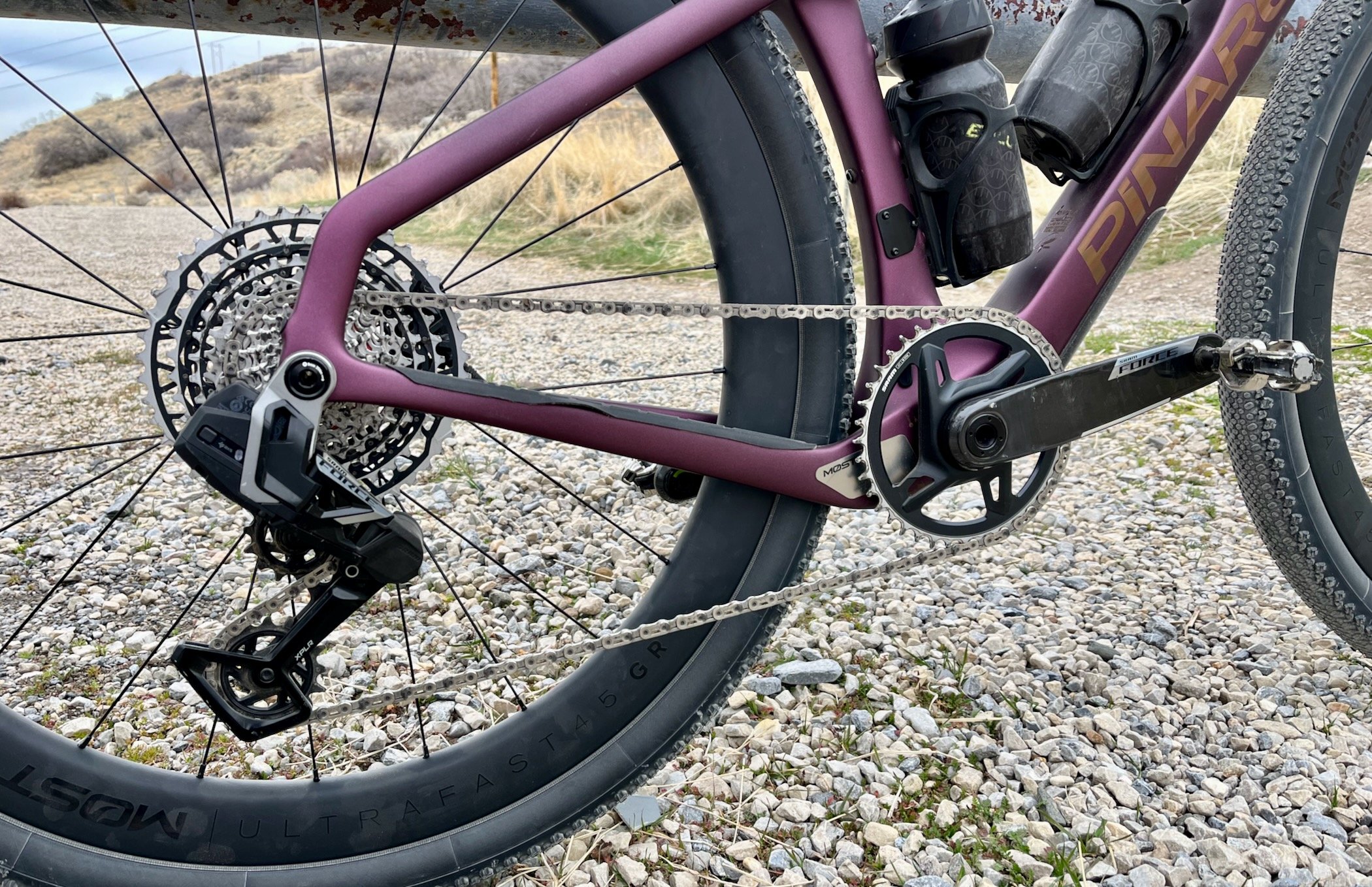
Second place. First loser. The next best. You know the game. Placing second isn’t always desirable, but in the case of the SRAM Force XPLR AXS E1, it’s a pretty sweet place to be. When SRAM went 13-speed with their XPLR groupsets, the ante was raised and an already-outstanding kit became the undisputed leader.
SRAM Force XPLR AXS E1 Groupset Features:
- 13-speed Force XPLR AXS cassette with 10-46T range
- Full Mount derailleur for precise shifting and easier setup
- Force XPLR AXS rear derailleur weighs 2686 grams, 80g lighter than previous generation
- 1x-specific derailleur design with strong clutch for secure chain management
- 80% less effort required for braking from the hoods, 33% less from the drops
- Wireless eTap shift logic with intuitive button layout
- Replaceable parts on the Force XPLR AXS rear derailleur for increased durability
- Compatible with AXS dropper post and other SRAM components
- Power meter available (dual-sided or single-sided) with precise power measurement
- Weight: ~2650 grams
- MSRP: $1850 (without power meter, as tested)
The setup… it was an Italian job
With the Pinarello Grevil F7 in the stable for a long-term review, it was a great time to consider the new SRAM Force XPLR AXS E1 groupset. With the top-shelf Red XPLR AXS E1 on my OPEN UPPER 2.0, I’ve had plenty of miles on SRAM’s latest gravel groupsets. But, knowing how expensive Red is compared to Force, I’d rather pocket that extra $1800 and keep up on “leg day” to compensate for the added 200 grams of SRAM’s second-tier groupset.
The Grevil F7 came equipped with a 40T chainring and no power meter — not even the single-sided one. So, this review is power-free and allowed me to unplug from one electronic bits for a few months. Yes, I missed it, but training with heart rate and virtual power didn’t cause permanent fitness damage. Phew! Kidding aside, a single-sided power meter upgrade is only $240 and would be a reasonable upgrade if your Force XPLR kit came without one.

The biggest question will be which size chainring to roll with. Since the cassette maxes out at 46T (plenty of low-range), you’ll want to adjust that front chainring accordingly. I had a 44T and went down to a 42T on the OPEN UPPER 2.0 for more low range. Here, Pinarello specs it with a 40T, which offers even lower range. I’m always grateful for a little extra oomph on those technical or steep climbs. The Force XPLR AXS E1 groupset is perfectly-suited to any all-road or gravel bike. Again, the front chainring will be your only real consideration.
SRAM has made the differences between Red, Force and Rival very subtle — particularly between Red and Force. Knowing that, you’ll never notice the differences between Red and Force (or maybe even Rival, for that matter).

Rolling gravel, road and singletrack
As expected, the overall feel and function of the new Force XPLR AXS is immediately comfortable and intuitive. If you haven’t had the pleasure of using SRAM AXS, you’ll immediately appreciate the paddle shifting. With this being 1x only, the shifting is even more simplified, with each hand moving the chain in that direction. It’s easy to configure the shifting to auto-shift when holding down the button (my recommendation).
Notably, the new Force hoods also offer Bonus Buttons on each side that can be configured to scroll through your computer screens or activate a dropper post. I wish it was able to control the Wahoo ELEMNT ROAM 3’s built-in bike bell (hopefully Wahoo is listening and makes that available).


Changing between the latest Shimano Di2 and SRAM AXS hoods, my hands clearly prefer SRAM’s take on shifting and braking. Shimano is very “Shimano” — reliable, fuss-free and smooth. However, SRAM’s size and shape put it on a different level. Particularly, the braking power and leverage. Braking from the hoods or the drops is equally outstanding with SRAM’s new levers, due to the lever shape, length and revised pivot points. The previous-gen Force hoods and levers were already great, but these take it over the top.
Even more, the lever reach is easily-adjusted to suit your hand size. This allows for consistent and powerful braking and shifting from wherever your hands are placed. The beauty of the updated levers is not only increased power but also increased modulation. That means, it’s not an on/off affair. No, SRAM’s engineers have changed the game completely, which allows for more subtle braking with less effort. I have Shimano 105 Di2 in for testing and I can confirm that even though Shimano’s braking is excellent, SRAM’s is even better — and even moreso with gravel riding where proper braking can mean the difference between hitting the deck on that loose corner or maintaining control.

While the large paddle shifters are easily-accessed and pushed, I do wish they had a more definitive cross-hatch pattern instead of just horizontal lines. While shifting in rough terrain, my fingers can slide fore/aft on the shifters and I really think a hatched pattern would reduce that uncertainty.
The gear range with the 40T chainring is excellent in the real world. I’ve got plenty of low-end and the gears pedal out at about 34 mph on road descents. For mere humans, either a 42 or 40 tooth chainring is the sweet spot.
When shifting, Force XPLR AXS E1 is superb. That burly, direct-mounted rear derailleur just gets the job done and does it with precision, speed and power. With the rear mech being the brains of the system, it’s built strong and capable of handling a ton of abuse. I love that the battery is tucked away neatly and that it lasts FOREVER. I usually charge it every month just to be sure, but in three months of riding, the button remains green.

Speaking of neat features of all AXS rear derailleurs — the ability to use the AXS button to shift up/down the cassette is awesome when working on your bike. The little-known “double-click” of the button allows a shift up the cassette as well. That comes in handy when I’m changing wheels. And, the Cage Lock Assembly is awesome as well — making quick work of wheelset changes.
Overall, I didn’t notice any functional differences between Force and Red and you won’t either. They both work awesome and are worthy of any bike you want to hang them on. But, Force is the more economical choice.
Buy Now: Visit PerformanceBike.com
The Bottom Line
The Force
The SRAM Force XPLR AXS E1 groupset is a top-notch choice for all-road or gravel bikes, offering precise shifting, exceptional braking power, and an intuitive, rider-friendly design. It’s perfectly suited for riders seeking a high-performance, wireless shifting experience without the premium price tag of the Red XPLR AXS E1. The Force XPLR AXS E1 is a great option for those who want to save $1800 compared to the Red XPLR AXS E1, with only a 200-gram weight penalty. The groupset’s features, such as the 13-speed Force XPLR AXS cassette and wireless eTap shift logic, make it an excellent choice for your next gravel build — no matter the frame you choose. Force is always a smart choice and I have no hesitation recommending it for all-road or gravel bikes.
The Good:
- Precise shifting — under all conditions
- Braking is not only powerful, but perfectly-modulated
- AXS ecosystem is the best in the industry (hardware, software, etc.)
- Over-the-air updates are easily-applied
- All the goodness of Red at a fraction of the price
- Carbon bits everywhere
- Single or dual-sided power meter options are available
- The right chainring will serve for all-road or gravel — rider’s choice
The Bad:
- A slight weight penalty to Red
- Those chains can get squeaky — lube them often
- A little more grippy shift paddles would be nice on rough terrain
- I might suggest getting the $15 crank boots for added protection