
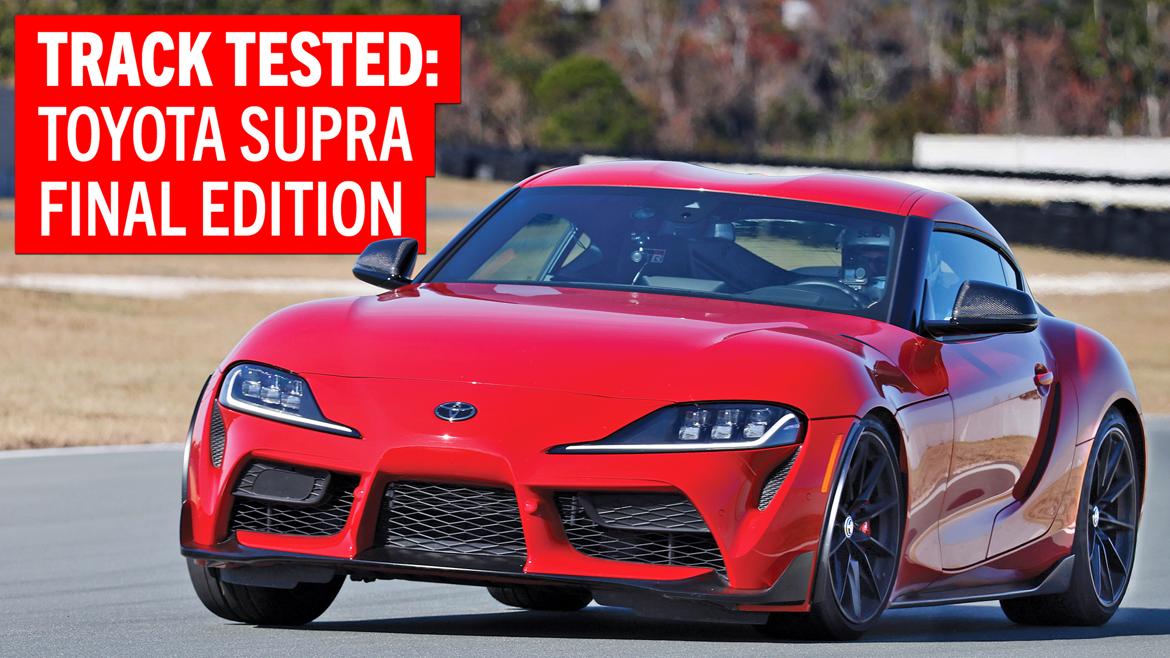
The last time the Supra said goodbye, it was for way too long. When the legendary A80 Supra bowed out of the U.S. market after the 1997 model year, Toyota had made no announcement that it would return–and had no public plans for another car to fill its slot.
A Team-Building Exercise
Toyota buddied up with another automotive powerhouse, BMW, and built the new Supra on the same platform and with the same powertrain as BMW’s Z4 roadster. It would be built in Graz, Austria, alongside its Teutonic cousin.
Originally, this caused a lot of consternation among some enthusiasts. Cries of “But it’s just a rebadged BMW” and “It’s NoT a ReAL SUPRa” rang out, as though two of the world’s most driver-centric car companies teaming up for a halo sports car was somehow bad and would create an undrivable mess.
Well, it wasn’t that, and while it may have strayed a bit from previous iterations of the model, which had always been a 2+2 to that point, it quickly won over many of the critics with exceptional dynamics and a very high performance ceiling through aftermarket tweaking.
The first models got 347 rated horsepower, but the output of that turbocharged B58 3.0-liter inline-six was bumped to 382 and 368 lb.-ft. of torque for 2021, although we all pretty much understand that those numbers are almost comically low. Supras routinely put their rated crank power figures to the ground right off the showroom floor in chassis dyno tests, and their exceptional straight-line performance hints at BMW and Toyota being very conservative with that rating.
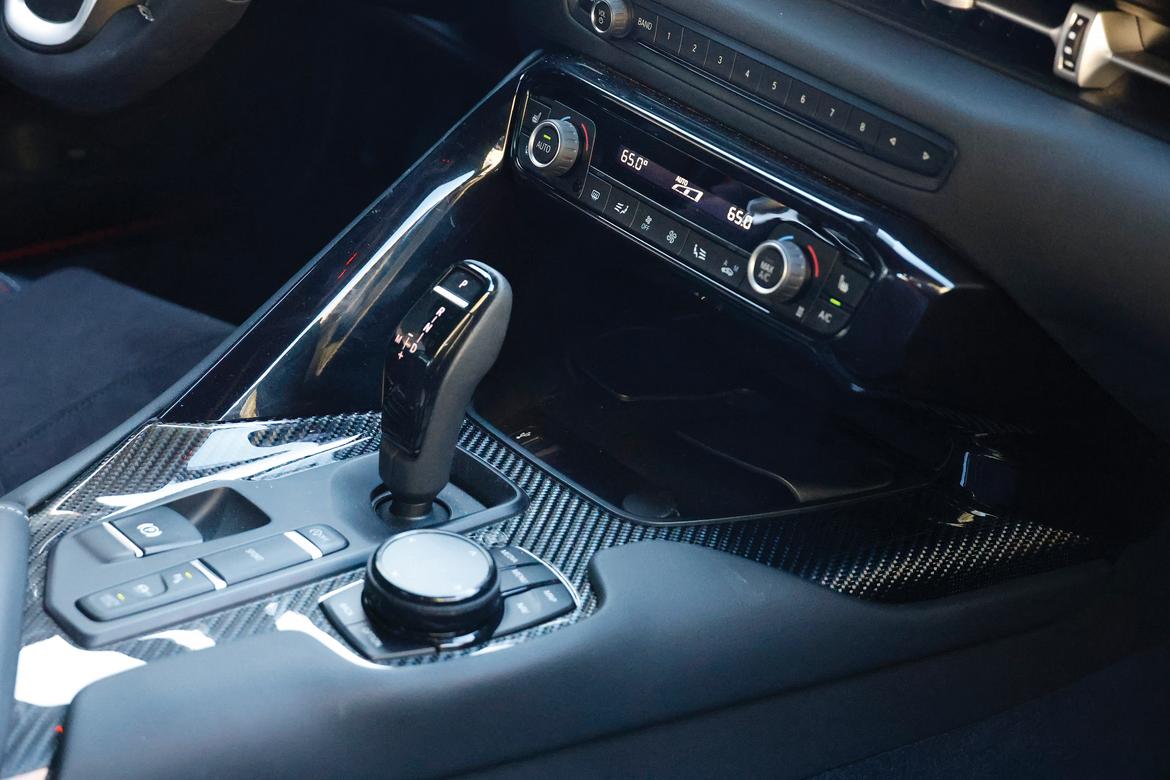
A ZF 8HP eight-speed automatic handles shifting duties, although a six-speed manual option was added for the 2023 model year. Conventional wisdom has shown that the paddle-shifted 8HP is the choice for track work, while the manual box fares quite well in an autocross situation, where its long, 70+ mph second gear and flexible power curve means no shifting once you get out of first. Either option makes an excellent companion for however you want to drive hard, though.
Time for the Final Edition
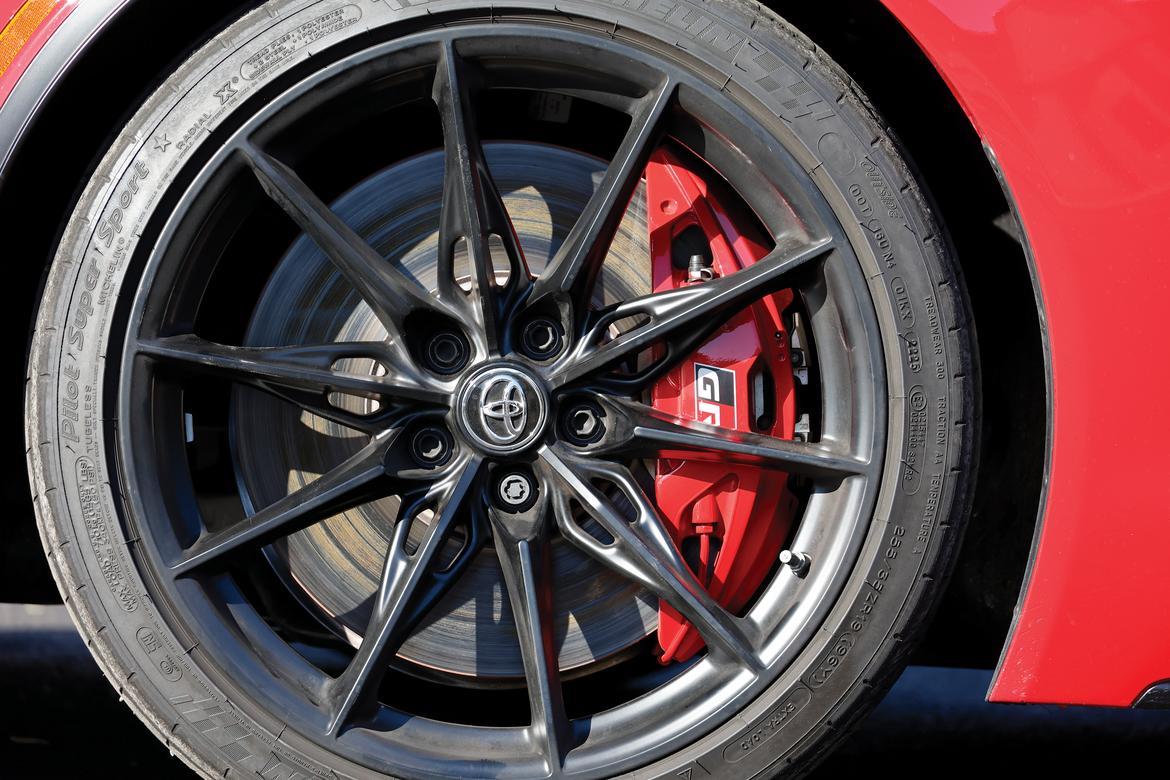
Aside from that manual option showing up and the early cycle power bump, there haven’t been many changes in this generation of the Supra. This Final Edition version, released for 2026, is MOSTLY a trim package, save for the big ol’ honkin’ 15.4-inch front rotors–nearly an inch bigger than the already healthy units on the non-Final Edition Supra–added to compliment the Brembo calipers.
We say “mostly” because Toyota claims a fairly lengthy list of minor improvements, like revised alignment, revised bushings, tweaked electronic diff control software algorithms, retuned damper software and an underbody brace. Whether those improvements are signal or noise once a set of proper 200tw track tires and a performance alignment are thrown at the car is debatable, but at least Toyota is making an effort to send the car out with a bang and not just some fancy, stuck-on trim.
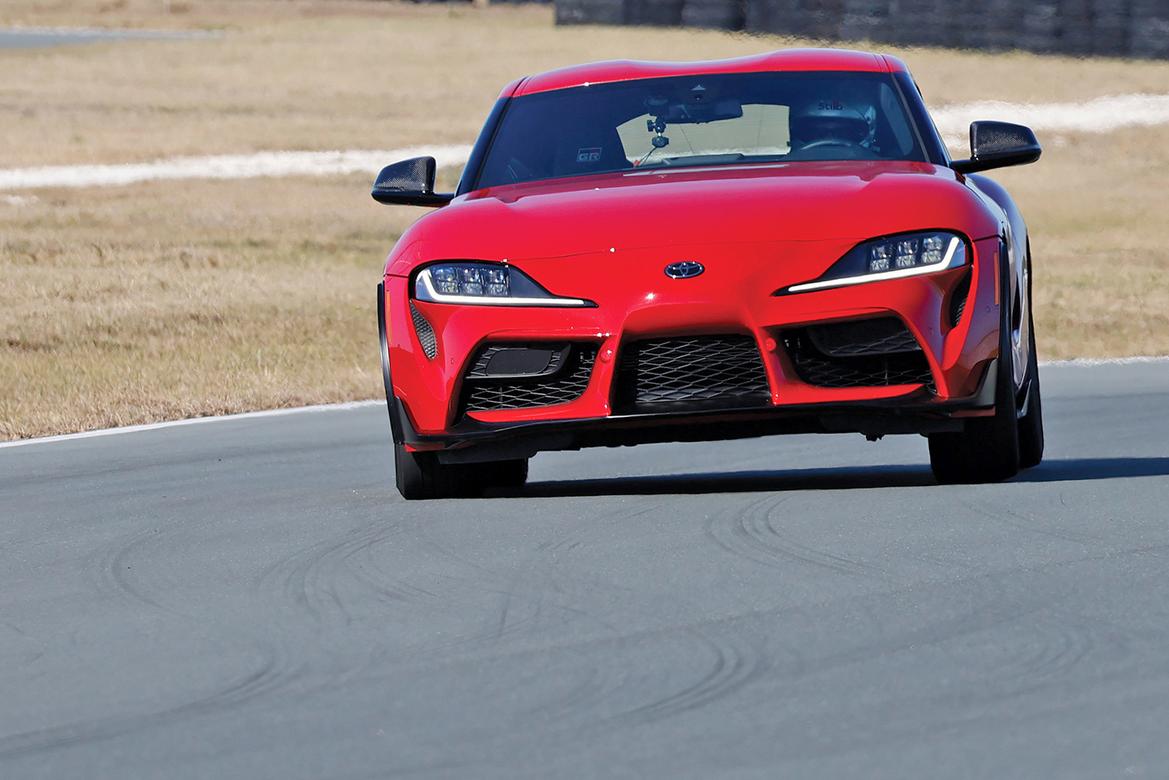
And yes, it does bang on track. Since the coming of this alliance between two of our favorite performance car manufacturers, we’ve been fans of the Supra’s track and autocross manners, and the Final Editon does nothing to dampen our joy as soon as we lean into the throttle or point the nose toward an apex.
The factory alignment and street tires give the car a bit of imprecision in early phases of cornering, particularly through the steering wheel (not unlike with many modern BMWs), but the chassis is so communicative that you always know what each tire is doing, even if you don’t feel it entirely though your hands.
The Supra also drives small and gives you a great idea of where each corner is at all times. It’s only an inch narrower than an M2, but it’s also 8 inches shorter and has a smaller wheelbase by a full 11 inches, and that lack of size really shows up on track.
The car feels tidy and placeable, and it never feels like you’re forcing it to do anything it doesn’t want to. When it breaks traction at the front, it does so gradually and gently, letting you decide whether to open your hands or feather your foot a bit to get the nose back in order.
Particularly impressive is the power delivery, which feels absolutely dialed to the throttle. There’s no discernible turbo lag, and exiting corners with that high-resolution gas pedal is an absolute delight. In slow and medium-speed corners, power oversteer is available at will on street tires, so that scalpel-like throttle really helps you balance traction, thrust and yaw with exceptional precision.
The VBox data from our test at Circuit Florida shows an extremely capable track car as well. Although we don’t yet have a particularly deep library of VBox data from this facility, we do have some quality laps from our BMW 435i project car, a machine that’s been fully dialed in for track use.
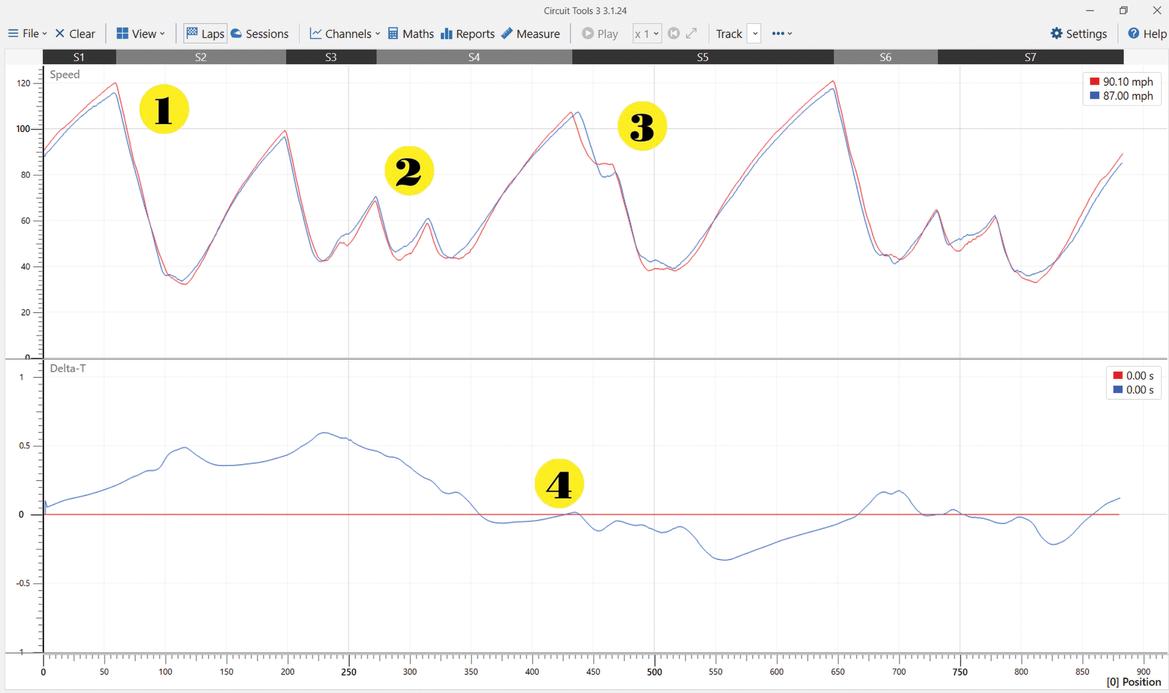
1. The Supra (red trace) consistently pulls the BMW 435i (blue trace) down the straights. The Supra’s B58 is clearly underrated at 382 horsepower.
2. The more heavily prepped BMW has the advantage in the twisties, but the Supra’s minimum cornering speeds aren’t bad considering the lack of camber and the street tires.
3. The Supra’s predictability, drivability and throttle control even do it some favors in spots like the quick left-hand kink into the braking area for Turn 10. Just toss it into the turn and sort it out in real time.
4. The delta graph, which shows the overall time difference, tells the story of the lap. The Supra (above the red line) has the advantage in the power sections, while the BMW (below the red line) claws it back in the twisties and, interestingly, in the final straight, where the Supra might have been heat-soaking.
Our 435i is also a front-engine, rear-drive BMW-built coupe with a turbocharged inline-six, although it gives up probably 70 to 80 horsepower, even with its tuned N55. Our BMW does have a well-prepped chassis, though, with MCS coil-overs, 034Motorsport anti-roll bars and a set of sticky Vitour P1 tires.
We expected the Supra to run faster down the straights, and it mostly delivered there, but we didn’t expect it to be so close to a modified BMW in the corners. The 435i has an advantage in the twisties, particularly in the transition-heavy middle section of Circuit Florida where the BMW carries speed and minimizes transition time, but the Supra keeps it close, even on Michelin Pilot Super Sport rubber.
While the BMW delivers longer sustained high-g cornering through each corner, the Supra shows that even on street tires, it points in nicely and has similar peak g numbers–even if it can’t sustain them the way the 435i does.
Particularly impressive is the Supra’s performance through the fast left-hand kink/braking area approaching Circuit Florida’s Turn 10. The Supra manages to get through this high-speed flick faster than the BMW, and it does so purely on vibes and feel.
While the Supra moves around more through this segment, its excellent feel allows you to just let all four tires slide, and it never feels out of control. The stickier BMW punishes too much slip angle in this section with friction-based speed loss, while the Supra simply glides through with little drama.
Braking from both cars is nearly identical, which is also impressive given that the BMW is on stickier rubber and has a beefy set of rotors and calipers. Both cars are more than capable of exceeding 1.0g of deceleration, although, again, the BMW shows the ability to sustain the deceleration a bit more steadily, mostly due to that stickier rubber.
Will We Meet Again?
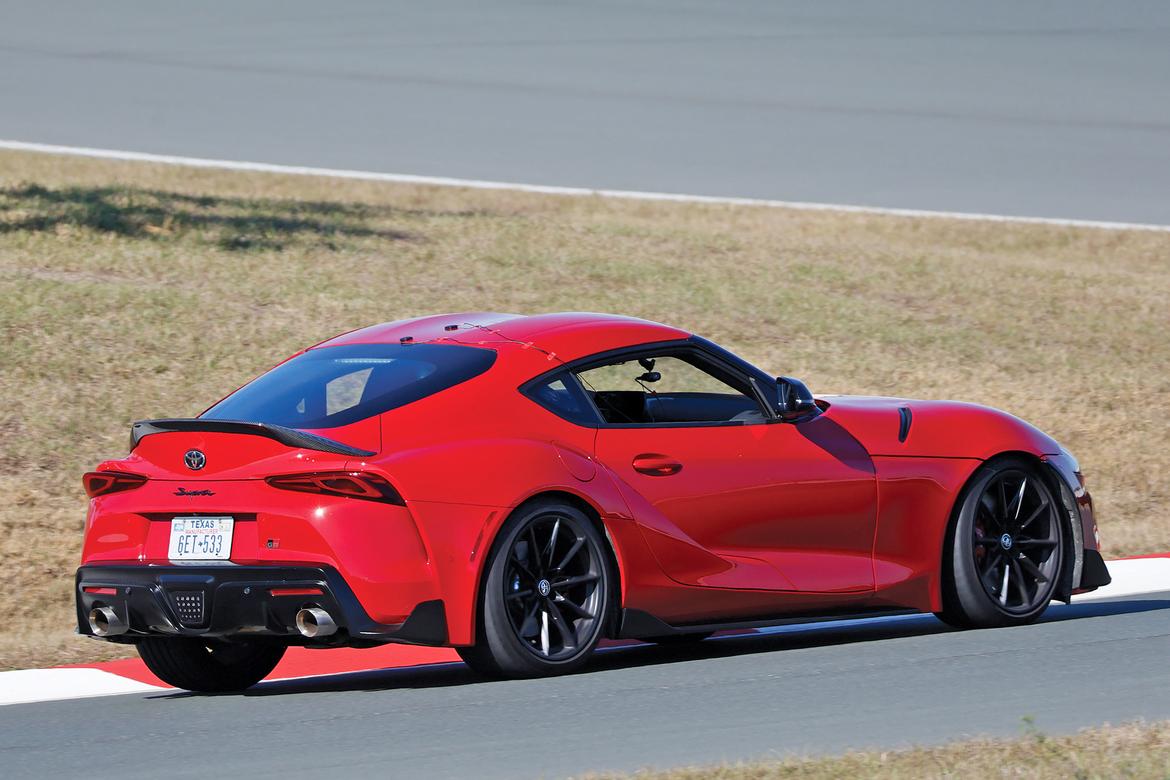
So what did we learn here from the data? Well, the times were a virtual dead heat, with a 1:28.33 best run for our BMW project and a 1:28.25 lap for the Supra–the fastest we’ve recorded so far at Circuit Florida.
On one hand, we’re impressed that the Supra can take down a similar, heavily prepped car in as-delivered condition. On the other hand, we’re also proud of our 435i, basically equaling the Final Edition Supra for a fraction of its $69,350 base MSRP.
Now think about making just a few simple modifications to that Supra. Heck, just a set of 200s and an alignment will drop loads of time and put it in supercar territory. Now consider how easy it is to coax an additional 50, 60 or even more power out of the Supra’s B58 engine. The ceiling on the Supra is stratospheric, and that’s a huge part of the appeal.
So we bid a fond farewell to an exceptional automobile, one of the most successful team-ups since Steve Rogers and Tony Stark set aside their petty differences and learned to work together. Okay, maybe a dude covering up that his best friend killed your parents isn’t exactly petty, but we’re glad BMW and Toyota gave us a look at what two titans can produce when they collaborate.
Does this Supra have weak points? Sure. The buffeting with the windows down is still borderline unacceptable, and it is, after all, a BMW, so it might not be nearly as tolerant of long-term neglect or deferred maintenance as your traditional Toyota products. Despite all this, we’re glad we got to experience it while it was here.
Now we’re faced with an uncertain future. The Supra, despite being about to disappear from showrooms, is still Toyota’s featured nameplate for high-profile racing series like GT4 and NASCAR Cup. Seems like that could get complicated without a replacement on the horizon anytime soon.
Will we have to wait another 22 years for the next car with a Supra badge to roll into local Toyota showrooms? Who knows. What we do know is that with every generation, this nameplate has shown it’s capable of truly exceptional things, so whatever the next Supra is–if there is one–it will have some big shoes to fill indeed.