
The 2025 season was beyond challenging for the Jets. It just didn’t work out with Justin Fields. He proceeded to rule over a dismal 3-14 campaign that saw Sauce Gardner, a cornerback they’d made the highest-paid at his position just months prior, traded away, packaged to Indianapolis in a teardown so complete it left little ambiguity about intent. Getting things right in the NFL draft woul do fo a
The Rebuild
In response, Geno Smith has been acquired from Las Vegas as the Raiders clear the way for the Heisman-winning National Champion Fernando Mendoza to take over as the face of the franchise at number one overall. He returns as a bridge option that did little to inspire much optimism, either with the MetLife Stadium faithful or online betting sites. The early NFL futures at Bovada make the Gang Green a whopping +650 outsider to reach the playoffs next season, the third longest odds of anybody behind the Miami Dolphins (+1000) and Arizona Cardinals (+1800).
Luckily, the front office seems acutely aware of just how far the Jets are behind the heaviest hitters in the AFC and has responded accordingly. The Big Apple outfit already had two first-round picks in the 2026 NFL draft following Gardner’s departure to Indianapolis. They would then surprisingly add a third to their arsenal when they traded with the San Francisco 49ers to secure the 30th overall pick, marking the second time in four years that they have had three picks in the opening round.
So, who did the Jets select, and what can we expect to see from each of them in 2026? Let’s take a look.
David Bailey, No. 2 Overall
David Bailey spent three seasons at Stanford, 29 career sacks across 46 games for the Cardinal, a true freshman who started from day one after choosing Palo Alto over Alabama and Penn State after being named state Defensive Player of the Year on a 12-0 championship team in high school. He was good at Stanford. Then he looked at his draft projections and decided good wasn’t enough.
The transfer to Texas Tech in 2025 was calculated. Lubbock gave him the schematic freedom and the volume of pass-rush opportunities he needed to prove what he already knew about himself. What followed was the most dominant individual edge season in recent college football memory: 14.5 sacks, co-leading all of FBS. Nineteen-and-a-half tackles for loss. Big 12 Defensive Lineman of the Year. AP First Team All-American. And here’s the number that makes all the others land harder, 81 pressures generated on 177 fewer pass-rush snaps than Rueben Bain Jr. Bailey didn’t accumulate those numbers through volume. He maximized every single opportunity he was given.
He walks into a Jets defensive room that allowed 36 touchdown passes in 2025, recorded zero interceptions, and finished 31st in the league in sacks. The void Bailey is attempting to fill is one of an outright identity crisis. Aaron Glenn’s defense has needed an anchor, an edge-setter who opposing offences genuinely have to plan around, and now they have their man.
Jets find their guy on D with David Bailey #2 💪
+205 ✅ pic.twitter.com/Ess5t6BX3q
— Bovada (@BovadaOfficial) April 24, 2026
Kenyon Sadiq, No. 16
When the Jets submitted their card at 16, most of the draft world had wide receivers penciled into that slot. Makai Lemon’s name circulated prominently among mock draft writers who thought they’d read the Jets’ room. Then Kenyon Sadiq’s name appeared on the screen, and the experts were forced to recalibrate in double-quick time.
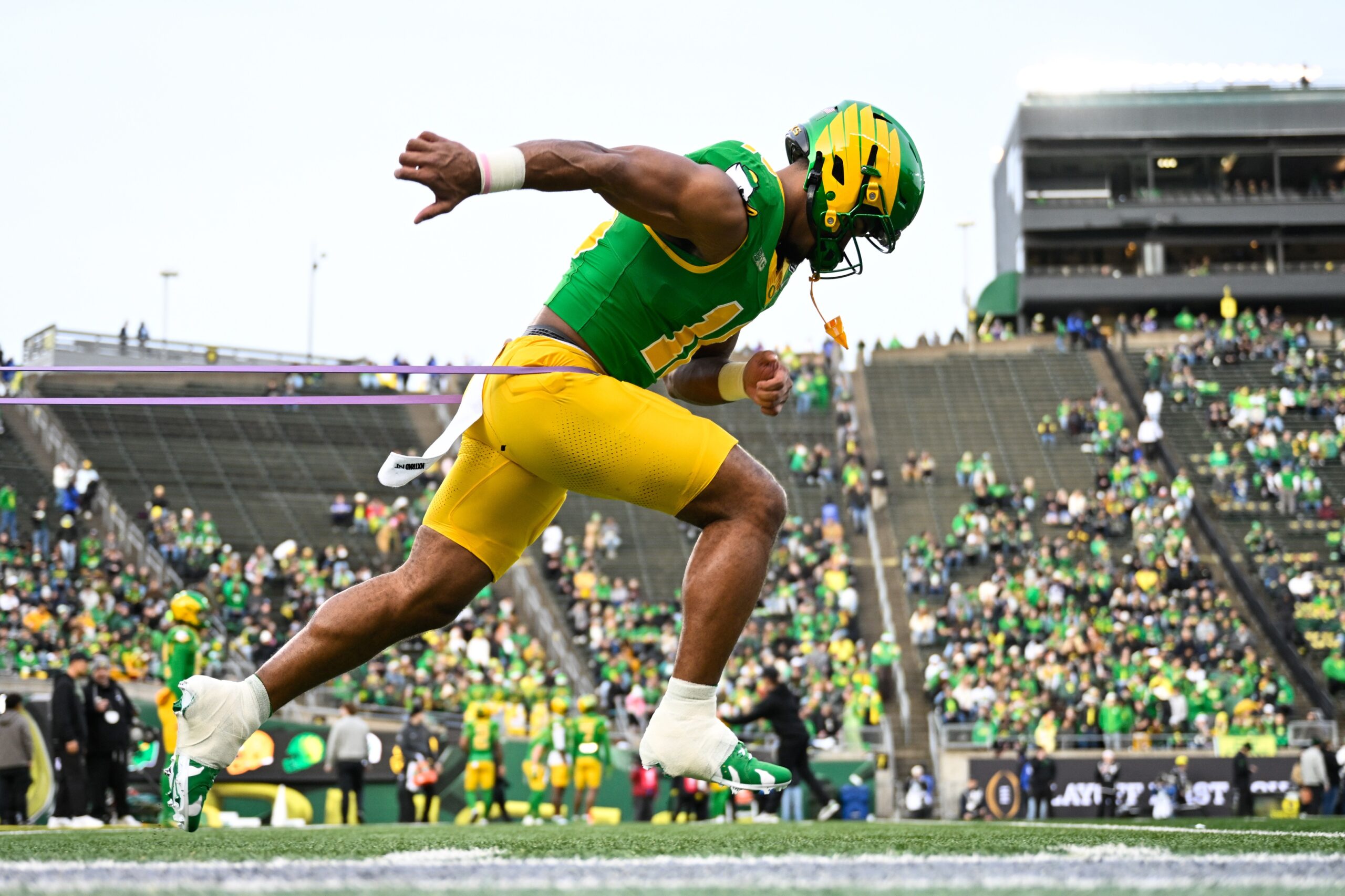
Instead of heading to the portal after just nine appearances and five catches in his freshman year, Sadiq stayed, developed within the program, and in 2025, he was rewarded for that patience. Fifty-One receptions for 560 yards and eight touchdowns, earning All-Big Ten First Team honors and the Ducks’ single-season record for catches by a tight end.
Then he ran a 4.39 at the Combine. From a 241-pound frame. A 43.5-inch vertical. Twenty-six bench-press reps. George Kittle comparisons were circulating before he’d shaken Roger Goodell’s hand, and for once, the comparison didn’t feel like hyperbole.
Pick 16 only existed because GM Darren Mougey turned Sauce Gardner into draft capital; the cornerback’s departure to Indianapolis generated the Colts’ 2026 first, which became this selection. That’s roster construction. You absorb the emotional difficulty of moving a franchise cornerstone, you convert the pain into assets, and you use those assets to land a potential franchise tight end who changes the mathematical problem defenses face on third down.
Sadiq’s formation versatility means you can’t pre-align your safety to the tight end spot and cheat coverage toward Garrett Wilson. You have to account for both of them. Every snap. That’s not a small thing for returning QB Geno Smith.
Omar Cooper Jr., No. 30
The Jets didn’t stumble into Omar Cooper Jr. They refused to let him leave the first round. The Jets traded back in surrendering Pick 33 and a fifth-round compensatory selection to San Francisco because they’d identified their target and weren’t willing to watch him disappear before they got the chance to claim him for themselves. That aggression is the opposite of sixteen years of reactive, passive draft-room culture. It’s the kind of move that tells you how a front office thinks.
Cooper is a kid from Indianapolis who attended Lawrence North High School, helped them claim their first sectional championship since 1990, stayed home when he could have gone anywhere, enrolled at Indiana, and repaid that loyalty with one of the great individual seasons in Hoosiers history. In 2025, on a 16-0 national championship team, he led Indiana with 69 receptions for 937 yards and 13 touchdowns, tied for third-most in FBS. Career: 115 catches, 1,798 yards, 22 touchdowns across 42 appearances, including a 75-yard rushing score that underlined the big-play upside you’re really drafting.
Now picture what Geno Smith’s weekly preparation looks like from a defensive coordinator’s desk. Wilson aligned outside. Cooper in the slot, running vertical stacks through zone coverage and pressing man with his short-area quickness. Sadiq flexed out from the formation, demanding linebacker attention on every route. Pick one to cheat toward. There isn’t a good answer, and that’s precisely the point. Bailey rushes the passer. Sadiq stresses linebackers. Cooper stretches the field. In one night, the Jets built something that looks like an actual offence and an actual defense simultaneously.