
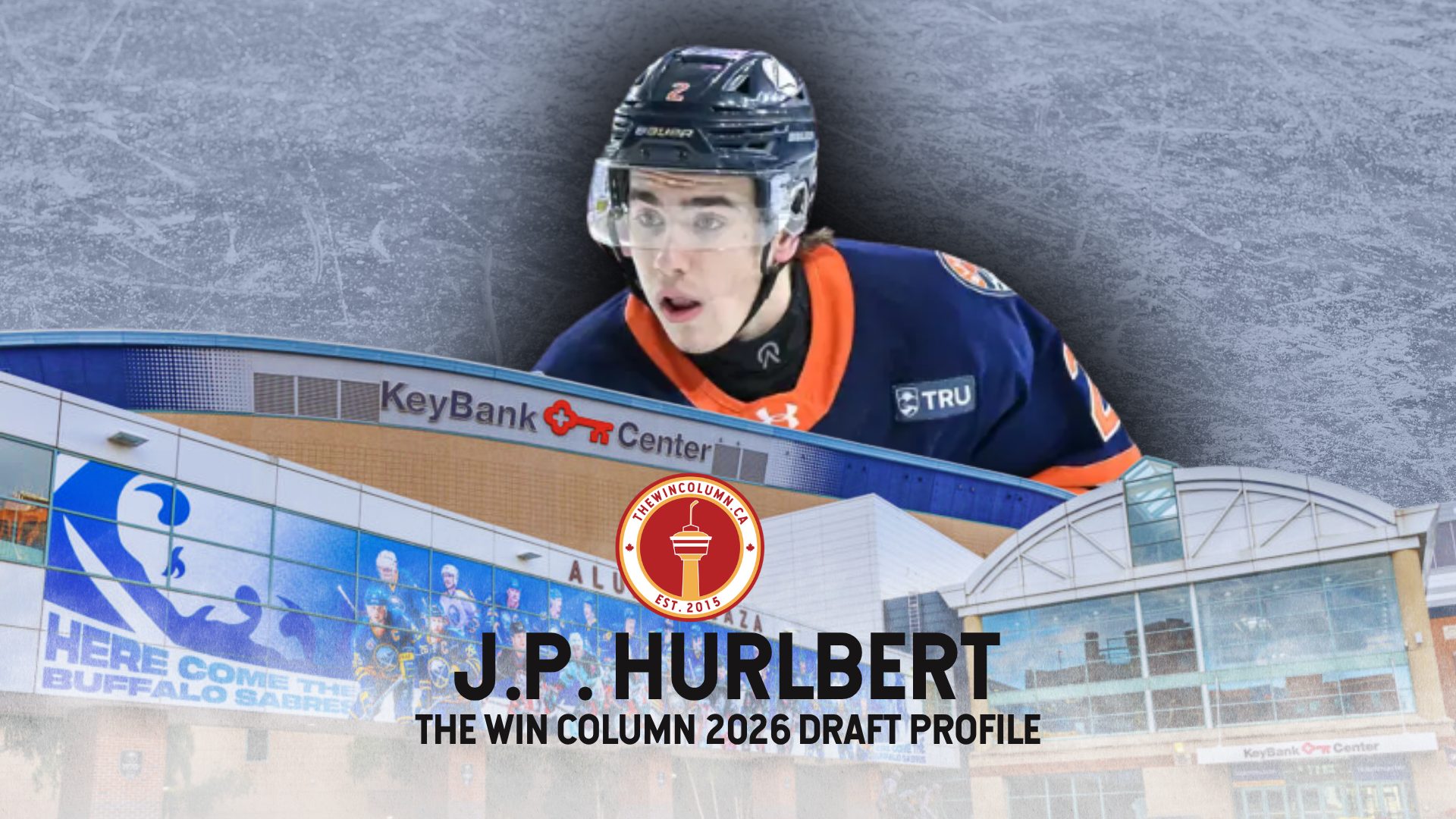
It’s that time of the year for The Win Column’s NHL Draft Rankings and Draft Profiles! Earlier on, we released the TWC consolidated 2026 NHL Draft rankings. The 2026 NHL Draft will take place on June 26 and 27 in Buffalo.
Placing 20th on our consolidated rankings is American forward J.P. Hurlbert. Hurlbert opted to sign in the WHL and leave USNTDP right before the season began. This choice led to Hurlbert being one of the top scorers in the WHL.
Who is J.P. Hurlbert?
| Player | Position | Shoots | Height | Weight | Nationality | Ranking |
|---|---|---|---|---|---|---|
| J.P. Hurlbert | C/RW | Right | 6’0″ / 183cm | 183lbs / 83kg | USA | TWC Rank #20 / CS NA #12 |
Being a product of Allen, Texas, Hurlbert developed his talent in the Texas youth hockey program. From the time he was 12-years-old, up until he was 16, Hurlbert produced with the Dallas Stars Elite AAA team. Just last season, he made the jump to the USHL with the USNTDP, planning to go the college route. However, with the new CHL/NCAA agreement, Hurlbert signed with his WHL team, the Kamloops Blazers, right before preparation for the 2025–26 season began.
Hurlbert’s on-ice production
| Year | Draft Rel. | League | Team | GP | G | A | P | P/GP |
|---|---|---|---|---|---|---|---|---|
| 2020-21 | D-5 | 14U AA | Dallas Stars Elite 13U AAA | 20 | 20 | 12 | 32 | 1.6 |
| 2021-22 | D-4 | T1EHL 14U | Dallas Stars Elite 14U AAA | 9 | 4 | 6 | 10 | 1.11 |
| 2022-23 | D-3 | T1EHL 14U | Dallas Stars Elite 14U AAA | 4 | 6 | 1 | 7 | 1.75 |
| 14U AAA | Dallas Stars Elite 14U AAA | 75 | 112 | 83 | 195 | 2.6 | ||
| 2023-24 | D-2 | T1EHL 16U | Dallas Stars Elite 16U AAA | 12 | 4 | 8 | 12 | 1.0 |
| 16U AAA | Dallas Stars Elite 16U AAA | 45 | 40 | 36 | 76 | 1.69 | ||
| 2024-25 | D-1 | NTDP | U.S. National U17 Team | 56 | 19 | 18 | 37 | 0.66 |
| USHL | USNTDP Juniors | 34 | 16 | 15 | 31 | 0.91 | ||
| 2025–26 | D+0 | WHL | Kamloops Blazers | 68 | 42 | 55 | 97 | 1.43 |
Joining the Kamloops Blazers proved to be a great decision for Hurlbert in terms of his draft stock. Across a full 68-game season, Hurlbert produced 42 goals and 97 points, placing him 1st on the team in all categories. In addition, Hurlbert also finished 4th in the league for points and goals. The high point totals and impact he made for the Blazers ended with Hurlbert winning rookie of the year in the WHL.
The playoffs weren’t as pretty as the regular season, as the Hurlbert and the Blazers would lose in four games to the Kelowna Rockets. Hurlbert would only produce three points in those games. Heading into the 2026–27 season, Hurlbert’s WHL career has ended as he is committed to the University of Michigan.
Hurlbert’s strengths
Passing
One area of the game in which Hurlbert has success is his playmaking abilities. Hurlbert brings a good arsenal of passes and some solid visions. I find that Hurlbert typically settles for simpler and more effective passes rather than trying for incredibly flashy ones. More often than not, Hurlbert is continuing the play with simple give-and-gos, strategic one-touch passes, or drop-backs within close distance to his teammates. He has moments where he attempts something flashier as well. I’ve seen Hurlbert make some nice tape-to-tape zone passes or spot a teammate in the slot after moving around the zone.
Shooting
Another trait Hurlbert has as a strength is his shot. Although I didn’t get the best look at it in my viewings, Hurlbert possesses a pretty valuable wrist shot. It’s quick and accurate, and can also have some snap to it. Hurlbert does a good job of placing himself in positions to make this shot a weapon. Whether it be on the left or right side, when Hurlbert has space, he can pose his body to threaten a laser to the net. I also noticed that Hurlbert can settle the puck quite smoothly. This definitely helps in certain situations for him to get off this wrist shot faster and in a more deadly manner.
Offensive sense
Rounding off the strengths of Hurlbert’s game would be his sense on the offensive end. Hurlbert has quite a good idea of where to position himself to create an offensive opportunity. When attacking with a puck carrier, he keeps his body in an open manner, prepared to receive the puck and wire a shot as soon as possible. He also does well at moving into space to generate a high-danger chance. Moving around the net, Hurlbert can silently find space in threatening areas such as the slot. This allows him to be in a prime position for rebounds, back-door passes, or to make said back-door passes.
Hurlbert also has a good read on which type of pass to make. As mentioned earlier, Hurlbert often opts for simple and effective passes. Typically, this allows him to find more success in his passing than the more obscure options, and keeps the attack flowing.
Hurlbert’s areas of improvement
Pace
When it came to Hurlbert’s skating, it was really odd for me. He skates with solid mechanics, good explosiveness, a decent stride, and looks like he should be nimble on his feet. However, he just seems to play the game in a slow fashion. I found that if he has steps on an opponent, he gets caught because he just doesn’t seem to be moving fast enough. He’s not the type of player in the offensive zone to be moving side to side and becoming difficult to keep track of. He sort of slowly waits, sometimes glides, instead of driving the play himself.
In the defensive end, I certainly noticed his leisurely glide. Often, he doesn’t really seem to have any urgency when in the defensive zone, and doesn’t pounce to clear or take away the puck either. Sometimes it can be a bit frustrating because if he just added a bit more pace in the offensive or defensive end, or in the transition, the play might’ve gone his way and created danger.
Physical engagement
Another trait of Hurlbert that I wasn’t too fond of is his approach to physicality. Frequently, Hurlbert would add no pressure at all to the physical battle. He’d enter into board battles softly and get easily pushed around or stripped of the puck. The inability he seems to possess concerning physicality causes him to rush the play and get the puck off his stick instantly. I find this to be the most prominent when he is in charge of the breakout. He’ll opt for passes that get intercepted or useless dump-ins. Another gripe I have with Hurlbert’s physical approach is that he can have the body advantage on an opponent, and then do nothing with it and lose that advantage in a frustrating fashion.
Hurlbert’s comparables
I think the best comparison I can make for Hurlbert is Vancouver Canucks winger, Brock Boeser. In a similar sense to Hurlbert, Boeser plays a dual-threat style in the offensive zone that leads more towards a quick and accurate wrist shot. He brings a good overall sense of the offensive side of the puck as well. Boeser isn’t a very fast player either. Struggling in playing with pace and some engagement are other similarities I think Hurlbert and Boeser share.
Fit with the Flames
| Organizational need addressed | Right-shot forward |
| Realistic pick range | 18-25 |
| NHL timeline | 2-3 seasons |
| Flames fit verdict | Possible fit |
Concerning a fit within the Flames organization, I think there’s a decent possibility you could see a match come draft day. Hurlbert projects as a winger, which the Flames have plenty of. However, outside of Matt Coronato and Ethan Wyttenbach, the young pieces of the Flames’ forwards seem lacking in terms of right-shot guys. Matvei Gridin, Cole Reschny, Cullen Potter, and many more all shoot left in the system. So, adding a right shot forward would bring some variety, despite it not necessarily being a match positionally.
Adding to the possibility of a fit would be the Vegas Golden Knights’ first-round pick that the Flames own. Unless the Golden Knights go to the conference finals, their pick for the Flames should be in the 20s. This is right around the same spot that Hurlbert seems to be projected to be drafted. Hurlbert seems like the type of player the current Flames would draft, so it would not surprise me to have them be a match come the day of the draft.
Summary
J.P. Hurlbert is a dual-threat capable winger who lit up the scoresheet in the WHL this year, leading him to capture the rookie of the year award. The Texas native produced an astonishing 97 points thanks to a good skillset of playmaking, shooting, and offensive sense. He still has some quirks that he needs to work out, such as playing with pace and how he approaches physicality. I think most likely, Hurlbert ends up as a solid scorer in a team’s middle-six. There’s probably a top-six forward in there somewhere, but some off-puck habits may hold him back.