
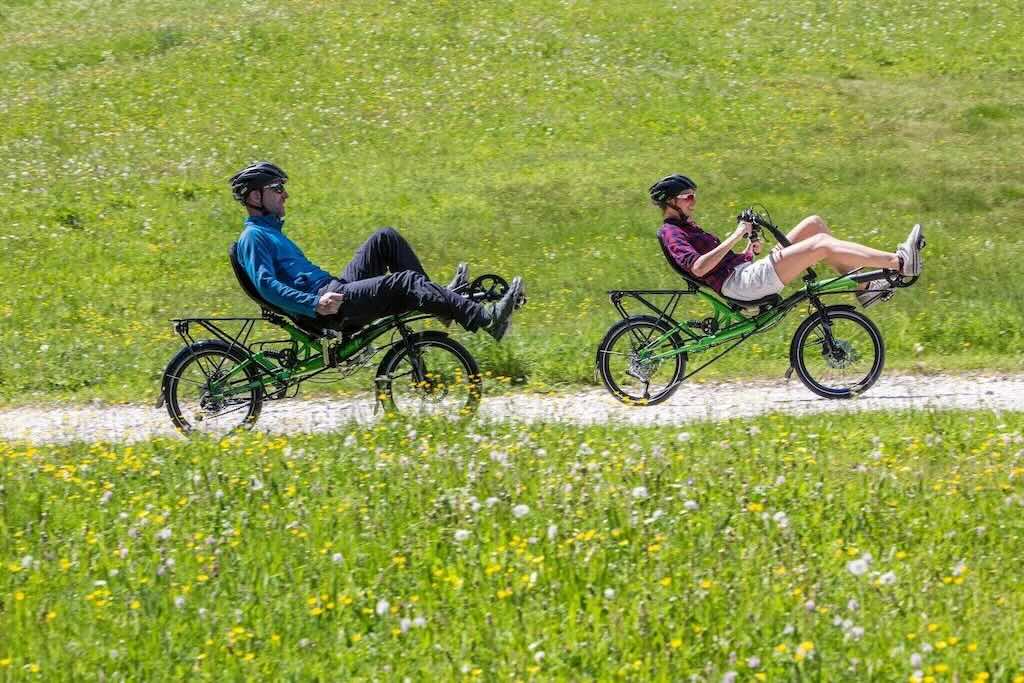
The first time you see someone on a recumbent, it looks a little strange—like a lawn chair that decided to join traffic. Then they glide past you. Effortless. Relaxed. Smiling. Meanwhile, you’re hunched over your handlebars, wondering what they’ve figured out that you haven’t.
Recumbent bikes flip the script. You sit back, legs stretched forward, eyes up, and suddenly cycling feels less like a grind and more like gliding.
Whether you’re rolling along a waterfront trail, commuting across town, or chasing distance records, recumbents offer a distinct blend of comfort, efficiency, and just enough quirkiness to make every ride feel interesting.
Recumbent trike from Sun Seeker Bicycles
So what exactly is a recumbent bike?
Picture a bike where you’re not perched on top, but settled into it. A recumbent bicycle places you in a reclined seat with full back support, and the pedals are out in front of you instead of beneath you. The result is a riding position that spreads your weight across your back and hips instead of dumping it onto your hands and saddle.
That one change solves a lot of the usual complaints. Less pressure on wrists, less strain on your neck, and far fewer reasons to stand up mid-ride just to get comfortable again. The lower center of gravity also gives the bike a planted, stable feel—especially once you’re moving.
A quick (and accurate) trip through history
Recumbents might look futuristic, but they’ve been around for more than a century. Early designs appeared in the late 1800s, but things got serious in the 1930s when French designer Charles Mochet built streamlined, reclined bikes that were dramatically faster than traditional uprights.
In 1933, cyclist Francis Faure used one of Mochet’s bikes to break the hour distance record, outpacing conventional bicycles of the time. That performance was so disruptive that cycling’s governing body eventually banned recumbents from official competitions—not because they were unsafe, but because they were too different.
Interest in recumbents surged again in the 1970s alongside broader cycling innovation, and today they occupy a niche that blends performance engineering, accessibility, and long-distance comfort.
Not all recumbents are the same
Spend five minutes around recumbent riders and you’ll realize there’s no single “look.” Some resemble stretched-out road bikes, others look like futuristic lounge chairs on wheels, and some have three wheels and zero interest in balancing.
Two-wheeled recumbents tend to fall into two camps. Long wheelbase designs stretch things out, placing the front wheel farther ahead and delivering a smooth, stable ride that’s ideal for touring. Short wheelbase models are more compact and responsive, which makes them better suited for tighter spaces and quicker handling.
Then there are trikes—three-wheeled recumbents that remove balance from the equation entirely. They’re incredibly stable, surprisingly quick in corners, and a favorite for riders who want confidence at any speed, including a full stop.
You’ll also find tandem recumbents for shared riding, handcycles powered by arm cranks instead of pedals, and electric-assist versions that make hills and long distances far more approachable. At the far end of the spectrum sit velomobiles—fully enclosed, aerodynamic machines that look like something between a bicycle and a tiny spaceship, built for speed and weather protection.
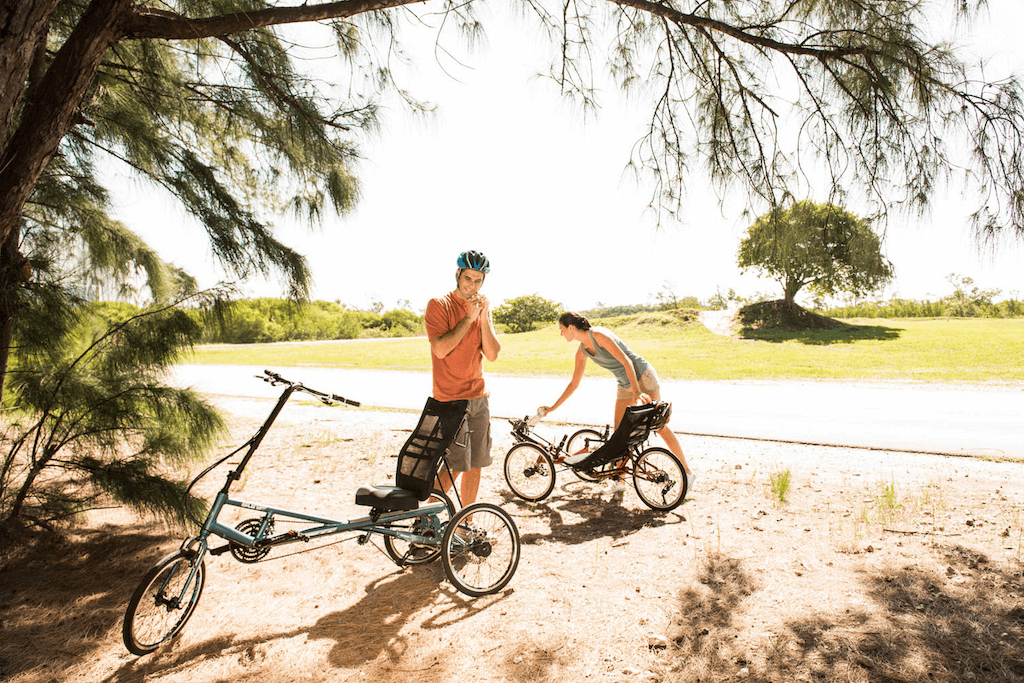
Recumbents from Sun Seeker Bicycles
Why people fall in love with them
Comfort is the headline, but it’s not the whole story. Because you’re reclined, your body presents less frontal area to the wind, which can make recumbents impressively efficient—especially on flat terrain. That’s why they’ve carved out a following among endurance riders and speed enthusiasts.
They’re also a game-changer for people who struggle with traditional bikes. Riders with back, neck, or wrist issues often find they can ride longer and more often without pain. Trikes, in particular, open the door for those who have balance concerns but still want the freedom of cycling.
And then there’s the simple joy factor. Riding low to the ground with a clear forward view feels different—in a good way. It’s relaxed, a little unconventional, and often a conversation starter at every stoplight.
The trade-offs (because there are always some)
Recumbents aren’t perfect, and pretending otherwise doesn’t help anyone. They can be harder to maneuver at very low speeds, especially two-wheeled versions while you’re learning. Their lower profile can make them less visible in traffic, which is why many riders use flags, lights, and bright gear.
They also tend to cost more than entry-level upright bikes, and transporting them—especially long wheelbase models or trikes—can take a bit more planning.
Most importantly, there’s a learning curve. The first ride might feel unusual, even wobbly. But give it a little time and your muscle memory catches up surprisingly quickly.
Safety and real-world riding
In many ways, recumbents are as safe as traditional bikes, and sometimes more stable at speed thanks to that low center of gravity. Your head position is naturally upright, which can improve your field of vision compared to being hunched over drop bars.
The biggest adjustment is awareness—both yours and everyone else’s. Being lower means you need to be proactive about visibility, especially in urban environments. Lights, flags, and smart route choices go a long way.
The bottom line
Recumbent bikes aren’t trying to replace traditional bicycles—they’re offering a different way to ride. For some people, they’re a curiosity. For others, they’re the only style of bike they’ll ever want to use again.
And if you ever find yourself watching one roll past—rider reclined, spinning smoothly, looking like they’re barely trying—you might start to wonder whether comfort isn’t just a luxury in cycling, but the whole point.
Here are 10 more reasons to buy a recumbent bicycle.