
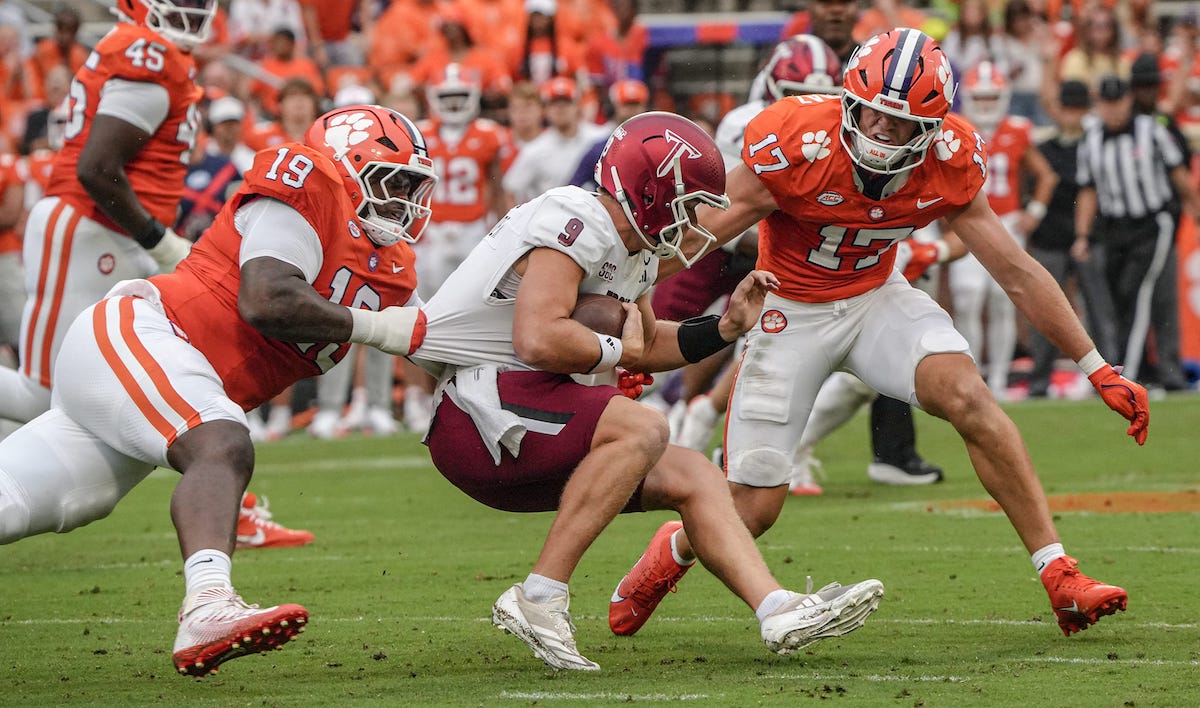
It’s not common for Day 3 picks to contribute in their first year in the NFL. Fifth- through seventh-rounders are usually fighting for roster spots and proving their worth on special teams – not carving out roles as a key part of a team’s two-deep depth chart. Bucs rookie defensive tackle DeMonte Capehart may break that mold.
Tampa Bay spent a fifth-round pick on a 6-foot-5, 313-pound interior defensive lineman out of Clemson, and the easy story to write is about a Day 3 nose tackle who may be a developmental piece where you hope to see him contribute in a small way by 2027. But after watching him against Georgia in 2024, and Louisville and Georgia State this year, that’s not what I see.
Capehart is closer to a Week 1 contributor than his draft slot suggests, and the reasons are specific.
Two themes carry the Capehart evaluation. He’s positionally versatile in a way most nose tackles aren’t, and he’s a quick-twitched athlete with the strength and power to play the position at an NFL level right now.
The pass-rush ceiling is a separate conversation. His production was low in college, but there may be more upside on the way that fits his athletic profile.
DeMonte Capehart’s Anchor Is Already There
Let’s start with what doesn’t need projection. DeMonte Capehart’s anchor is a finished product. He holds the point against doubles and doesn’t get bullied one-on-one. His upper-body strength shows up on every snap that asks him to two-gap. Against wide zone runs, Capehart requires a second blocker to keep him out of the backfield. And when he gets singled up there, he’s denting the line.
Demonte Capehart. Strong hands/anchor then the quick transition and lateral mobility for the run stuff.
Think #Bucs fans are going to like what he has to offer strengthening the depth of the DL. pic.twitter.com/NPI48laPQH
— Josh Queipo (@JoshQueipo_NFL) May 3, 2026
The athletic profile is the part that separates him from the typical fifth-round interior body. Capehart has rare lateral mobility for a player his size. He keeps his eyes in the backfield and processes well, which is why the lateral mobility translates into actual run defense rather than just movement skills on paper. That combination, anchor, processing, and lateral range, is the floor. Even if nothing else develops, that’s a rotational run-down player on a roster that is going through a two-year turnover in the defensive line room.
Love this rep from Demonte Capehart.
Keeps his eyes in the backfield and works horizontally without losing leverage. Works through to disengage and the burst to track down the back.
Not many noses move like this. pic.twitter.com/D2tFf4AHRz
— Josh Queipo (@JoshQueipo_NFL) May 3, 2026
The secondary athletic traits show up in the get-off. Capehart’s first step is genuinely fast off the snap, and his hand usage is already pro-ready: strong punch, good placement, an uppercut to clear hands when he needs to disengage as a pass rusher. His pad level can get high, and Capehart will need to work on that. But he’s not learning how to use his length – he’s already doing it.
DeMonte Capehart’s Positional Versatility With The Bucs
Versatility is one of the most overused words in draft coverage, but in DeMonte Capehart’s case the alignment range is real and it’s wide. On the three games of tape, he played heads-up over the center, in a shade, at 3-technique, at 4i. That’s a near-full interior alignment range, which is unusual for a player listed as a nose. It’s also the kind of flex that fits the way Todd Bowles deploys his front where Capehart will be deployed similarly and potentially even further out to a 5-tech spot.
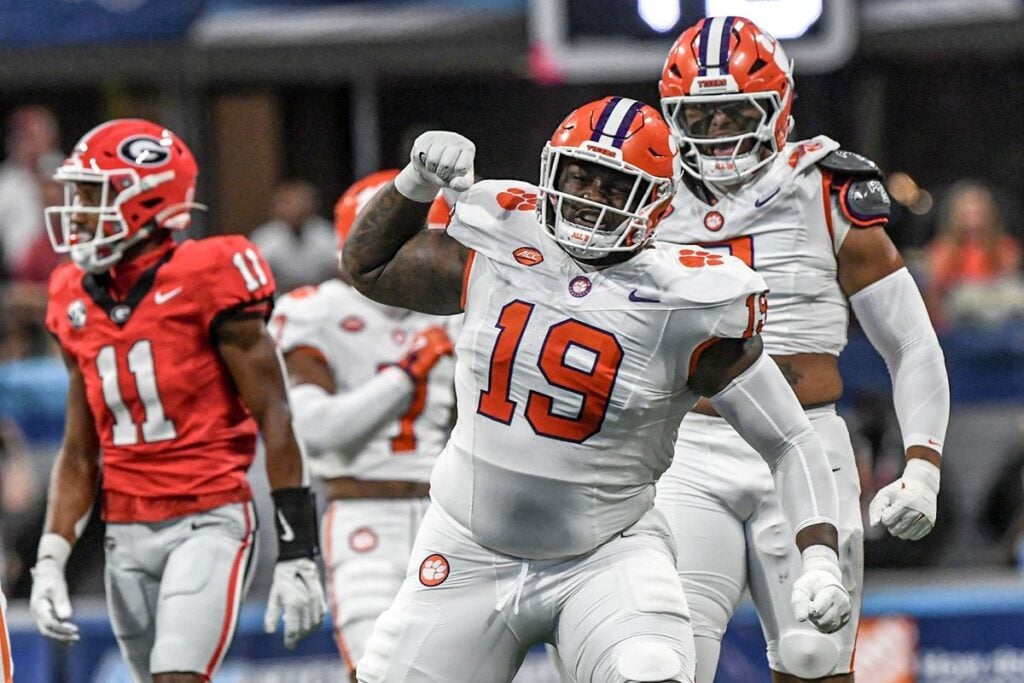
Clemson DT DeMonte Capehart – Photo by: IMAGN Images – Ken Ruinard
The Bucs don’t run a static defense. They move bodies, they disguise looks, and they ask interior players to fit different roles snap-to-snap rather than sitting in one gap and reading. A player who can line up across five spots and execute the same job description well at each of them is more valuable in that scheme than a pure 0-technique who has to come off the field when the call changes.
Capehart’s run defense doesn’t fall off when he kicks outside, and his anchor doesn’t get exposed when he shades. That’s not common from a Day 3 pick.
The other piece of the versatility argument is scheme buy-in. The notes that stand out most across three games are the ones that show up on stunts and twists. Capehart will sell out for the call. He loops well, he gets to his landmarks, and Capehart doesn’t half-rep the assignment when he’s the decoy rather than the finisher. For a defense that uses stunts as a primary pass-rush mechanism, that’s a player you can put on the field with confidence.
Pass Rush – The Right Now And The Potential
Here’s where the evaluation gets interesting. DeMonte Capehart’s pass-rush repertoire is limited. He wins on get-off and power, pushes the pocket. But that’s most of what’s on the menu…right now. There aren’t a lot of counters, and on obvious passing downs at Clemson he came off the field. That’s the surface read.
But part of the reason why his pass rush production was light in college – just three sacks and 34 pressures over 57 games – came down to how Clemson utilized him. The specific coaching tips they were asking him to execute related to his first step and burst. They asked him to launch horizontally, jumping a gap or attacking the gap rather than running through the man he was lined up over more often than not. That hampers his ability to win with speed off the snap and get into the pocket early.
Bucs assistant general manager Rob McCartney may have been referring to that when he spoke about Capehart’s pass rush upside. When I asked him if they could unlock more out of him by moving him away from the nose more often, McCartney went in a different direction.
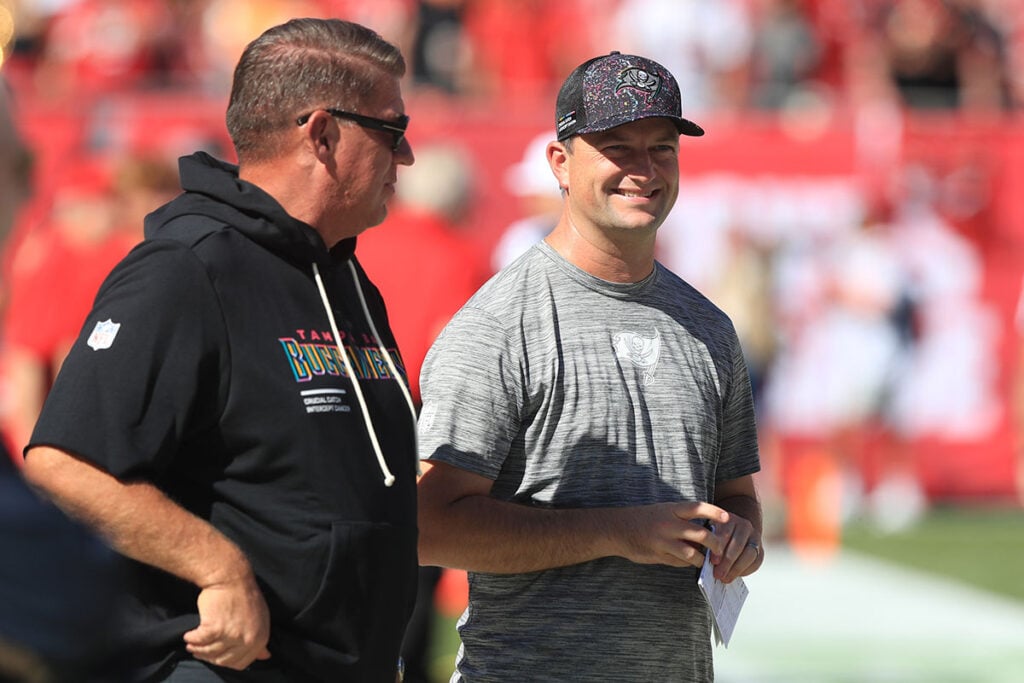
Bucs GM Jason Licht and assistant GM Rob McCartney – Photo by: Cliff Welch/PR
“You see glimpses of it [his athleticism], and you see him work out and he’s a guy that also made you go back and watch,” McCartney said. “You see just his ability to uncoil his hips. He’s got really long arms, he’s explosive. So, with straight ahead power I think similar kind of like A’Shawn [Robinson] and Vita [Vea], like he’s going to be able to walk you back in the pocket. I don’t know if moving him farther away from the ball is going to accentuate. I think there’s stuff we can do with him to help him.
“But I think one-on-ones, his ability to have power and just have pure knockback was one of the better ones in the draft. So, I think accentuating that and kind of giving him some options to work off of that is going to help.”
That’s a specific development plan that can yield real results. Ask Capehart to fire straight forward, rather than horizontally and he can beat centers to engagement post-snap and then overwhelm them with power. Speed-to-power. You hear it referred to a lot. You can also see both traits in Capehart. The unlock is linking the two together.
When he gets a clean rep, Capehart can dent the pocket. The issue isn’t that the power doesn’t translate. It’s that there’s no second move when the first one doesn’t immediately win. Can he build counters off the bull rush threat and the same get-off that already wins against the run? That’s where most tools-y projects never develop.
Beyond The Individual Player – Working Within The Team Concept
The part that likely gets undersold is how much DeMonte Capehart helps the defense even when he isn’t the one finishing the play. Todd Bowles runs a stunt-heavy scheme, and stunts produce sacks for the stunter’s partner more often than for the stunter himself. The player crashing inside is creating the win. Somebody else is collecting the credit.
Between Capehart, Josiah Trotter, Rueben Bain Jr. and Keionte Scott the Bucs seemed to target downhill players in the draft who can elevate those around them by executing the chaos-approach well. Everyone contributes to the plan. Everyone eats in the aggregate.
Capehart is built for that role. He has the get-off to make a stunt actually function on time, the lateral mobility to loop without losing rush integrity, and the strength to push through contact when his job is to occupy a blocker rather than beat one.
Contributing Right Away
The Bucs’ interior defensive line has a clear shape. Vita Vea is the centerpiece. Calijah Kancey is the disruptor at 3-technique. A’Shawn Robinson is the starter at 4i in the 3-4 base defense. The rotational snaps behind them are where DeMonte Capehart competes, and his alignment range is the argument for getting on the field early. He can spell Vea at nose, slide to 3-technique on a sub-package, or kick out to 4i or 5 in heavier looks. He doesn’t need a specific personnel grouping to get him on the field.
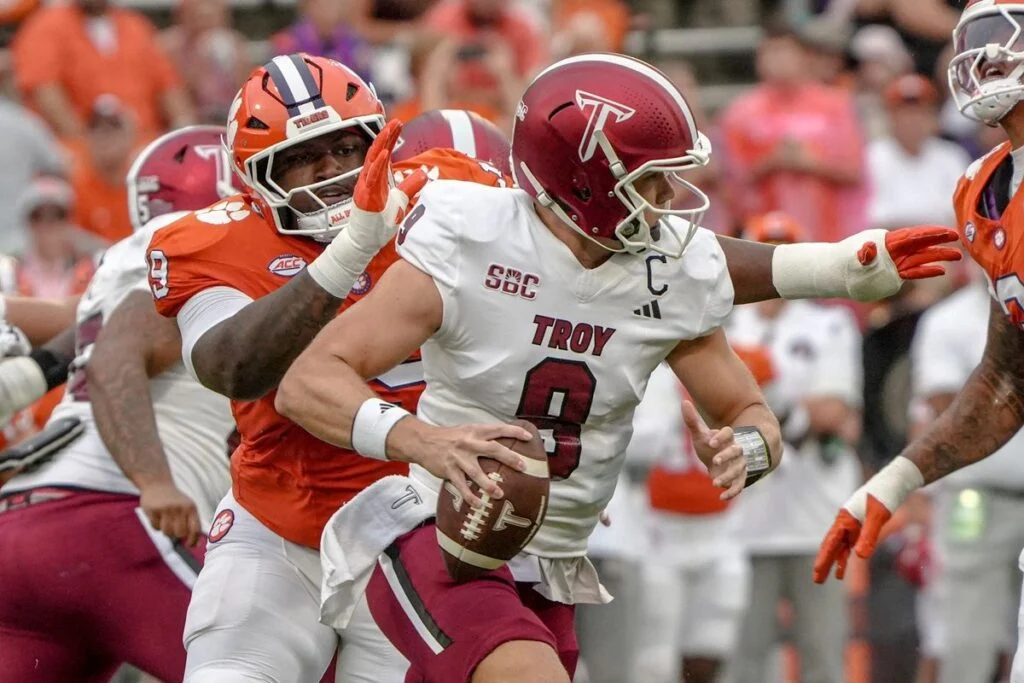
Clemson DT DeMonte Capehart – Photo by: IMAGN Images – Ken Ruinard
Capehart can play in 2026. Give him 15-25 snaps a game and he will provide high-level play fitting the run while helping teammates tee off against the pass. Let him build on the anchor and the scheme buy-in he already has and see how the counter-development work compounds by year two. The floor is a rotational interior piece who holds up against doubles. The ceiling is a 40-snap player who contributes to the stunt game and starts collecting actual pressures himself if the vertical first step and secondary counters develop.
McCartney comped him Robinson and Vea in terms of his power. The Bucs didn’t draft a project. They drafted a player with a clear job description, a plan to expand it, and the athletic and physical tools to execute both.
Capehart is ready to contribute in 2026. The question worth tracking is how much that contribution grows by 2027.