
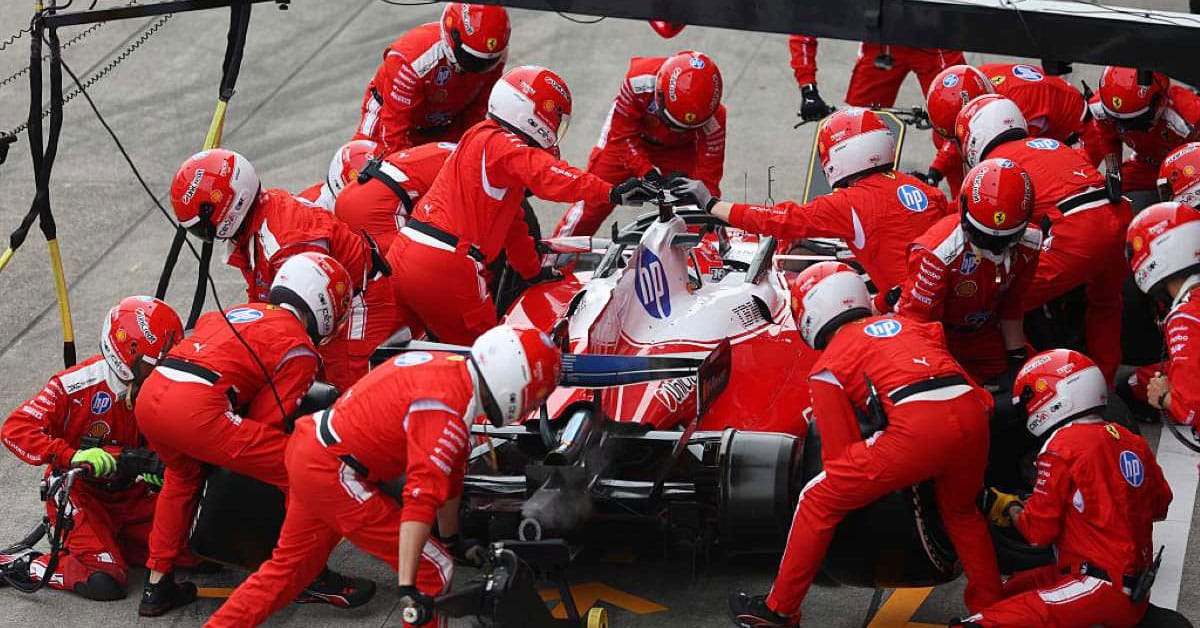
Ferrari introduced one of the most extensive aerodynamic upgrade packages of the 2026 Formula 1 season at the Miami Grand Prix, bringing a total of eleven changes to the SF-26 as officially declared in FIA technical submissions. The update represents a significant recalibration of the car’s aerodynamic philosophy, with developments applied across multiple areas from the front wing to the rear diffuser.
While the package affects the entire aerodynamic structure of the SF-26 driven by Lewis Hamilton and Charles Leclerc, the most substantial focus of Ferrari’s development work has clearly been concentrated on the rear section of the car, where efficiency and downforce generation play a decisive role in overall performance.
Front wing redesign improves airflow direction to mid-section of Ferrari SF-26
One of the first visible updates on the Ferrari SF-26 concerns the front wing endplates, which now feature a revised curvature in their vertical profile. This adjustment is designed to significantly influence how airflow is guided from the front of the car towards the central aerodynamic structures.
The revised geometry plays a key role in directing airflow towards the bargeboard region and sidepod area, improving how air is conditioned before it interacts with the mid-section of the car. This results in a more controlled airflow structure feeding both the mid-body and sidepod inlets, enhancing aerodynamic stability.
Overhauled bargeboards and improved turbulence management
Ferrari has introduced a heavily revised bargeboard concept, with major changes to the deflectors positioned ahead of the sidepods. One of the most significant developments is the separation of vertical and horizontal elements through a full-length slot gap, effectively doubling the vertical structure in this area.
This configuration is designed to better manage airflow generated by the front tyres, pushing turbulence further outboard while maintaining a cleaner aerodynamic pathway along the car’s flanks. For Lewis Hamilton and Charles Leclerc, this should translate into a more stable aerodynamic platform through high-speed cornering sequences.
In addition, the revised design helps stabilise the overall aerodynamic map of the SF-26, ensuring more consistent downforce distribution across varying cornering conditions.
Sidepod and undercut revisions enhance rear aerodynamic load
Further updates have been applied to the sidepod inlet geometry and the undercut section, which forms the channel between the sidepods and the floor of the Ferrari SF-26. These changes are aimed at improving airflow conditioning as it travels towards the rear of the car.
By optimising how air is guided along the inner surfaces of the sidepods, Ferrari aims to increase aerodynamic load at the rear axle. This development works in combination with revised floor geometry to improve overall rear stability and traction.
Floor edge and diffuser updates focus on airflow extraction efficiency
The floor of the SF-26 has also undergone significant revision, particularly in the region ahead of the rear wheels. This area now transitions into a redesigned central diffuser section, featuring an enlarged outlet designed to improve airflow expansion and extraction.
These modifications are primarily focused on increasing aerodynamic efficiency at the rear of the car, where even small gains in airflow management can have a major impact on overall lap time performance for Lewis Hamilton and Charles Leclerc.
Extended rear brake duct vanes improve diffuser flow structure
One of the more technically advanced additions to the Ferrari SF-26 is the introduction of extended vertical vanes integrated into the rear brake duct region. These elements effectively split diffuser airflow into two lateral channels, improving flow organisation at the rear of the car.
The extended brake duct design also creates an additional airflow channel between the outer edge of the diffuser and the brake cooling structures, increasing air velocity at the exit point and enhancing overall aerodynamic extraction efficiency.
“Macarena” rear wing brings advanced stall and efficiency control
Perhaps the most highly anticipated element of the Miami upgrade package is the revised rear wing concept, commonly referred to as the “Macarena” wing. This component has undergone extensive validation throughout the season, including testing during free practice sessions earlier in the year.
The final specification reflects a highly refined aerodynamic solution, particularly in the endplate area, where integrated actuators now allow for precise adjustment of wing profiles under different conditions.
The lower wing element has also been revised, but the most significant innovation lies in the FTM structure — a sculpted fin with a pronounced central concavity positioned behind the exhaust outlet. This feature is designed to promote controlled rear wing stall on straights while simultaneously improving diffuser airflow extraction.
Overall aerodynamic impact of Ferrari SF-26 Miami upgrade package
When combined, these eleven upgrades represent a comprehensive aerodynamic recalibration of the Ferrari SF-26 platform. The updates improve efficiency across both upper and lower surfaces of the car, with particular emphasis on optimising diffuser performance and rear-end stability.
The result is a measurable increase in downforce generation potential, as well as improved airflow control across multiple operating conditions. For Lewis Hamilton and Charles Leclerc, these developments are intended to provide a more stable and predictable aerodynamic platform, particularly in high-speed and traction-sensitive sections of a Grand Prix weekend.
Let other Scuderia Fans know about us


