
Note: All stats courtesy of TennisViz and Courtside Advantage
Jannik Sinner defeated Alexander Zverev 6/1 6/2 in the final of the Madrid Masters on Sunday to clinch a record-breaking fifth straight Masters title. Sinner has now won his last nine encounters with Zverev.
There’s not much to unpack from this match. Sinner played above average — which means his level was very good by anyone’s standards — and Zverev played poorly, and didn’t try anything new either.
Let’s get some of the match notes out of the way quickly.
The first is that Sinner’s deep return position is a major headache for Zverev. The German enjoys a 52-week average of 39% of his first-serves going unreturned, but on Sunday that number dropped to 24%. Then on second serves, Sinner essentially starts in attack or neutral with one swing of the racquet: the ultimate return +1. It’s the most vulnerable spot for Zverev, given he’s inside the baseline and having to back up to handle the weight of shot.
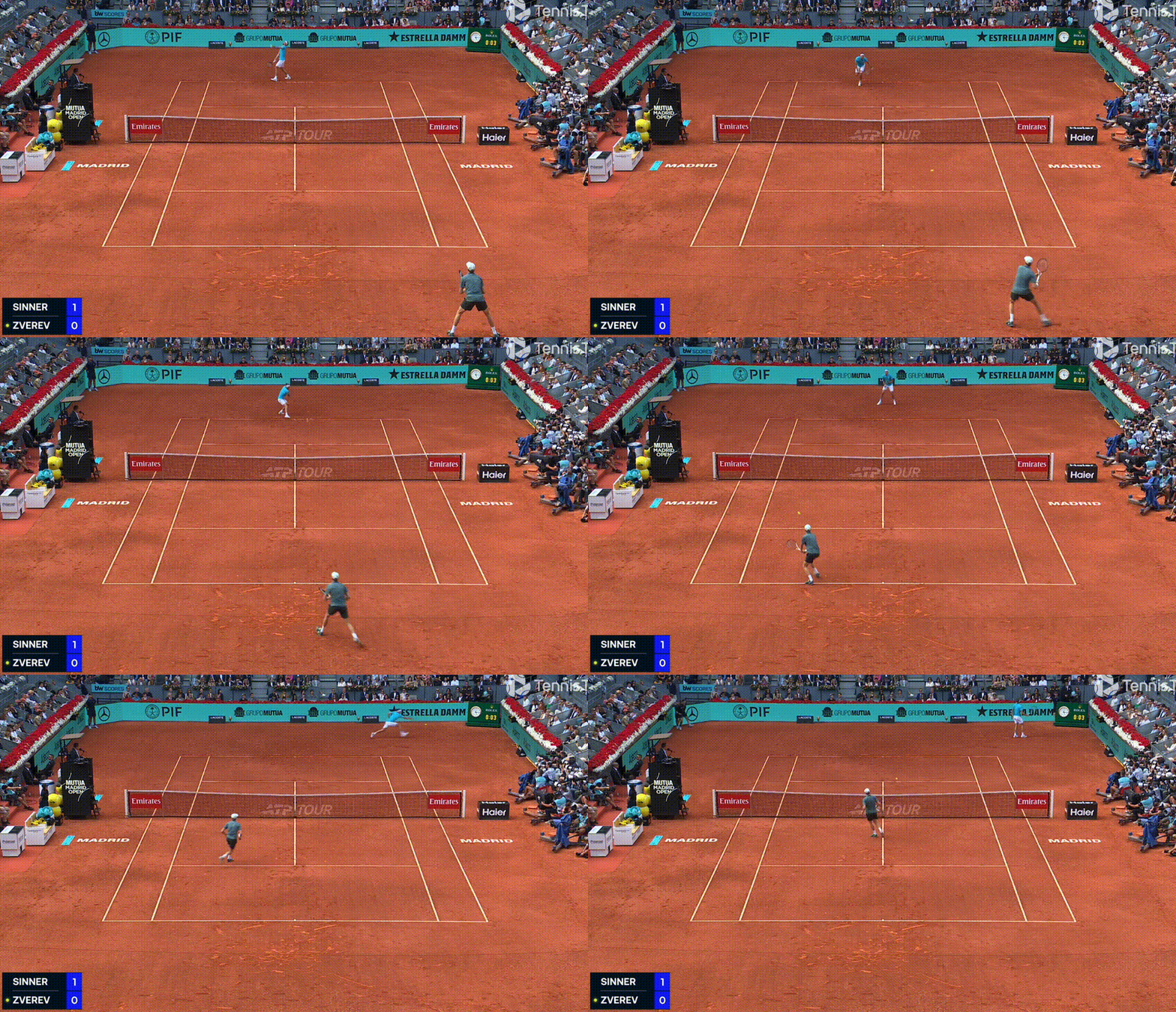
Add in the German’s preference for backhands from middle, and you realise there is just zero threat or pressure for Sinner. He knows he’s getting to neutral at worst after the return.
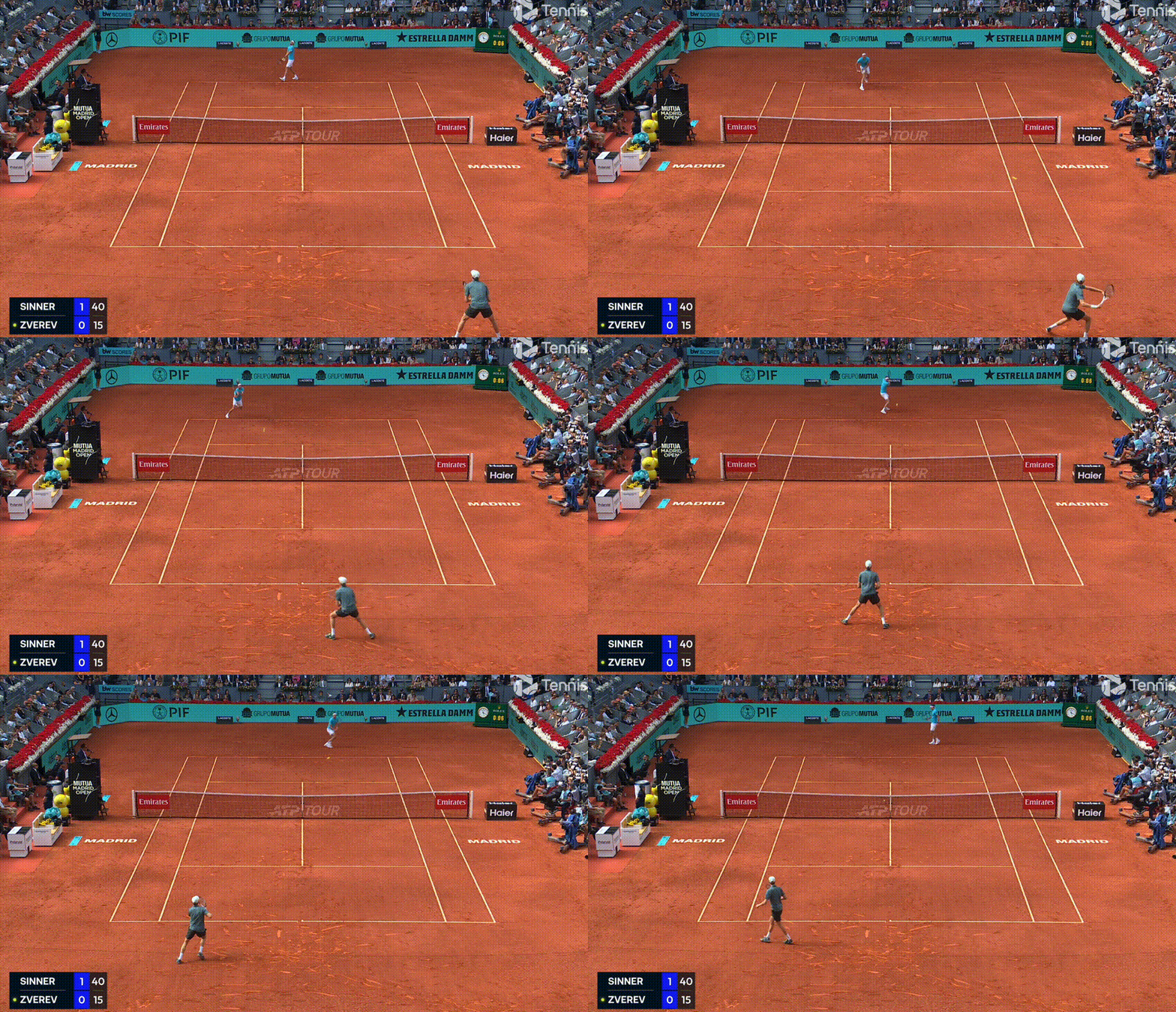
The one area you might have thought Zverev would have an advantage is on the serve, but Sinner’s recent serve improvements were on full display here: he averaged under 38 centimetres from the lines on first-serve accuracy (Zverev was at 58cm, which is his average). That’s a stat that I’ve repeatedly brought up for the Italian recently, but I keep having to do it because it’s insane how much he has improved that shot in the space of six months.
And that notion of improvement is really what I want to spend the rest of the piece talking about.
Sport is often compared to the brutal and competitive elements of nature and evolution, the “survival of the fittest” and all that. Turns out that is a misquote. It is actually better summarised as “the one that is most adaptable to change.”
After the 2023 Wimbledon Final, Djokovic said this of Alcaraz (emphasis added):
“He surprised me, he surprised everyone in how quickly he adapted to grass this year, because he hasn’t had too many wins on grass and obviously him coming from clay and having the kind of style that he has, you know…the slices, the chipping, the net play. It’s very impressive.”
I haven’t played a player like him, ever, to be honest. Roger and Rafa have their own strengths and weaknesses…Carlos is a very complete player. Amazing adapting capabilities that I think are key for longevity and a successful career on all surfaces.”
This quality of being adaptable is something I look for in young players, because I think Djokovic is right (and has been a prime example of someone who adapted their games over generations).
And this is why Sinner, Alcaraz, and Djokovic have performed best in slams over the last couple of seasons. They not only have an acute self-awareness that enables them to identify their weaknesses honestly, but a freakish ability to patch them at a speed that makes the rest of the tour look untalented by comparison:
-
Alcaraz lost the 2025 Wimbledon final and then immediately patched the running forehand in New York, two months later. (Not to mention his serve and backhand tweaks throughout 2025)
-
Djokovic’s serve and forehand potency goes way up when playing Sincaraz.
-
Sinner’s serve underperformed in that USO Final, and he went to work on it, making tweaks in the Fall that have improved massively. He also vowed to add more variety, and has implemented the drop shot more in 2026.
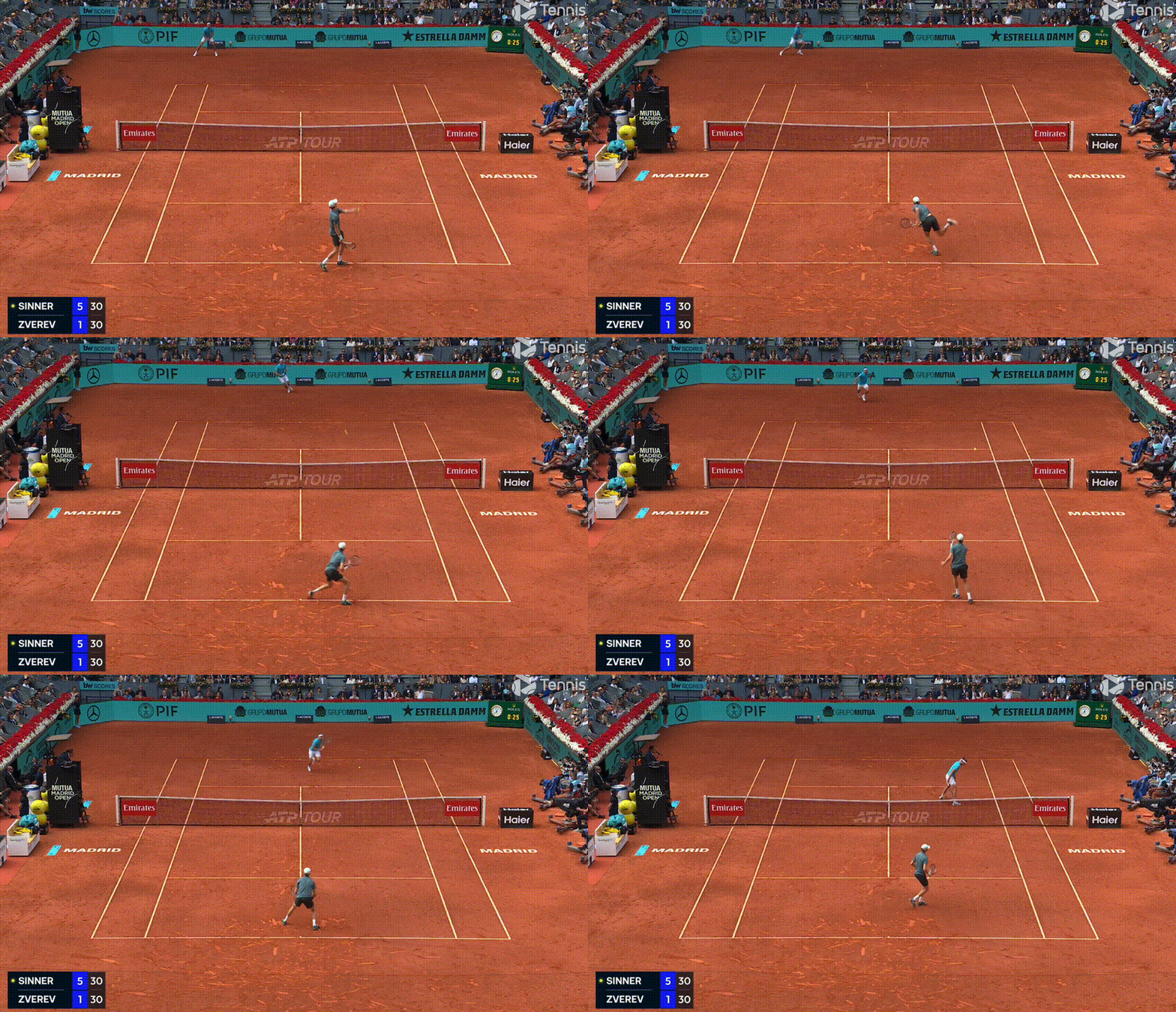
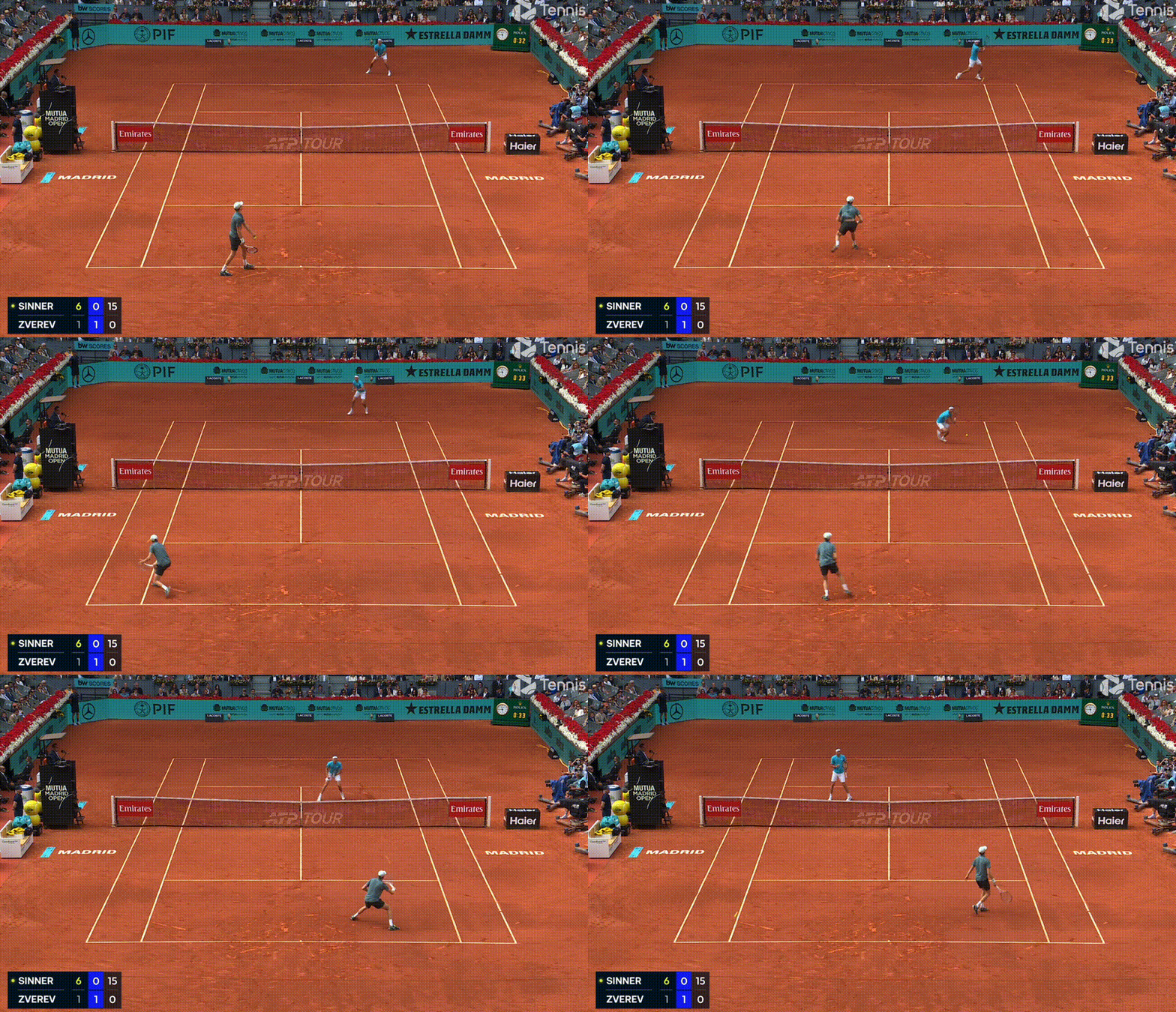
“He’s [Sinner] worked on that shot this week quite a lot — the backhand drop shot crosscourt — looking to add that element to his game. We’ve seen the forehand drop shot being used a fair bit this season… Of course, it was just a couple of months ago that he was doing a post-match interview with Jim Courier, and he was saying ‘my backhand drop shot is terrible. Sometimes it doesn’t even arrive at the net.’ But already some huge improvements this week.”
— Robbie Koenig
A couple of years ago I did a Gill Gross mailbag and one of the questions was how I think on court coaching (then quite a new thing) might evolve in the next few years, given the bucketload of data available to players and coaches. My answer was basically: I don’t think it’s going to become all that important during matches, but I do think the data will help players target what they can improve in practice so that they can bring better skills to the matches.
And I think this answer was largely on point.
The lack of data has never been the bottleneck; Zverev knows — and openly admits — that his forehand isn’t very good, that he needs to be braver in big moments. But in 2026, Zverev still does this on his +1 after losing 11 sets in a row:
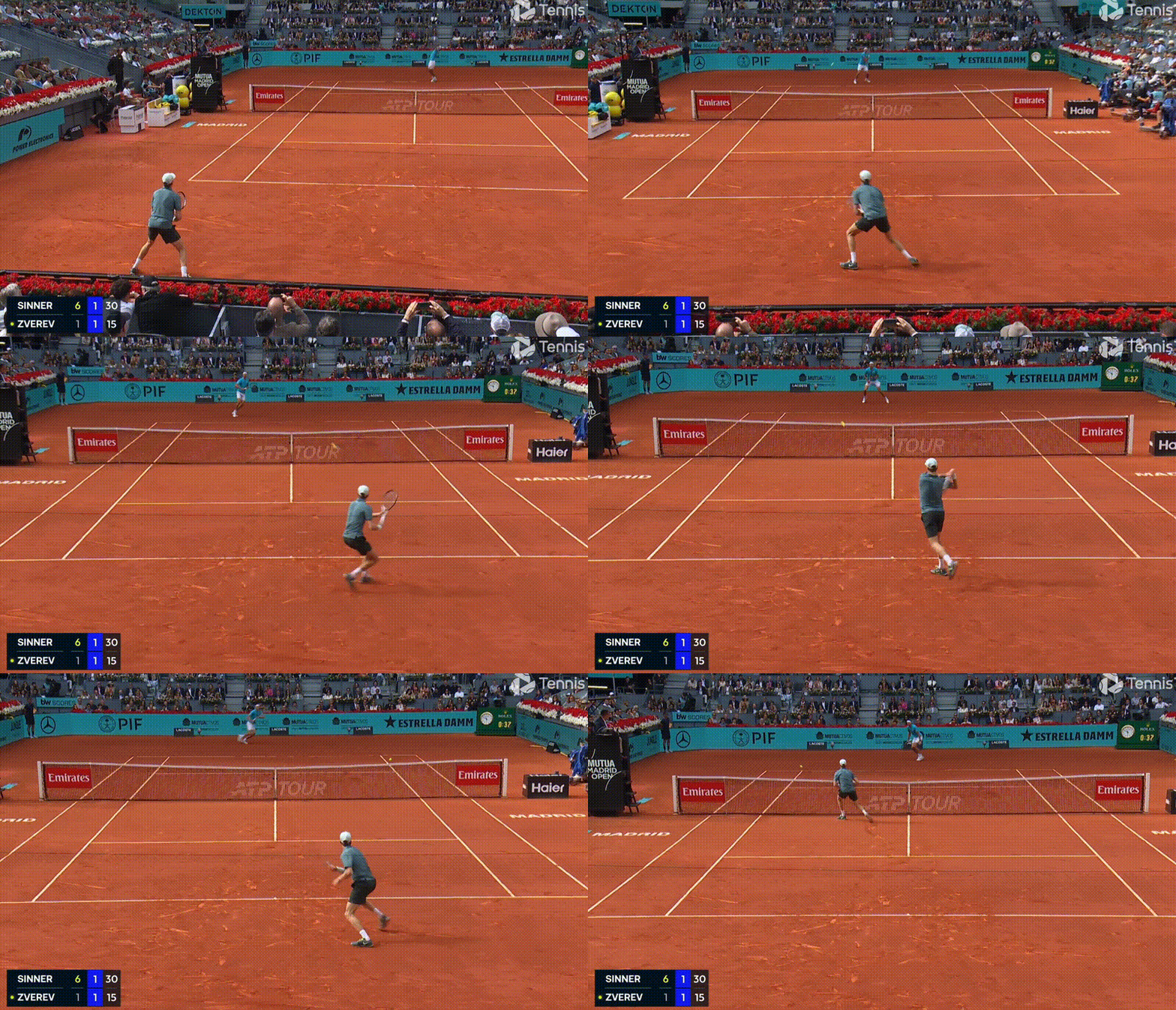
The bottleneck is acting on data. Whether that’s a skill issue or a courage issue probably differs from player to player.
In academia this might get labeled ‘knowledge translation’. Someone creates new knowledge — say, biomechanics fundamentals, physical therapy and conditioning best practices, mental performance approaches, or rally/serve location data — and then someone goes out and tries to apply it technically/physically/mentally/tactically in a meaningful way.
Sinner and Alcaraz are masters at taking in new knowledge — technical, tactical, physical, mental — and implementing it quickly on tour. And in 2026 the speed with which data can be created and disseminated means it is a major weapon for players who can use it. I think this is partly why it took two years for Djokovic to fix his serve in 2009-2010, but that Sincaraz can tweak and move in a matter of weeks; the information is more abundant now.
One of the things that is often said in tennis (and pro sports more broadly) is that going sideways means going backwards, and I think this is true. Over the last ten years we’ve seen a tour-wide adoption of hitting harder, deeper return positions, sliding and open-stanced movement, implementation of the drop shot more often, and gravitating to lighter, more powerful racquets and string setups. You have to keep up just to stay where you are.
I’ll use forehand speed trends as a clear example.
Here are a collection of various sources reporting on some top forehands over the last ~10 years:
“Two years ago, Hawkeye technology determined that, on average, Rafael Nadal’s forehand produced 3,391 revolutions per minute. Jack Sock, with his extreme western grip, was second at 3,351. The two also had the fastest average forehand speed, 77 miles per hour, and are generally considered to have the fastest racket-head speed when swinging at the ball.”
— Greg Garber for ESPN, March 29th, 2017
“Mark Hodgkinson’s book “Fedegraphica” found in 2016 that one of Federer’s forehands traveled at 75.4 mph on average. His flat forehands, with little or no spin, moved at an average of 78.11 mph, quicker than his typical topspin forehand at 76.06 mph or heavy topspin at 74.08 mph. His topspin forehand averaged roughly 47* revolutions per second (less than Nadal’s 55 rps but more than Novak Djokovic’s 45 rps average).”
— Amy Lundy for fivethirtyeight.com
* (Federer’s 47 revolutions per second = 2820 revolutions per minute; Nadal’s 55 = 3300; Djokovic = 2700)
“Thiem’s pre-injury numbers (of 1,564 forehands examined):
87.5 percent in the field
an average speed of 77.6 miles/hour
an average topspin rate of 2,978 rpm”
— Florian Goosmann for tennisnet.com
If we dropped these reported metrics into 2025, even peak Thiem looks pedestrian:
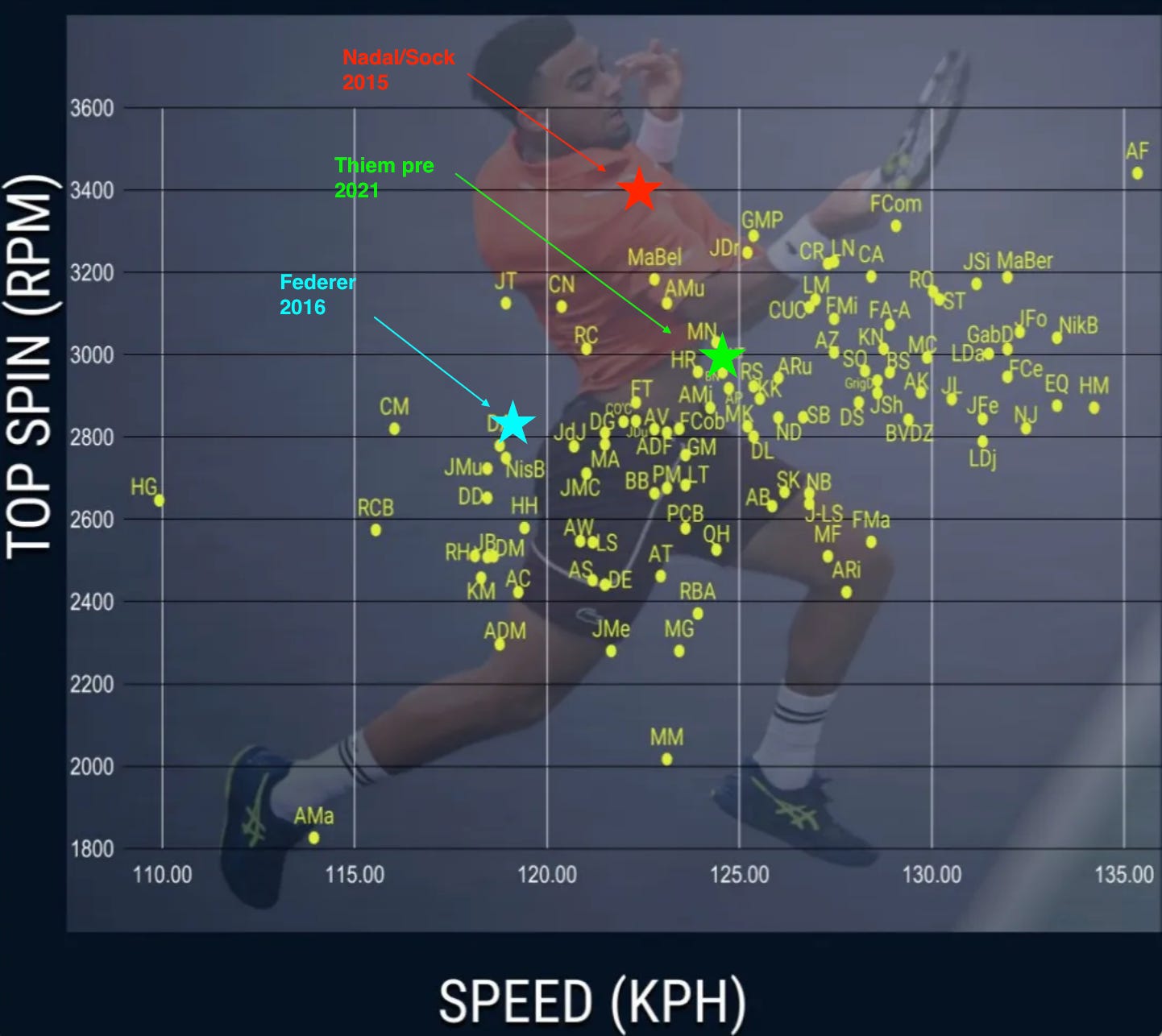
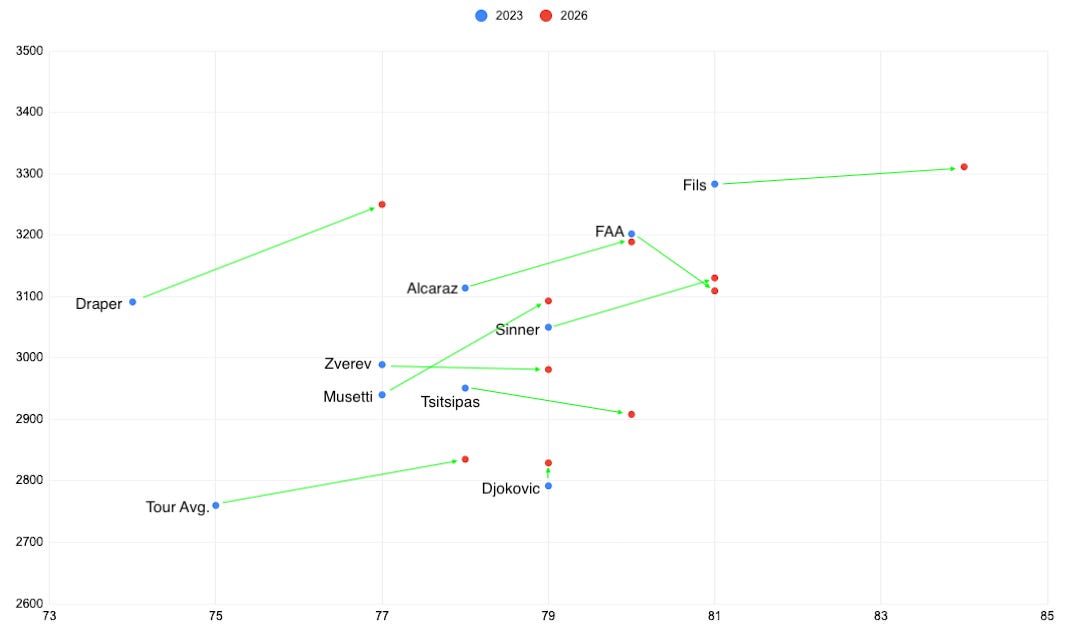
The last three years alone — all post-Covid ball editions — have seen dramatic increases. In 2023 the tour average for forehand speed was 75 mph (120.7 kmh). Less than three years later it is currently 78 mph (125.5 kmh).
To Zverev’s credit, he has increased his forehand speed since 2023, but so have his harder hitting peers:
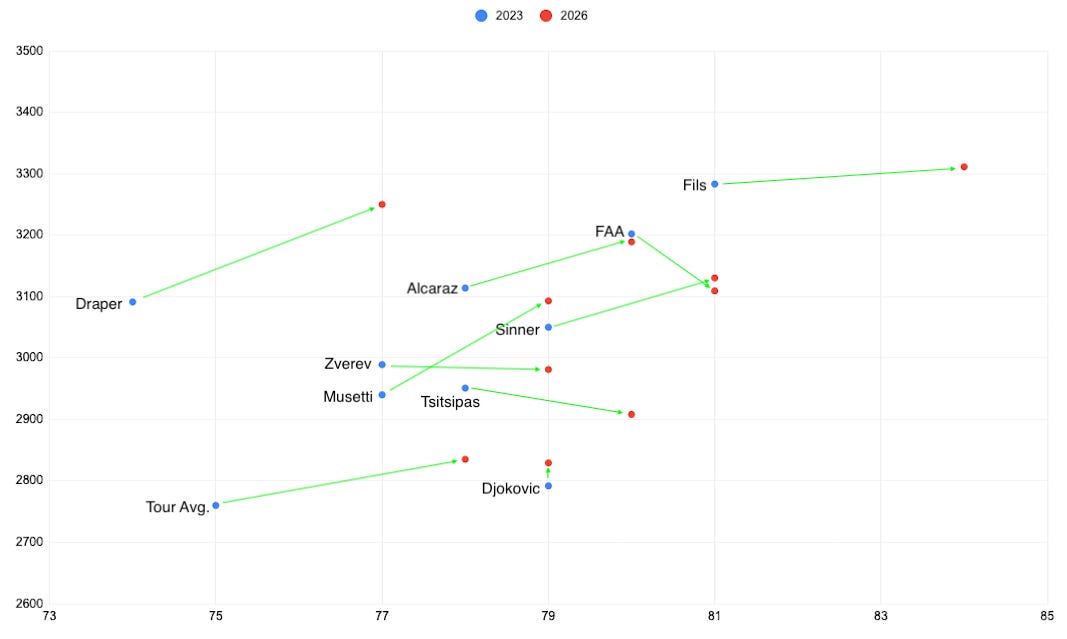
It’s interesting that the younger players of this cohort — Draper, Fils, Alcaraz, Sinner, Musetti — are the only ones who have been able to add more speed and spin, whereas Zverev, Tsitsipas, and FAA have made marginal spin/speed tradeoffs. It might be an equipment factor (are the youngsters using collectively more powerful/lighter frames on balance?), an appetite for aggression that is more native to them, or simply those younger players reaching physical maturity in the intervening years.
Another point to keep in mind is the court positioning of these players. Arthur Fils and Lorenzo Musetti play from farther back than Alcaraz and Sinner on average, so they have more time to load up, and more court length to play with, when hitting their forehands. Aggression is often this speed/positioning tradeoff:
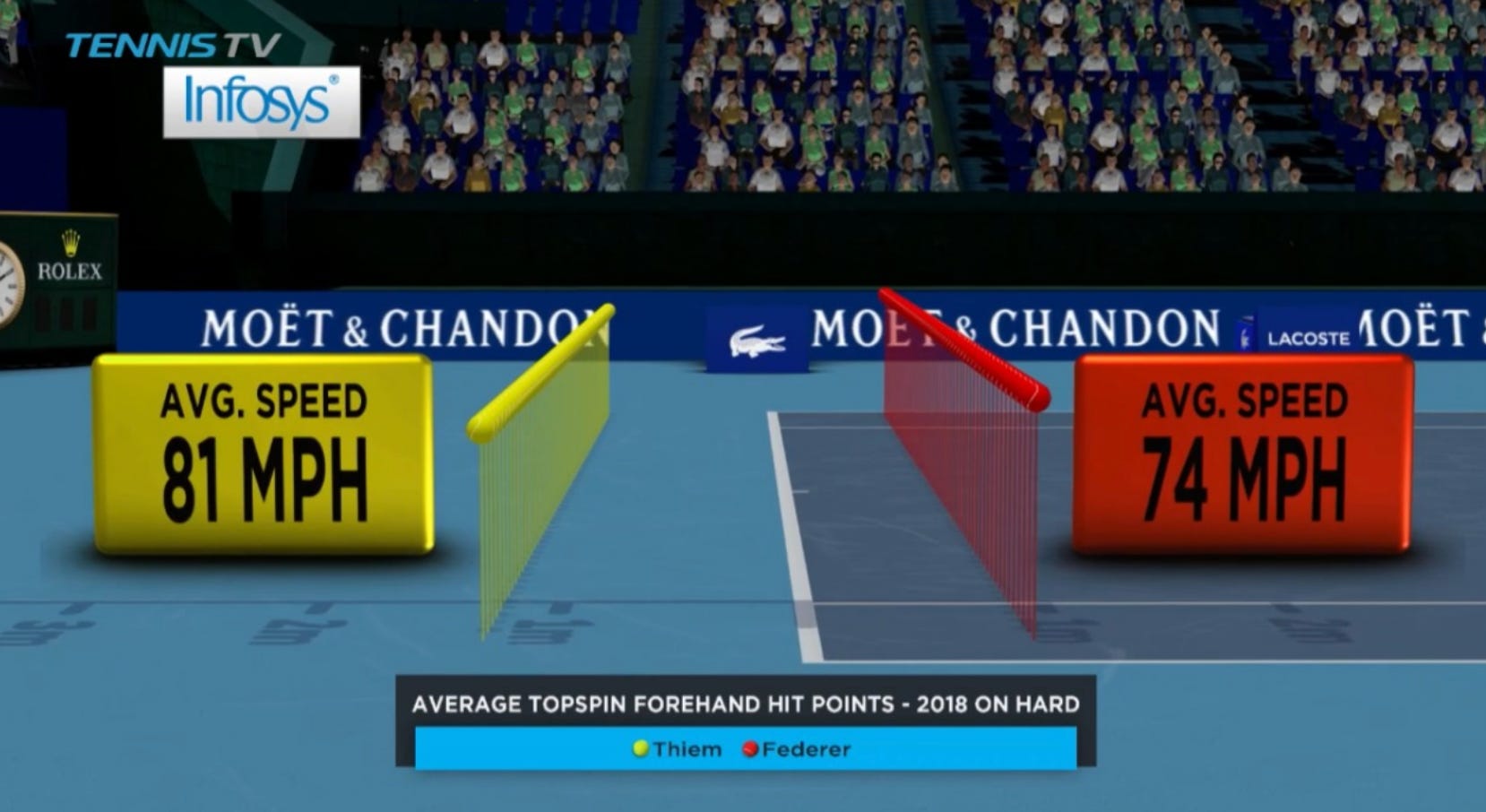
Matt Willis made this forehand rally contact-point graphic for clay (52-week) that does a good job visualising how top players position themselves in rally in terms of depth, as well as how forehand hungry they are.
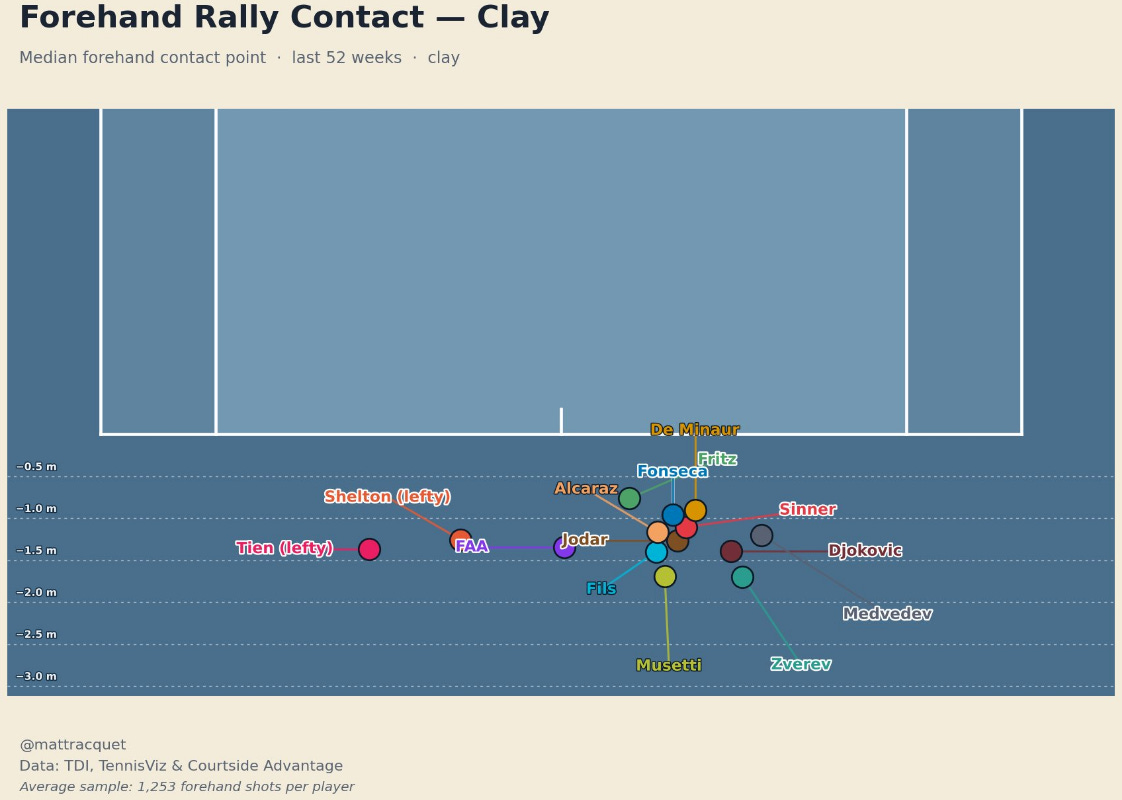
Arthur Fils is the hardest hitter on tour, but he also plays a little deeper and only makes 82% of his forehands. It’s a good tradeoff because he hits the absolute crap out of the ball and therefore still does a lot of damage, but someone like Zverev is even deeper than Musetti and Fils, yet hits softer, is less forehand hungry, and is only making 84% this year. It’s worked against the rest of the tour, but when playing Sinner those numbers just don’t add up; Sinner will not gift you errors. For how deep Zverev operates, he either needs to hit way bigger than he is trying to, or missing way less (Musetti is making 87% this year).
That’s all I got. Rome gets underway tomorrow. I’ll see you in the comments. HC.