
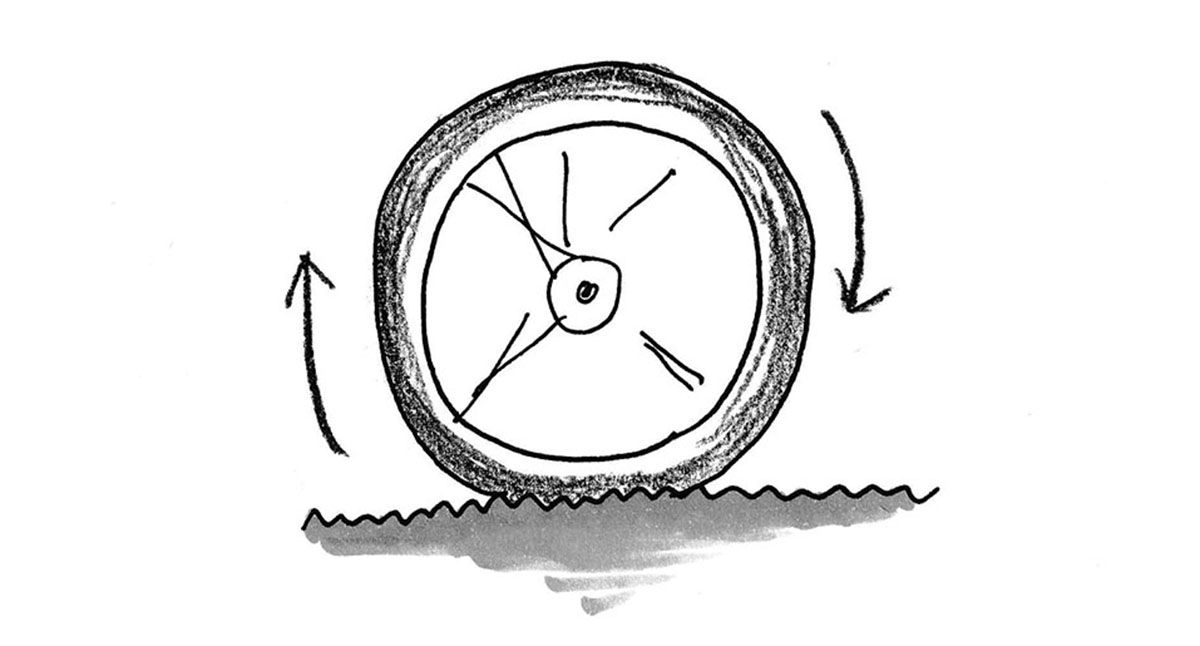
You have to give the bike media credit: The original argument about the benefits of 32″ wheels on road and gravel bikes—that they are more efficient because of their better ‘roll-over’—has pretty much vanished from the discussion. A while ago, we laid out why that isn’t the case—basically, the tire is filled with air so it absorbs the bumps, rather than lifts the bike over them like a solid wheel does.
Now a new argument in favor of the larger wheels has emerged: They have more inertia. As one article wrote: “A bigger wheel has greater momentum and therefore, we’re told, carries more speed.” Another reviewer had a chance to ride a 32″ bike. They reported that, once the wheels were moving, “they didn’t want to stop. There’s more rotational inertia. A bigger wheel puts more mass farther from the hub, so once it’s spinning, it takes more energy to slow it down. That whole ‘big wheels keep rolling’ thing certainly applies here.”
A first check of the physics, seems to support that. Rotational inertia is:
I = m * r2 (1)
where I is the moment of inertia, m the wheel mass, and r the radius.
A larger wheel has a greater radius, so it looks like the moment of inertia will increase with the square of the radius. Even a small increase in radius will have a significant effect on the rotational inertia and momentum of the wheel. In other words, making a wheel larger seems like a great way to increase its rotational inertia.
There’s one problem: Equation (1) applies only when you’re spinning the wheel in a truing stand. A large wheel spinning a the same rpm (revolutions per minute) will spin longer than a small wheel—it has more momentum.
Things change when the wheels are mounted on bikes: At the same bicycle speed, the larger wheel spins more slowly. Thanks to its larger circumference, the larger wheel covers more distance with each rotation. That’s why we need to calibrate our bike computer to the wheel circumference if we want to get accurate speed data.
Obviously, that changes the equation: Instead of comparing two wheels spinning at the same rpm, we’re comparing a big wheel spinning slowly and a small wheel spinning fast.
Too many unsupported claims have been thrown around when it comes to 32″ wheels, so we’ll do a quick dive into the physics. To understand the wheel’s resistance to speeding up or slowing down, let’s look at the total kinetic energy (Ek) of the wheel as it rolls over the surface. To simplify things, we’ll think of the wheel as a simple hoop and neglect the weight of spokes and hub. (Rim and tire weigh much more than spokes and hub.) In that case, the radius of the wheel becomes irrelevant: It doesn’t change the wheel’s inertia or momentum.
Here’s the equation combining the wheel’s center-of-mass translation speed V with its rotation rate V/r:
Ek = [ m*V2 + I*(V/r)2 ] / 2 (2)
where m is wheel mass, r is wheel radius, I is inertia as approximated by Equation (1), and V is speed of the bike.
When we input Equation (1) into (2), we get:
Ek = [ m*V2 + m*r2*(V/r)2 ] / 2 (3)
Now we see that r (wheel radius) cancels out:
Ek = [ m*V2 + m*V2 ] / 2 (4)
or:
Ek = m*V2 (5)
What this means: The kinetic energy of a rolling wheel with most of its weight near the rim depends only on its mass and the speed of the bicycle. In other words, the only reason a larger wheel has more rotational inertia and more momentum is that it’s inevitably heavier. There’s more material in the rim and tire, plus the spokes are longer.
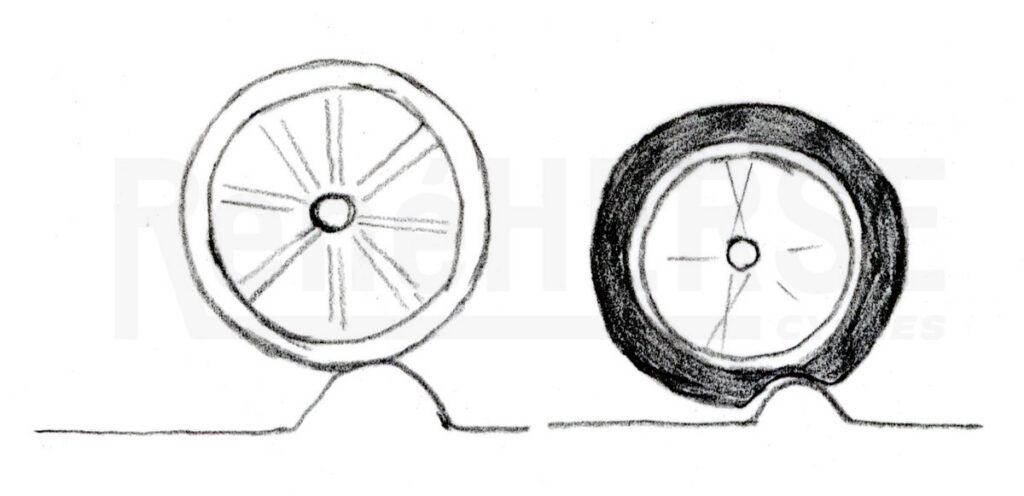
We already know that the bigger wheels don’t have better ‘roll-over’ when it comes to the (relatively) small surface irregularities of gravel or cobblestones: They absorb the irregularities within the tire rather than lifting the wheel over them (above). We’ve just seen that the larger diameter also doesn’t give a 32″ wheel more momentum. The only ‘advantage’ of 32″ wheels is that they’re heavier.
Obviously, there are easier ways to make a wheel heavier: Replacing a carbon rim with an aluminum rim is a good place to start. No need to create a new wheel size—and new bicycles to go with that wheel size. (Unless the point is to sell those new bicycles…)
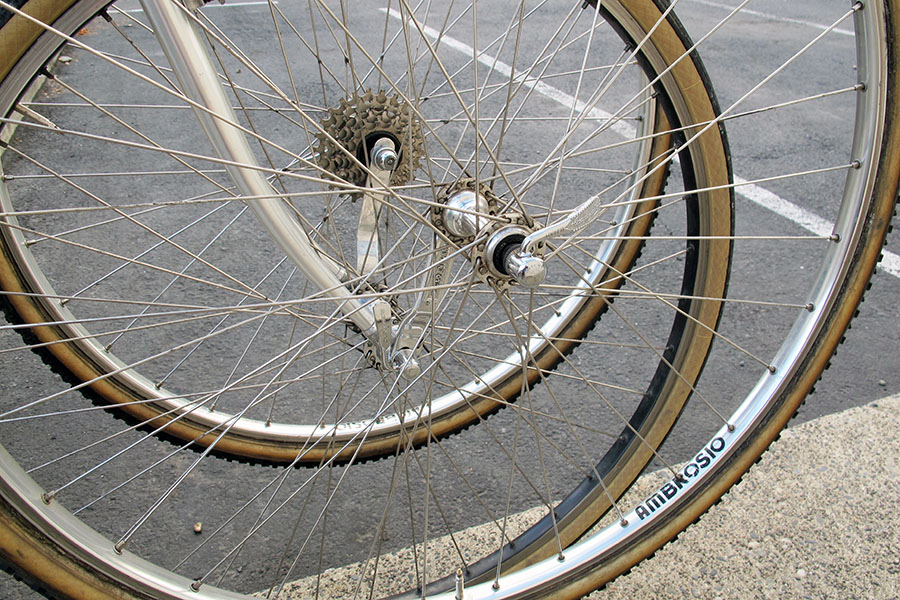
What about the momentum, though? Is it really true that heavier wheels are faster? Like many racers, I used to have superlight racing wheels (with tubular tires) and heavier training wheels (with clinchers). To my knowledge, nobody has ever suggested that heavy training wheels were faster! In fact, wheel makers spend a lot of effort on making their wheels lighter. It’s true that the effect of wheel weight is sometimes overstated, but it’s a bit of a stretch to say that heavier wheels roll faster.
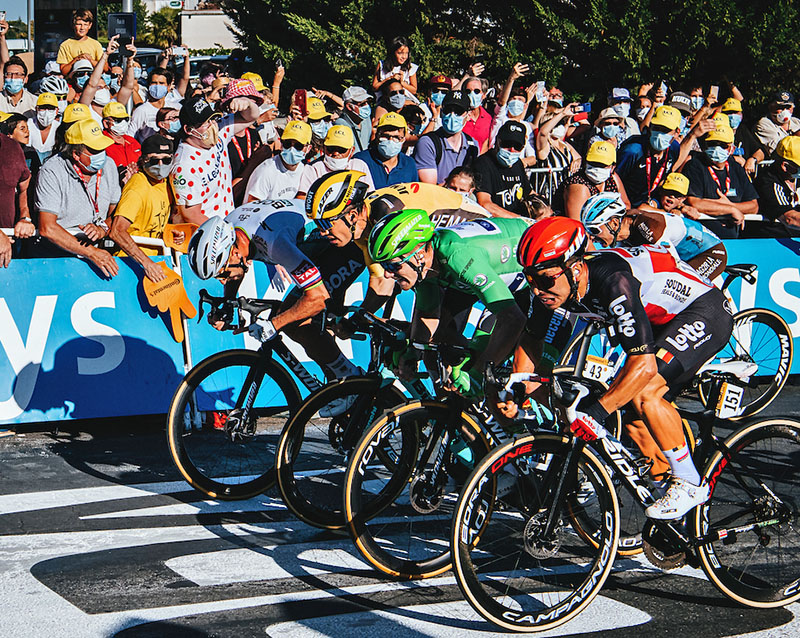
This also works the other way around: Smaller wheels don’t have less rotational inertia, if they weigh the same. That means smaller wheels don’t spin up faster just because they are smaller. If smaller wheels accelerate (marginally) faster, it’s only because they can be lighter—rims, spokes and tires use less material. That effect is pretty small.
When you look at the bikes of the pros, you’ll notice that everybody, sprinters included, is on 700C wheels, even though UCI rules allow wheels that are about 10 cm smaller. Racers and builders have tried smaller wheels in the past, but it seems like they haven’t found them to ‘spin up’ noticeably faster.
The reality is simple: The only effect of wheel size on inertia is due to weight differences—smaller wheels can be lighter; larger wheels are inevitably heavier. There are other ways to make wheels lighter or heavier, without changing their size.
Physics can be tricky, as it’s easy to overlook something important—in this case, that a larger wheel spins more slowly. Here at Rene Herse Cycles, we’ve developed plenty of revolutionary new products: ultra-wide supple tires, noise-canceling knobbies, semi-slicks with new features… Coming from a background in science, we don’t rush head-first into new ideas. At the start of our R&D, we always check the physics. We don’t just do that ourselves: We work with experts who double-check our ideas and calculations. When we say: “We don’t want to sell you anything you don’t need,” then that also applies to ‘innovations’ that don’t provide any benefit.
Further Reading:
Photo credit: Jered Gruber (Tour de France sprint); used with permission