
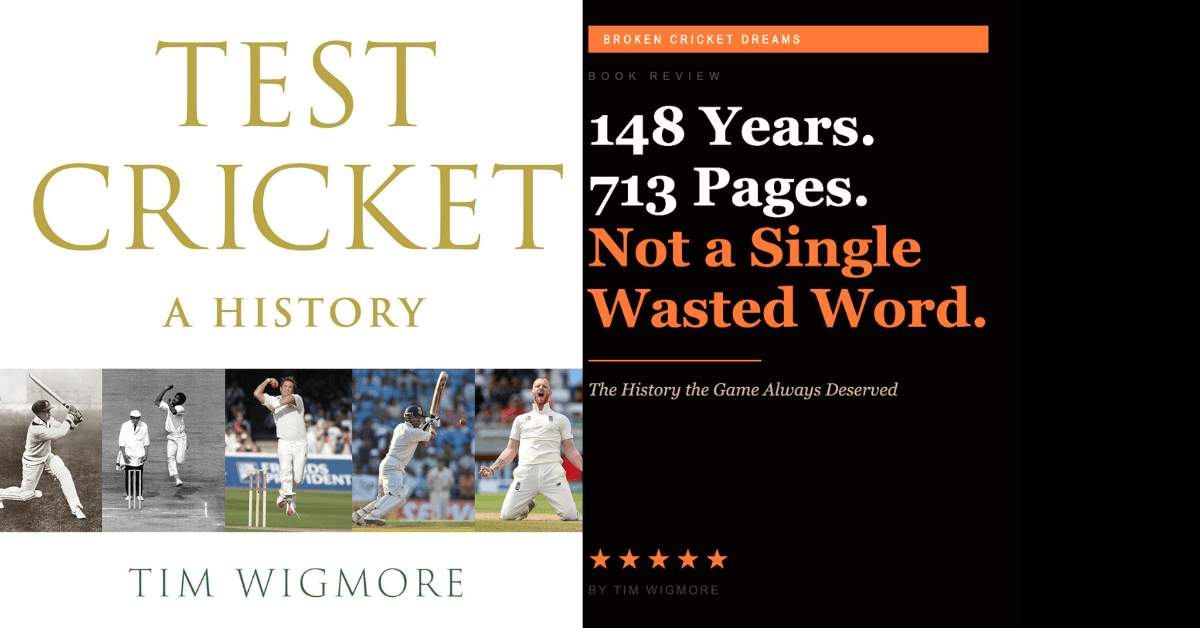
148 Years. 713 pages. 35 Chapters. Not a single wasted word. Tim Wigmore’s Test Cricket: A History is the history this game always deserved.
Read It For
- A deep, well-researched history. You are bound to learn something new regardless of your cricketing background.
- Wigmore’s writing range: Storytelling, stats and trivia, humor, philosophy, journalism, all in one.
Do Not Read It For
- A quick read. This book is a commitment, so pace yourself accordingly.
Spoiler Alert: If you are not a cricket fan, everything coming up here will be a spoiler.
****
Will Test cricket survive? The perennial question.
I thought this was just the sentiment from the past 50 years with the advent of ODI cricket and more recently, T20 cricket. After reading this book, I learned that Test cricket surviving to this day is nothing short of a miracle.
Test Cricket: A History takes on the almost impossible task of synthesizing a story that spans two centuries and six continents without losing its grip on you.
I bought this last summer and finally completed it last month. There were times when months went by before I picked it up again. Never once did I feel lost returning to it.
The book is organized in such a way that you can start at any point. Want to understand the significance of Bazball? Start toward the end. Want to dive into the controversies? Jump to chapter 20 (How to Buy a Test Match). Each chapter is its own world.
The only other book that I have read with similar depth and breadth is India After Gandhi by Ramachandra Guha. What Guha’s book does with India’s survival as a nation-state and its complex geopolitical history, Wigmore does with Test cricket.
From Bodyline to Bazball: What Wigmore Gets Right
Wigmore balances what moments to pick and which players to spotlight without going overboard.
From Victor Trumper’s century before lunch all the way to Donald vs Atherton and Mitchell Johnson scarring an entire England generation, the moments are chosen with precision and described with vivid imagery. Certain teams, quartets, and allrounders are given room to breathe, while players like Warne, Tendulkar, and Murali get their own dedicated chapters.
What sets this apart from other books is the writing style. It is not a bunch of Wikipedias glued together. There is storytelling, anecdotes, interviews Wigmore conducted himself, and excerpts from cricket writers of yesteryear. The witty chapter titles alone convey the tone: “Cricket’s Uncivil Wars” and “The Impossible Job.”
No book of this scope can cover everything. I would have loved a deeper dive into Sandpapergate, one of the most dramatic moments in modern Test cricket. But that is a minor gripe.
This book has something for every kind of cricket reader. The technical purist interested in how reverse swing and the wobble seam work, the historian fascinated by the lore of Bodyline, the philosopher, and the fan who just wants to argue about who was the best since Bradman.
The philosophy is what stayed with me the most. The “in-built second chance” and “the prolonged duel” as an “essential part of Test cricket’s allure.” And Wigmore’s reminder that even 150 years since its inception, through Bodyline and Bazball, fans are still arguing about how this format should be played.
A Fan’s Honest Reckoning: What This Book Left Me With
What does a cricket fan who started watching in 2003 take away from a book that begins in 1877?
The final chapters felt familiar because I had lived through that timeline. The early chapters, however, sent me down rabbit holes: the first official Test or the abandoned Timeless Test of 1939 that had to be called off because England’s ship home was leaving.
Then there was history I knew on the surface but had never fully understood the impact.
Case in point: Kerry Packer. I had heard about World Series Cricket but did not know about the ins and outs of broadcasting and how Packer changed cricket as we know it. I had always heard about the great West Indies Test team, but how exactly did they get there, and more importantly, what factors both on and off the field contributed to their downfall? Reading these 1970s and 80s chapters would spark follow-up conversations with my dad: “Who did you prefer, Botham, Imran, Kapil, or Hadlee?”
And then there was history I did not see coming. The Hendricks Law and South Africa’s checkered past. Abraham Lincoln watching a cricket match between Chicago and Milwaukee. And Nobel Laureate Samuel Beckett, whose Waiting for Godot was one of my favorite reads in college, playing two first-class matches.
This is what the book does. It reaches into corners you did not know existed.
Final Thoughts
I can foresee spin-offs of the history of ODI World Cups, the Ashes, or County Cricket. Wigmore himself acknowledges that the women’s game deserves its own study.
What excites me is the version of this book that will be written thirty years from now. Three more Test nations, a prospering WTC, cricket in America & Argentina, and another generation of moments no one saw coming.
And to the larger question, will Test cricket survive? It has outlasted empires. I have no doubt it will endure.
This book is an exception. Solid five out of five. Get your copy now.
****
Thank you all for reading. If you like cricket book and movie reviews, you may enjoy this section.
Test Cricket: A History – Details and Where To Buy
Release Date: April 24th, 2025
Where to Purchase: (Amazon Prime Link)
Note: The purchase link above is not an affiliate link. BCD does not earn any commission from purchases.
Title Name: Test Cricket: A History
Publisher Summary:
“Test cricket is on the cusp of its 150th anniversary. For the first time, Test Cricket: A History tells the full, gripping story of the players and stories that have shaped the game’s evolution since 1877.
Award-winning author Tim Wigmore brings to life both Test cricket on the pitch and the game’s social significance around the world. This captivating tour is illuminated by dozens of exclusive interviews with the game’s greatest players, including Sachin Tendulkar, Pat Cummins, Michael Holding, Muttiah Muralidaran, Kevin Pietersen, Ian Chappell, Dale Steyn and Rahul Dravid.
From Bodyline to Bazball, the golden age to the rise of West Indies, and Shane Warne to Ian Botham, readers will come to appreciate Test cricket’s remarkable history like never before.”
Author: Tim Wigmore
Length: 713 pages
Language: English
Publisher: Quercus
Chapters:
- Introduction: The cruellest game
- 1: A mad idea
- 2: Two become three: the emergence of South Africa
- 3: The Golden Age – or Test cricket’s great missed opportunity?
- 4: The greatest opening pair
- 5: Three become six: Test cricket opens up
- 6: Bradman, Bodyline, and the Invincibles
- 7: No rations any more
- 8: The emergence of Pakistan
- 9: Cricket, lovely cricket
- 10: Captaincy: a tale of class
- 11: The South Africa question
- 12: Tiger and the quartet
- 13: The rise of West Indies
- 14: Cricket’s uncivil wars
- 15: The impossible job
- 16: The oracle: the story of reverse swing
- 17: No longer just a whistlestop
- 18: Shane Warne and the resurgence of leg spin
- 19: The road less travelled
- 20: How to buy a Test match
- 21: The two ages of Tendulkar
- 22: The magic and mystery of Murali
- 23: The transformation of wicketkeeping
- 24: Expansionism and its discontents
- 25: England learns to expect
- 26: The great team hiding in plain sight
- 27: The slow rise of the Tigers
- 28: How umpires and technology changed Test cricket
- 29: Test cricket in exile
- 30: The parable of West Indies
- 31: Cricket’s superpower
- 32: In the fast lane
- 33: New Zealand’s moment
- 34: More than just a Commonwealth club
- 35: Bazball and beyond
BCD#411 © Copyright @Nitesh Mathur and Broken Cricket Dreams, LLC 2023. Originally published on 05/10/2026. Unauthorized use and/or duplication of this material without express and written permission from this site’s author and/or owner is strictly prohibited. Excerpts and links may be used, provided that full and clear credit is given to Broken Cricket Dreams with appropriate and specific direction to the original content (i.e. linked to the exact post/article).