
With a single great Mega Auction performance, the historically poor duo of PBKS and RCB contested just their fifth combined final in 2025. It brings up an interesting question; what makes for a good Mega Auction, and which teams have done it best over the nearly two-decade history of the IPL?
With that in mind, we’ve evaluated the five best Mega Auction performances since 2008 across three different metrics: New Player Value (10 points), Cycle Impact (5), & Longevity Bonus (3). Players that were retained or signed before the auction don’t count because they weren’t available at their true auction values. The full methodology is available below.
With that out of the way, let’s look at the five best Mega Auction performances of all time!
Jump to a team;
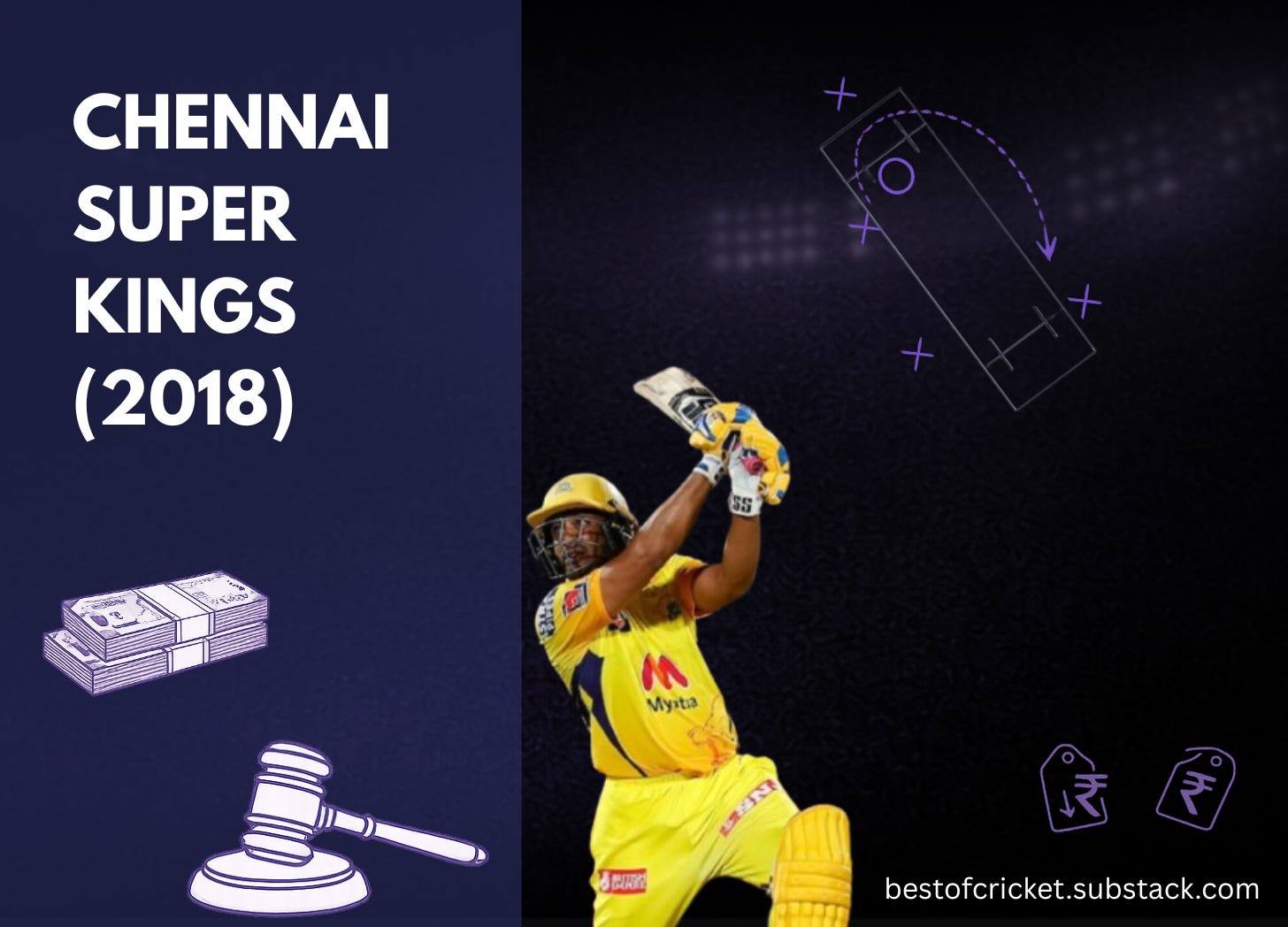
Superstars: Shane Watson (₹4 Cr), Ambati Rayudu (₹2.2 Cr), Faf du Plessis (₹1.6 Cr), & Imran Tahir (1 Cr).
Stars: Harbhajan Singh (₹2 Cr), & Deepak Chahar (₹0.8 Cr).
Quality Starters: Dwayne Bravo (₹6.4 Cr), Shardul Thakur (₹2.6 Cr), & Lungi Ngidi (₹0.5 Cr).
Below Average Starters: None.
Flops: Kedar Jadhav (₹7.8 Cr), & Karn Sharma (₹5 Cr).
While the big money signings of Jadhav (SR of 96.5) and Sharma (11 appearances in 3 years) flopped, using an expensive RTM on Bravo (₹6.4 Cr) was a good decision. The West Indian picked up 45 wickets in 45 innings across four seasons. He was their death overs maestro with the ball, and contributed handy runs at the bottom of the order.
Watson (₹4 Cr) and Rayudu (₹2.2 Cr) would prove to be mid-level masterstrokes. The former was their go-to opener and scored a career-best 555 runs at 154.59 in 2018, including a staggering 117* (57) in the 2018 final. The latter would provide reliable middle-order stability, scoring 602 runs at 149.75 in 2018, and remaining a solid contributor across the entire cycle. Meanwhile, Thakur (₹2.6 Cr) was a more-than-solid middle overs option, taking 55 wickets in 47 innings.
However, the real genius of CSK’s 2018 auction came in the extreme value they found while bargain hunting. At age 34, CSK’s use of an RTM to pick up du Plessis (₹1.6 Cr) wasn’t seen as a notable move at the time. He had an IPL SR of 127.96 before 2018, but would score 1082 runs at a SR of 139.25 in 2020-21 – including 86 (59) in the 2021 final.
Similarly, the 38-year-old Tahir (₹1 Cr) was not in much demand, but would pick up the purple cap in 2019 with 26 wickets at an economy of 6.69. Fellow veteran spinner Harbhajan (₹2 Cr) would take 16 wickets at 7.09 in 2019 as well.
Chahar (₹0.8 Cr) would turn into CSK’s primary new ball threat across the Covid-impacted four-year cycle, picking up 58 wickets in 58 innings at an economy of 7.7. Ngidi (₹0.5 Cr) would have a smaller impact – playing just 7 games in 2018 – but he took 11 wickets while conceding just 6 RPO and was a key part of CSK’s instant title win in the first year of the cycle.
CSK had a 100% success rate with their mid-level signings, while a full third of their bargain signings played at either a Star or Superstar level for at least one season. Those are unheard of numbers, and explain why the five-time champs walk away with such a high score despite two of their three big money signings flopping.
New Player Value score: 8.5/10
Across four seasons between 2018 and 2021 in the auction cycle, CSK won two titles and reached three finals.
Their 2018 title campaign was led by Rayudu and Watson, combining to score 1157 runs and ranking in the top 5 run-scorers for the season. The rest of the auction buys largely produced starter-level seasons without standing out as stars. Ngidi, who took 11 wickets in 7 innings while conceding just 6 RPO, was the best of the rest, while the likes of Du Plessis, Bravo, Chahar, Harbhajan, and Thakur were solid regulars who had their moments.
A season later, CSK’s batting heroes regressed, but the slack was picked up by the bowlers. Tahir (26 wickets) and Chahar (22 wickets) were among the season’s top three wicket-takers while Harbhajan added another 16 wickets. As the team’s three leading wicket-takers, they helped CSK record the best bowling average (21.98) and economy (7.46) of the 2019 season as their team made another run to the Finals.
After a down-year in 2020, CSK won another title in 2021 with Faf Du Plessis playing a prominent role. The batter scored four consecutive 50+ scores in the first half of the season to help CSK get off to a good start. He capped off his 633-run campaign with 86 (59) in the 2021 final to win CSK their second title of the cycle. CSK’s regular starters that season included Thakur, Bravo, Chahar, and Rayudu.
In the 2018 auction, CSK bought three of the league’s top five run-scorers, and two of the top three wicket-takers across the cycle. Surrounding these stars, CSK got an assortment of quality role players that helped them make multiple finals runs.
Cycle Impact score: 4.5/5
CSK’s bargain-heavy strategy was dependent on signing undervalued veterans who had all largely become redundant by the end of the cycle. They didn’t retain a single player at the 2022 Mega Auction and, therefore, are not eligible for any points in this section.
Longevity Score: 0/3
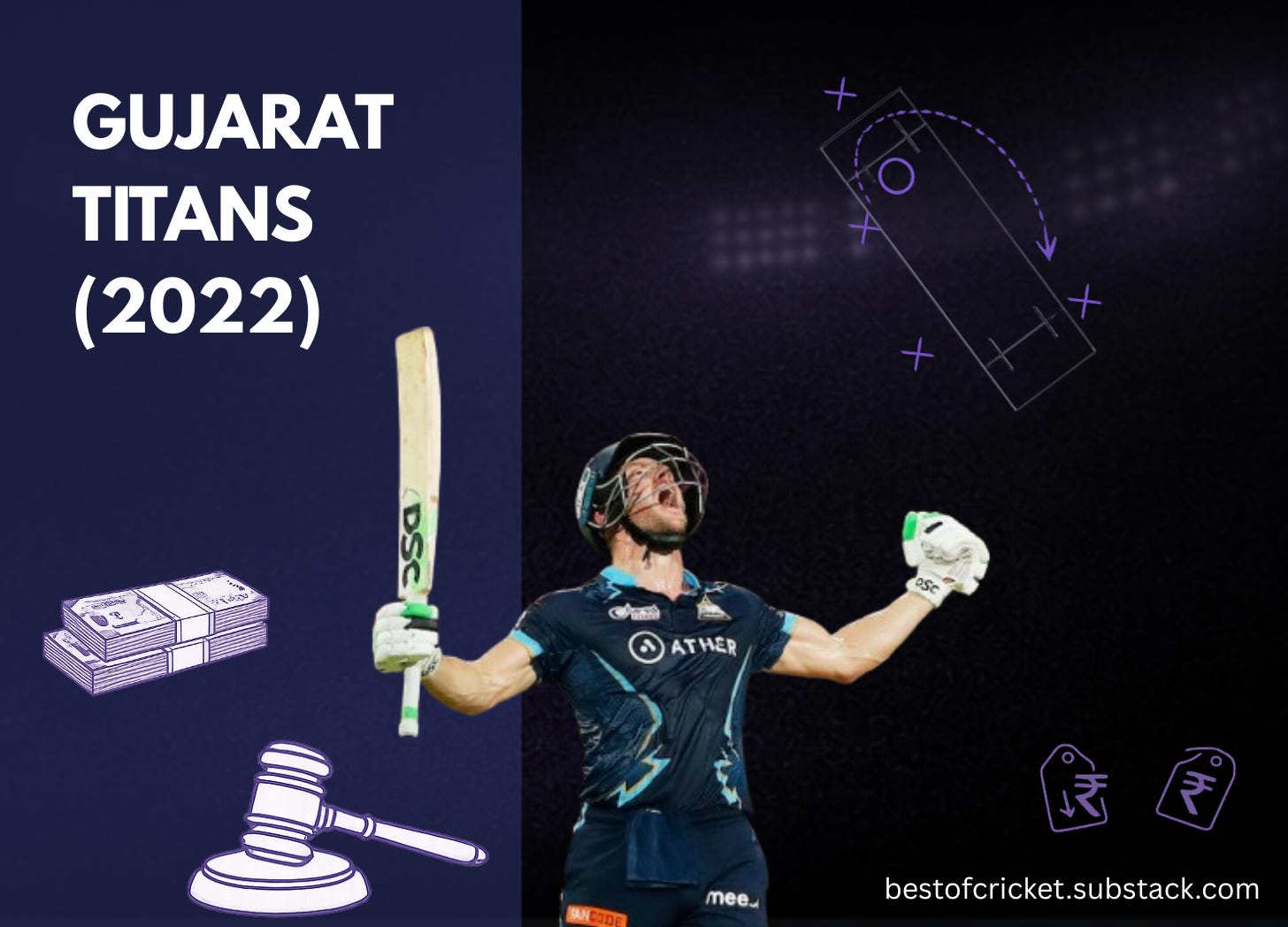
Superstars: Mohammed Shami (6.25 Cr), & David Miller (3 Cr).
Stars: Rahul Tewatia (9 Cr), Noor Ahmed (0.3 Cr), & Sai Sudharsan (0.2 Cr).
Quality Starters: R Sai Kishore (3 Cr), & Vijay Shankar (1.4 Cr).
Below Average Starters: Lockie Ferguson (10 Cr), Abhinav Manohar (2.6 Cr), Alzarri Joseph (2.4 Cr), & Wriddhiman Saha (1.9 Cr).
Flops: Yash Dayal (3.2 Cr), & Matthew Wade (2.4 Cr).
GT used their big money moves to successfully solidify their bowling-heavy identity, which was complemented by dynamic middle and lower order batting.
GT spent big on two marquee fast bowlers. Mohammad Shami (₹6.25 Cr) was a new ball machine, taking 48 wickets in 33 innings with an economy of 8.01 across 2 seasons. Results were mixed for Ferguson (₹10 Cr), who was a regular in 2022, but could only pick up 12 wickets in 13 innings at an economy of 8.95 before being traded.
Rahul Tewatia (₹9 Cr) was the most expensive batting signing at the auction. He was their designated finisher, and he thrived in the role, scoring 492 runs at a SR of 147.74.
Amongst the mid-level signings, a resurgent David Miller (₹3 Cr) scored 950 runs in three seasons with at a SR of 145.25. R Sai Kishore (₹3.0 Cr) took 13 wickets (including 2/20 in the 2022 IPL Final) at an economy of 8.32; however, he only played 10 games in the entire cycle.
GT got some output from veterans Wriddhiman Saha (₹1.9 Cr) and Vijay Shankar (₹1.4 Cr). Saha scored 688 runs at a SR of 126 in 2022-23, while Vijay Shankar had a good year in 2023 (301 runs at a SR of 160.1).
However, the rest of GT’s mid-level business was underwhelming.
Yash Dayal (₹3.2 Cr) conceded an economy of 10.02 in 14 innings. Matthew Wade (₹2.4 Cr) scored just 161 runs off 144 balls in 11 innings. Abhinav Manohar (₹2.6 Cr) started 17 games in his first two seasons, and his average of 18.5 at 132.76 would see him dropped eventually. Similarly, Alzarri Joseph (₹2.4 Cr) was a part of the side’s early setup, but an economy of 9.36 in his second season would see him released.
On the other hand, GT thrived with their bargain signings, finding two genuine stars for a combined ₹50 lakhs. Sai Sudharsan (₹0.2 Cr) was their second-highest run-scorer in the cycle, and their highest scorer in 2024. He showed initial promise after a memorable 96 in the 2023 final, and followed that up with a team-high 527 runs at a SR of 141.3 in 2024. Meanwhile, Noor Ahmed (₹0.3 Cr) picked up 24 wickets in 23 innings at an economy of 8.03 in 2023-24.
GT did a good job with their big-money & bargain signings, but their mid-level signings were underwhelming. It undermined their ability to build on their perfect debut season, especially after the advent of the Impact Player rule.
New Player Value score: 7.5/10
GT impressively made two finals in the first two years of their existence, winning it all in their first season.
In 2022, their strength lay in strong finishes as they won seven different chases in the 20th over of the match. Miller was the leading scorer in second innings that season, scoring 320 runs at a SR of 152.38. Accompanying him in most games, Tewatia added 145 runs at a SR of 159.34. In every one of those seven nail-biters, either Tewatia or Miller remained at the crease to finish the job.
In 2023, GT’s return to the final was built on their bowling prowess as Shami picked up 28 wickets en route to the Purple Cap. Noor Ahmad emerged as a breakout star, taking 16 wickets in 13 innings at an economy of 7.82. Sudharsan’s rise to full-time starter and Shankar’s golden year meant that batting order was less reliant on Miller & Tewatia to bail them out.
GT’s Mega Auction signings were vital in giving them a start that no team in the IPL’s history can match. However, their performance does get dinged slightly since their most important players were all pre-Auction signings; Hardik Pandya, Shubman Gill & Rashid Khan. Every other team on this list saw a Mega Auction purchase become their team’s MVP for at least one year.
Cycle Impact score: 4/5
GT prioritised retaining their 2022 pre-auction signings – Gill & Rashid – before the 2025 Mega Auction. Of their other three retention slots, one went to mid-cycle signing Shahrukh Khan, while the other two were spent on Tewatia & Sudharsan.
Sudharsan has repaid GT’s faith with the Orange Cap in 2025, as he scored 759 runs at a SR of 156.17. However, Tewatia has been disappointing with just 99 runs in 12 innings in 2025, and a similarly poor 2026 so far.
Longevity score: 1.5/3
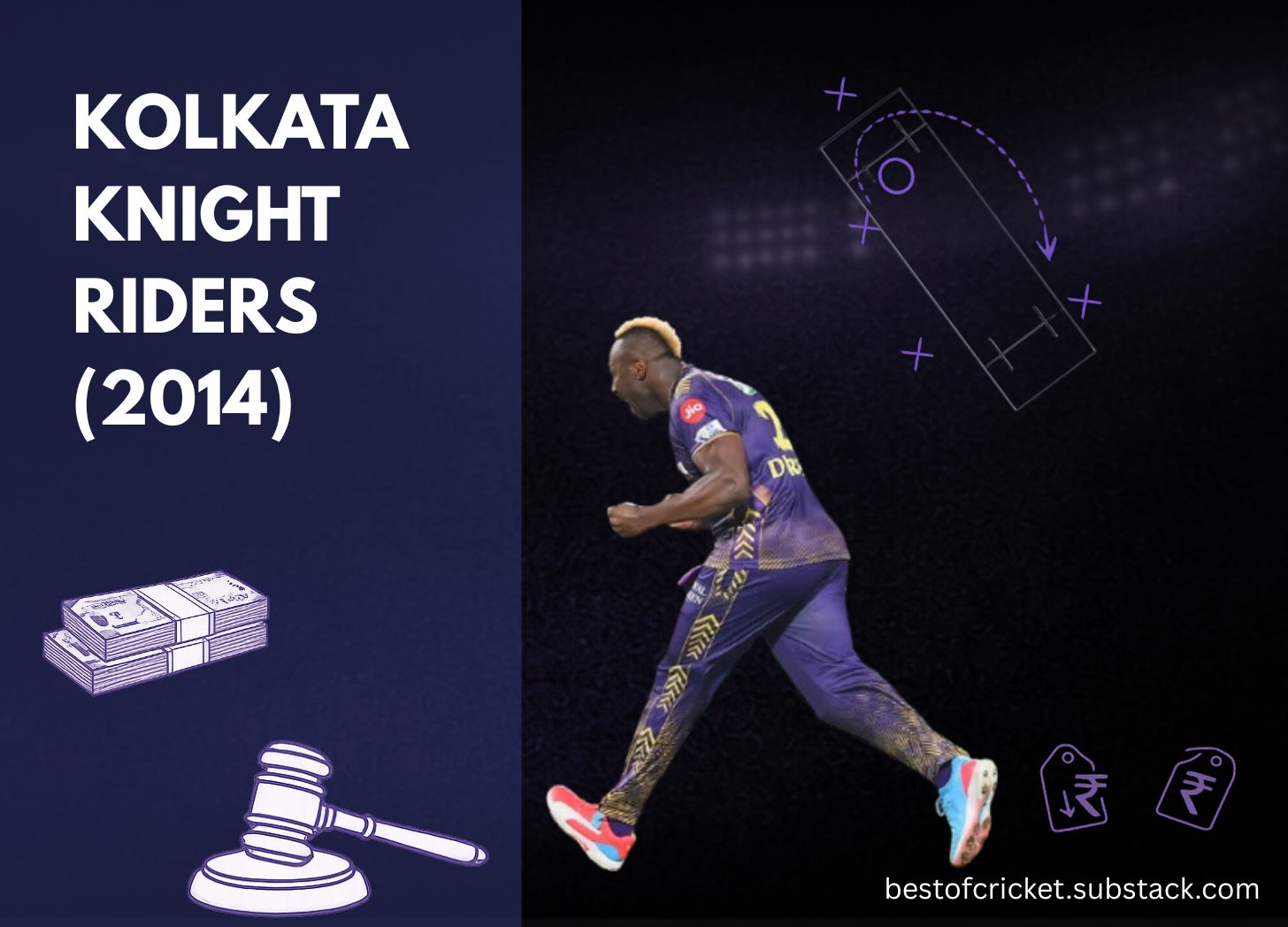
Superstars: Robin Uthappa (₹5 Cr), Shakib Al Hasan (₹2.8 Cr), & Andre Russell (₹0.6 Cr).
Stars: None.
Quality Starters: Piyush Chawla (₹4.25 Cr), Yusuf Pathan (₹3.25 Cr), Morne Morkel (₹2.8 Cr), Umesh Yadav (₹2.6 Cr), Manish Pandey (₹1.7 Cr), Chris Lynn (₹1.3 Cr), & Kuldeep Yadav ₹(0.4 Cr).
Below Average Starters: Suryakumar Yadav (₹0.7 Cr)
Flops: Jacques Kallis (₹5.5 Cr), & Vinay Kumar (₹2.8 Cr).
Big money signing Robin Uthappa (₹5 Cr) initially struggled, scoring just 97 runs in his first 5 innings. However, a mid-season move to the top of the order yielded instant results. He scored ten consecutive 40+ scores to win the league’s Orange Cap with 660 runs. He would remain a vital player throughout the cycle.
Similarly, Yusuf Pathan (₹3.25 Cr) & Piyush Chawla (₹4.25 Cr) were quality starters during their KKR stints. The former was a reliable middle order bat, while the latter was a consistent frontline spinner who took 36 wickets in 35 innings at an economy of 7.69 in 2014-16.
On the other hand, their big gamble on 38-year old Jacques Kallis (₹5.5 Cr) was a swing and a miss. The South African lasted 8 games before retiring from the IPL. He scored 79 runs off 83 balls in his last 7 innings, and took just 4 wickets at an economy of 8.45.
However, the team made up for one all-rounder whiff by nailing Kallis’ alternate. Shakib Al Hasan (₹2.8 Cr) took 11 wickets at an economy of 6.68 in 2014. In the final, the Bangladeshi went at just 6.5 RPO in a game where both sides combined to score 399 runs. He also pitched in with handy lower order runs all year, scoring 227 runs at a 149 SR.
KKR’s other mid-level signings – Manish Pandey (₹1.7 Cr), Morne Morkel (₹2.8 Cr), and Umesh Yadav (₹2.6 Cr) – were also regular quality starters throughout their stints. However, Vinay Kumar (₹2.8 Cr) was a disappointment. Coming off a 23-wicket season in 2013, he could only manage 7 wickets at an economy of 8.78 in 2014 before he was dropped (and released at the end of the season).
However, this is all a preamble to the real star of KKR’s auction; Andre Russell (₹0.6 Cr). While most teams struggle to find starters at bargain prices, KKR picked up a multi-time league MVP.
Russell had been pretty underwhelming in his first stints in the IPL, scoring just 60 runs in 9 innings across his first 3 seasons. However, with the unwavering backing of his new side, the West Indian hit his stride in 2015. He scored 326 runs at 193 SR, and took 14 wickets at 23.14, earning his first MVP for the team.
If that wasn’t enough, KKR also nailed a couple of other bargain signings in Kuldeep Yadav (₹0.4 Cr) and Chris Lynn (₹1.3 Cr). Both junior players would take a while to get going, but Yadav picked up 12 wickets in 11 games in 2017, while Lynn scored 280 runs in 7 innings at a 181 SR.
Despite whiffing on a big money all-rounder and a man who was meant to be their frontline bowler, KKR came away with as good a selection of players as possible. The depth of their successful mid-level and bargain signings would already be impressive before you count in Russell’s impact.
New Player Value score: 8.5/10
KKR’s ability to effectively build around their core stars of Gautam Gambhir and Sunil Narine in the 2014 Mega Auction led to their most successful four-year run in the IPL. Three playoff appearances yielded one win (with Russell & Narine vital for another win a decade later in 2024 as well), as well as one official league MVP.
Uthappa and Shakib headlined the title-winning 2014 team, but the role players stepped up when necessary. Pathan’s 72 (22) in the last league game ensured a top-two finish, Umesh Yadav’s 3/13 in the first eliminator got them to the final, & Pandey’s 94 (50) was crucial in the last game of the season.
Most importantly, despite the big-name successes, KKR were a genuine team. Russell led them to the playoffs in 2016 with 188 runs and 15 wickets, but the team still finished in the top four in 2017 when he was suspended. Uthappa, Shakib, Pathan, Morkel, Umesh Yadav and Pandey all had career seasons at some point during the cycle to keep the good times rolling for KKR.
Six of the team’s eight big-money and mid-level signings were quality starters for at least 3 years, while their bargains turned into MVPs and future starters by 2017. Barring one playoff-less season in 2015, it’s as perfect a cycle as KKR could’ve hoped for.
Cycle Impact score: 4.5/5
Russell’s long legacy – including the 2019 MVP where he became the only player to score more than 500 runs at a 200+ SR – largely underpins KKR’s longevity bonus. He became a Knight Rider for life, playing for the team until his retirement in 2025. As of today, Russell is one of only two players with at least 2,000 runs and 100 wickets in the IPL. He also holds the highest SR of any batter with 2,000+ runs.
KKR’s other retentions in 2018 were less successful. Uthappa could only average 25.3 at 124 in 2018-19 before being released. Kuldeep Yadav and Piyush Chawla had encouraging 2018 seasons before struggling in the following year and being benched or released by 2019.
Longevity score: 2.5/3
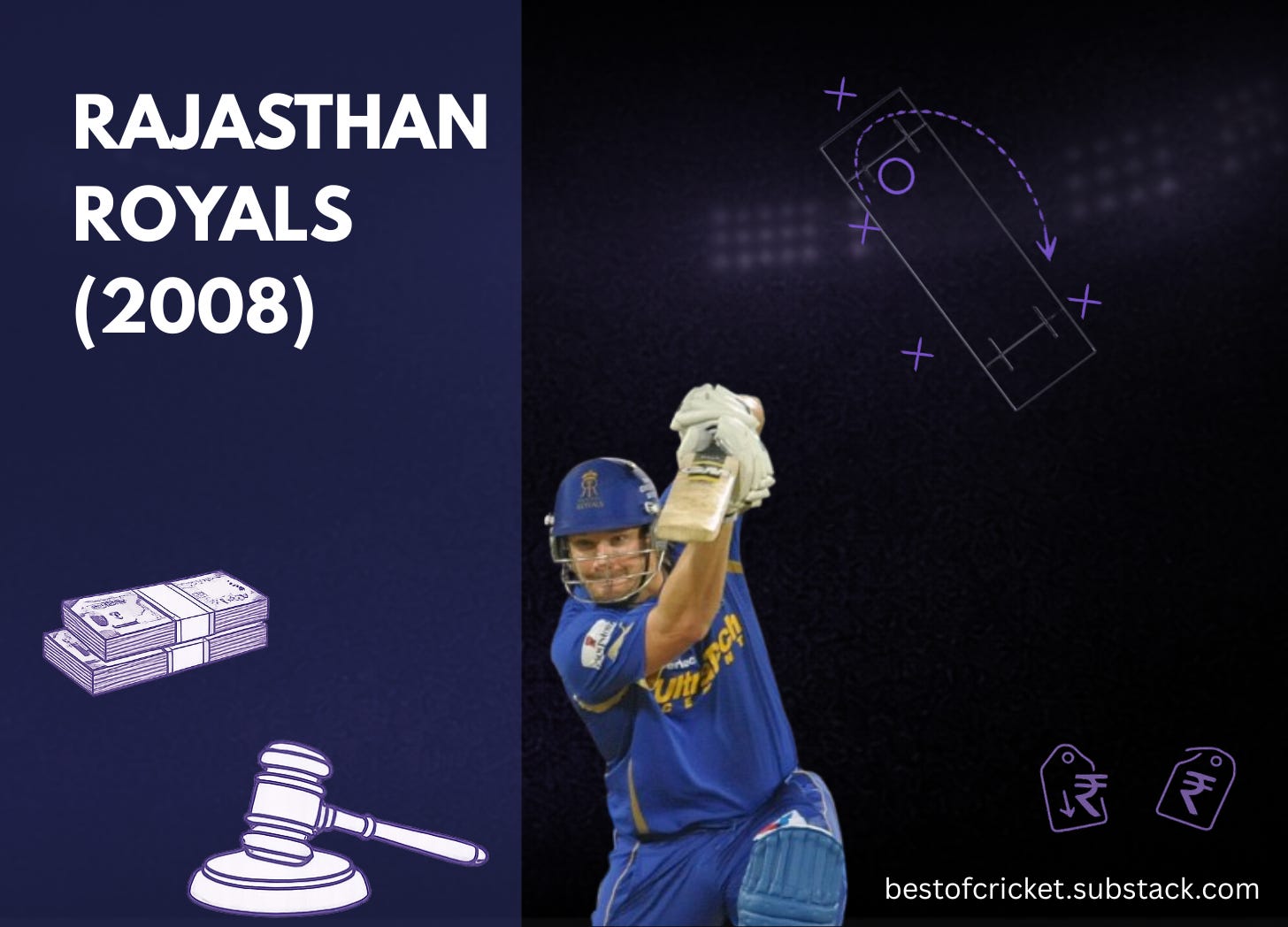
Superstars: Yusuf Pathan ($475K), Shane Warne ($450K), Shane Watson ($125K), & Sohail Tanvir ($100K).
Stars: None.
Quality Starters: Munaf Patel ($275K), Graeme Smith ($250K), & Kamran Akmal ($150K).
Below Average Starters: None.
Flops: Mohammad Kaif ($675K).
RR’s biggest buy of the auction was a flop. Mohammad Kaif ($675K) only scored 176 runs at an average of 16 and a SR of 103 in 2008, and was released immediately. However, that was the only significant mistake the first IPL champions made.
33 players were sold at half a million dollars in the first auction, but RR got their captain and face of their franchise for less than that. 38-year old Shane Warne ($450K) was an instant success, and took 44 wickets in 42 matches in the first IPL cycle.
Under Warne, RR’s high-potential but high-risk auction strategy was made a success..
Yusuf Pathan ($475K) was one of the league’s earliest stars, scoring 435 runs at 179 (in 2008!), including a Player of the Match performance in the final. Shane Watson ($125K) did even better, picking up the first league MVP in 2008 for his unexpected exploits with bat and ball. In all, he scored 472 runs at an SR of 151.8, and took 17 wickets at an economy of 7.07.
Two of the three players above Watson in the Purple Cap race? Shane Warne with 19 wickets, and Sohail Tanvir ($100K) with 22 – in just 11 games! Tanvir had an average of 12.09 and an economy of just 6.46. Most impressively, he took 16 wickets at the death, at an economy of 6.56.
RR’s bargain hunting didn’t end there. Greame Smith ($250K) scored the fifth-most runs in 2008 with 441 runs, while Munaf Patel ($275K) took 30 wickets in 26 innings across 2008-09.
RR made up for their mistake with Kaif by signing four genuine stars in the mid-level and bargain range, plus a couple of fantastic role players. No one expected RR to get even a sniff of the title in 2008. It was their brilliant recruitment – along with Warne’s leadership – that helped RR win what remains the most unlikely title in IPL history.
New Player Value score: 9/10
As the league’s first-ever winners, it would be fair to say no auction has directly contributed to a title win more than RR’s 2008 Mega Auction.
Watson and Pathan were the top two players in ESPNCricinfo’s 2008 MVP leaderboard, while Tanvir and Warne were the league’s top two wicket-takers. For the 2008 season, RR had four genuinely MVP-caliber players on the same team. Meanwhile, Smith ranked in top 10 batters by impact according to ESPNcricinfo (alongside, of course, Watson and Pathan).
However, unlike other teams on this list, RR dropped off in the latter years of this cycle. They didn’t make the postseason in 2009 or 2010. Tanvir would never play after 2008 due to the Pakistani player ban, while Watson could only play 6 more games in 2009-10 due to injuries. Pathan and Smith could never replicate their fairytale form of 2008, leaving Warne as the lone star in a side that dropped back to their predicted mid-table ranking in following years.
However, considering the instability and uncertainty surrounding the first auction – and the complete miss on their “franchise” player in Kaif – RR’s 2008 was so successful it overrides a lot of those negatives. This side’s flame may not have burned as long as the others on this list, but it’s hard to argue that any other IPL team has ever burned brighter.
Cycle Impact score: 4.5/5
Ahead of the new auction cycle in 2011, RR retained Warne and Watson. The skipper would only play one more season, but he went out on a high with 13 wickets in 12 innings at an economy of just 6.31.
Watson remained a part of the Royals until their suspension in 2015. He topped his 2008 run total in 2013 with 543 runs, even as he was asked to bat in every position from No.1 to No.5. He also picked up 13 wickets at an economy of 7.15, winning his second MVP that year.
Watson was RR’s highest run-scorer and wicket-taker when he left in 2015. He’s still in the Top 5 for the former, while the latter record stood until 2026 when Jofra Archer finally went past him.
Longevity score: 2.5/3
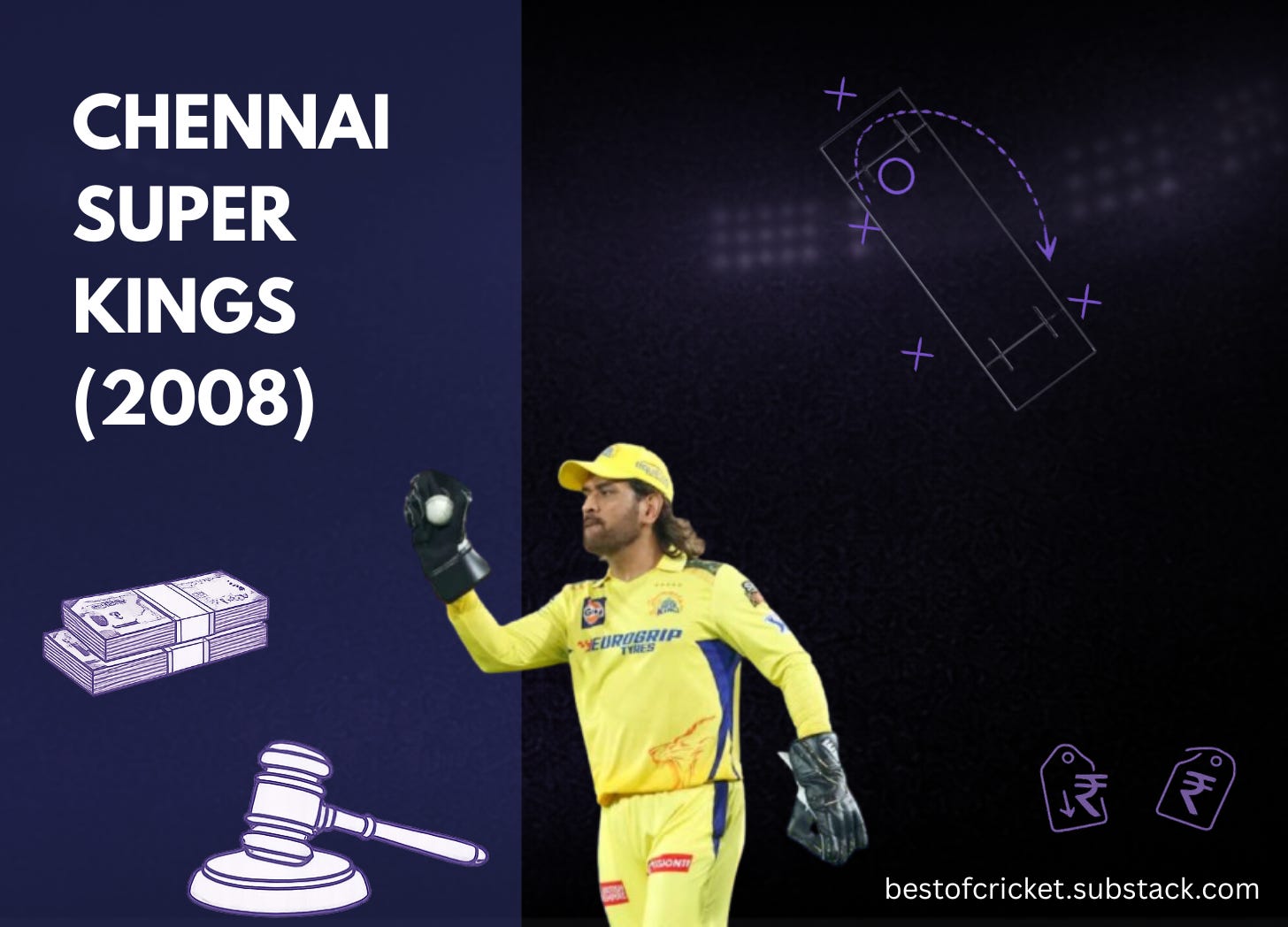
Superstars: MS Dhoni ($1.5M), Albie Morkel ($675K), Suresh Raina ($650K), Muttiah Muralitharan ($600K), & Matthew Hayden ($375K).
Stars: None
Quality Starters: Makhaya Ntini ($200K).
Below Average Starters: Stephen Fleming ($350K), & Parthiv Patel ($325K).
Flops: Jacob Oram ($675K).
CSK’s signing of MS Dhoni for $1.5 million was one of the most significant moves in IPL history. Despite his hefty price tag, which was 30% of the team’s purse, Dhoni led his side to three consecutive playoffs in the first auction cycle, including a title in 2010. With the bat, the wicketkeeper was among the league’s best middle-order batters, scoring 1,033 runs at a SR of 132.3 in 2008-10.
Suresh Raina ($650K) was the IPL’s leading run-scorer across the first three seasons, scoring 1,375 runs at a SR of 142.2. Albie Morkel ($675K) scored 536 runs at an SR of 147.3 in the first three years, along with 41 wickets. Muttiah Muralitharan ($600K) was CSK’s go-to spinner during his 3-year stint, taking 40 wickets at an economy of 6.37. Their only big-money failure was Jacob Oram ($675K), who featured in 15 unimpressive games.
Amongst the mid-level signings, Matthew Hayden ($375K) only played 4 games in 2008 (scoring 189 runs), but picked up the Orange Cap in 2009 with 572 runs at a SR of 144.8.However, CSK’s other mid-level batters weren’t as successful.
Stephen Fleming ($350K), & Parthiv Patel ($325K) were CSK’s first-choice openers in the early years, but didn’t convince. The former could only score 196 runs in 10 innings at 118.8, while the latter put up 516 runs in 26 innings at 102.8.
CSK’s bargain buys were largely uneventful, but Makhaya Ntini ($200K)’s nine-game stint was notable. He took 7 wickets at an economy of 6.91, including a vital 2/23 in the 2008 semi-final against Kings XI Punjab.
CSK did not have the most balanced auction across categories, but a historic big-money haul gave them a uniquely successful Mega Auction strategy. They nailed their biggest signings, picked up an Orange Cap winner for a mid-level amount, and bought the captain that would lead them to five wins in 14 seasons.
New Player Value score: 9/10
CSK picked up the cycle’s leading run-scorer, an Orange Cap winner, the best captain in IPL history, a legendary lead spinner, and one of the best IPL all-rounders of all time in a single Mega Auction. They reached two finals and one semi-final, won a title in 2010, and set up the core of their team for a championship repeat in 2011.
Morkel’s all-round returns of 241 runs at 147.9, plus 17 wickets, in 2008 made him one of the top 5 players in the league according to ESPNcricinfo’s MVP leaderboard. You could argue he barely made CSK’s top 5 auction buys, with their best batter (Raina; 421 runs with 142.7 SR), best spinner (Muralitharan, 11 wickets at 6.96 economy), and tone-setting captain (Dhoni) all part of the auction haul.
In 2009, CSK finished second in the league table, with Raina (434 runs at 140.9) making hay on the tricky South African surfaces. He also got 7 wickets at an economy of 5.92 as a part-time spinner. Raina and Orange Cap winner Hayden would rank as the most valuable players of the season according to ESPNcricinfo’s Impact Ratings – even if neither won the official award.
In 2010, CSK finally got over the hump and won their first title. Fittingly, Raina was the star of the campaign with 520 runs at 142.9 and 6 wickets – and a Player of the Match performance in the final. Morkel and Muralitharan featured prominently, while Dhoni continued to lead from the front.
CSK’s Mega Auction performance led to arguably the most consistent IPL cycle ever, earning them a full score in the Cycle Impact criterion.
Cycle Impact score: 5/5
CSK retained 3 of their auction buys from 2008 ahead of the 2011 auction cycle: Dhoni, Raina, and Morkel.
Dhoni led CSK to a further four titles in 2011, 2018, 2021, and 2023. Raina would remain CSK’s leading run-scorer across his 12-season stint with 5,528 runs, That’s still good for the sixth most runs in IPL history and the most runs in CSK’s history – four seasons after he retired.
Longevity score: 3/3