
Formula 1 could learn plenty from Max Verstappen’s Nurburgring 24 Hours debut.
No, I’m not advocating for F1 to ditch its energy-starved 2026 cars for a field of better-sounding GT cars, nor hold all of its 24 rounds on the Nordschleife (although a new F1 showrun there is well overdue).
But there are genuine lessons F1 can take from how I saw the entire Nurburgring 24 Hours event play out.
First off. The barrier to entry.
Weekend tickets were sold for £69. That kind of price would struggle to even get you a single-day general admission ticket to watch two practice sessions on the Friday of a British Grand Prix.
That’s despite the Nurburgring 24 Hours organisers long being aware of the prospect of Verstappen racing. Yet no huge price hike year-on-year.
It got people through the door (or forest gate) with an F1-comparable 352,000 people reported to be in attendance across the weekend.
F1 is sorely lacking that kind of financially accessible ticket option at many of its races.
That may not directly hurt it, if you take a ‘well, most races are sold out anyway, so why change?’ stance.
Yes, F1 is a business and every circuit needs to make a return on the huge investment of hosting an F1 race. But it shouldn’t be your hardcore fans parting with their hard-earned cash who are footing that bill.
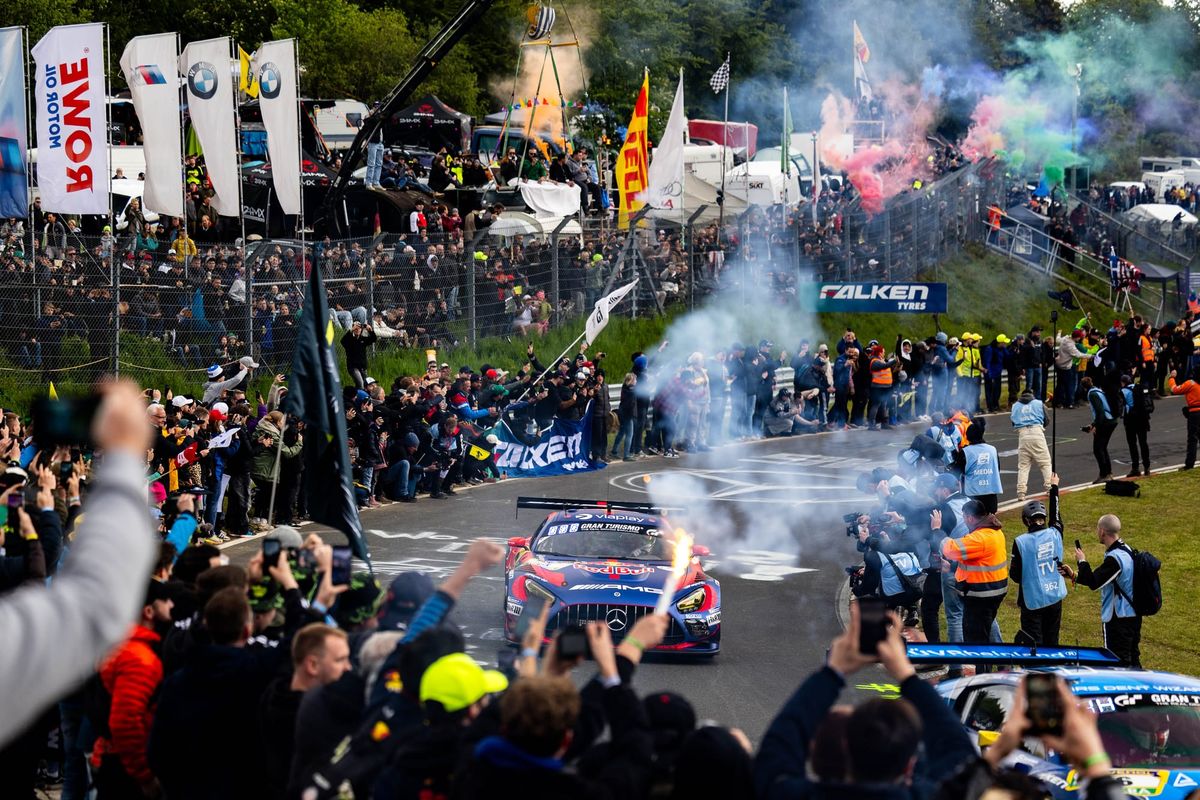
Then there’s the spectacular Nurburgring 24 Hours formation lap with fans lined along the circuit to get properly up close and personal with the stars.
It’s a beautifully ceremonial start to the race and a good reminder that racing is impossible without fans.
Sure, doing that on the actual formation lap before the F1 race would probably be a logistical and safety nightmare – but is there anything to stop it happening during the drivers’ parade?
Currently, F1 fans are locked away in the grandstands, far too distant from the drivers who are being paraded around to engage with them.
Similarly the open-to-fans paddock at the Nurburgring 24 Hours was fantastic for everyone to be able to get up close with the stars and their cars.
F1 does allow fans into the paddock, but usually only for a hefty price.
A completely open paddock would be impractical, but it could consider how it can let more fans into the paddock, without there being such a high cost barrier.
Another lesson is remembering that the drivers are the stars. The cars in the Nurburgring 24 Hours are mesmerising, but the implosion of interest in the event in 2026 is down to one driver.
A driver with huge star power who has gone the extra mile to complete this event because it was so attractive to him as a driving challenge.
Verstappen then has to return to his ‘day job’ next weekend in Montreal, and the contrast between his Nurburgring positivity and his growing disillusionment with the product F1 has produced is clearly evident.
F1 is failing if a driver as good as Verstappen – and with the star appeal to convert thousands of fans to whatever he sets his attention to – only really has negative things to say about the product.
And those views are shared by plenty of fans who tuned in this weekend and enjoyed the racing being the central theme rather than management.
There was, of course, plenty of management in the Nurburgring 24 Hours, but it didn’t swallow the spectacle as it has at times in F1.
I spoke to many first-time Nurburgring fans throughout the week and there was a common theme: we love the racing here, we didn’t realise that motorsport can be like this.
F1’s trying to rectify that with both its mid-2026 and more comprehensive 2027 rule changes.
And its, likely V8-led, future is more promising when it comes to delivering something both the drivers and fans can get behind.
It’s just a shame it didn’t have that realisation prior to implementing the 2026 rules.
At the Nurburgring, everything else is secondary to the racing. That’s exactly how motorsport should be. And it’s a line that it feels like F1 has veered over at times – not least with so much of the early 2026 conversation being about its energy-starved cars.
This week’s Nurburgring 24 Hours felt like a time capsule of a bygone era. One before social media. One before the torturous commercialisation of everything.
Walking through the campsite forests of the Nordschleife, all I saw were passionate motorsport fans and breathtaking views of racing cars being pushed to their limits on one of the world’s greatest circuits.
That’s exactly what motorsport should be. It’s what F1 can be – and is – at times. But if it ever needed a reminder, then its four-time world champion has just shone a spotlight on what it can’t forget as it shapes its future.