
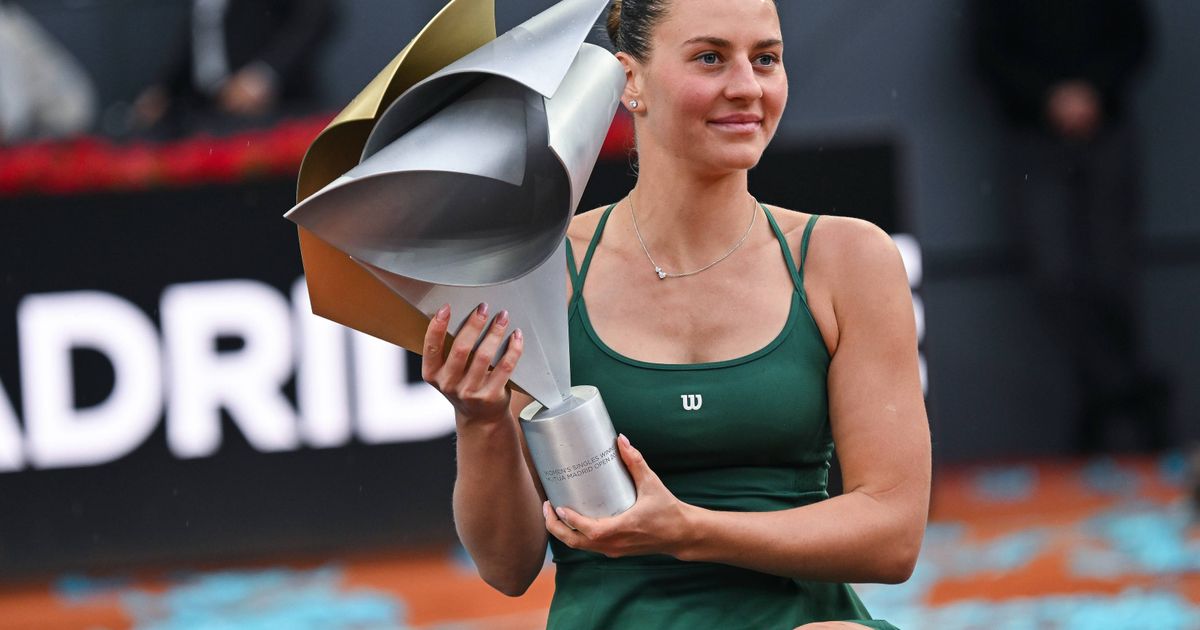
Her Madrid title confirmed a broader upward trend in the 2026 season, where she has been among the most consistent performers on the WTA Tour, losing only a handful of matches, including against Elena Rybakina and Aryna Sabalenka. However, the physical cost of her clay-court surge quickly became part of the narrative.
The 23-year-old has been one of the most consistent players on the clay swing, compiling an 11–0 run with titles at the Rouen Open and Madrid Open. That streak extended to 12 consecutive victories including her Billie Jean King Cup qualifier win over Magda Linette on clay, and she has not lost a match since March at the Miami Open against Elena Rybakina.
Breakthrough season, mindset shift and coaching stability
Kostyuk’s 2026 season has been defined not only by the Madrid title, but by a sustained increase in consistency that has taken her to a career-high ranking. She attributed this progression to long-term work with her team rather than a single technical adjustment.
“I think we’ve done a lot of work with my team. Good days, bad days, you know how it goes. I think it was just a matter of time. I’ve always felt like I can be there, but things were not aligning. In tennis you need a lot of things to align to win big tournaments. I’m very happy I’m in this position now, but it took many years to come here.”
Marta Kostyuk of Ukraine celebrates the victory after the Women’s Singles final match against Mirra Andreeva at the 2026 Mutua Madrid Open
Her relationship with coach Sandra Zdanowska has been central to that evolution. Kostyuk described a dynamic built on emotional openness and detailed communication, which she sees as essential given her own intensity on court.
“She brings something that allows me to be myself, and I’m not afraid to be myself. I am a very emotional, very explosive, very honest person. I think we are both emotionally mature, and we handle difficult situations well. We never cross certain lines, which we agreed on.”
She added that the relationship is defined by constant dialogue, extending beyond technical instruction into emotional and psychological understanding of performance.
“We go into depths of pretty much any topic you can pick in life, in tennis, whatever it is. I think that respect and emotional maturity helps us on a daily basis and understanding each other.”
Madrid title, hip injury and Rome withdrawal
Kostyuk’s Madrid campaign ended with a title, but the aftermath revealed the physical strain of her run through the draw. She explained that the hip issue became progressively more problematic in the final stages of the tournament before peaking immediately after the final.
She navigated a demanding path to the title, defeating strong opponents including Jessica Pegula, Linda Noskova and Anastasia Potapova before overcoming Mirra Andreeva in the final, dropping only one set en route. Across the tournament, she also won 24 of her last 27 sets on clay, underlining the level of dominance she produced during the swing.

“My hip was not good at all. It was not good for the past three matches. After I woke up after the finals, I couldn’t walk. It wasn’t good at all, and I was really scared that something happened.”
“I did MRI and it wasn’t bad, but it wasn’t as good as we wanted it to be. It made no sense to push for Rome because I knew maybe I could play one match, but then I don’t know what would happen. I’m happy I made that decision.”
Ukrainian tennis context, upbringing and long-term perspective
Kostyuk also placed her season within the broader rise of Ukrainian tennis, which has produced consistent results across the WTA Tour in recent months. She highlighted the significance of shared success among Ukrainian players during a period of ongoing national disruption.
While acknowledging the symbolic weight of these results, she stressed that her focus remains on performance consistency rather than external narrative expectations tied to national representation.
“It’s incredible. Every single week a Ukrainian player was winning a title. Being able to share these emotions with Ukrainian players during this time, there is not much more I can ask for. The most important thing is that people in Ukraine are happy and celebrating with us.”
Her reflections also extended to her upbringing in a tennis family, where exposure to the sport began extremely early due to her mother’s professional background. “I think my mom was on court the day she gave birth. I don’t remember my life without tennis courts.”
Finally, Kostyuk addressed the pressures associated with early success, noting that her rapid rise through junior and early professional levels required a significant adjustment period to manage expectations and sustain consistency at elite level.
“I don’t think people understand how much it takes to be consistent at this level. I wasn’t handling success well back then. If I had more of it, I wouldn’t be sitting here now.”