
Posted on
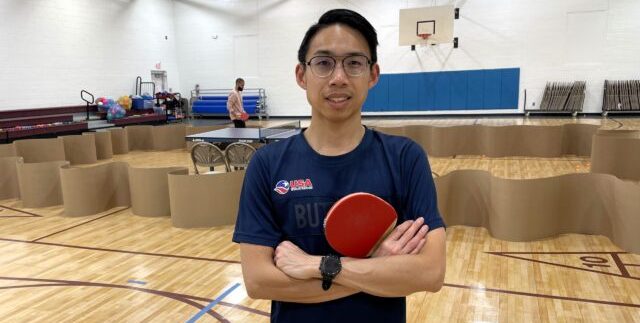
(by Dr. Alan Chu, PhD, CMPC)
The Mental Edge That Won the World: Lessons from Team China at London 2026
On May 10, 2026, inside a sold-out OVO Arena Wembley, Team China did something that no longer surprises the table tennis world. They won again in both the men’s and women’s titles, but what made London 2026 different was how they got there.
This was not a dominant, trouble-free sweep. China Men’s Team lost back-to-back group-stage matches to South Korea and Sweden, revealing a level of vulnerability rarely seen from the defending champions. China had to fight, and they did with a mental edge that offers powerful lessons for every table tennis player. This article mentions a few of those with practical tips to take away.
Liang Jingkun and the Art of the Comeback
If there is one player whose performances captured the tournament’s psychological drama, it was Liang Jingkun. In the semi-final against France, the tie swung on a stunning comeback by Liang, who conceded only four points across the opening two games but somehow recovered to defeat Alexis Lebrun after saving several match points.
Astonishingly, or not, he did it again the very next day. Just one day after rallying from two games down, Liang repeated the feat against Japan’s top player Tomokazu Harimoto in the final. Liang struggled early on, dropping the opening two games 11–8 and 11–4, but found his rhythm and turned the match around, including winning 8 points in a row in the last game when down 3–8.
Two 0–2 deficits, two comebacks, two days in a row. How does someone do that?
Reframing Pressure: Challenge and Opportunity
When a player is 0–2 down in a table tennis match, the brain is doing something very unhelpful. It is treating the deficit as a threat, triggering anxiety, and causing you to play tight. The key mental shift is moving from threat to challenge. Research in sport psychology shows that by reframing pressure situations as challenges and opportunities for growth, athletes can be more composed and resilient to perform under pressure and overcome obstacles.
Liang’s coach, Wang Hao, seemed to understand this intuitively. Rather than offering comfort or tactical tweaks, Wang Hao inspired the turnaround with blunt words during his 0–2 against Lebrun, “You’ve already lost the match indeed. When you go back out there, fight like a man”! It was a radical reframe — by telling Liang the match was already lost, the pressure of saving it evaporated. What remained, instead, was freedom to perform.
Apply it to your game: When you find yourself falling behind, try deliberately reframing the situation. Instead of “I can’t afford to lose this point,” try “I’ve got nothing to lose — let’s attack.” This isn’t wishful thinking; it’s a science-backed cognitive strategy that literally changes how your brain processes the situation.
Implementing Self-Talk: The Inner Coach at the Table
One of the most well-researched tools in sport psychology is self-talk — the internal (or sometimes very external) dialogue athletes have with themselves during competition. Watch Liang’s body language during his comeback: roaring after winners, pumping his fist, talking himself forward.
From the third game in both matches, he began playing with conviction, roaring after winners and stepping around the table with renewed aggression. This is not coincidental emotion — it is a feedback loop. Expressing intensity outwardly reinforces it internally, and research confirms that productive use of self-talk can facilitate helpful thought patterns and emotions, leading to improved performance outcomes.
Apply it to your game: Develop 2–3 short personal cue words or phrases for key moments. “Play free,” “stay aggressive/patient,” or “next point” can redirect your attention during a tough rally. Practice using them in training so they become automatic under pressure in a match when thinking time is measured in milliseconds.
Harnessing Social Support: The Team Behind the Team As I alluded to in my previous post, table tennis is a team sport! One of the most moving moments at London 2026 came not from Liang himself, but from what his comeback meant to his teammates. “I think Liang’s victory gave all of us confidence,” Wang Chuqin said. “Even after losing the first game [to Sora Matsushima], I stayed calm because the team spirit was already there.” Beyond the three players who fight on the court, Wang Hao had to steady the ship after difficult early results. Squad members Xiang Peng and Zhou Qihao also played their part, constantly keeping their teammates motivated and driving the energy while on the bench.
This reflects something that has been documented clearly. Research on competitive athletes found that social resources and social competence predicted greater mental toughness, suggesting that a strong social support system strengthens an athlete’s resilience during challenging moments. Bench players and support staff do shape the outcome because of team effort.
Apply it to your game: Build a support network with training partners who encourage you during rough patches, a coach who challenges rather than coddles you, and even a training diary where you track mental (not just physical) progress. All of these are necessary performance resources, not extras.
Moral of the Story
The 2026 World Championships didn’t just crown champions; they offered a masterclass in what happens when mental preparation meets the biggest stage. You may not be playing at Wembley, but the same principles apply at every level of the game.


 Stay “In The Loop” with Butterfly professional table tennis equipment, table tennis news, table tennis technology, tournament results, and We Are Butterfly players, coaches, clubs and more.
Share the post “The Mental Edge That Won the World: Lessons from Team China at London 2026”