
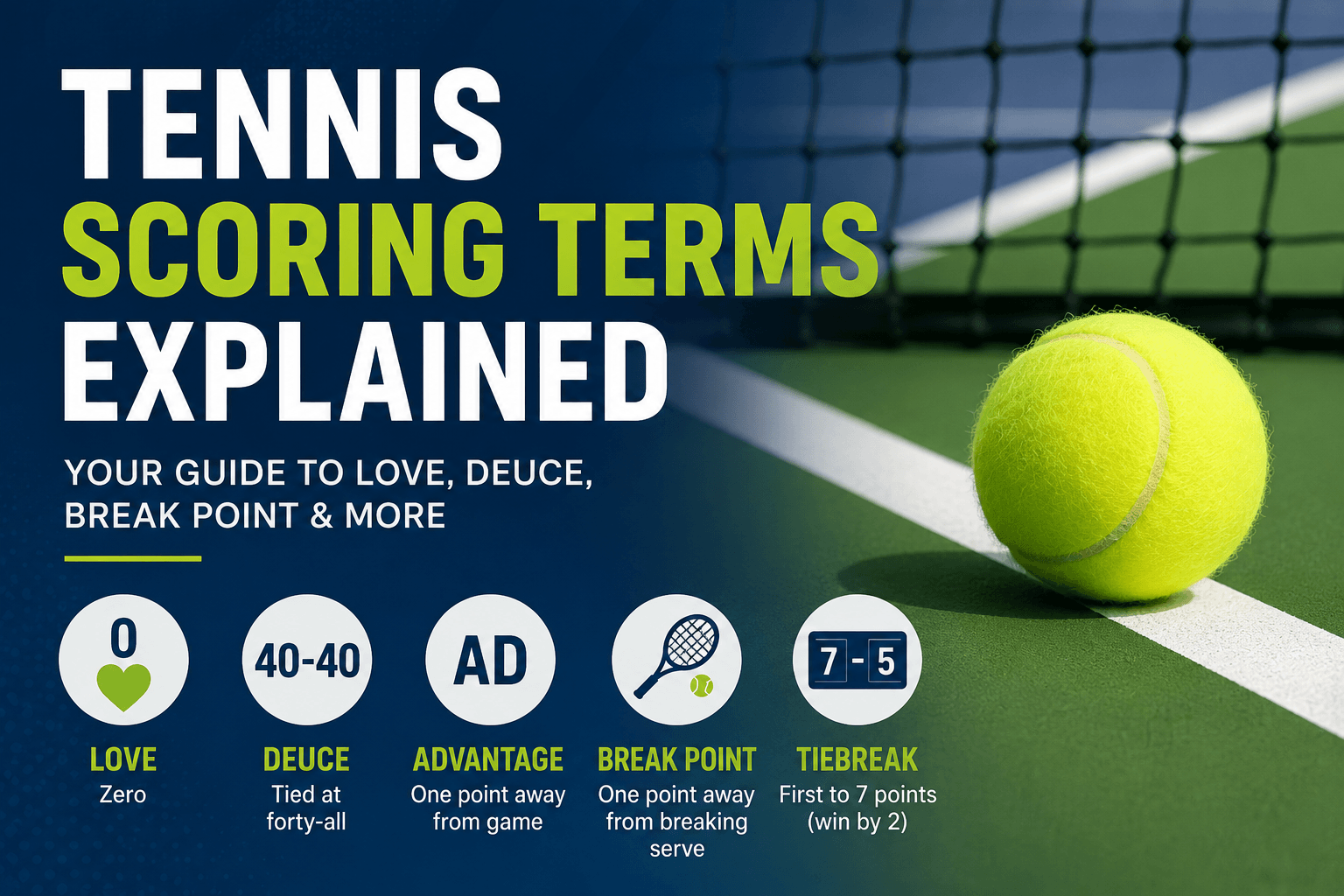
Tennis has one of the most unique scoring systems in sport, with terms like love, deuce, break point, and tiebreak often confusing new fans and players.
In this guide, you’ll learn the most important tennis scoring terms, what they mean, and how they are used during a match.
How Tennis Scoring Works
A tennis match is made up of:
- Points
- Games
- Sets
- Match
Players win points to win games, games to win sets, and sets to win the match.
Basic Tennis Point Scoring
The standard point sequence in tennis is:
| Points Won | Tennis Score |
|---|---|
| 0 | Love |
| 1 | 15 |
| 2 | 30 |
| 3 | 40 |
| 4 | Game (if leading by two points) |
Example:
- 15–0 = server won the first point
- 30–15 = server has two points, opponent has one
- 40–30 = server is one point away from winning the game
Common Tennis Scoring Terms
Love
“Love” means zero points.
Examples:
- Love–15
- 30–Love
- Love–Love
Nobody knows the exact origin of the term, but it has been used in tennis scoring for centuries.
Deuce
Deuce occurs when both players reach 40–40 in a game.
At deuce, a player must win two consecutive points to win the game.
Advantage
After deuce:
- The player who wins the next point gets the advantage
- If they win the following point, they win the game
- If they lose the next point, the score returns to deuce
Examples:
- Advantage Federer
- Ad-In (server has advantage)
- Ad-Out (receiver has advantage)
Game
A player wins a game by winning at least four points and leading by two points.
Example scores:
- 40–15 → one point from game
- Advantage → one point from game
Set
A player wins a set by winning at least six games and leading by two games.
Common set scores include:
If the score reaches 6–6, a tiebreak is usually played.
Match
Matches are usually played as:
- Best of 3 sets (most ATP/WTA events)
- Best of 5 sets (men’s Grand Slams)
The player who wins the required number of sets wins the match.
Tiebreak
A tiebreak is used to decide a set when the score reaches 6–6.
Players score points normally:
The first player to reach 7 points with a two-point lead wins the tiebreak and the set.
Example:
Super Tiebreak
A super tiebreak is often used instead of a final set in doubles matches and some tournaments.
The first player/team to reach 10 points with a two-point lead wins.
Break Point
A break point occurs when the receiving player is one point away from winning the game on the opponent’s serve.
Examples:
- 30–40
- Advantage receiver
Breaking serve is considered very important in tennis because serving gives a natural advantage.
Service Break
A service break happens when a player wins a game on their opponent’s serve.
Example:
If the score moves from 2–2 to 3–2 after the receiver wins the game, they have broken serve.
Hold Serve
Holding serve means winning your own service game.
Players with powerful serves often have high hold percentages.
Double Fault
A double fault happens when a player misses both serves on the same point, automatically losing the point.
Ace
An ace is a serve that the opponent cannot touch with their racket.
Big servers like John Isner and Ivo Karlović are famous for hitting large numbers of aces.
Let
A let occurs when:
- The serve clips the net
- But still lands in the correct service box
The serve is replayed without penalty.
Unforced Error
An unforced error is a mistake made by a player without heavy pressure from the opponent.
Examples include:
- Missing an easy forehand
- Hitting a simple volley into the net
Winner
A winner is a shot that lands in and cannot be returned by the opponent.
Love Set
A love set is a set won 6–0.
Example:
Bagel and Double Bagel
A “bagel” is slang for winning a set 6–0 because the zero resembles a bagel. A “double bagel” is when you win 6-0, 6-0.
Breadstick
A “breadstick” refers to a 6–1 set score.
Golden Set
A golden set is when a player wins a set without losing a single point.
It is extremely rare in professional tennis.
Tennis Scoring Example
Here’s an example of how scoring progresses in a game:
- Love–Love
- 15–Love
- 15–15
- 30–15
- 40–15
- Game
If the score reaches 40–40:
- Deuce
- Advantage Player A
- Deuce
- Advantage Player B
- Game Player B
FAQs
Why does tennis scoring go 15, 30, 40?
The exact origin is unclear, but it is believed to come from old French clock-face scoring systems used in early tennis.
What does “love” mean in tennis?
Love means zero points or zero games in tennis scoring.
What is deuce in tennis?
Deuce occurs when both players reach 40–40. A player must then win two consecutive points to win the game.
What is a break point in tennis?
A break point is when the receiving player is one point away from winning the server’s game.
What is the difference between a tiebreak and a super tiebreak?
A standard tiebreak is usually played to 7 points, while a super tiebreak is played to 10 points.
What does “holding serve” mean?
Holding serve means winning your own service game.
What is a bagel in tennis?
A bagel is slang for a 6–0 set score.
What is a golden set?
A golden set is when a player wins an entire set without losing a single point.