

The Brussels Court of Appeal ruled that the UCI cannot use safety regulations to unfairly target specific drivetrain manufacturers.
(Photo: Josh Ross/Velo)
Updated May 21, 2026 02:06PM
The Union Cycliste Internationale (UCI) suffered a definitive defeat in its ongoing legal battle against SRAM, losing its appeal to the Belgian Competition Authority (BCA).
This news is the latest in an ongoing back and forth legal proceedings between SRAM and the UCI that largely played out at the end of last summer. As reported in June, the UCI had planned to initiate a maximum gearing test in select races starting August 1, 2025.
The 54×11 Restriction and the 10-Tooth Cog
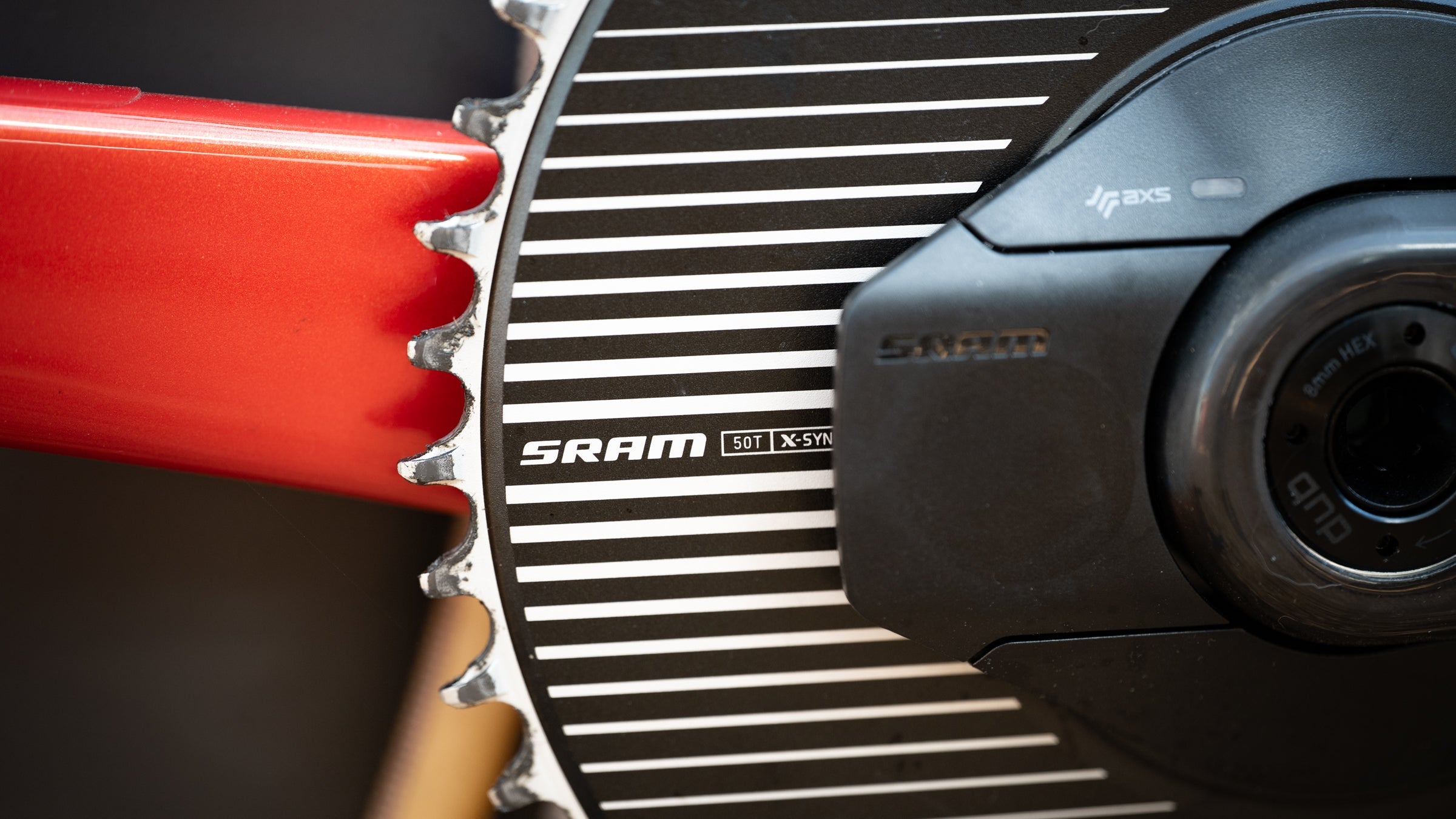
The suggested protocol would have limited riders to a maximum of 54×11 gearing in an effort to increase safety by slowing riders down. The problem for SRAM in that scenario was that the American company had already chosen to differentiate its drivetrains through the use of a 10-tooth cog. By structuring the rule as it did, the UCI favored Shimano gearing, giving Shimano a slight advantage in the maximum achievable gear ratio under the rules.
BCA Halts Testing
In response, SRAM initiated legal proceedings against the UCI through a formal complaint submitted to the BCA. On October 9, SRAM scored a win when the BCA stated that “SRAM is one of the two main suppliers of transmission systems for road bikes used by professional riders and the only one that does not currently have a product meeting the requirements of the Maximum Gear Ratio Standard. The standard, adopted under disputable conditions, is likely to cause harm to SRAM that is serious and difficult to repair, thereby justifying its suspension. The harm also extends to professional cycling teams equipped with SRAM transmission systems. Furthermore, the urgency of adopting interim measures is motivated by the first application of the Maximum Gear Ratio Standard during the Tour of Guangxi in China, starting on 14 October 2025, which closes the UCI World Tour calendar for this season.”
The decision immediately stopped the testing as the BCA required the “UCI to suspend immediately, and no later than 13 October, the implementation of the Maximum Gear Ratio Standard.” The BCA also prohibited the UCI from “imposing transmission ratio limitations or taking any other measure having the direct or indirect effect of prohibiting the use of certain types of transmission systems in any professional road cycling event governed by the UCI, either until the UCI adopts a new safety measure based on a transparent, objective and non-discriminatory procedure, or until a decision on the merits is adopted.”
To further lend weight to the decision, the BCA stated that “The implementation of the interim measures adopted today will be monitored by the BCA’s Investigation and Prosecution Service. In the event of non-compliance, the imposition of penalty payments may be requested from the BCA’s Competition College, which will also arbitrate disputes concerning the interpretation of its decision. The decision will soon be published on the website of the BCA.”
At the time, the last requirement of the decision was that the UCI publish “within 24 hours following the date of notification of the decision, a press release indicating that the Maximum Gear Ratio Standard is not applicable and referring to the BCA’s decision.” The UCI did this, but also made clear that the organization intended to appeal the decision.

The Court’s Final Verdict
That brings us to today where the appeal has been heard and the decision handed down. The court accepted the appeal from the UCI and the “voluntary interventions of SRAM LLC, the Association of Associated Professional Cyclists, the International Association of Cycling Race Organizers, Argyle Sports Inc., Q36.5 Pro Cycling Team AG, Red Bull Pro Cycling GmbH & Co. KG, Yellow B. Cycling B.V., and Lauke Pro Radsport GMBH admissible.”
However, once accepted, the appeal from the UCI was not successful. The court upheld the ruling that the 54×11 gear restriction unduly damaged SRAM as the only supplier without a product that met this standard. Because of this, the court also upheld that the UCI’s protocol risked causing “serious and irreparable harm” to both SRAM’s brand reputation and the sporting results of the teams using its equipment. Further, these rulings precluded the UCI from acting purely as a sports regulator because of the market results that could come from a rule of this nature.

SRAM Responds
SRAM CEO Ken Lousberg responded to today’s news, saying, “This case began as a dispute about our 10-tooth cog. Today’s ruling is much bigger than that. The Brussels Court of Appeal has issued a groundbreaking ruling on how sports federations across Europe must exercise regulatory power. The Court upheld the Belgian Competition Authority’s previous findings that open, transparent, objective, and non-discriminatory governance is the legal standard for rule-making in sport. It endorsed that reasoning in full, applying well-established European Court of Justice case law in a way that will guide federation governance well beyond this case, and sharply rebuked the UCI’s appeal.”