
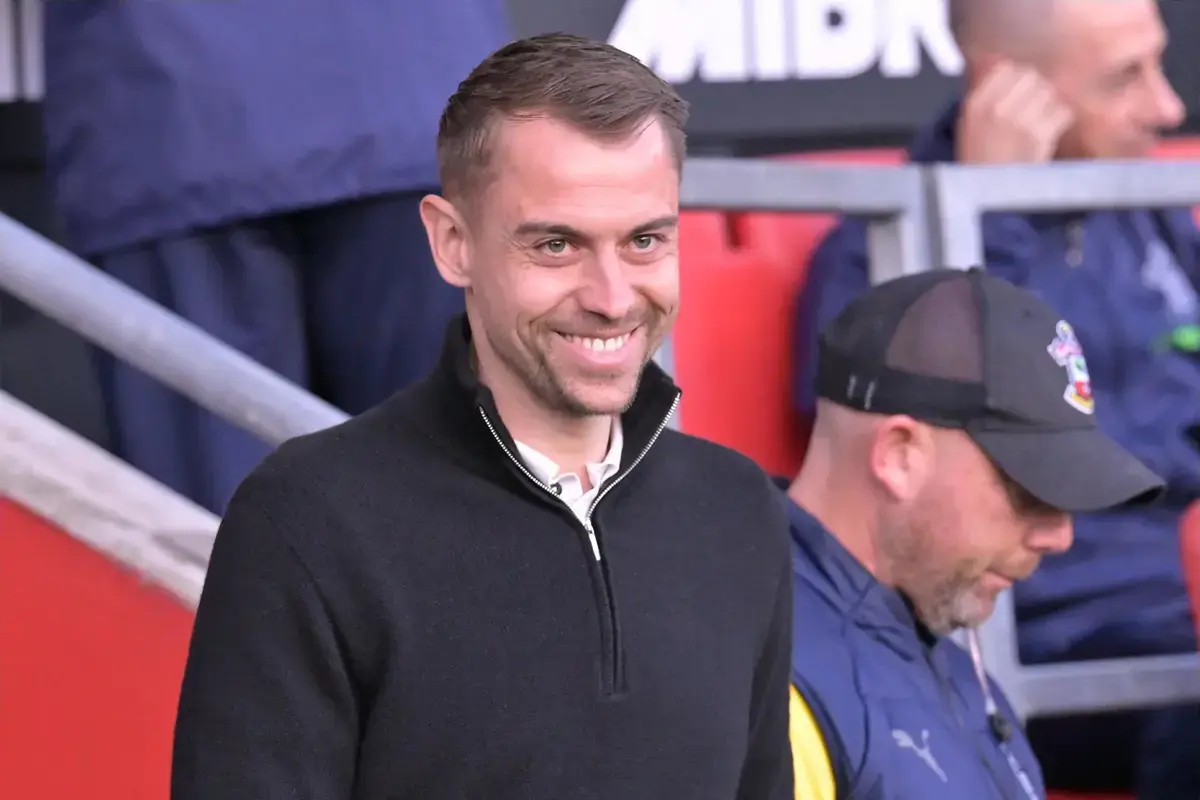
There have been new revelations from the Spygate investigation, the written reasons of the commission’s judgement now showing Southampton in an even worse light. If that is possible.
William Salt was the 23-year-old Southampton intern and this is what the independent commission have said about him.
The written reasons for the judgement against Southampton including: ‘The three-person panel’s judgment states: “The EFL submitted that the evidence supported the view that the observations were authorised at a senior level and that the task was delegated to the intern in relation to the MFC [Middlesbrough] incident and the OU [Oxford] incident. He declined to be involved in the IT [Ipswich] incident. We heard evidence from the intern who described the pressure he was placed under.”
When William Salt refused to go to spy on Ipswich Town training, Southampton then sent somebody else.
The Times report: ‘The revelations, contained in the written reasons of the commission’s judgement, appear to make the position of Southampton’s head coach Tonda Eckert untenable — the use of a junior staff member was described as “deplorable”.
The written reasons from the commission also said that a reprimand was issued as well as the sporting sanctions “because of the way in which junior members of staff were put under pressure to carry out activities which they felt were, at the least, morally wrong”.
Southampton were kicked out of the play-off final and deducted four points next season.
The written reasons going on to add: “Such staff were in a vulnerable position without job security and with limited ability to object to or resist the instructions given to them. We have concluded that there was, on the part of the respondent [Southampton], a contrived and determined plan from the top down to gain a competitive advantage in competitions of real significance by deliberate attendance at opposition training grounds for the purpose of obtaining tactical and selection information. It involved far more than innocent activity and a particularly deplorable approach in its use of junior members of staff to conduct the clandestine observations at the direction of senior personnel.”
To make matters even worse, the commission has also now revealed that Southampton had initially made false claims to the EFL on May 8 about the spying: “Southampton acknowledged that in its initial response to the EFL on May 8, 2026 it provided inaccurate information, suggesting that the conduct was not part of the SFC’s culture and that no video footage was captured, transmitted, shared or analysed, when in fact the opposite was the case. There was transmission and internal dissemination and analysis of footage and observations.”
The Southampton boss Tonda Eckert (pictured above) admitted that he had authorised the missions to Middlesbrough and Oxford, but Southampton claimed to the commission that they had “derived no material sporting or competitive advantage from viewing and filming opponents’ training”.
That begs the question, if they were deriving no advantage from the spying, why do it?
The FA have waited until after the EFL’s hearing was finalised and are now expected to issue charges against individuals who commissioned or participated in the spying.
This is sure to include Tonda Eckert.
The Times though say “he is expected to claim he was not informed about the rule — which was brought in after a similar case involving Leeds United in 2019 — when he took over as head coach. Spying on opponents’ training is not banned in the Bundesliga, where Eckert spent much of his early coaching career.”
When laws are broken, the usual reaction is that ignorance is no defence.
When breaking these particular rules it is difficult to believe that Tonda Eckert will be successful if taking that line of defence. Even if he was not aware of the spying rules when it comes to football in this country, it is very difficult (impossible?) to believe that nobody at Southampton pointed this out to him. Especially when the spying happened across such a long period of time.