

James Breese | Founder, Cricket Matters
All clinical standards and performance work at Cricket Matters are overseen by James Breese — Level 5 Sports Clinical Therapist (LCSP Member No. 9390) and ECB Coach. Our integrated approach holds three perspectives at once — clinical, strength training, and cricket coaching — applied to athlete safety, injury rehabilitation, and performance under load.
Most parents of junior fast bowlers eventually find themselves carrying a frustration that’s hard to name. The ECB rules feel arbitrary. The coaches contradict each other. The physio diagnoses but doesn’t explain what’s actually going on inside the body.
What you’re actually circling is the question that came out of our own client research: “Parents complain about the ECB directives as a proxy for ‘I don’t know what’s happening inside my son’s body’.” That question — what’s actually happening inside — is what this post is about.
The short answer is that bowling faster doesn’t just mean more speed. It means exponentially more load at the bowling arm itself. What that load does at the spine is more complicated. Both halves of that sentence matter, and the gap between them is where most of the confusion lives.
This post sits inside Cricket Matters’ broader work on cricket-specific mechanics — how the body generates and absorbs the forces cricket loads through it. The bigger picture lives at the Cricket Matters performance system; the broader work on technique and cricket mechanics sits at our technique work; this piece zooms into the physics under fast bowling and junior back pain.
Rules Aren’t the Answer. They’re the Starting Point.
The ECB’s fast bowling directives are the right starting point. They cap how much young bowlers bowl, age-banded, and they’re built on years of research into when and how young spines get injured. They are the foundation.
What they don’t do is measure how hard the bowling is. A 14-year-old bowling 70 mph at four overs may be loading more than a 14-year-old bowling 60 mph at six. The directives are useful — but velocity isn’t directly captured. That gap is not a flaw in the rules. It’s a known limit of any volume-based system. Speed sits outside the explicit measurement layer, even where it’s implicitly assumed.
Once you see where the gap is, you can stop fighting the rules and start thinking about what they’re not measuring. The rules tell you how much. The body is asking how hard.
Spike Isn’t Volume. It’s Velocity.
Most parents have heard about “workload spikes” — the warning sign when a young bowler goes from ten overs one week to fifty the next. The cognition is roughly right. The mechanism beneath it is what’s worth understanding.
A spike isn’t dangerous because it’s more. It’s dangerous because force doesn’t add linearly with speed. The body trained for ten overs at 65 mph faces a different physics problem at fifty overs — or at 75 mph. Same body. Different demand.
A spike isn’t just bowling more. It’s bowling faster than the body has had time to adapt to.
The risk isn’t speed itself. The risk is a sudden jump in speed before the body has had time to adapt — particularly when it happens alongside more bowling, harder matches, or moving up to a senior team. Most young bowlers gain pace gradually as they grow. Gradual change is what the body is built to absorb. A sudden jump is what it isn’t.
The Physics Under the Spike
More speed isn’t more speed. It’s exponentially more load.
More Speed Isn’t More Speed. It’s Exponentially More Load.
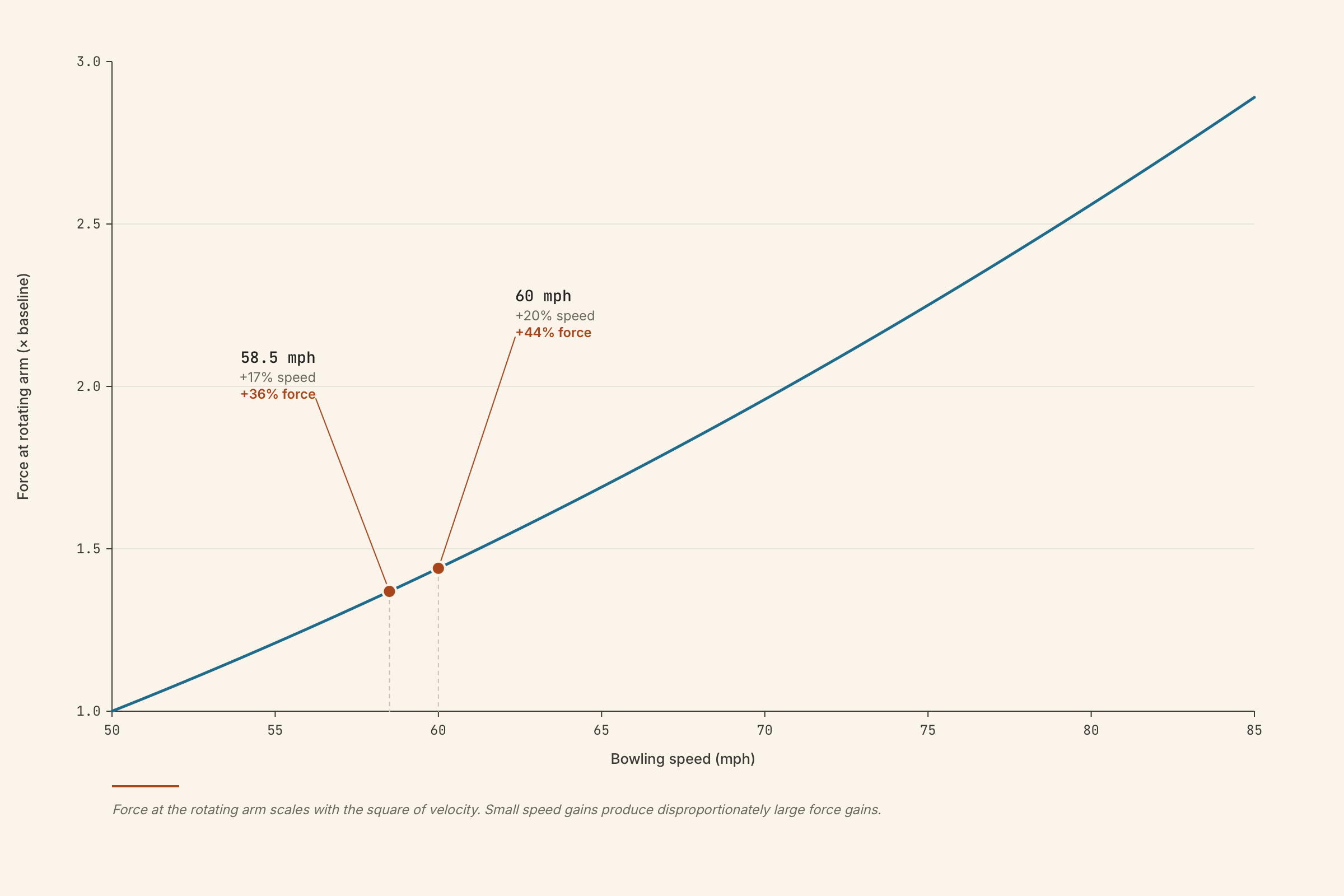
Here’s the physics. The force a body has to generate to swing the bowling arm through delivery scales with the square of the velocity. That’s centripetal force — written in textbook physics as F = m × v²/r. The v² term is the key. Small gains in speed produce much bigger gains in force.
A worked example. When bowling speed increases by 20%, the force generated at the bowling arm increases by 44%. When speed increases by 17%, force at the arm increases by 36%. These numbers describe force at the action point — the rotating arm — not lumbar-spine-specific force, which is more complicated. The arithmetic is clean. The point is that small speed gains produce large force gains, not small ones.
The squared-scaling tells you what’s happening at the bowling arm itself. What lands at the spine is more complicated. At front-foot impact, the spine sees ground reaction force of around 5.8 times body weight in the vertical direction and 3.2 times body weight in the horizontal. Those multiples land alongside trunk rotation, counter-rotation between the pelvis and the upper trunk, and the repetition load that accumulates over a season — each one a separate loading mechanism, layered on top of the squared-scaling at the bowling arm.
There’s a useful nuance to add here. Peak vertical force at front-foot impact — the straight-down landing force — doesn’t actually predict bowling speed. Faster bowlers don’t necessarily land harder vertically. What does predict bowling speed is the horizontal braking impulse at the front foot — the combined push-back force and contact time at landing — how the bowler converts run-up momentum into rotational drive at delivery. The squared-scaling tells you about force at the bowling arm; how that force lands at the body depends on the direction it travels and the time over which it lands, not just the magnitude. Same physics; more honest application.
That sounds like a hedge. It isn’t. It’s the honest position, and it’s the one most worth holding onto. The point isn’t “velocity is the only thing.” The point is “velocity is a multiplier that lands on top of everything else.” For a young bowler whose pace is climbing, that multiplier is doing more work each season — even if the volume looks the same on the spreadsheet, and even if the ECB rules are being followed to the letter. The same physics covered in our cornerstone on fast bowling and back pain shapes how the rotational chain transmits that force through the body — covered in detail in the rotational chain piece.
A 12-Year-Old Isn’t a Small Adult. The Spine Is Still Building.
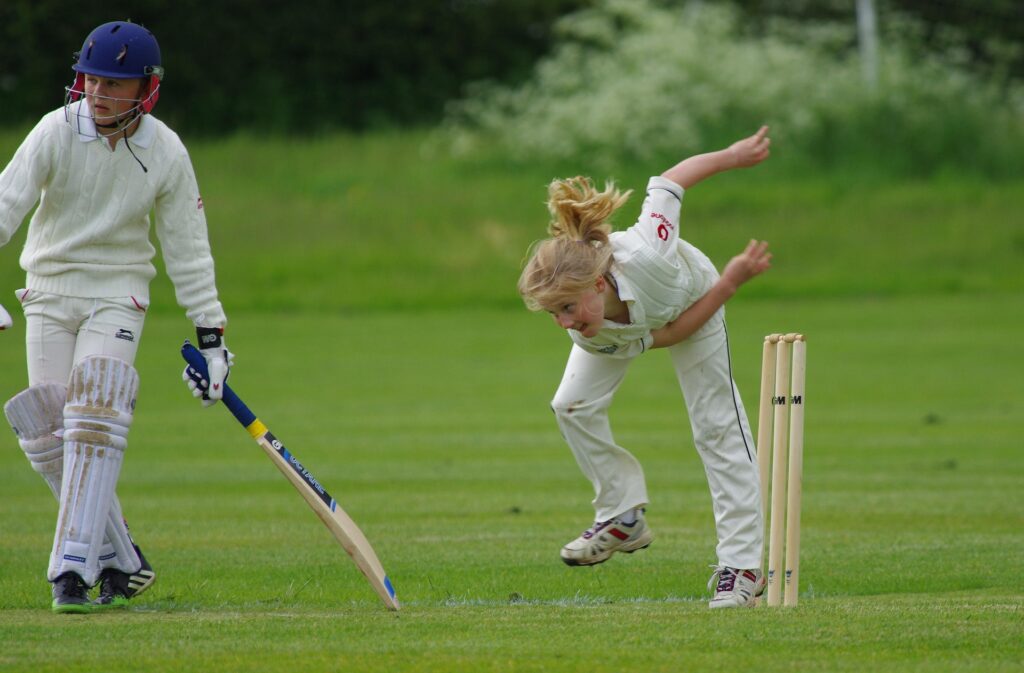
Young bowlers aren’t small adults. Their bones are still growing — particularly the small structures at the back of the spine called the pars — and those structures don’t fully mature until late teens or early twenties. A 14-year-old can generate force close to what an adult bowler produces. The spine absorbing that force is still developing. The same load lands on a structure with less reserve.
The clearest single piece of evidence on this is a study of adolescent fast bowlers from 2007. Twenty-two percent had stress lesions in the lower spine. In age-matched swimmers — same age, same training intensity, different sport — the figure was zero percent.
Twenty-two percent of the bowlers had stress lesions in the lower spine. The age-matched swimmers? Zero.
The difference isn’t fitness. It’s what the cricket action does to a developing spine. The pelvis and the upper trunk rotate in opposite directions through the bowling action; under axial compression, with the trunk laterally flexed and rotated, the load lands at the small joints in the lower back. In a fully ossified adult spine, that’s manageable repetitive load. In a still-developing adolescent spine, it’s load against structure that hasn’t finished forming.
Between roughly twelve and seventeen — the years when junior bowlers gain the most pace, train the most, and play the most — the spine that absorbs the force is also the spine that’s still building. That’s the cricket-specific mechanism behind why this sport, more than swimming or rowing or running, sees young athletes with back stress fractures. If pain is already in the picture for your son, the broader injury and rehab work at Cricket Matters is the right place to start understanding what’s actually going on.
Cricket Matters Isn’t Three Practitioners. It’s One Head Holding Three Perspectives.
What Cricket Matters does about it is built around an idea we call the Triple Effect — the diagnosis, the load on the body, and the cricket your son plays, held in one head at once. The full picture of how that works lives at the Cricket Matters performance system and the technique work it sits inside.
For this post — the physics under fast bowling and the developing spine — what matters is that no single corner answers the question alone. The clinical read needs the load read needs the cricket read. A physiotherapist can diagnose the back pain. A strength coach can build the capacity. A cricket coach can adjust the technique. Each on its own is useful. None on its own catches the full picture, because the diagnosis, the capacity, and the cricket are inseparable parts of the same problem.
The same physics that shapes professional rotational-sport training — what specialists teach at the highest level of golf, baseball, and tennis — applies to fast bowlers too. The integrated approach isn’t stylistic; it’s structural. The physics demands it.
Next Isn’t a Step. It’s a Starting Question.
Understanding the mechanism is one thing. Knowing what to do about it is what matters next.
Start where most parents start — with the free junior back pain guide. The at-home check substance lives inside the guide; about fifteen minutes, no equipment, kitchen-table friendly. If something looks off in what you spot, you’ll know where to go next. Get the guide here.
If your son is in pain — currently, recently, or recurring — that’s a different conversation. The Clinical Screen at Cricket Matters looks at what’s driving the pain, not just what’s working. The path from there depends on what we find together. Book a clarity call — twenty minutes with James to talk through where your son actually is and what comes next.
If you want the fuller picture of how the assessment work fits together at Cricket Matters, the parent’s back-pain guide for junior fast bowlers is the next place to read — the cluster pillar lives here.
Diagnosis Isn’t a Label. It’s a Starting Point.
If you’ve read this far, you already know more about why young fast bowlers get back pain than most parents do. The next move isn’t bigger. It’s smaller. Pick a single step. The guide tonight. A clarity call in the next week.
This isn’t optional in the sense that the physics goes away if ignored. The body keeps loading. What you can choose is whether the next conversation about your son’s back is led by what you understand or what you don’t.

What to do when your child’s back hurts.
Eleven conditions cricket can produce in a teenage spine. A seven-station home screen. A clear next step for every result.
Evidence Corner: What the Research Says
The physics under fast bowling and junior back pain isn’t speculation — it’s a known load equation backed by biomechanics literature across cricket and adjacent rotational sports. The research that follows supports the squared-scaling position at the bowling arm, the multi-factorial nature of spine load at front-foot impact, and the developmental vulnerability of the adolescent spine. Together they explain why velocity matters disproportionately — and why volume-only frameworks miss the mechanism.
What It Does Well
- Squared-scaling at the bowling arm holds at the action point: physics-based — small speed gains produce disproportionately large force gains. The cognition is foundational to fast-bowling biomechanics literature.
- Component-form GRF at front-foot impact is well-quantified: the spine sees ~5.8 BW vertical / ~3.2 BW horizontal at delivery, with consistent reporting across adult fast bowler cohorts.
- Adolescent vulnerability is clear and substantial: 22% of adolescent fast bowlers showed stress lesions in the lower spine; 0% in age-matched swimmers — same age, same training intensity, different sport.
- Multi-factorial spine load is honestly reported: peak vertical GRF doesn’t predict bowling speed (r=-0.364, NS); horizontal braking impulse at front-foot contact does (r=0.574, P=0.008). How force is distributed in time and direction matters as much as magnitude.
- Prospective lumbar-load injury data: biomechanical risk factors track the adolescent fast bowling action through the season — not retrospective inference.
- Risk factor stratification: bone stress injury risk factors in adolescent cricket fast bowlers identified across multiple cohorts and workload windows.
Where It Falls Short
- Most cricket-specific substrate is biomechanics-only: links between specific force profiles and actual injury outcomes are partial; effect sizes vary by population, technique maturity, and recovery profile.
- Adjacent-sport substrate (baseball, golf, tennis) provides useful physics analogues, but cricket-specific application requires careful translation: bowling action mechanics differ from pitching, swinging, and serving in ways that matter at the spine. Borrowed-authority frames work for general principles; individual prescription requires cricket-specific assessment.
- Group-level reporting masks individual variation: spine reserve, technique maturity, and training history vary substantially between young bowlers. Population averages are useful framing but not predictive at the individual level.
What This Means for Cricketers
The ECB directives cover overs per spell and per day — they’re the right starting point. What they don’t capture is the velocity at which the body is generating those overs. Velocity is the multiplier that volume-only systems miss. Pace-spike monitoring matters as much as overs counting — especially during the 12–17 year window when the spine is still building and pace is climbing fast. The mechanism beneath workload spikes isn’t “more overs” — it’s “force generated at the bowling arm scaling with the square of velocity, landing on a still-developing spine.” That’s a different cognition, and it changes how you watch for risk.
Key Research References
- Bayne, H., Elliott, B., Campbell, A., & Alderson, J. (2015). Lumbar load in adolescent fast bowlers: A prospective injury study. Journal of Science and Medicine in Sport, 19(2), 117–122. doi: 10.1016/j.jsams.2015.02.011.
- Engstrom, C. M., & Walker, D. G. (2007). Pars interarticularis stress lesions in the lumbar spine of cricket fast bowlers. Medicine & Science in Sports & Exercise, 39(1), 28–33. doi: 10.1249/01.mss.0000241642.82725.ac.
- King, M. A., Worthington, P. J., & Ranson, C. A. (2015). Does maximising ball speed in cricket fast bowling necessitate higher ground reaction forces? Journal of Sports Sciences, 34(8), 707–712. doi: 10.1080/02640414.2015.1069375.
- Senington, B., Lee, R. Y., & Williams, J. M. (2018). Ground reaction force, spinal kinematics and their relationship to lower back pain and injury in cricket fast bowling: A review. Journal of Back and Musculoskeletal Rehabilitation, 31(4), 671–683. doi: 10.3233/BMR-170851.
- Keylock, L., Alway, P., Felton, P., McCaig, S., Brooke-Wavell, K., King, M., & Peirce, N. (2022). Lumbar bone stress injuries and risk factors in adolescent cricket fast bowlers. Journal of Sports Sciences, 40(12), 1336–1342. doi: 10.1080/02640414.2022.2080161.
- Fleisig, G. S., Andrews, J. R., Dillman, C. J., & Escamilla, R. F. (1995). Kinetics of baseball pitching with implications about injury mechanisms. American Journal of Sports Medicine, 23(2), 233–239.
- Loftice, J., Fleisig, G. S., Zheng, N., & Andrews, J. R. (2004). Biomechanics of the elbow in sports. Clinics in Sports Medicine, 23(4), 519–530.
- Diffendaffer, A. Z., Bagwell, M. S., Fleisig, G. S., Yanagita, Y., Stewart, M., Cain, E. L., Dugas, J. R., & Wilk, K. E. (2022). The Clinician’s Guide to Baseball Pitching Biomechanics. Sports Health, 15(2), 274–281. doi: 10.1177/19417381221078537.
- Hume, P. A., Keogh, J., & Reid, D. (2005). The role of biomechanics in maximising distance and accuracy of golf shots. Sports Medicine, 35(5), 429–449.
- Escamilla, R. F., & Andrews, J. R. (2009). Shoulder muscle recruitment patterns and related biomechanics during upper extremity sports. Sports Medicine, 39(7), 569–590.
- ECB Fast Bowling Regulations (March 2025). England and Wales Cricket Board.
- ECB Recreational Cricket Safety Guidelines (March 2025). England and Wales Cricket Board.
- ECB Fast Bowling FAQ (April 2025). England and Wales Cricket Board.
Bottom Line for Cricketers
Back pain in junior fast bowlers isn’t a strength issue or a flexibility issue or “bad luck.” It’s the predictable consequence of squared-scaling force at the bowling arm landing on a still-developing spine — across a season, across years. The physics is known. The vulnerability window is known. What you can do about it is what changes the outcome.
Parent Questions Answered
Is my son’s bowling speed too much for his body?
There’s no single safe speed. What matters more is whether your son’s body has built the capacity to absorb the load his speed is generating. A 14-year-old bowling 65 mph with a strong base may load less per delivery than one bowling 55 mph with poor movement quality. The right question is the capacity-to-demand match.
Can young cricketers bowl too fast?
Yes — but not in the way most parents imagine. The risk isn’t the absolute speed. It’s the rate of change: a sudden jump in pace before the body has adapted, especially alongside more overs or harder matches. Steady gains across a season are normal. Sudden jumps are where injury risk rises.
How do I know if my child is at risk fast bowling?
Three signals are worth watching: recurring back stiffness or pain that won’t fully resolve; a sudden rise in bowling pace over weeks rather than months; and stepping up to a higher level of cricket within the same season. Any one of these is worth a movement screen. Two together is worth a clinical look.
What’s a safe bowling speed for a 14-year-old?
There’s no published safe-speed threshold for age 14. Safe-load thinking is more useful than safe-speed thinking. The ECB’s age-banded directives cover overs per spell and per day; velocity sits outside their explicit measurement layer. The honest answer is: it depends on the bowler’s capacity, technique, and recovery — which is what an assessment finds out.