
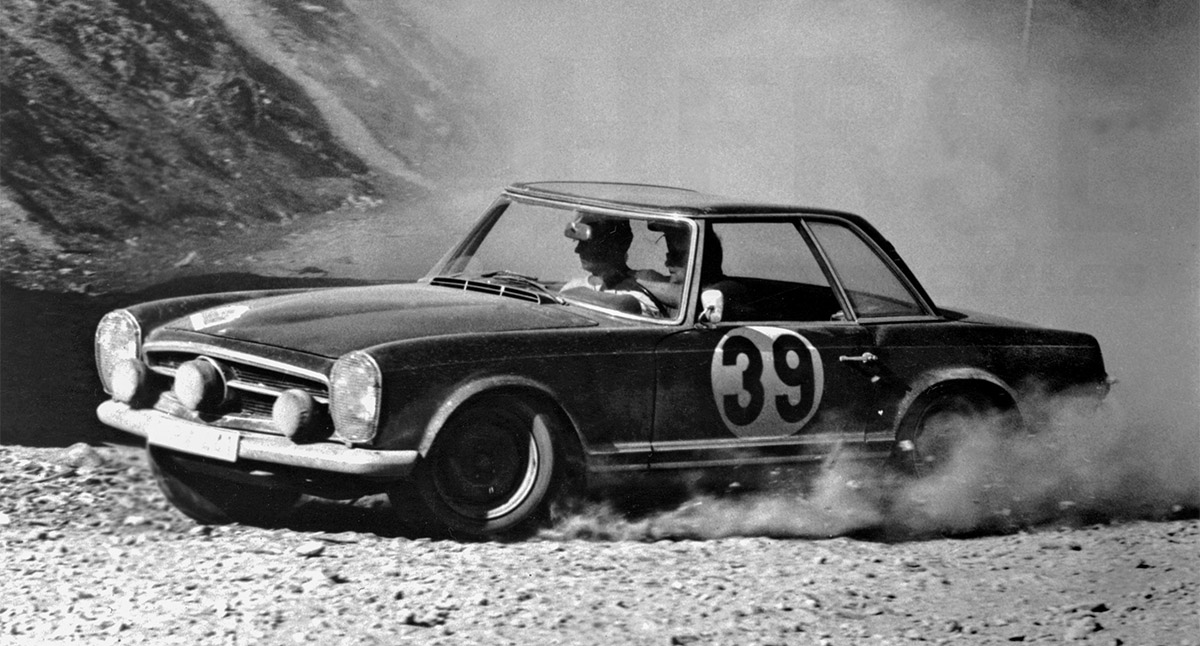
When someone asks me why they should care about bike racing, I think of Soichiro Honda’s famous words: “Racing improves the breed.” Honda was talking about cars and motorcycles—above is a Mercedes in the grueling Liège-Sofia-Liège rally—but the same applies to bicycles. Racing is the reason why modern carbon bikes are so good. It’s also the reason why classic steel bikes perform so well. They’ve been honed in competition to bring out their best performance.
Why can’t we make great products without pushing them to the limit in racing? Perhaps the best answer came from John Surtees, the the only driver to win World Championships on both two and four wheels (Motorcycle and Formula 1). After driving a Lamborghini Miura (above), the world’s first mid-engined supercar, Surtees said: “When companies follow race car trends, but never prove them on the track, they always fall short. The […] lack of competitive breeding shows in little things which would annoy a good driver.” He mentioned poorly laid-out controls, a spongy gearshift, and brakes that lacked feedback.
When you aren’t racing, it’s easy to accept ‘good enough.’ Racing stresses everything to the maximum, and there are no excuses. If your bike, your tires or your components don’t have top-level performance, the peloton will pull away. And if they aren’t strong enough, you may not make it to the finish line at all.
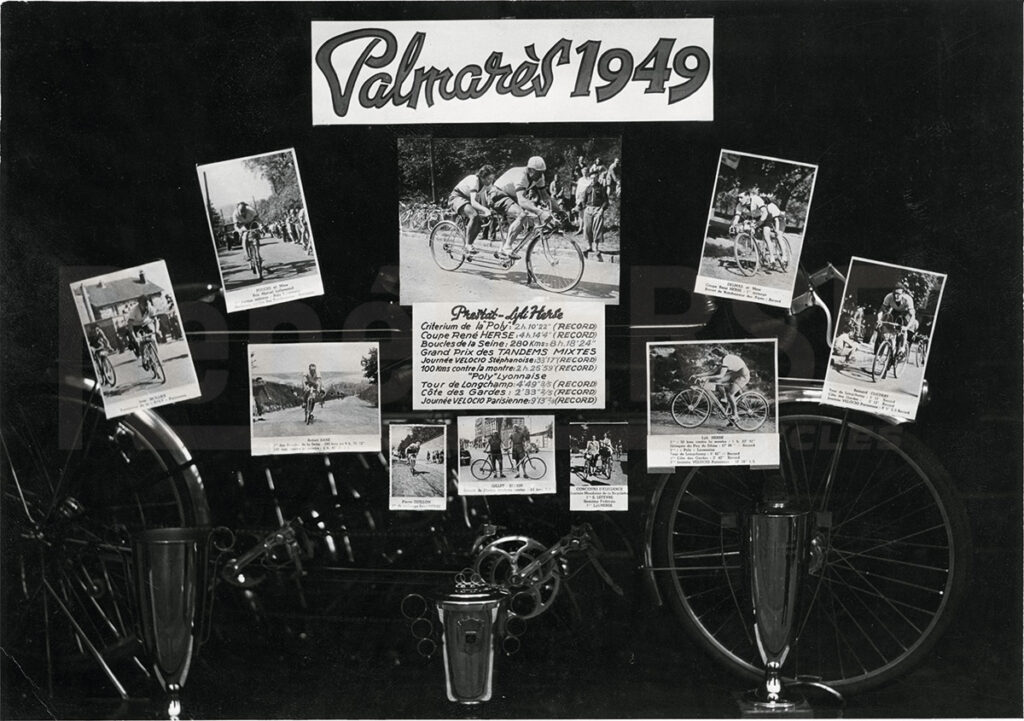
Competition is part of the René Herse history. Our founders, René and Marcelle Herse, rode for other builders in the Concours de Machines (competitions for the best bikes) and set FKTs before they started our company. While Marcelle was pregnant with her daughter Lyli, the Herses set the fastest time in a randonneur brevet from Paris to Dieppe. Lyli herself became an accomplished racer, winning the French championships eight times! In addition to their own riding, the Herses supported a team of strong riders and proudly listed their achievements in the window of their shop. More than just marketing, competition was the reason why Herse’s bikes offered superior performance and reliability.
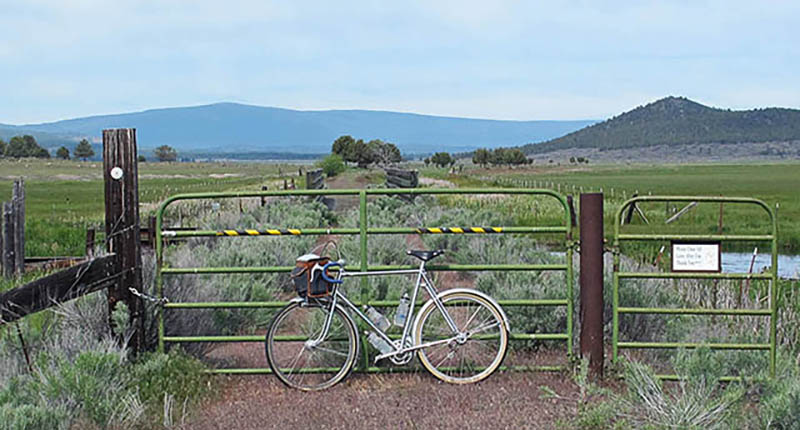
When Rene Herse Cycles was reborn in the Cascade Mountains, it was natural to continue this heritage. When I rode the inaugural Oregon Outback bikepacking race in 2014, I was confident that my Rene Herse rando bike was up to the punishment of this rough course. So confident, in fact, that I didn’t bring any tools apart from a pump and a few spare tubes. Riding with a broken hand in a cast, I finished in second place behind Ira Ryan, the framebuilder and legendary long-distance racer.
Despite almost 30 hours of riding at speed on rough gravel, nothing on the bike fell off or came loose. Fenders, racks, lights all passed the test with flying colors. However, the seatpost cradle and rims cracked from the vibrations—leading us to seek out better components that we now carry in the Rene Herse program. Most of all, the Oregon Outback showed that 42 mm tires weren’t wide enough for really rough and soft gravel. So we developed 55 mm-wide all-road and gravel tires—more than a decade ago. You could say that the Oregon Outback gave us a big head start on other tire companies, which only now are exploring ultra-wide gravel tires.
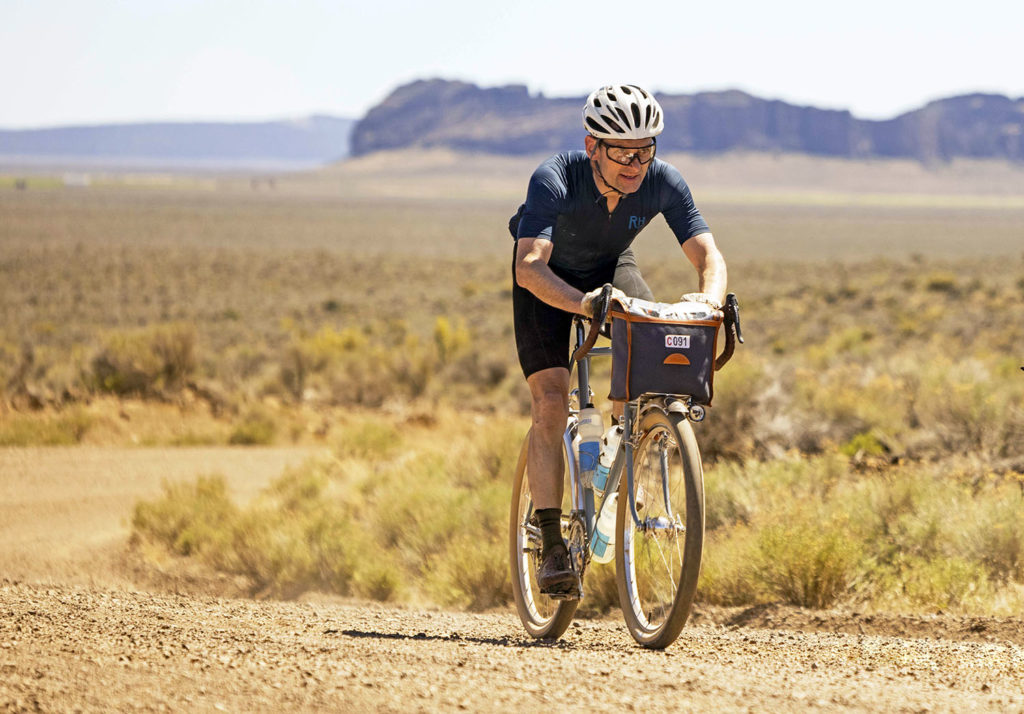
To test whether our ideas about wide tires really worked, I returned to the Outback with a new bike and 54 mm tires. I wasn’t in better shape than I had been in 2014, yet I managed to take almost four hours off my time and set the FKT (Fastest Known Time). Setting a new record is fun, but more important for us is the proof-of-concept that wide tires are faster in the real-world—and not just in our testing. And that benefits all riders, not just those who race.
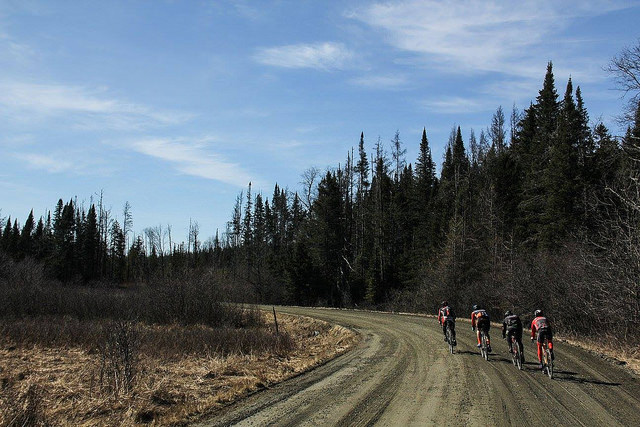
Around the same time of that first Oregon Outback, racers started using our tires in the first big gravel races (above the 2016 Rasputitsa). We saw that as an opportunity for our R&D. We started working with top racers to push our tires even harder.
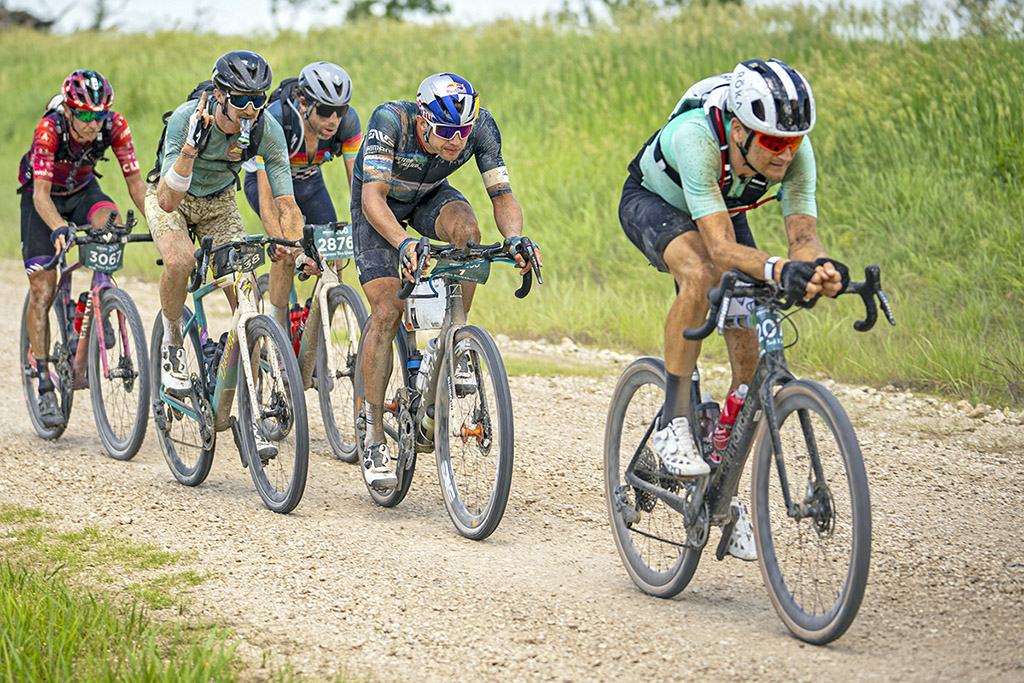
We quickly found that normal casings aren’t strong enough when racing in a dense peloton across the Flint Hills of Kansas during Unbound. Working with Ted King (above in the lead) and others, we developed the Endurance casing, which uses the same fabric as our ultra-supple Extralights, but in a denser weave and with a high-tech protection layer that stretches from bead to bead. The Endurance is ultra-tough, yet it maintains the famous speed and supple comfort that Rene Herse tires are famous for.
The Endurance casings today are among our best-selling models—another example how ‘racing improves the breed’ for everybody, not just racers.
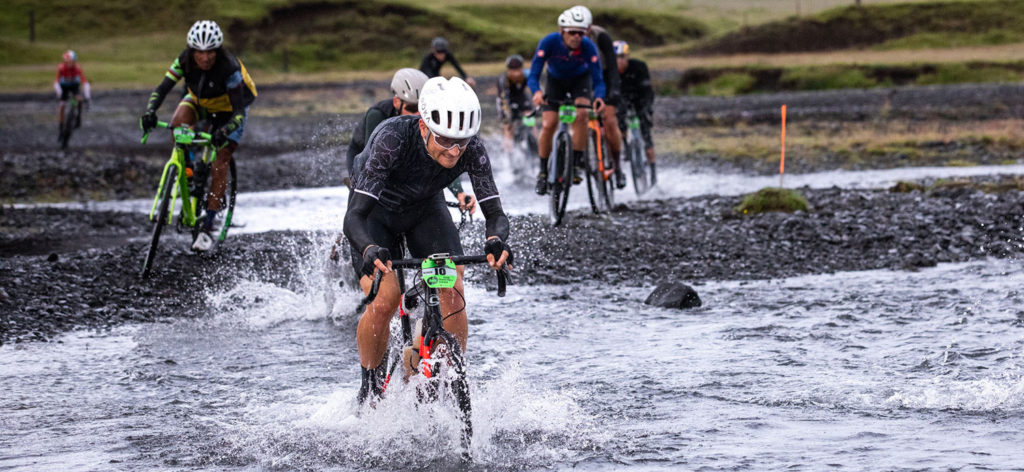
For even tougher courses, like the sharp volcanic rocks of the Rift Iceland, we developed the Endurance Plus, a casing that’s tougher than anything this side of a downhill mountain bike tire, yet rolls with remarkable speed. For tough courses like Unbound, the Endurance Plus is the choice of tall and heavy racers like Ted King and Brennan Wertz, who push their tires like nobody else.

It’s not just our tires that benefit from racing. When we developed our Nivex derailleurs, our goal was to create an analog derailleur that’s tougher and works better than the best components of the big makers. That’s why we raced prototypes in Unbound XL as part of our R&D. We weren’t expecting the Nivex to become a best-seller, but we wanted to make sure that our derailleur was not a boutique part that looks great, but may have only questionable performance. The derailleur survived creek crossings, mud baths and everything else that this amazing race could throw at it—without ever missing a shift.
These days, there is often only a tenuous link between racing and the products companies sell. Car companies often farm out the development of their Formula 1 racecars to specialists that don’t have much connection to the sponsors. Many bike companies also treat racing as a marketing effort more than part of their R&D. I’m always surprised when our racers tell us that we’re almost the only ones asking for their feedback. For us, that feedback is why we work with racers—and why we race ourselves. Of course, there’s also no denying that racing can take the fun and passion of cycling to the next level. For us, that is just the icing on the cake.
More Information:
Photo credits: Mercedes-Benz Classic (Photo 1); Rugile Kaladyte (Photo 5); Andy Chasteen (Photo 7); Ansel Dickey (Photo 8); Linda Guerrette (Photo 9)