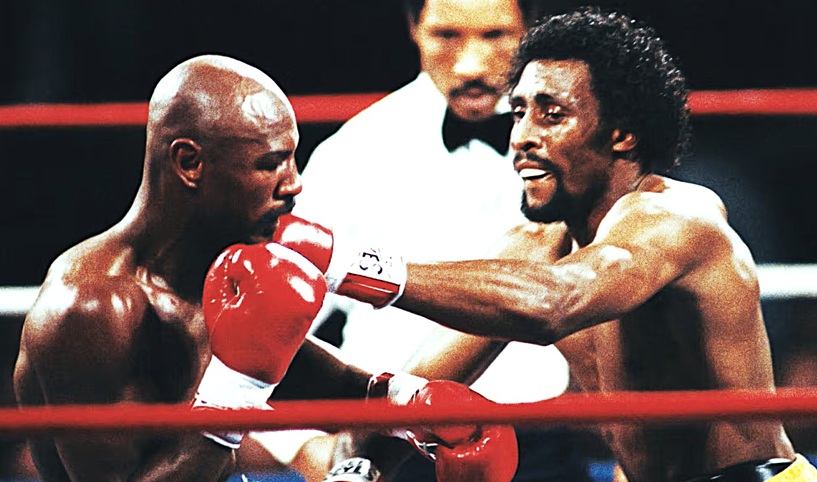
The prospect of a fist-fight is an immediate attraction. From the playground onwards there are those of us eager to watch, speculate on, and vicariously participate in, the basic drama enacted when two men face each other in a defined space and use their hands as weapons to decide who is top dog. And once in a while you witness a contest that gives some indication as to how it might have been when boxers fought to the death in the amphitheaters of ancient Rome, the combatants wearing the lethal cestus — spiked thongs of coarse leather tightly wrapped around their fists.
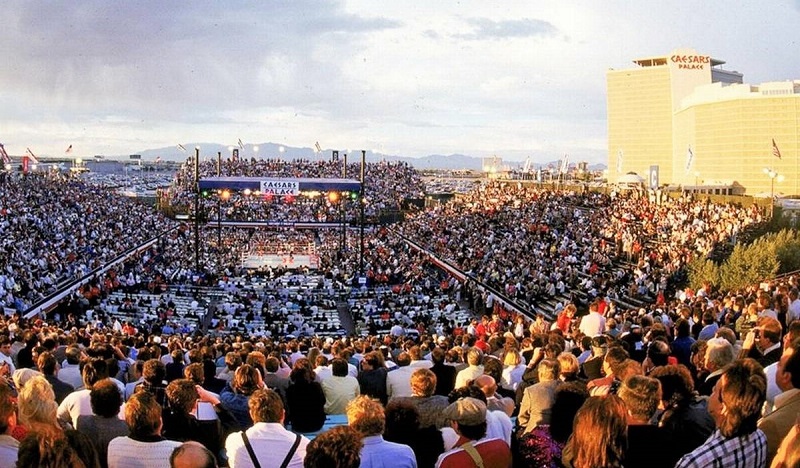
Such a confrontation took place in a converted car park at the back of Caesar’s Palace casino in Las Vegas on an April evening in 1985, its protagonists Marvelous Marvin Hagler, middleweight champion of the world, and his latest challenger, Thomas “Hit Man” Hearns.
This prizefight was one that not only the aficionados and cognoscenti, but anyone with a remote interest in boxing, had been waiting for. There was bad blood between the two of them and the promoters happily exploited the fact, billing it as a war. The odds were so short on its outcome that even in the outrageous capital of the American dream of a fast buck, it did not rate as a gamble.
A comparison of their respective performances in beating Roberto Duran, the hard man from Panama City, lent a certain credibility to the suggestion that, at 30, Hagler was beginning a decline and Hearns, stepping up a weight, was at his peak. But if you were going to lay money on either one, it would be based on a feeling generated in the region of the gut rather than the form book.

The work-gangs had set up seats, rigged lights, television and radio cables, erected advertisement hoardings and, in the centre of it all, assembled a red-roped boxing ring. Regardless of this transformation the venue was still, appropriately, a car park. Appropriate because this conflict, carrying the richest purse ever, was as sudden and ferocious as a street fight, primeval in its commitment and intent.
Thomas Hearns, fighting out of Detroit, Michigan, was a product of the famed Kronk gymnasium. The Kronk style is speed, perfected left jabs and fluent combination punching, characterised by a loose, gloves-low stance, deceptive in its apparent carelessness. Nicknamed “The Hit Man,” Hearns was tall for a middleweight – six feet one inch – and weighed in at half a pound heavier than Hagler. As he approached the ring, his black, tightly curled hair and the melancholic set of his features gave him a look resembling that of a Byzantine icon.
There was a significant difference between his entrance and Hagler’s. The champion approached the ring all keyed-up, punching the air and with his shaven head held low. He looked as smooth, hard and proportional as a piece of African sculpture.
Whereas Hearns was relaxed, lazy-looking, as he climbed through the ropes and stood waiting, Hagler had difficulty containing the nervous energy within him that was ready to explode. During the announcements he pummelled his chest and head as if he could not wait to feel the impact of his fists on flesh and bone.
Hearns looked in prime condition, illustrated by the development of the extra weight he had put on into firm muscle, the intercostals particularly prominent. But his long legs, lacking the thick, slabbed strength of Hagler’s, gave an impression of vulnerability.
Marvelous Marvin Hagler — the Runyonesque prefix having been legally added to his name and proving a statement of fact in the way he took and has held the middleweight title — fought out of Brockton, Massachusetts, as had heavyweight Rocky Marciano. The similarity did not end there.
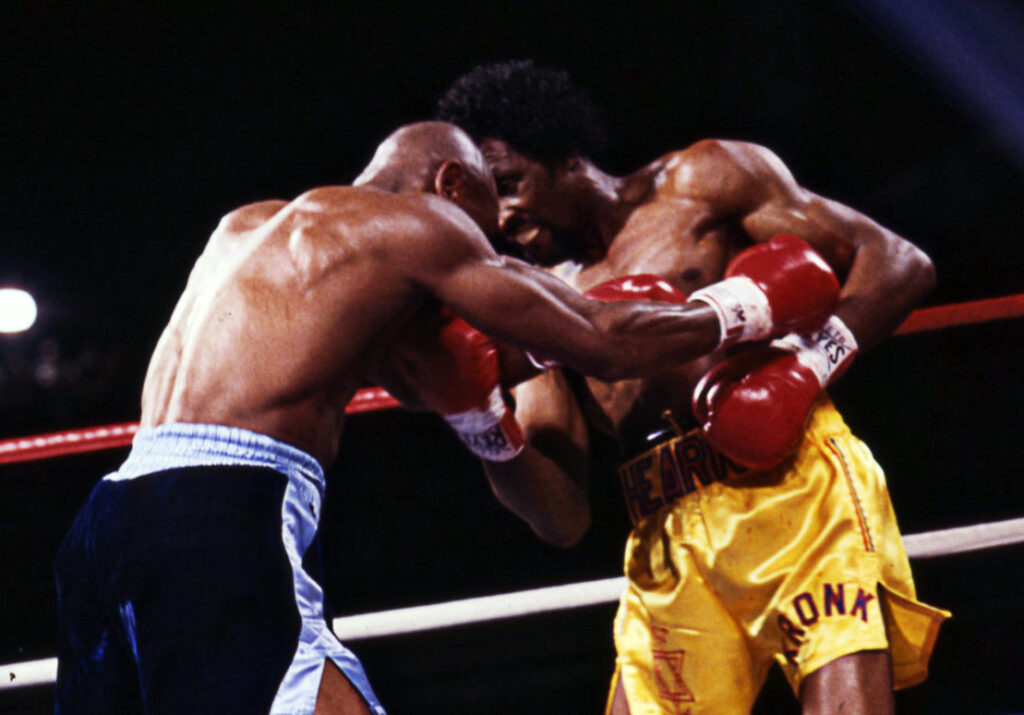
When the bell sounded for the first round Hagler came out with all the unleashed fury of an enraged pit-bull terrier and launched himself at Hearns. But the challenger did not retreat, did not use his classic, beautiful jab or those extraordinarily long legs to get some distance between himself and the vicious trajectories described by Hagler’s fists. Instead he chose to match the champion for strength and power and the two of them were locked in the middle of the ring, performing a kind of murderous ballet in which their bodies tangled, separated, clashed again, punches finding the targets of head and body with damaging regularity.
Those three minutes were fought at the pace of featherweights and it seemed impossible for it to be sustained. Yet at the end of the round, Hagler, blood running from a cut high on his forehead, appeared undiminished.
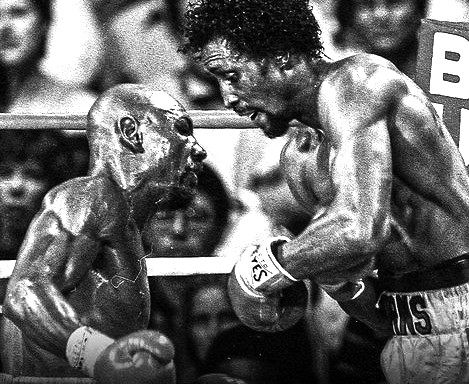
Hearns, too, seemed ready for more. But the illusion of a nonchalant grin, created by the exposure of his white gumshield, was a recognizable mask for the true effect of the insult suffered by his body and spirit not only from Hagler’s attacks, but also his considerable expenditure of energy and the knowledge that his best shots, whilst bloodying Hagler, had far from subdued him.
In the second round Hagler switched from southpaw to orthodox with skillful shifts of balance. Again, reminiscent of Marciano, he continually crowded Hearns, cornered him, allowed him no respite. The man from Detroit fought back, attempting to employ the lancing jab. He tripped over his own feet as he sought ring space, trying to instill some kind of order to the mayhem he found himself involved in. At the end of the round his cornermen yelled at him to box, to use his reach and stay out of trouble. This sound advice carried undertones of anxiety and, at this stage, irrelevance: Hagler’s mood and the dominance of his will were a force that threatened to ride roughshod over such demands and ignore any tactical strategy.
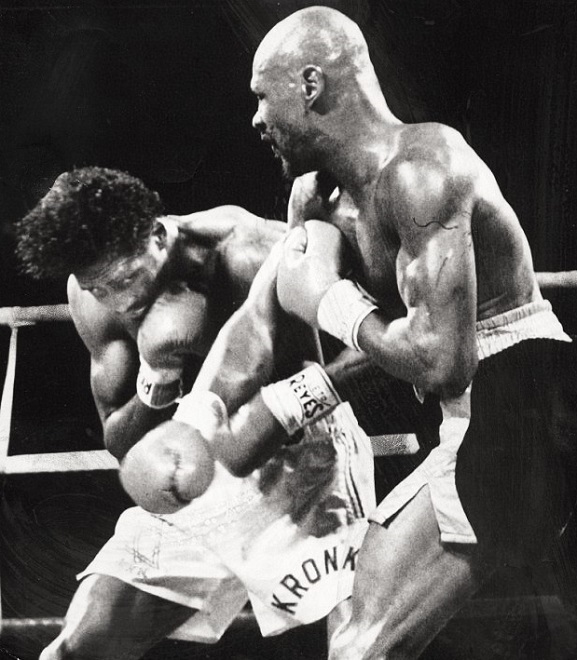
They came out for the third, the harsh ring-lights highlighting the movement of muscles under sweat-soaked skins and the red smears of blood from Hagler’s cut forehead and eye. This damage, inflicted by the raking sharpness of Hearns’s punching in the first round, suddenly became the focus of attention from the referee and then the doctor, causing immediate conjecture as to whether the fight would be stopped.
The doctor leaned over the ropes and inspected Hagler’s cuts and looked into his eyes. ‘He’s okay!’ he called out to the referee. ‘Let him box on!’
That medical opinion proved to be climactic. Hagler went in for the kill.
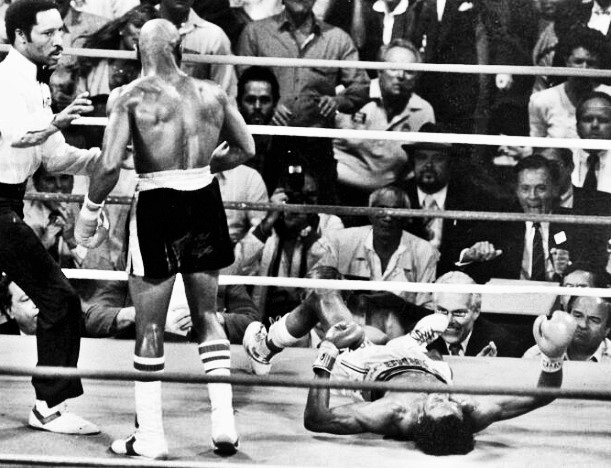
He hit Hearns with a combination of short, accurate hooks to the body and head and finally, a high, looping right that caught him on the left temple. Hearns went staggering across the ring, long legs gone, unpinned at the knees, feet vainly seeking a purchase on the canvas and the wild, gum-shield grin advertising his desperate state. He rose at the count of eight, courage beyond dispute, but with body and soul in no condition to muster a defence against another Hagler bombardment as the referee stepped in to stop it.
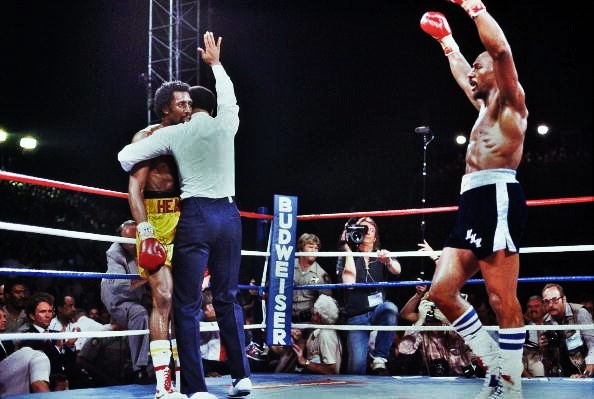
The Hitman had been outgunned, but not disgraced. Maybe going up a weight, trying to outreach his natural balance against a middleweight of Hagler’s class, was his basic mistake. But it is difficult to imagine anyone surviving the raw aggression and burning self-belief exhibited by Marvelous Marvin Hagler on that April evening.
It left you with the stark realisation that although the cestus has been replaced by padded gloves and the prize at stake is, even when counted in millions of dollars, far less vital, the fight game has not changed much over two or three thousand years. – Edward Clark
From The Big Red Hotel and Other Essays, Stories and Poems by Edward Clark.