
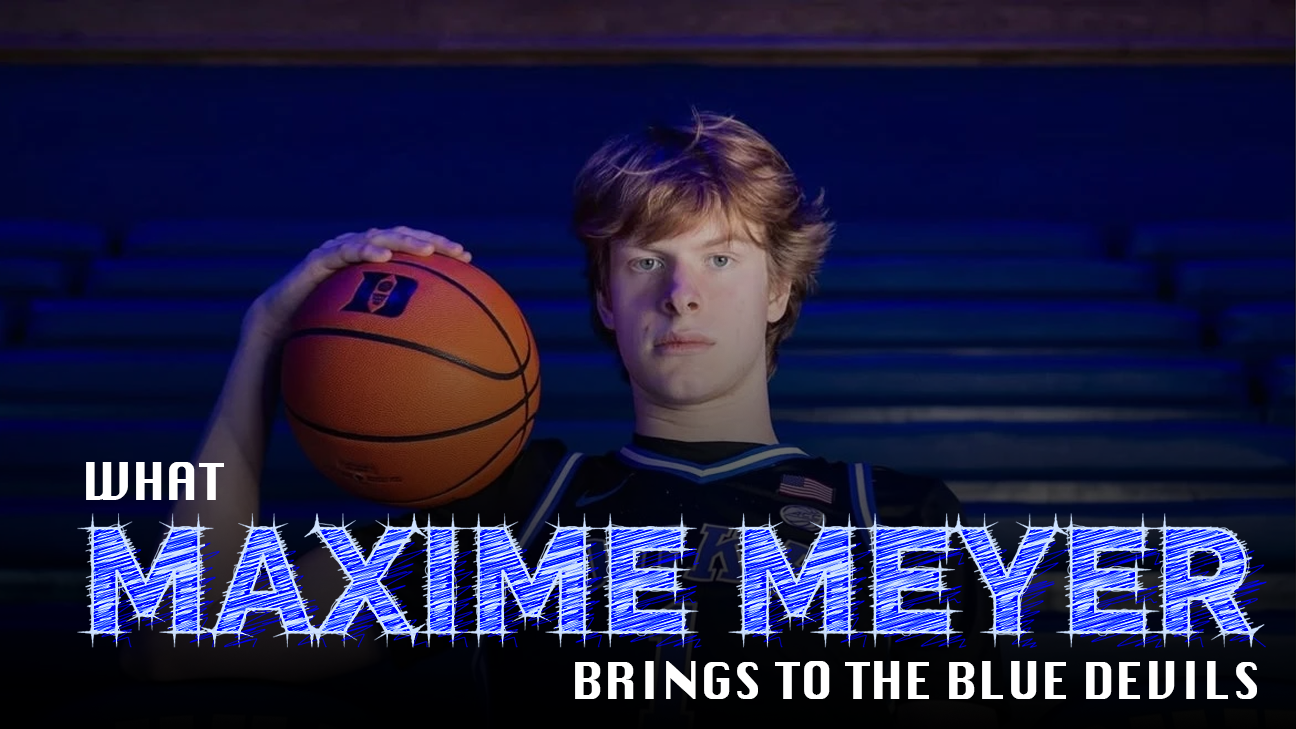
Development Without the Pressure
Where Meyer’s long-term value really starts to show is in the developmental timeline Duke can afford to give him. He’s not arriving as a polished product. His frame still needs strength, his footwork needs refinement, and his offensive game is still evolving. But you can’t teach 7-foot-1 size, coordination, or natural rim protection instincts.
A quieter freshman season gives Duke’s staff the chance to focus on the details without rushing the process:
- Adding strength and physicality
- Improving balance and mobility
- Developing touch around the basket
- Tightening defensive discipline and positioning
Instead of learning through mistakes in major minutes, Meyer gets a full year to absorb the system behind the scenes. For players with his profile, that kind of development year can completely change what they look like by year two. And that second year is where things start to get interesting.
Why Joaquim Boumtje-Boumtje Changes the Conversation
One of the more overlooked parts of Duke adding Joaquim Boumtje-Boumtje is that he doesn’t just help this season’s roster — he helps stabilize the next one too. Boumtje-Boumtje projects as a multi-year forward with positional versatility, physicality, and developing offensive skill. While Meyer develops behind the scenes this season, Duke is also bringing in another long-term frontcourt piece who could still be around when Meyer is ready for a larger role.
That pairing is important for Duke. Instead of Meyer entering year two as an isolated developmental project surrounded by roster uncertainty, he could step into a frontcourt that already has continuity built into it. Boumtje-Boumtje’s experience, versatility, and physical style would naturally complement Meyer’s size and rim protection.
In a lot of ways, the two fit together conceptually:
- Meyer provides length, interior defense, and true center size
- Boumtje-Boumtje brings mobility, toughness, and lineup flexibility
- Both give Duke developmental pieces instead of short-term fixes
And in an era where most programs are rebuilding their frontcourts every offseason through the portal, having two young players who can potentially grow together over multiple years becomes valuable. That’s how sustainable roster building happens.
The Importance of Year Two
This season may largely be about preparation for Meyer, but next season is where the investment could begin paying off.
By then, he’ll have:
- A full year in Duke’s strength program
- Daily experience competing against elite talent
- A stronger understanding of defensive rotations and physical ACC play
- Greater comfort within the pace and expectations of the system
That’s often when developmental bigs begin to make real jumps.
And if Boumtje-Boumtje is still part of the roster alongside him, Duke suddenly has the framework for a more experienced, internally developed frontcourt rather than having to rebuild entirely through transfers. Programs talk constantly about continuity. Players like Meyer and Boumtje-Boumtje are what continuity actually looks like.
 A Different Kind of Value
Not every important player contributes immediately. And not every meaningful season is measured by minutes played. Maxime Meyer may spend much of this year developing behind the scenes, but that doesn’t make his role insignificant. He helps Duke prepare in practice. He strengthens the long-term structure of the roster. And he gives the program another developmental piece that could become much more visible a year from now. With Joaquim Boumtje-Boumtje potentially growing alongside him as another multi-year frontcourt option, Jon Scheyer isn’t just thinking about this season he’s building toward what comes next.