
By Dave Campbell — Paul Willerton stands as a remarkable figure in American cycling history who has seemingly done it all. He raced all over the world as both an amateur and a professional road cyclist, and later as a mountain biker. He is a partner in a successful cycling apparel company and a filmmaker. He also crusades passionately for clean and ethical sport, and his bold anti-doping stance helped drive crucial changes in cycling. He sees cycling as “his lens” and “the window through which he sees the world.” Since he didn’t attend college in the traditional sense, he sought “the most education in the shortest possible time,” finding it through cycling, traveling the world, and building his company, DeFeet. This is his story.
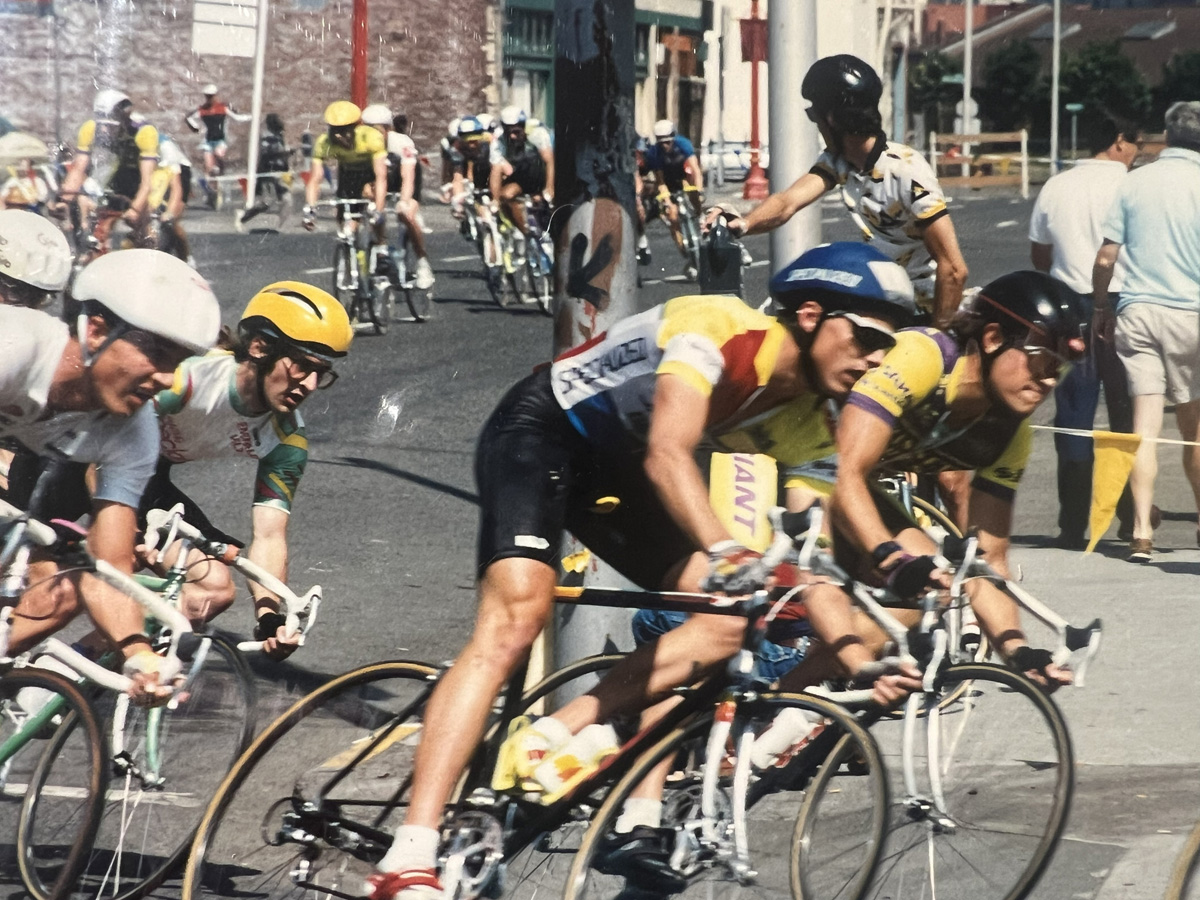
Willerton discovered road cycling in 1981 through his love of the outdoors, riding the quiet roads around Hollister, California, especially Fremont Peak. He embraced cycling in that era as an adventure in every sense, and in the pre-internet world, he had to learn everything proactively. In 1982, he was often the only cyclist on the roads between Hollister and Salinas. California junior racing at the time regularly featured fields of 120 riders aged 14 and 15, battling across undulating, twisting coastal roads in the rain. During this “find it yourself” era of American cycling, he met his hero Greg LeMond at the 1985 Fisherman’s Wharf criterium stage of the Coors Classic. In a remarkably serendipitous turn, he began training regularly with LeMond just over a year later and became his teammate only six years after that.
A dual Swiss citizen who quickly learned languages, Willerton felt comfortable in Europe. By 1986, he raced the Giro della Lunigiana (the junior version of the Giro d’Italia, later won by future stars such as Remco Evenepoel and Tadej Pogačar) in Italy against a young Marco Pantani. That winter, while living in Lake Tahoe, he frequently traveled to Rancho Murieta, California, to train with LeMond, who became his mentor and close friend. He discovered he could stay with the Tour de France champion when others fell away. Their shared love of fishing and outdoor adventure forged a lifelong bond.
Willerton spent much of 1987 riding with LeMond during his recovery from a hunting accident. By 1989, he admitted he wasn’t sure his friend would return to the top of the sport—but he did, and Willerton witnessed that struggle firsthand. Beyond cycling, Willerton came to deeply admire LeMond as a person and saw his family endure challenges most could not survive.

In 1987 and 1988, Willerton became a key member of what may have been the finest junior cycling program in U.S. history—the Plymouth/Reebok team. These riders dominated the national junior scene, competed strongly in senior events, and raced extensively in Europe. LeMond himself designed their training programs, advised their positioning, and provided bikes built by legendary Californian frame builder Roland Della Santa. After winning the Junior Worlds Trials, Willerton raced the 1987 Junior World Championships in Bergamo, Italy, finishing seventh in the team time trial behind the Italians and strong Eastern European squads.
From 1988 to 1990, he raced the demanding and prestigious pro-am Tour de l’Avenir (renamed the Tour of the EEC in 1990) in France, a race LeMond famously won in 1982 and one widely regarded as a “Tour of the Future.” In 1989, as a member of the U.S. National Team, he ventured into the Vuelta Colombia. In his words, “Escabar was raging, the Medellin and Cali Cartels were at war, and a two weeklong stage race went right through all of it!” Norberto Cáceres, a Colombian friend of LeMond’s from the Coors Classic, “came along as a liaison just to keep us alive!”
Willerton missed the first half of the 1990 season due to knee surgery but returned strong, finishing second in the amateur National Road Race behind 1988 Olympian Bob Mionske in New York. Because of his early-season results, he needed to win the national title to qualify for the World Championships in Japan. Devastated by missing out, he continued racing the domestic “National Prestige Calendar.” After a high-speed crash at the Washington Trust Stage Race, he still fought back to finish fifth atop Mount Spokane. When injuries sidelined several riders slated for Worlds, selectors added him to the team alongside a young Lance Armstrong.
In 1991, Willerton realized a childhood dream—“signing for the Yankees”—when he turned professional with Greg LeMond’s French Z team. As the only other American on the squad, he received no special treatment. LeMond made that clear. Willerton carved out his place the hard way and found the transition brutally difficult. Like LeMond before him, he based himself in Kortrijk, Belgium, sharing a home with teammate Miguel Arroyo and soigneur Otto Jacome.
Life in Europe differed greatly then, and Willerton brought a fax machine so he could handwrite letters and send them home cheaply. As a young pro, he worked tirelessly for teammates, but his own results remained limited—and so did those of many established riders. The pro peloton was changing rapidly. Even LeMond, the two-time defending Tour de France champion, finished seventh in 1991 despite feeling in peak form. As Willerton put it, his “timing was terrible.” Still, he valued riding alongside childhood heroes like Robert Millar, Gilbert Duclos-Lasalle, Bruno Cornillet, Jérôme Simon, and Eric Boyer—“real, no bullshit bike riders on a clean team.”
In June, Willerton returned to the United States to race for the national title. In the 1991 USPRO CoreStates Championships in Philadelphia, he broke clear late in the race but, for the second year in a row, missed out on a major title. Team tactics within the breakaway allowed the group to be caught in the final moments of the 156-mile race. In 1992, he joined Subaru-Montgomery, a European-based American team directed by Eddie Borysewicz. He balanced emerging American races with Europe’s biggest events, including Paris-Roubaix and the Professional Road Race at the World Championships in Spain, again alongside Armstrong. As speeds continued to rise, Willerton and his teammates struggled not only to compete but sometimes even to finish what he described as “turbo-charged” races. That same Subaru team would later form the foundation of the infamous U.S. Postal Team.
One of his defining moments came at the 1993 Tour DuPont, his final road season with Subaru. After a stage, an upstart sock company handed out samples, and Willerton stuffed a pair into his jersey pocket. Later, he realized DeFeet had created the first cycling-specific sock—the Aireator. It surpassed anything he had used before. When he called the number stitched into the sock, he connected with Shane Cooper, and the two formed a lasting partnership. Willerton became the brand’s first ambassador, introducing the socks across Europe, often customizing them for teams. Within a few years, they became ubiquitous in the peloton.
When Subaru folded, Willerton found few opportunities on American pro teams and lost his enthusiasm for European road racing. Returning to familiar domestic races held little appeal. He needed a new challenge to revive both his career and his passion. Having long dreamed of winning the Tour de France, he now accepted that goal had passed—and turned instead to mountain biking.
With support from Chums and Keith Bontrager, Willerton attacked the 1994 World Cup mountain bike circuit with determination. Early results proved difficult—mechanicals, DNFs, and off-form finishes—but back home in Winter Park, Colorado, his confidence returned. Racing the NORBA series, he steadily improved, culminating in a second-place finish at the National Finals in Big Bear, just 16 seconds behind Ned Overend. That result earned him a spot on the U.S. team for the World Championships in Vail.
Starting 130th out of 175 riders, Willerton faced long odds. But with LeMond cheering from the sidelines, he charged through the field in a remarkable ride, finishing sixth. Many believed that with a better starting position, he could have reached the podium—or even won the world title.
Looking back, Willerton later reflected, “I wasn’t prepared to make the necessary sacrifices.” At the time, he questioned whether he lacked maturity or mental toughness—or whether he simply no longer loved the sport enough. Riders he once beat as juniors now dominated. In the years that followed, the reasons became clear. As doping spread through cycling and later mountain biking, Willerton found himself again outpaced in what he recognized as another era of “terrible timing.”

After retiring, Willerton returned to fishing, skiing, and self-directed learning, while writing for cycling publications and deepening his involvement with DeFeet. Frustrated by doping, he again took a proactive stance. Alongside other retired riders, he protested outside Nike’s campus in Beaverton following the USADA report. Outraged by what he saw as the fraud of the Lance era, he publicly challenged Nike and Phil Knight, asking why the brand ignored mounting evidence. Within days, the façade collapsed. Willerton later appeared in documentaries and news programs, emerging as a powerful voice for integrity in the sport. He modestly described himself as a “tiny needle” that helped burst a massive bubble, while crediting others such as David Walsh, LeMond, and Betsy Andreu.
Building DeFeet provided the second half of his education. Over three decades, he engaged in every aspect of the business—from materials and product development to manufacturing, marketing, and fulfillment. He views it as an ongoing journey that continues to inform his work across industries.
Most recently, Willerton directed the film Flandrien. Originally conceived as a brand film, the project evolved into a celebration of Flanders, one of cycling’s great cultural heartlands. Fascinated by cameras as long as by cycling, Willerton drew on his early experiences racing in Belgium to create a film that captures the region’s spirit—something he wished he had seen as a young rider. The film celebrates the riders, races, and enduring passion of Flanders, and is available on YouTube. ( https://www.youtube.com/watch?v=iIcD3Rpc3n0&t=0s)
He continues to plan future cycling films.
Despite setbacks and redirections, Willerton’s love of cycling remains undiminished. He recently traveled to Washington, D.C., to watch Greg LeMond receive the Congressional Gold Medal. He still fishes, plays tennis, and reflects on the lessons cycling has taught him. Today, he divides his time between Buenos Aires and Bend, Oregon, striving to remain a positive force for his family and others—and continuing to live an extraordinary life.
SOURCE MATERIAL:
- Fisher, Gary. “Flandrien: Interview with director Paul Willerton”. (2024, January 24), “Bicycles are Drugs”,
- Gruenwedel, Eric. “A Will to Win”, Winning Bicycle Racing Illustrated. No. 130, December 1994. Pp. 30-34.
- “Paul Willerton-Cycling Legend and Renaissance Man”, (2013, February 3), Steel Wül Cycle Club,
- “Pez Talk-US Pro Paul Willerton”, (2019, March 17), Pez Cycling News,
- www.firstcycling.com
- www.procyclingstats.com
- Correspondence with Paul Willerton, February and March 2026
(Visited 25 times, 24 visits today)