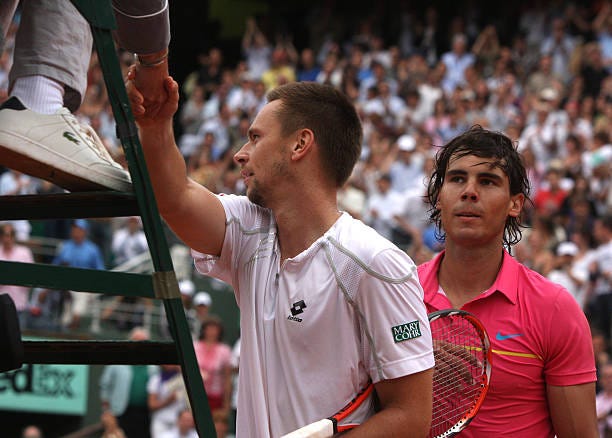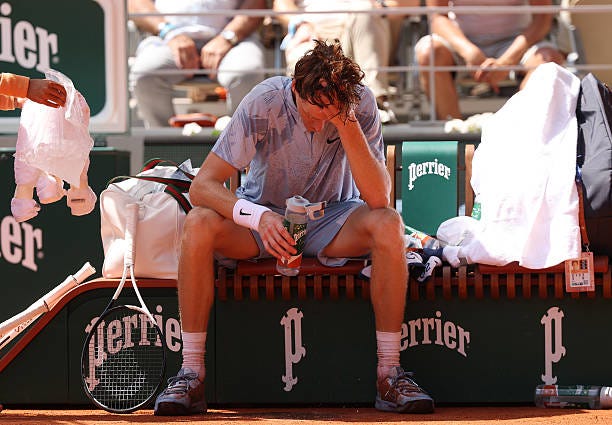
PARIS – As Jannik Sinner was dissolving into a puddle and losing 18 points in a row on Thursday against Juan Manuel Cerundolo, I was flashing back to a dash up a staircase on another spring afternoon at Roland Garros full of surprises.
It was May 31, 2009, and, as I wrote in my recent book THE WARRIOR, I was hardly sprinting alone. Rafael Nadal had just gone down two sets to one on the Philippe Chatrier Court against Robin Soderling of all people. A number of us who had been camped out in the old French Open media room working on routine stories were suddenly scurrying up the stairs to the press box to get a firsthand look at the biggest French Open story imaginable.
Nadal had never lost at Roland Garros, securing four straight titles from 2005 to 2008. He had won 31 straight matches and was a preposterous 48-0 in best-of-five-set matches on clay. A few weeks earlier, he had demolished Soderling 6-1, 6-0 in Rome. But Nadal was, improbably, on his way out that afternoon, a victim of sore knees, family trouble, an off day and an inspired and well-schooled adversary (bravo, coach Magnus Norman). It all demonstrated that nothing is a given in sports and that even the king of kings of clay can fall victim to a palace coup.
Soderling’s third-round victory was perhaps the biggest upset in tennis’s long history (it’s a good debate). Though Sinner, who had won 30 straight matches, was nearly as big an oddsmaker’s favorite in Paris this year as Nadal was in 2009, Thursday’s earthquake of a defeat on the same rectangle of clay does not truly equate on the Richter Scale.