

Shown on most modern bikes and Peloton screen
Roughly how hard you worked
How hard was the class overall
Calories Burned
Total Energy Burned
—
kcal
Enter your workout details and hit Calculate Calories to see your energy expenditure.
Recumbent bikes get a bad rap. People assume the comfy reclined seat means you’re barely working, so the calorie burn must be useless. That’s wrong. A recumbent can deliver a serious workout, but only if you know the real numbers instead of trusting the inflated count on the bike’s display or a generic online calculator that treats all bikes the same.
This recumbent bike calorie calculator uses MET (Metabolic Equivalent of Task) values from the 2024 Adult Compendium of Physical Activities, adjusted for the reclined position, to estimate calories burned by weight, duration, and either watts or effort level in metric or imperial units.
Below, I cover calorie ranges by effort, why recumbents burn less than upright bikes, whether they actually work for weight loss, and how to burn more.
How This Recumbent Bicycle Calorie Calculator Works
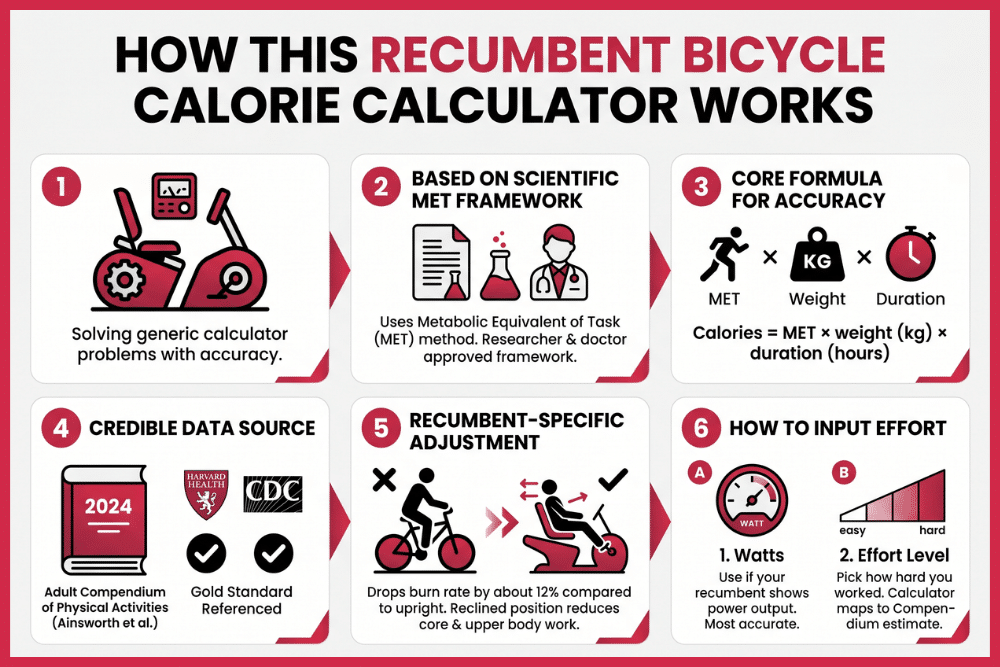
Most recumbent bike calorie calculators online use a single generic MET value and call it a day. The problem is that recumbent biking isn’t the same as upright biking, and treating them identically gives you an inflated number. This calculator corrects for that.
The math uses the MET method (Metabolic Equivalent of Task), the same framework researchers and doctors use to measure energy burn. The core formula:
Calories = MET × weight (kg) × duration (hours)
The MET values come from the 2024 Adult Compendium of Physical Activities (Ainsworth et al.), which is the gold standard referenced by Harvard Health and the CDC.
Here’s the recumbent-specific part: the calculator drops the burn rate by about 12% compared to an upright bike at the same wattage. The reclined position takes your core and upper body out of the work, so less of you is firing to keep you stable and pedaling. That adjustment is based on exercise physiology research, and it’s the piece most generic calculators skip.
You can enter your effort two ways:
Watts. If your recumbent shows power output, use it. Most accurate.
Effort level. No watts display? Pick how hard you worked and the calculator maps it to a Compendium-based estimate.
Recumbent Bike Calories Burned by Effort and Weight
These numbers assume a 30-minute session with the recumbent adjustment already applied. Use the calculator above for your exact workout, including longer rides and watts-based input.
Light Effort (Warm-Up / Recovery)
150 lb (68 kg) rider: 120 to 155 kcal in 30 minutes
200 lb (91 kg) rider: 160 to 205 kcal in 30 minutes
This is easy pedaling. The pace you’d use to warm up, cool down, or spin while watching TV. You can talk, read, or scroll your phone without missing a beat. MET sits around 3.5 to 4.5.
It won’t torch calories, but it’s perfect for active recovery days or for easing back into exercise after a long break.
Moderate Effort (Steady Cardio)
150 lb (68 kg) rider: 180 to 205 kcal in 30 minutes
200 lb (91 kg) rider: 240 to 275 kcal in 30 minutes
This is where most recumbent workouts live. You’re breathing harder and feeling the effort, but you could still hold a conversation in short sentences. MET sits around 5.3 to 6.0.
This is the sweet spot for steady fat-burning cardio. A comfortable 45-minute session here adds up fast without leaving you wrecked.
Vigorous Effort (Intervals / Hard Climbs)
150 lb (68 kg) rider: 240 to 305 kcal in 30 minutes
200 lb (91 kg) rider: 320 to 410 kcal in 30 minutes
This is cranking up the resistance, pushing hard intervals, or simulating climbs. Talking is tough. You’re working. MET climbs to 7 to 9.
People assume you can’t get a hard workout on a recumbent. You absolutely can. Bump the resistance and add intervals, and the burn rivals an upright bike. The position is comfier, not necessarily easier.
Why Recumbents Burn Less Than Upright Bikes
At the same wattage, a recumbent bike burns roughly 12% fewer calories than an upright. The reason comes down to how much of your body is working.
On an upright bike, you’re holding yourself up. Your core fires to stabilize your torso, your back muscles stay engaged, and you can stand up to push hard on climbs. On a recumbent, the seat does all that work for you. You’re reclined against a backrest with your core relaxed, so fewer muscles are firing to keep you upright and moving.
Less muscle engagement means less energy burned. Simple as that.
But here’s why that 12% isn’t the full story. The recumbent’s comfort is exactly what lets you ride longer and more often. A 45-minute recumbent session is genuinely pleasant. Forty-five minutes hunched on an upright saddle is a test of willpower for most people.
So while you burn less per minute, you can rack up more minutes. For total weekly calorie burn, the comfier bike you actually want to use beats the harder bike you avoid. Consistency wins.
Are Recumbent Bikes Good for Weight Loss?
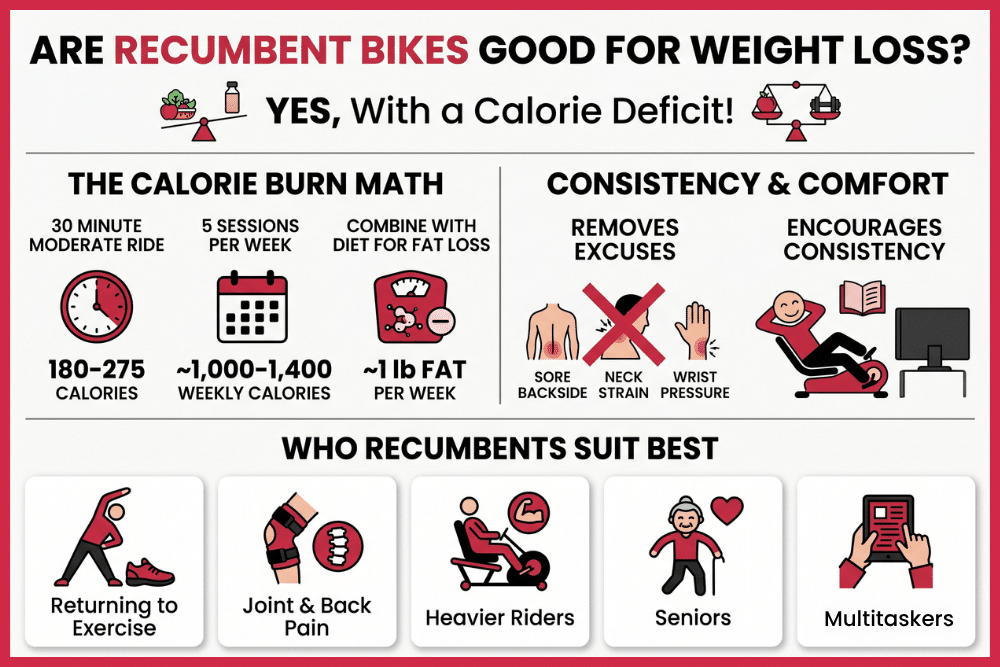
Recumbent bikes work well for weight loss, as long as you pair them with a calorie deficit from your diet. No machine out-trains bad eating. But as a tool for burning calories consistently without beating up your body, recumbents are genuinely underrated.
The math is straightforward. A 30-minute moderate session burns 180 to 275 calories for most adults. Do that five times a week and that’s roughly 1,000 to 1,400 calories from riding alone. Hold a 500-calorie daily deficit through diet plus riding, and you’re losing about a pound of fat per week.
The real advantage is consistency. Here’s the thing about weight loss: the best workout is the one you actually do. Recumbents remove the usual excuses. No sore backside, no neck strain from leaning over bars, no wrist pressure. You can ride while watching a show and barely notice the time.
Who recumbents suit best:
- Anyone returning to exercise after a long break
- People with back pain, knee issues, or joint problems
- Heavier riders who find upright saddles uncomfortable
- Seniors who want safe, low-impact cardio
- Anyone who wants to multitask (read, work, watch TV) while exercising
The lower per-minute burn matters less when you’re riding longer and sticking with it for months instead of quitting in two weeks.
How to Burn More Calories on a Recumbent Bike
Crank Up the Resistance
This is the single biggest lever you have. Higher resistance means more watts, and watts are what actually drive calorie burn. Pedaling easy for an hour burns less than pedaling hard for 30 minutes. If your workouts feel too comfortable, add resistance before you add time.
Add Intervals
Steady-state riding is fine, but intervals burn more in less time. Try one minute hard, two minutes easy, repeated for 20 to 30 minutes. The hard bursts spike your effort, and you’ll keep burning calories after you finish thanks to the afterburn effect. I do this on recovery days when I still want a decent burn without destroying my legs.
Pick Up Your Cadence
Cadence is how fast you pedal, measured in RPM. Most people drift around 60 RPM. Pushing to 75 to 85 RPM at the same resistance raises your power output and your calorie burn. It also keeps your legs from getting lazy.
Extend Your Duration
This is the recumbent’s superpower. Because it’s comfortable, you can ride longer than you ever would on an upright. Adding 15 minutes to a comfortable session is easy, and those extra minutes are pure bonus calories.
Track Watts, Not Just Time
If your bike shows watts, watch them. “I rode for 45 minutes” tells you nothing about effort. Watching your average watts climb week over week is how you know you’re actually getting fitter and burning more.
Frequently Asked Questions (FAQs) About Recumbent Bike Calorie Burns
Recumbent bike vs upright vs treadmill: which burns the most?
Treadmill usually burns the most at the same effort because walking and running involve your whole body and bear your full weight. Upright bikes come next. Recumbents burn the least per minute, but they’re the easiest on your joints, so you can go longer. For total burn over a full session, the gap narrows.
Are recumbent bikes good for seniors or bad knees?
Yes, they’re one of the best options. The reclined position supports your back, the seated pedaling is low-impact, and there’s no pressure on your wrists or neck. People with knee issues can adjust resistance to stay in a pain-free range while still getting solid cardio.
How long to burn 300 calories on a recumbent bike?
For a 175 lb rider at moderate effort, roughly 45 to 50 minutes. Bump the resistance to vigorous and you can hit 300 in about 30 minutes. Use the calculator above for your exact numbers.
Can a recumbent bike help lose belly fat?
Not directly. You can’t spot-reduce fat from one area. But regular recumbent sessions plus a calorie deficit reduce overall body fat, including belly fat, over time.