
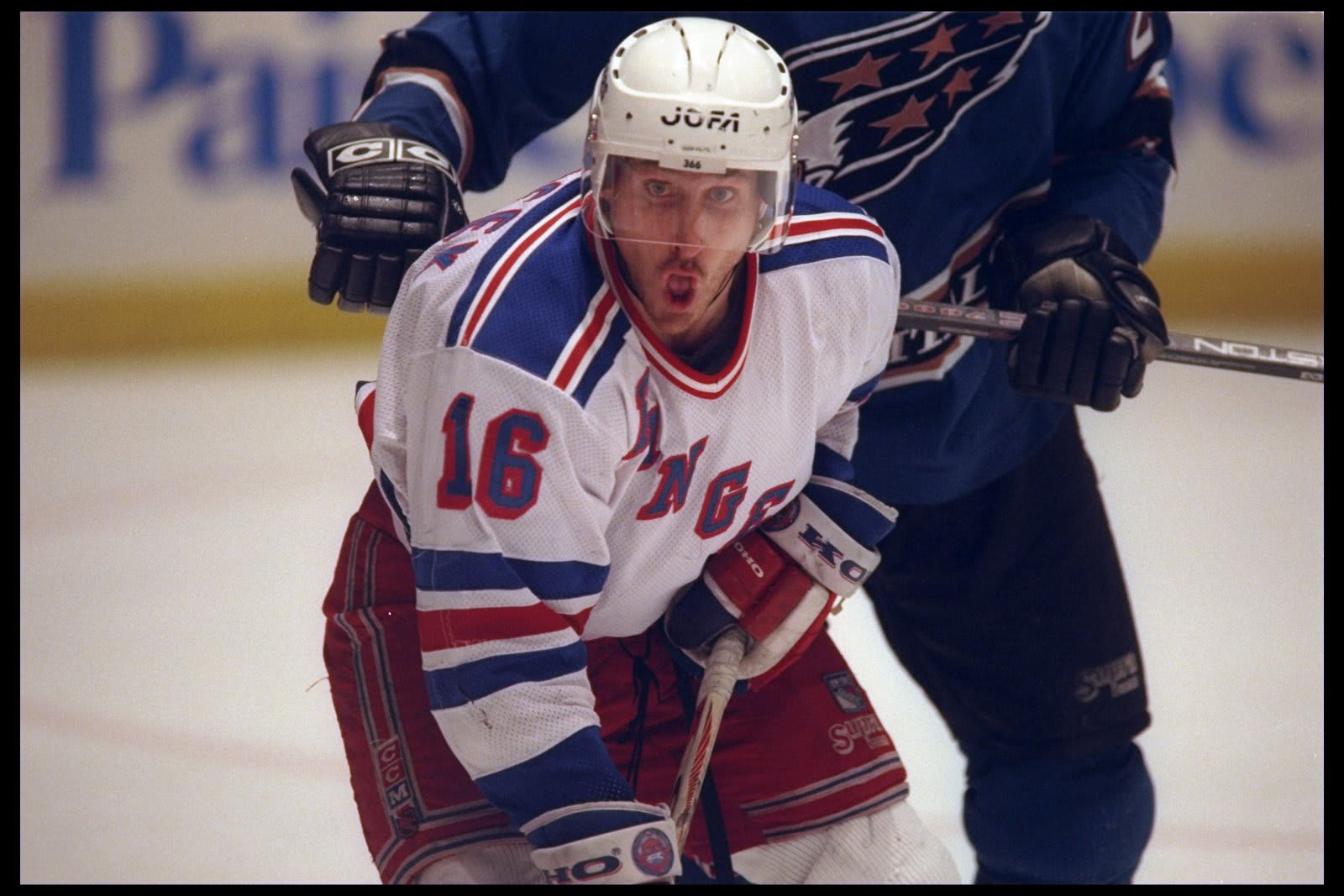
Pat Verbeek was the kind of player who always stood out, though not always in the way you might expect. Nicknamed “The Little Ball of Hate” by Glenn Healy, the 5’9″ forward built his identity around relentless physical play, constant agitation, and a refusal to back down. That edge defined his reputation, but it often masked just how dangerous he was offensively.
Beneath the scrums and confrontations was a high-end scorer who quietly totaled 522 goals and more than 1,000 points over his career. Pat Verbeek recorded multiple 40-goal seasons, including a 46-goal, 89-point performance with the Hartford Whalers, all while playing a punishing style. He also became the first player in NHL history to surpass both 500 goals and 2,500 penalty minutes, a rare statistical combination that perfectly reflected his dual-threat nature, equally capable of hurting opponents on the scoreboard or physically.
During his six seasons in Hartford–Whalers, not Wolf Pack–before joining New York, Pat Verbeek put together an impressive body of work, totaling 522 goals and 540 assists for 1,062 points, along with 2,905 penalty minutes. His consistency was just as notable as his intensity, as he posted four 40-goal seasons, four more with at least 30 goals, and another five seasons with no fewer than 20.
He was traded to the Rangers in March 1995 in a deal that sent defenseman Glen Featherstone, minor-leaguer Michael Stewart, a first-round pick in the 1995 NHL Draft, and a fourth-round pick in 1996 to Hartford. The Whalers used those selections to draft goaltender Jean-Sebastien Giguere and center Steve Wasylko, respectively.
Pat Verbeek made an immediate impact with the Rangers, appearing in 88 games total for the club. After the trade, he recorded 10 goals, 15 points, and 18 penalty minutes in just 19 regular-season games, then added 10 points and 20 penalty minutes in 10 playoff games. He played a key role in helping the Rangers defeat the Quebec Nordiques in six games before they were swept by the Philadelphia Flyers. That postseason, he tied Brian Leetch for the team lead with three power-play goals.
In his only full season with the Rangers (1995–96), Verbeek remained a major contributor. He finished second on the team in goals (41) and game-winning goals (six), led the team with 17 power-play goals, and ranked third in both points (82) and penalty minutes (129). In the playoffs, he added nine points and 12 penalty minutes in 11 games, helping New York eliminate the Montreal Canadiens in six games before falling to the Pittsburgh Penguins in five. His nine playoff points ranked second on the team behind Mark Messier’s 11.
Pat Verbeek turned his strong performance in New York into a free-agent deal with the Dallas Stars in August 1996, where he would go on to win the Stanley Cup in 1999.
Over a 20-year NHL career, Verbeek played 1,424 games, recording 1,062 points and 2,905 penalty minutes, a testament to both his durability and toughness. A two-time All-Star and Stanley Cup champion, he was capable of handling top-six minutes, scoring in tight spaces, and generating offense through sheer effort and physicality.
Because he lacked flash and spent much of his career with smaller-market teams like the New Jersey Devils, Hartford, and Dallas, Pat Verbeek never quite reached true superstar status. Still, he was one of the most consistent and dangerous scorers of his era, an intense competitor whose offensive ability was often overshadowed by his reputation as an agitator and for a short time, an incredibly productive forward for the Rangers.