
Modern bicycles are engineering marvels. Carbon frames now weigh less than steel forks once did. Electronic drivetrains shift with microscopic precision. Wheel and tyre technology have evolved dramatically, especially with the widespread adoption of tubeless systems.
Yet one component has remained surprisingly unchanged: the valve on a bicycle’s rim.
Despite the rise of tubeless systems, most riders still rely on the same narrow Presta-core architecture that has existed in broadly familiar form for over a century. Tiny airflow passages, delicate locknuts and sealant-clogged valve cores have simply become accepted as part of modern tubeless ownership.
According to absoluteBLACK, that assumption needs to be revisited.
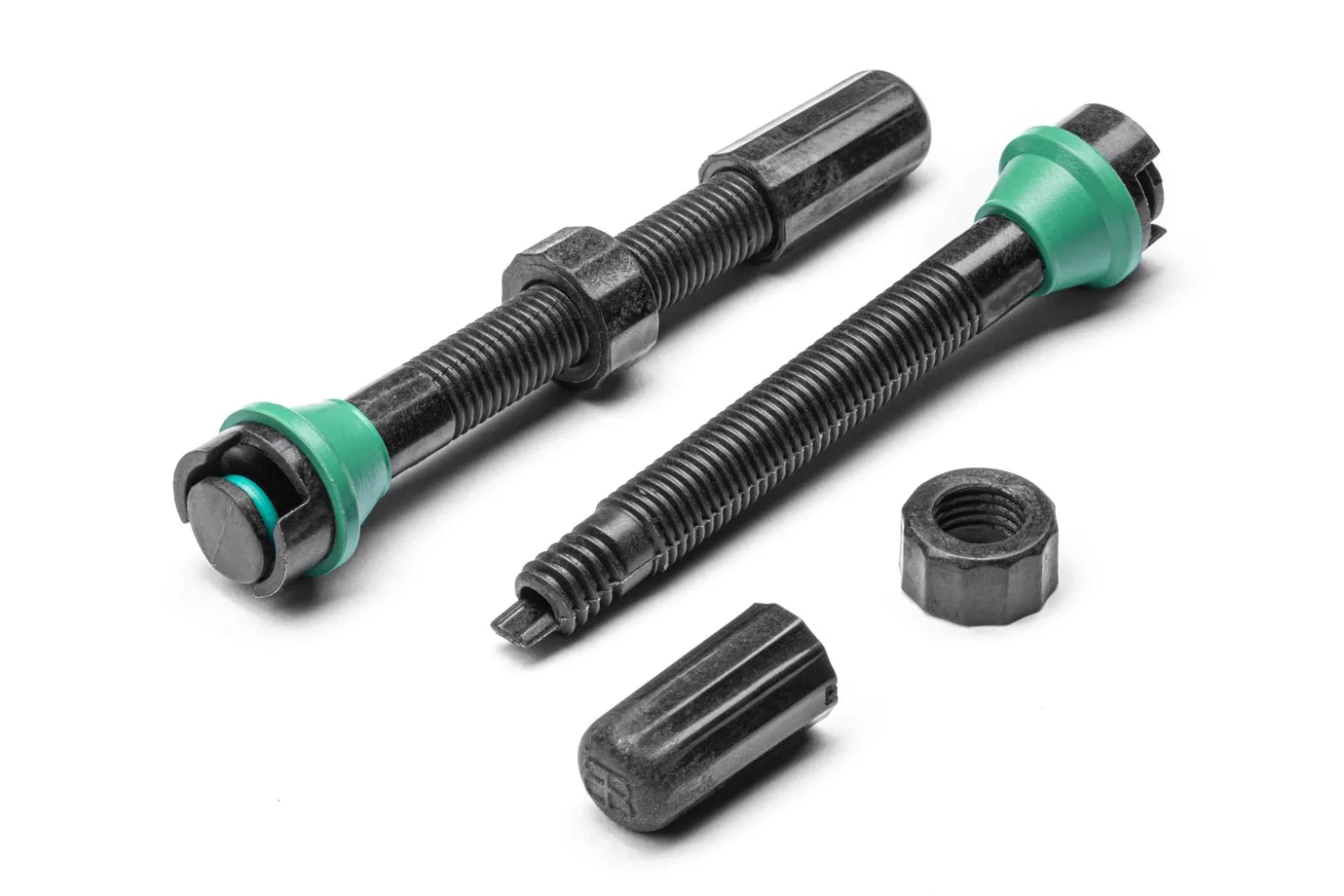
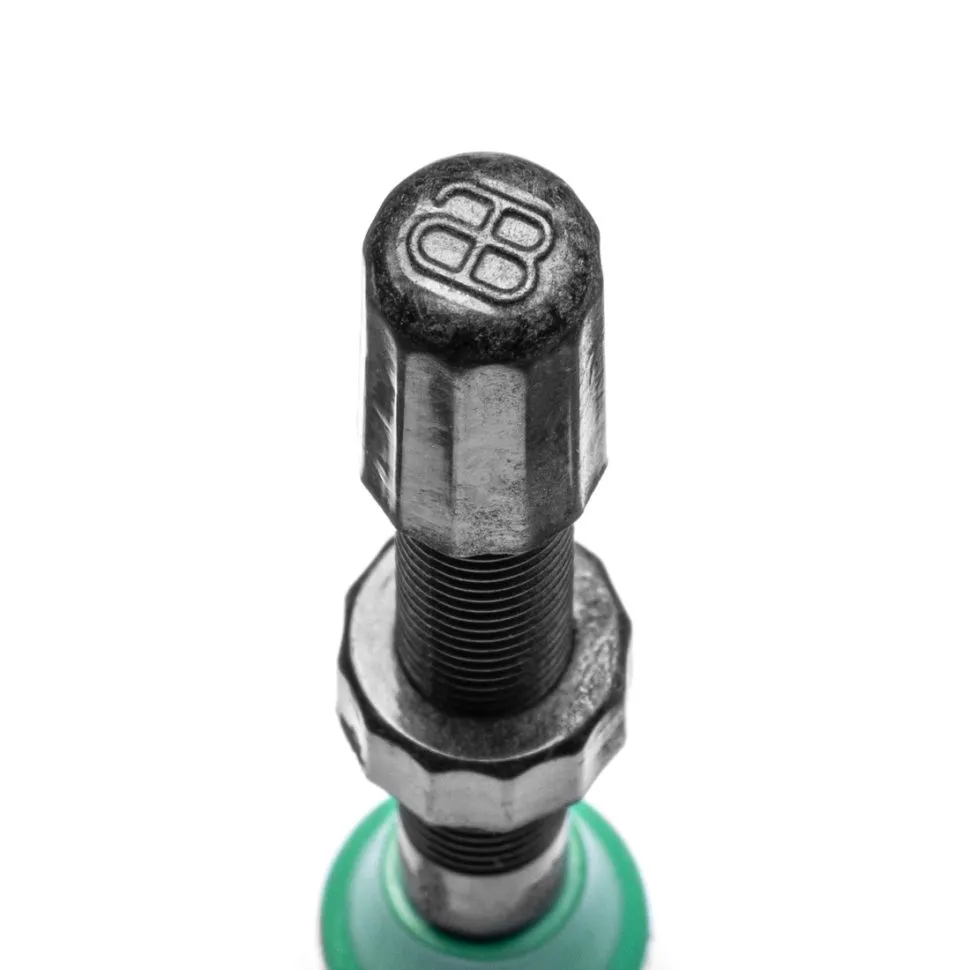
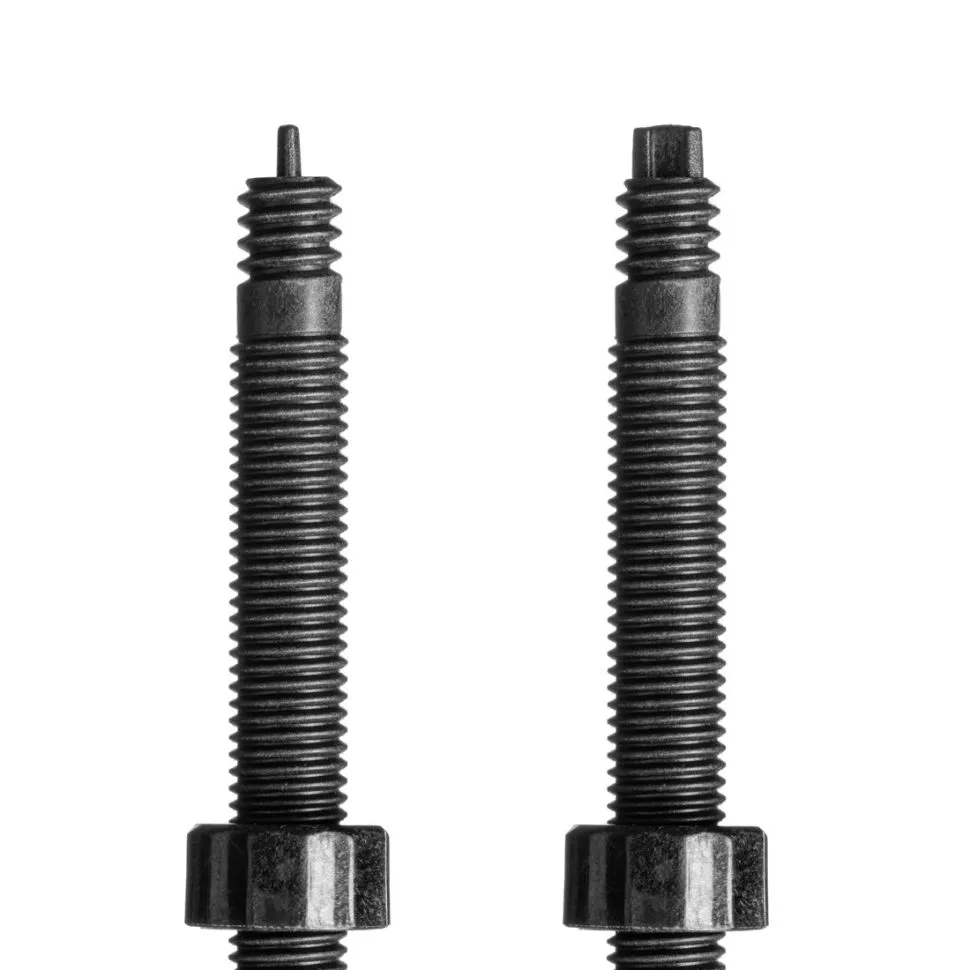
The company’s recently launched Aether valve initially appears unconventional, even slightly over-engineered. A 2.6g tubeless valve made from a carbon fibre composite, without a traditional Presta core, sounds closer to an engineering exercise than an everyday workshop component. However, the thinking behind it is arguably more conservative than radical: simplify the mechanism as much as possible and remove unnecessary internal complexity.
Interestingly, the concept itself is not entirely new. Early versions of bottom-sealing valve systems appeared as far back as the 1915 US Patent 1,129,585. More recently, products such as Fillmore and Peaty’s valves have revisited similar ideas by relocating the sealing mechanism away from the top of the valve. absoluteBLACK’s contribution is not necessarily the concept itself, but the extent to which the architecture has been simplified.
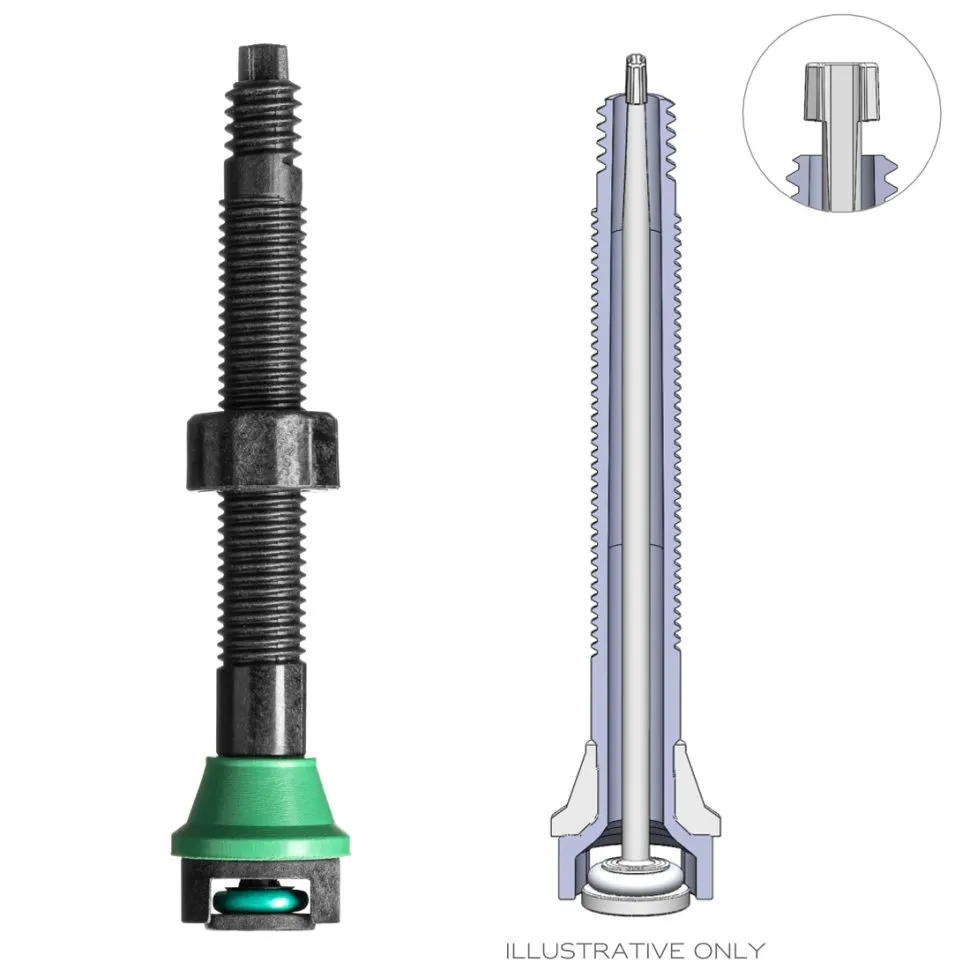
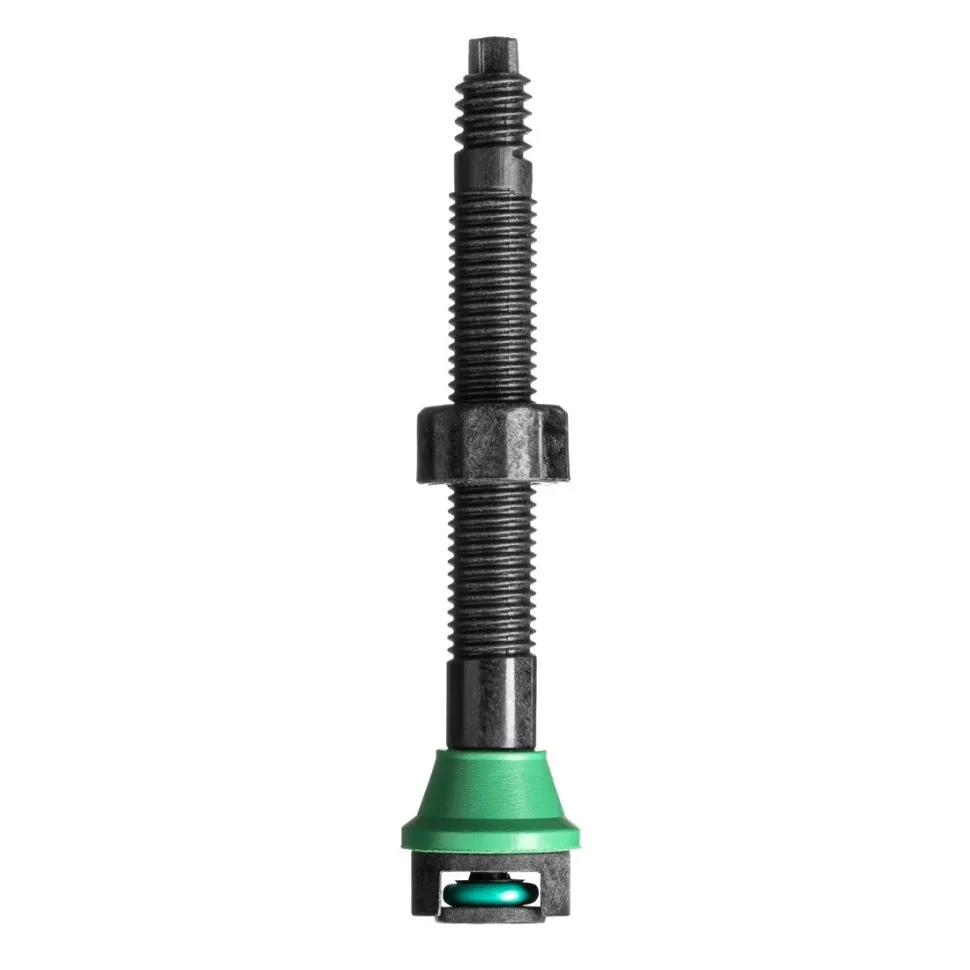
At the core of the Aether valve are only two primary functional parts: the valve tube and a lightweight plunger sealing mechanism. Rather than using springs, removable valve cores or complex internal retention systems, the plunger is secured by a widened tip at the end of the rod itself. The approach is mechanically minimal, but also unusually direct from an airflow perspective.
Removing the traditional Presta core eliminates one of the narrowest and most restrictive sections of the airflow path. It also removes one of the most common accumulation points for dried tubeless sealant. In practical terms, the valve is intended to inflate more easily, resist clogging and require less maintenance over time.
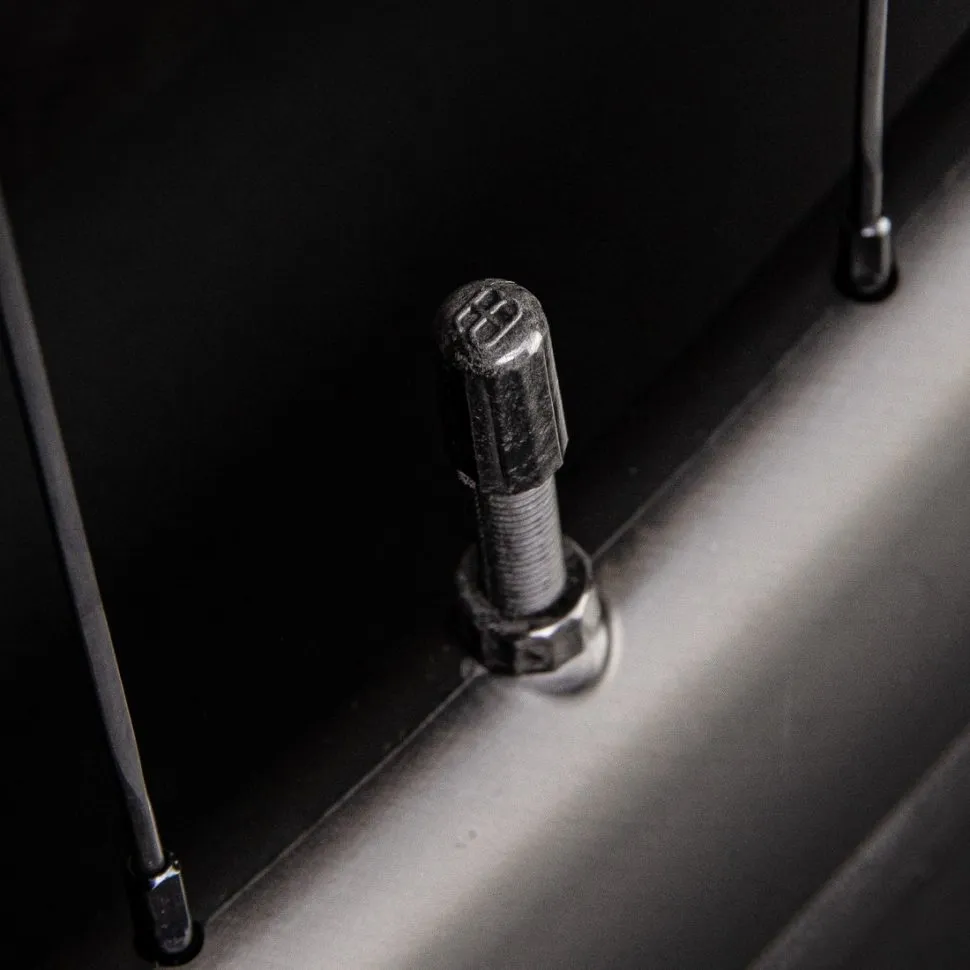
The philosophy behind the design matches the overall approach of absoluteBLACK. The company has long focused on the more engineered side of cycling culture, particularly riders obsessed with lightweight efficiency and mechanical elegance. In that sense, absoluteBLACK sees the Aether as less about just chasing weight savings, and more a demonstrable faith in simpler structures with fewer parts resulting in lighter components.
That thinking also explains the unusual material choice. Instead of conventional machined aluminium, Aether uses a long carbon-fibre composite material. According to absoluteBLACK, the tensile and yield strength of the material exceeds the 6061-T6 aluminium commonly used in many tubeless valves. More importantly, the material allowed the company to create wall structures and internal geometries difficult to achieve through traditional machining methods.
Perhaps surprisingly, absoluteBLACK claims the final valve proved stronger than expected during development. The absence of internal threading for a removable valve core also allows thicker tube walls, further increasing structural strength.
Of course, unconventional designs inevitably raise questions. Cyclist put several of the most common ones directly to absoluteBLACK.
Without a locknut like a Presta valve, can Aether open by itself while riding?
According to absoluteBLACK, no. The valve remains sealed by tyre pressure itself. The sealing mechanism sits at the bottom of the valve with a relatively large sealing surface, while tyre pressure continuously pushes the lightweight plunger upward into the closed position.
The company explains that, theoretically, centrifugal force would need to overcome the upward force created by tyre pressure for the valve to open unintentionally. Because the moving components are extremely light, they estimate this would require unrealistic cycling speeds.
If there is no Presta core, how does the valve actually work?
Instead of sealing at the top of the valve like a traditional Presta system, Aether seals at the bottom using a lightweight plunger mechanism protected inside the rim cavity.
During inflation, incoming air pressure temporarily lifts the plunger to allow airflow. Once inflation stops, tyre pressure immediately pushes the mechanism back into its sealed position.
The result is a much more direct internal airflow path without the narrow restrictions associated with removable Presta cores.
Will tubeless sealant still clog the valve?
absoluteBLACK says reducing clogging was one of the primary reasons for redesigning the valve in the first place.
Traditional Presta valves contain narrow internal passages and small moving components where dried sealant can accumulate over time. Aether uses a more open internal structure with fewer restrictions and fewer small internal parts, allowing sealant particles to pass through more freely.
How is Aether different from Clik valves?
Although both systems eliminate the tiny threaded locknut associated with traditional Presta valves, their internal designs are fundamentally different.
Clik valves are conceptually closer to Schrader systems adapted for Presta-sized rim holes, with convenience and push-on pump attachment as their primary objective.
Aether instead uses a bottom-mounted sealing mechanism with no spring-loaded valve core at the top. According to absoluteBLACK, this allows a simpler structure, lower weight and a more direct airflow path.
How is Aether different from Fillmore or Peaty’s valves?
absoluteBLACK acknowledges that Aether is conceptually similar to Fillmore and Peaty’s valves in relocating the sealing mechanism away from the traditional Presta core.
The company argues the main distinction is simplicity. Aether uses only two primary functional components and avoids the more complex internal retention systems found in some other designs. Instead, the plunger assembly is retained simply by widening and flattening the tip of the rod so it cannot pass through the valve opening.
The result, according to the company, is a cleaner airflow path with fewer potential clogging points and fewer overall components.
Is the composite material actually strong enough for everyday use?
absoluteBLACK claims the long carbon fibre composite used in Aether exceeds the strength of the 6061-T6 aluminium commonly used in many tubeless valves.
Additionally, because the valve does not require internal threading for a removable valve core, the valve tube itself can use thicker wall sections, which further improves structural strength.
Whether riders embrace the concept long term remains to be seen. The launch of the Aether suggests that there is still plenty of space for design development, even in the smallest of bicycle components.
Find out more at absoluteBLACK.cc