
Summary
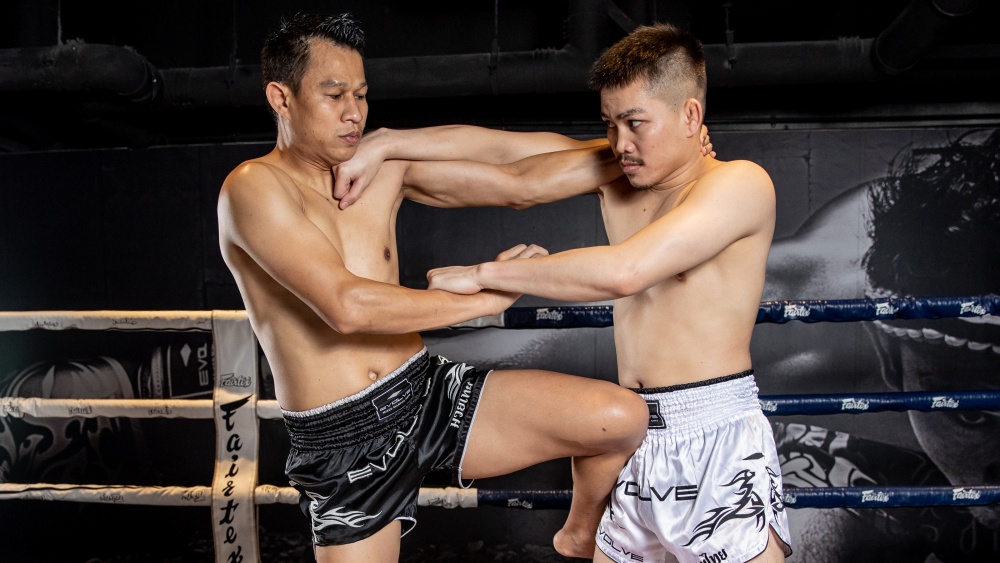
The knee guard is one of Muay Thai‘s most intelligent and underappreciated techniques, a transitional move that transforms the moment immediately after a knee strike from a moment of vulnerability into a position of control. By raising the same-side leg horizontally across the opponent’s body after delivering a knee, a fighter simultaneously protects against counterattacks, maintains clinch dominance, and sets up devastating follow-up strikes, sweeps, and throws. This article breaks down everything you need to know about the knee guard: its mechanics, the key principles of balance and body positioning required to execute it correctly, how it differs from other guard positions in Muay Thai, its defensive and offensive applications, and the conditioning exercises and drills that build the physical foundation to use it effectively under pressure. As Muay Thai World Champion and Evolve MMA instructor Chaowalit Jocky Gym puts it, “The knee guard is what separates a fighter who throws a knee from a fighter who controls the fight with a knee. The strike is just the beginning — what you do immediately after is where the real advantage is created.” Master this transitional move, and you will find that your clinch game, your defensive structure, and your ability to chain techniques together all improve significantly.
Key Takeaways
- The knee guard is a transitional move, not a static position. It is executed in the immediate moment after a knee strike, using the momentum of the strike itself to flow seamlessly into a defensive and controlling posture — making it a natural extension of the knee rather than a separate technique.
- Balance, core strength, and hip stability are the physical foundations of an effective knee guard. Without a strong base on the supporting leg and an engaged core, the guard collapses under pressure and provides neither the protection nor the control it is designed to deliver.
- The knee guard serves both defensive and offensive purposes simultaneously. While its primary function is to shield against counterattacks after a knee strike, it also creates immediate opportunities for elbows, punches, kicks, sweeps, and throws, making it one of the most versatile positions in Muay Thai.
- Active pressure is what makes the knee guard effective. A passive knee guard that simply rests against the opponent does little. Pressing the guarding leg firmly into the opponent’s body disrupts their structure, limits their movement, and prevents them from resetting their position.
- The knee guard is distinct from other guard positions in Muay Thai. Unlike the high guard or low guard, which are static defensive positions, the knee guard is dynamic and transitional, requiring constant adjustment and adaptability in response to the opponent’s movement.
- Developing the knee guard requires both physical conditioning and deliberate drilling. The technique demands specific strength in the legs and core, combined with the timing and fluidity that only comes from repeated partner work and live sparring application.
Importance Of Mastering This Transitional Move
Mastering the knee guard in Muay Thai is important for any fighter looking to excel in the clinch and gain an upper hand in the ring. It not only safeguards against an opponent’s potential retaliation after a knee strike but also serves as a launchpad for offensive maneuvers. By effectively utilizing the knee guard, fighters can neutralize their opponents’ attacks, create openings for strikes, and exert dominance in close-quarters combat.
Understanding The Knee Guard
To grasp the essence of the knee guard in Muay Thai, you need to understand its mechanics and the underlying technique. The knee guard involves raising the same-side leg that executed the knee strike and positioning it horizontally across the opponent’s body. This creates a physical barrier that shields against incoming strikes and controls the opponent’s movement.
The knee guard relies on a combination of balance, stability, and core strength. The supporting leg provides a solid foundation, while the knee acts as the pivotal point for maintaining control. The fighter’s arms can be positioned for added stability, either clasping the opponent’s arms or engaging in a clinch position.
Key Principles And Body Positioning For Effective Execution
Executing the knee guard effectively requires adherence to several key principles and optimal body positioning. Here are some essential considerations:
- Balance And Stability: Maintaining a strong base and stable posture is paramount. Distribute your weight evenly between your legs, engage your core, and keep your upper body upright.
- Active Guarding: Apply pressure with the knee guard by pressing it firmly against your opponent’s body. This actively obstructs their movements and makes it more challenging for them to mount an effective counterattack.
- Counterbalance: To enhance balance and stability, use your non-supporting hand to grasp your opponent’s arm or shoulder, creating a counterbalance against their attempts to disrupt your position.
- Head Positioning: Keep your head upright and aligned with your spine. This helps you maintain awareness of your surroundings and prevents your opponent from gaining advantageous positioning.
- Weight Distribution: Optimize weight distribution between your legs. Too much weight on the front leg can compromise balance, while too much weight on the back leg limits mobility. Find the right balance for quick transitions and effective defense.
By adhering to these principles and maintaining proper body positioning, you can execute the knee guard with precision and maximize its defensive capabilities in the heat of combat.
Differentiating The Knee Guard From Other Guard Positions In Muay Thai
It’s important to note that the knee guard is a distinct guard position in Muay Thai, separate from other commonly used guards such as the traditional high guard or low guard. While the knee guard shares some similarities in terms of its defensive purpose, it specifically capitalizes on the transitional moment after a knee strike, allowing the fighter to seamlessly transition from offense to defense.
Unlike static guards, such as the high guard or low guard, the knee guard is a dynamic position that demands constant adjustments and adaptability. It enables the fighter to maintain control and readiness for further engagement, setting the stage for potential follow-up strikes or defensive maneuvers.
Understanding the unique mechanics, principles, and differentiating factors of the knee guard in Muay Thai lays a solid foundation for mastering this transitional move.
Defensive Advantages Of The Knee Guard
- Protection Against Counterattacks: The knee guard serves as a formidable defensive tool, shielding you from an opponent’s immediate counterattacks following a knee strike. By positioning your leg horizontally across their body, you create a barrier that blocks strikes and disrupts their ability to mount an effective offensive response.
- Control In The Clinch: The knee guard enables you to maintain control in the clinch, a crucial aspect of Muay Thai. By utilizing the knee guard, you can effectively neutralize your opponent’s attempts to gain dominant positioning and limit their ability to execute strikes or initiate grappling techniques.
Offensive Opportunities Presented By The Knee Guard
- Follow-Up Strikes: The knee guard sets the stage for devastating follow-up strikes. By utilizing the knee guard as a transitional position, you can quickly transition from defense to offense and capitalize on your opponent’s compromised position. Strikes such as elbows, punches, or kicks can be seamlessly launched from the knee guard, catching your opponent off guard and inflicting significant damage.
- Sweeps And Throws: The knee guard also provides opportunities for sweeps and throws. By leveraging your stability and control in the knee guard position, you can off-balance your opponent and execute sweeps or throws, effectively taking them down to the canvas and gaining a dominant position.
The knee guard’s versatility in both defense and offense makes it a valuable asset in the arsenal of a Muay Thai practitioner. It not only offers protection and control but also opens up avenues for devastating strikes and grappling techniques.
Conditioning Exercises To Strengthen The Core And Legs For Stability
- Plank Variations: Planks help develop core strength, which is essential for maintaining stability in the knee guard. Incorporate standard planks, side planks, and plank variations such as plank leg lifts to challenge your core muscles.
- Squats And Lunges: These exercises target the muscles of the legs, including the quadriceps, hamstrings, and glutes. Strong leg muscles provide stability and power in executing the knee guard.
- Balance Exercises: Incorporate exercises like single-leg balances or balance board drills to enhance proprioception and improve overall balance, crucial for maintaining control in the knee guard position.
Drills For Developing Quick Transitions Into The Knee Guard
- Strike Combinations: Practice combinations that culminate in a knee, such as jab–cross–knee or hook–uppercut-knee. Focus on fluidly transitioning from a strike to the knee guard position immediately after the strike.
- Mirror Drills: Partner up and take turns practicing knee strikes and transitioning into the knee guard position. Work on speed and precision, aiming to seamlessly flow from strike to guard and vice versa.
- Shadowboxing With Knee Guard Transitions: Incorporate knee guard transitions into your shadowboxing routine. Visualize an opponent’s strikes and practice executing the knee guard as a defensive response.
Partner Training Exercises To Simulate Real Combat Scenarios And Improve Timing
- Clinch Drills: Engage in clinch training with a partner, focusing on utilizing the knee guard as a defensive tool within the clinch. Practice controlling your partner’s movements, maintaining the knee guard position, and countering with strikes or sweeps when opportunities arise.
- Counterattack Drills: Have your partner simulate various strikes and attacks while you practice transitioning into the knee guard position to defend against them. React quickly and effectively, utilizing the knee guard to block and counter with strikes of your own.
Consistent training with these conditioning exercises and drills will help develop the necessary physical attributes, timing, and fluidity required to execute the knee guard effectively in real combat scenarios. By incorporating these training methods into your routine, you’ll enhance your proficiency in the knee guard and elevate your overall performance in Muay Thai.
Application And Strategy
In the realm of real-world applications, the knee guard in Muay Thai has been successfully utilized by professional fighters to gain an edge in the heat of battle. By implementing the knee guard effectively, fighters can defend against counterattacks, control the flow of the fight in the clinch, and capitalize on offensive opportunities.
Strategies for integrating the knee guard into one’s overall fighting style involve reading opponents, timing the knee guard, and adapting it to different opponents and fight scenarios. Understanding these strategies and applying them in the ring can significantly enhance a fighter’s performance and ability to dominate their opponents.
Frequently Asked Questions About The Knee Guard In Muay Thai
Q: What Exactly Is The Knee Guard And When Should It Be Used?
A: The knee guard is a transitional defensive position executed immediately after delivering a knee strike. The same leg that threw the knee is raised and held horizontally across the opponent’s body, creating a physical barrier that protects against counterattacks while maintaining close-range control. It should be used any time you deliver a knee strike and need to protect yourself from an immediate counter, which in practice means it should become an automatic part of every knee strike you throw, rather than a conscious decision made in the moment.
Q: How Is The Knee Guard Different From Simply Holding Your Leg Up After A Knee Strike?
A: The distinction is in the intent, positioning, and pressure. Passively leaving your leg raised after a knee strike offers minimal protection and leaves you vulnerable to being swept or pushed off balance. The knee guard involves actively pressing the raised leg into the opponent’s body at a horizontal angle, disrupting their structure and limiting their ability to counter. The supporting leg, core, and arm position all work together to create a stable, controlled position — not just a momentarily raised leg.
Q: What Are The Most Common Mistakes Fighters Make With The Knee Guard?
A: The most frequent errors are failing to apply active pressure with the guarding leg, allowing the position to become passive and easy for the opponent to push through; poor weight distribution on the supporting leg, which compromises balance and makes the fighter easy to sweep; dropping the hands during the transition, leaving the head exposed to punches; and holding the position for too long without transitioning into a follow-up strike or returning to stance. The knee guard is a transitional position — it is most effective when used as a brief moment of control that flows immediately into the next action.
Q: Can The Knee Guard Be Used Against Taller Or Stronger Opponents?
A: Yes, though the execution may require adjustment. Against a taller opponent, the horizontal leg may need to be positioned higher to effectively obstruct their movement rather than catching only their lower body. Against a stronger opponent who is actively pushing back against the guard, arm positioning and counterbalance become more important — gripping the opponent’s arm or shoulder with the non-supporting hand gives you additional leverage to maintain the position. Core strength and hip stability are the great equalisers here; a fighter with a strong base can hold the knee guard effectively regardless of size differences.
Q: How Does The Knee Guard Fit Into Clinch Fighting Strategy?
A: The knee guard is one of the most important tools for maintaining dominance in the clinch. After landing a knee, the natural tendency of the opponent is to attempt to reset their position, create distance, or counter with their own strike. The knee guard disrupts all of these responses simultaneously — it blocks immediate counters, controls their body, and keeps them close enough for follow-up knees, elbows, or sweeps. Fighters who integrate the knee guard naturally into their clinch game are significantly harder to counter and maintain a persistent threat that opponents must constantly manage.
Q: What Follow-Up Strikes Work Best From The Knee Guard Position?
A: The elbow is arguably the most natural and dangerous follow-up from the knee guard, as the close range created by the guard puts you in ideal elbow range. The cross or overhand punch is effective when the opponent’s guard has been disrupted by the guarding leg pressing into their body. A sweep or throw is available when the opponent’s weight is sufficiently compromised. If you choose to disengage and return to range, a teep or body kick from the disengaging leg can be used to create distance with additional scoring intent. The key is to have at least one follow-up option drilled as a single fluid sequence — knee, guard, follow-up — rather than deciding in the moment.
Q: How Long Does It Take To Develop The Knee Guard To A Usable Level In Sparring?
A: The basic mechanics of the knee guard can be understood and approximated within a few sessions of deliberate drilling. Developing the balance, core stability, and timing required to hold it reliably against a resisting partner in sparring typically takes several weeks to months of consistent practice. The transition from a technique you can perform in drills to one you deploy automatically in live sparring is the most demanding step, it requires enough sparring repetition that the guard becomes a reflexive response to throwing a knee rather than a conscious decision. Prioritising partner drills and clinch sparring will accelerate this process significantly.
Q: Does The Knee Guard Work In Competitive Muay Thai Scoring?
A: Yes, and not just defensively. In competitive Muay Thai, judges reward fighters who demonstrate control, dominance, and effective defence. A fighter who consistently lands knees and flows immediately into the knee guard signals technical maturity and ring intelligence to the judges, qualities that influence scoring beyond the individual strikes themselves. Additionally, if the knee guard enables sweeps or throws, those techniques score highly in Muay Thai and can shift the momentum of a round. The knee guard is as much a strategic scoring tool as it is a defensive one.
Final Thoughts
The knee guard is a technique that rewards the fighters who take the time to understand it properly. On the surface, it appears simple — raise the leg, press it across the opponent, protect yourself from the counter. But in practice, it is a nuanced position that demands balance, active pressure, timing, and the physical conditioning to hold it under resistance. When those elements come together, the knee guard becomes one of the most effective tools in close-range Muay Thai, a position that simultaneously neutralises your opponent’s response, asserts your dominance in the clinch, and opens the door to follow-up damage.
The fighters who master transitional techniques like the knee guard are the ones who make Muay Thai look effortless. Every knee they throw is connected to what comes before and after it, flowing through the guard into the next strike or sweep without pause or hesitation. That fluidity is not a natural gift; it is the product of deliberate drilling, consistent partner work, and the patience to build a technique properly before testing it under pressure. Start with the mechanics, build the physical foundation, and commit to the sparring repetitions that make it automatic. The knee guard will repay that investment many times over.
You may also like:
Reading Your Opponent: How To Spot Subtle Tells And Patterns During A Fight