
Shortly before noon on May 24, the IndyCars field was forming up in three-wide rows around the Indianapolis Motor Speedway, anticipating the start of the 110th running of the Greatest Spectacle in Racing.
The only thing connecting those cars to the fabled circuit, with its legendary “yard of bricks,” were Firestone tires–as has been the case for over two decades. In …
Tire Specs
After a week’s worth of off-and-on rain, track test day dawned cloudy with ambients in the mid-70s. As usual, we spent a session on some scrubs to clean the track surface–but raindrops appeared on our windshield as we finished. Then we saw the lightning.
The Central Texas spring weather is very hard to predict, and the forecast when we loaded up had been dead wrong: A rogue storm had suddenly changed direction, and the outer bands were now hitting the track.
A quick glance at the radar app showed light rain for a couple of hours. Hmm, what to do? We were already at the track with a car and a stack of tires. When life gives you lemons, you make lemonade. Let’s do wet testing.
Splish Splash
We spent the next couple of hours going through our usual test procedure, but this time on a fully soaked Harris Hill Raceway. There was little standing water, but the wet surface meant using the full rain line to avoid the slicker polished dry line.
Consistency of lap times would suffer, but the variance in grip of each tire in the wet was large enough to show clear trends. So we softened the dampers, turned the stability control back on and went to work.
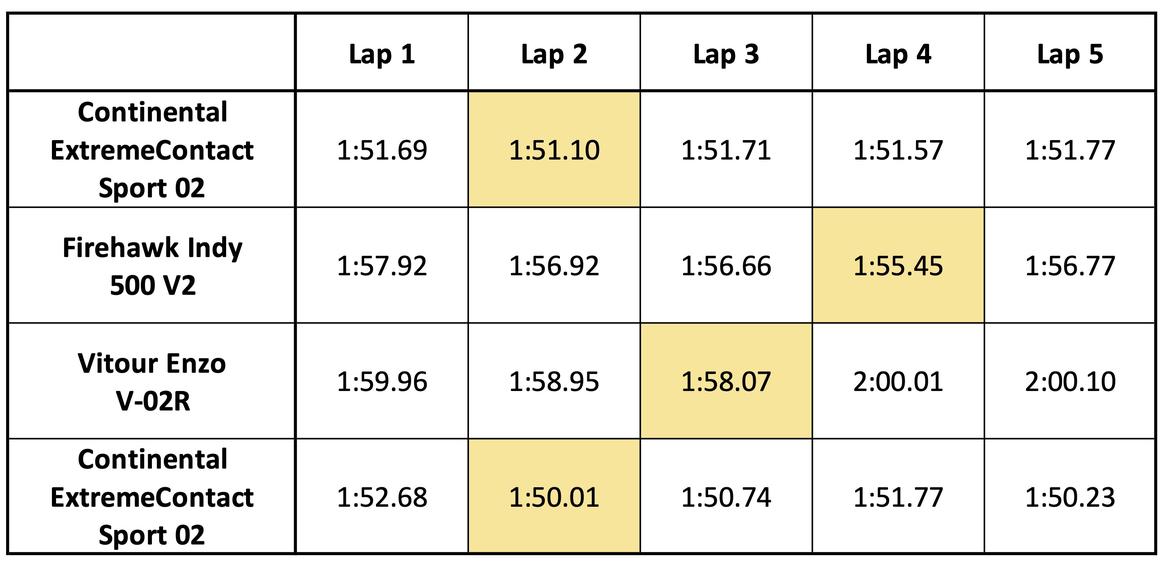
The Continental ExtremeContact Sport 02 in the wet is a cheat code. While that tire wants a soft approach with every input, the wet grip is unsurpassed. It’s especially impressive at the corners of the friction circle while multitasking between longitudinal and lateral asks–so your trail braking and corner-exit power-up. Further, the breakaway is very progressive, offering lots of warning and recovering quickly.
The Firestone Firehawk Indy 500 V2 had a similar feel to it but with a bit less overall grip. It was also less adept at combined asks, requiring a more stepwise approach to corner entry and exit: Brake to a bit slower speed, release early and then carve the turn; on exit, wait longer to squeeze on the power.
By contrast, the Vitour Tempesta Enzo V-02R was simply not good in the wet–unless we slowed way down. Most notably, the breakaway characteristic was quite sudden and recovery slow. Staying anywhere near the limit where grip changes constantly was a massive challenge, and we hit the stability control nanny often. This is a tire that will get you home at a reduced pace in a storm but would not be a good choice for tracking in inclement weather.
A note on the final bracket session of the Continental ExtremeContact Sport 02: By this point, active precipitation had diminished compared to the consistent light rain of the earlier round. So the minor time improvement was not a surprise.
Wet Track Testing
The Sun Will Come Out Tomorrow
We returned the next day to a completely dry track under full sun, with temps in the mid-70s and climbing to the low 80s during our work. Perfect.
We again bolted on some scrubs to clean the track surface, noting how green everything was from all of the recent precipitation. Overall lap times were more than a second off optimal conditions.
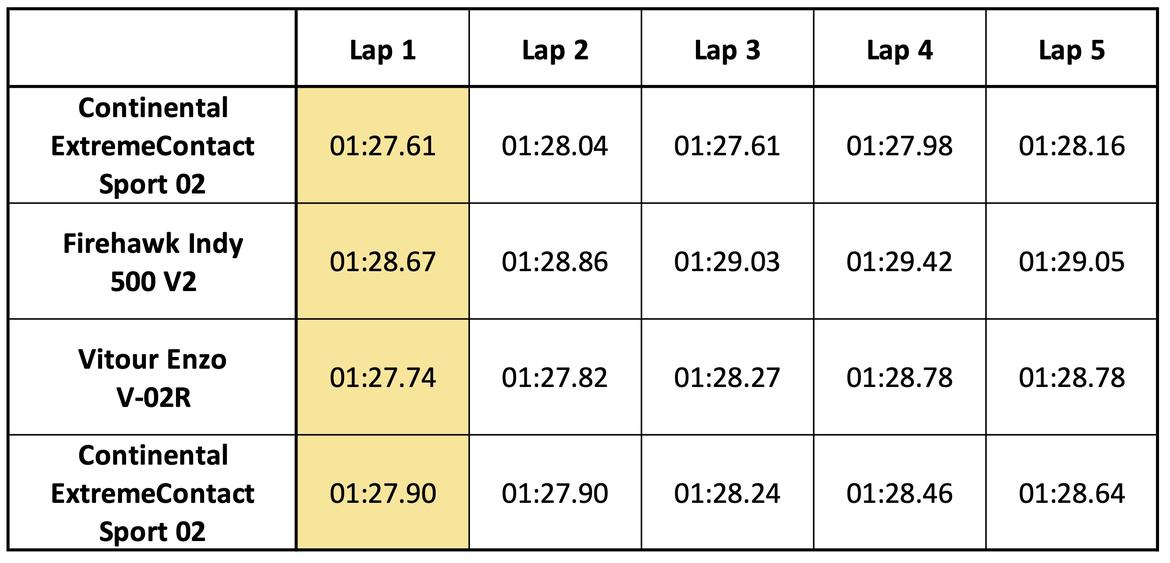
Mounting up the Continentals first, we noticed eager steering but with a softer, less responsive feeling than the Super 200 scrubs we had just run. Lap times were fairly consistent as we dialed in our expectations. Grip limits were announced by audible feedback, and recovery at the limit was quick–unless we went too far over. Then there’d be a long pause as speed was scrubbed off and lap time slipped away. That’s exactly what happened on Lap 2.
The Firestone Indy 500 V2 was next–just as its namesake race began formations laps at Indiana’s Speedway. In the wet, its characteristics were similar to the Continental but with a bit less grip. Audible feedback at and over the limit was much more pronounced, though. The tire heat-soaked a bit after a couple of laps but held firm thereafter. With precise driving, consistency was quite good–though lap times were about a second off the ExtremeContact Sport 02.
Next up was the Vitour Enzo V-02R, which had the most aggressive steering response when pushed. As we built load, it pulled us further into the turn. To some degree, this encouraged overdriving, from which recovery was slow–as with the Continental. But if we colored carefully within the lines, it was every bit as quick as that tire. Eventually it heat-soaked and became loud and sloppy. For full sessions, intermittent cooldown laps would be advised.
Dry Track Testing
The Final Countdown
Photograph by Andy Hollis
Each of these tires has its place in the market. The Firehawk Indy 500 V2 is a clear improvement over its predecessor, offering strong performance in all conditions for a modest price. Based on known relative performance of the control tires, the Firestone Firehawk Indy 500 V2 picked up at least a full second in dry pace. The internet will keep suggesting this one for many years to come.
The Vitour Tempesta Enzo V-02R is the price-performance king for a fair-weather sports car that sees occasional track time or cone dodging. And it does so with a pleasant street experience. Save money, go fast, enjoy the ride.
And if you’re willing to pay its price, the Continental ExtremeContact Sport 02 can provide superior performance across all conditions. It’s best in the wet, strong in the dry and has excellent street manners.