
Six months ago, the League of American Bicyclists released the Bike Advocacy Toolkit: a practical, grassroots-focused guide for advocates working to make biking better in their communities. We sat down with the toolkit’s author, Anna Tang, the League’s Bicycle Friendly America Program Specialist, to talk about what inspired it, who it’s for, and what she hopes it becomes.
What inspired the creation of the Bike Advocacy Toolkit, and was there a particular moment that made you realize it was needed?
As the League’s Bicycle Friendly America Program Specialist, I travel around the country facilitating Bicycle Friendly Community Workshops to help people make biking better in their cities and towns. As I’ve listened to the challenges people face at the local level, it became clear that there is a need to help the grassroots bike movement get better organized and learn the fundamentals of doing that work.
To answer that need, the League developed a series of bike advocacy workshops that I lead to certify people as League Cycling Advocates (LCAs). The LCA program was the real instigator for creating the toolkit — so that advocates would have a manual of sorts, for use as an educational tool during the workshop, and as a reference for continuing their advocacy journey beyond the workshop. Our next LCA workshop is in Chicago, Illinois, this September, and registration is open through August 14th, 2026.
Who do you imagine using the toolkit most — first-time advocates or established organizations refining their strategies?
While it’s written for anyone, novice and seasoned advocates alike, I imagine most toolkit users are bike advocates who are probably at least a year into their bike advocacy journey. I do hope established bike nonprofits will use it, particularly to distribute to their local members to help them get organized and educated. It’s also written with new advocates in mind who are early in the work, starting their own advocacy initiatives in their community, and who need some guidance to build up their local circles of support.
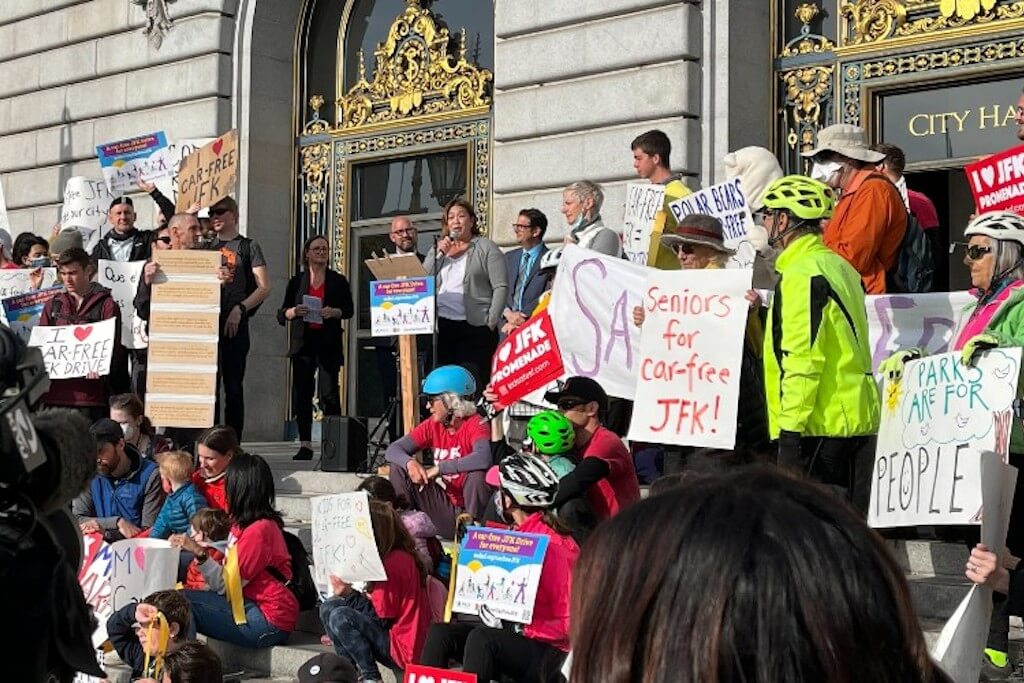
San Francisco Bicycle Coaltion pushes for car-free JFK Drive (Photo: SFBC)
What are some of the biggest barriers local advocates face when trying to create change in their communities?
Personality clashes, moving forward without a plan, access to funding, and time constraints are probably the most common barriers that I see local advocates face. Often, outside factors beyond the group’s control are part of the issue at hand, so I’m a strong believer in debating ideas instead of debating people. That mindset helps not to take those conflicts so personally.
Many advocates also plow forward with an idea or goal, but they don’t do their homework first. For example (and to tie into the time and money barriers), I’ve often seen advocates jump in at the end of a project and ask for a bike lane when the project has already gone through the design phase, environmental review, council approval, and budget hearings. Unfortunately, at that point, it’s probably too late in the game to include a bike lane. It would behoove advocates to make a plan, do their homework, and be strategic to get ahead of the next big project. The Bike Advocacy Toolkit is meant to help them do so, especially the section on the “7 Steps to a Winning Campaign,” which helps organize ideas into a strategic effort.
Why do you think grassroots, community-level organizing is such an effective force for better biking infrastructure?
There’s a saying out there — “Nothing about us without us” — and it’s really what being an effective organizer means. When you invite as many perspectives and people as possible to the table (and intentionally include folks to be part of the conversation), not only will the work that you’re trying to do have a better result, but people in the community will have more buy-in, understanding, and support for the end project.
It’s okay to have different perspectives and opinions about various issues; that’s what makes this work interesting. If there’s no space to share diverse perspectives and engage in dialogue about the work you’re doing, then the result usually won’t be as robust as it could be. Grassroots, community-level organizing is the most effective way to build sustainable power and create structure for long-term change — not just making a bunch of quick wins.
How did you ensure the toolkit reflects equity and inclusion and elevates diverse voices within cycling advocacy?
Equity, inclusion, working towards justice, and accessibility are the starting points for effective and good advocacy work, so that is where we started. We wanted to make sure these values were woven throughout the toolkit, and invited a variety of external reviewers to offer different perspectives and provide feedback to make it more accessible, equitable, and inclusive. I know there’s also probably a lot more we could do to make our document more accessible to different types of learners and abilities, and welcome feedback on how to do so.
Which tool or exercise inside the toolkit are you most proud of?
I think the local budget section and the example capital budget request letter are very useful, and I hope people get a lot of mileage out of those sections. If local advocates can work on influencing their local budget to get more funding for biking projects, that would be a dream come true — it would really make a difference for people today and for generations to come. Not enough people realize how influential they can be on their local budget, no matter the size of their community.
How does this new resource fit within the League’s broader mission to make biking safer and more accessible nationwide?
The League’s mission is to create a bicycle-friendly America for everyone. Right now, the U.S. population is around 340 million people, which our staff of fifteen could not possibly reach individually in a lifetime. The Bike Advocacy Toolkit aims to amplify our reach by helping those who are already in the bike advocacy movement to be more effective organizers and advocates.

Washington Area Bicyclist Association protest ride
What role do you see technology and digital organizing playing in the future of local bike advocacy?
Technology and digital organizing will only ever be as good as the user puts it into practice. With that being said, I can see it being a huge help for organizers who are trying to scale their work up and manage large projects with lots of moving parts. However, people have been organizing impactful advocacy campaigns for decades upon decades without the newfangled technology of today, so it’s not a necessary tool to be effective or impactful. The best-case scenario is that advocates can use tech to cut down on busy work and let folks do more of what they love.
What advice would you give to advocates who feel discouraged by slow or bureaucratic progress in their city?
Have fun along the way and incorporate your existing hobbies and interests into your bike advocacy work. For example, if you’re an event planning connoisseur and like to curate gatherings, then do that and just have people bike to the event! Or if you love to take pictures and videos, you can use that skill for social media or influencer opportunities.
Unfortunately, some advocacy projects (like building huge infrastructure projects) take a long time, but some don’t. You can focus on both at the same time, boosting your morale for long-term projects by celebrating a small, bite-sized win. Just taking a bike ride is a form of advocacy, after all. You don’t have to always build a bike lane to make a difference.
How do you hope the toolkit will grow and evolve over time — could there be updates, translations, or new versions?
I’m hoping for all of the above! I definitely would love to see it translated into several languages as funding becomes available. (P.S. If anyone knows of relevant funding opportunities, let me know!) I also plan to expand on this toolkit to answer questions and cover advocacy topics that we didn’t cover in this version, like how to recruit board members, start bike buses, engage with various populations like college students, and much more — but I think we would produce a new toolkit or addendum, rather than make this one even longer. Our resources for advocates are always intended to be as useful as possible, so if you have feedback or ideas, the door (or really, my inbox) is always open!
On a personal note, what kind of rider are you, and how does your own cycling experience shape the way you approach advocacy?
I would say that I’m a bike commuter and adventure rider. I enjoy getting around town on a bike and also use it as a form of adventure — bikepacking is my favorite form of biking. Commuting by bike is really what first influenced me and my approach towards advocacy. I started out feeling very overwhelmed, confused, and scared, but I was determined to make my own personal experience biking to work better. This led me to the organizing and bike advocacy world, where I had to learn through experience and educate myself firsthand. I wish someone could have just handed it all to me in a manual instead of having to learn everything the hard way, and I hope the Bike Advocacy Toolkit can be that manual for all the emerging bike advocates out there.