
Will O’Rourke is one of the greatest blockers in cricket.
Can he bat? That is a complicated question. But can he stay in? Yes. And in the first innings, having a man whose best shot is mildly propping forward with no follow through and playing every ball under his eyes was almost perfect. It allowed Kyle Jamieson at the other end to keep swinging hard, and it was an annoying partnership.
But the thing with O’Rourke’s batting is it’s remarkably one note. In fact, it’s almost soundless. The ball hits the bat, and his hands are so soft that it muffles the impact entirely. He does not score runs, and we assumed he was the slowest scorer this century, which he is.
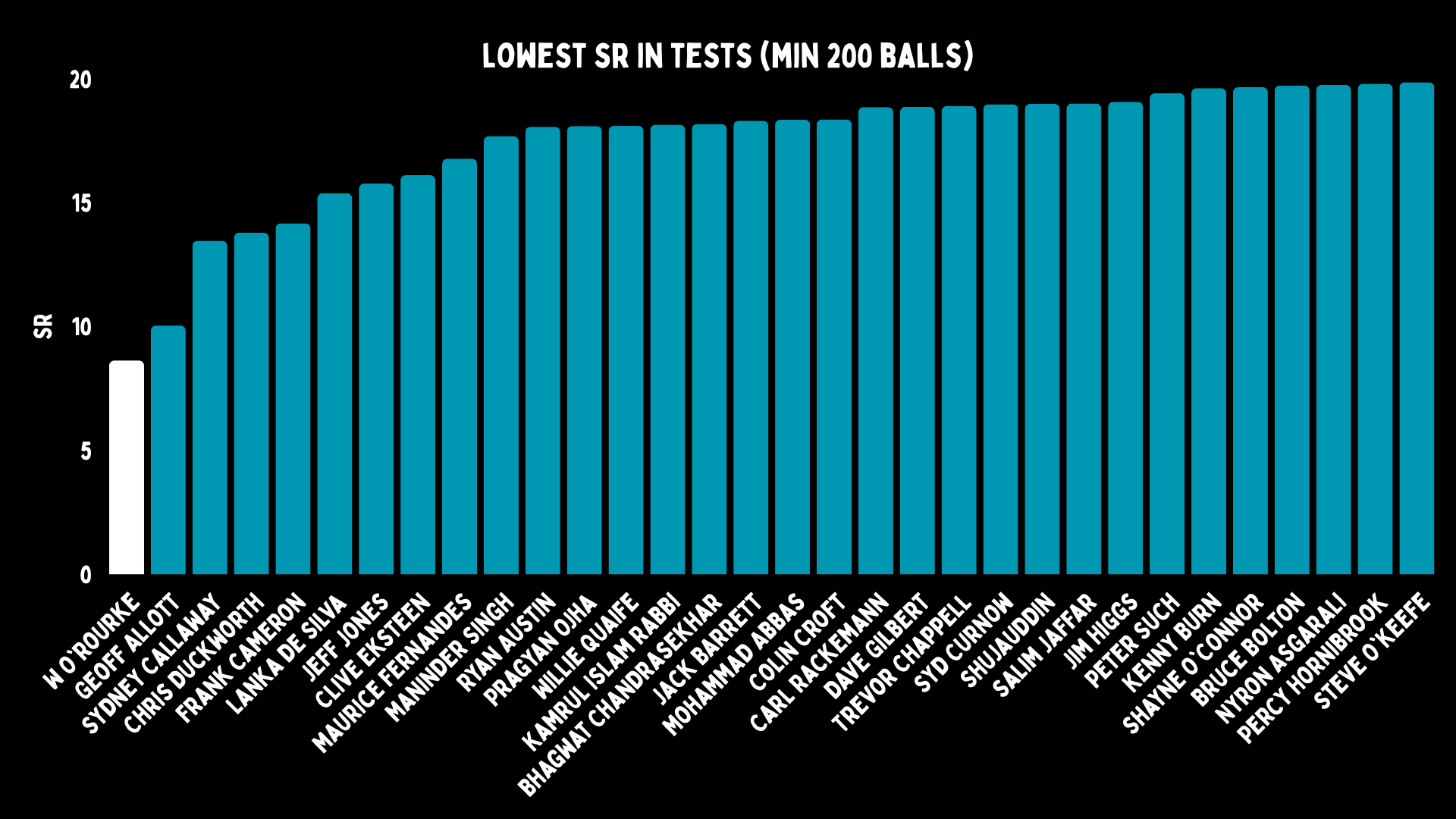
What we also found out is that he’s the slowest scorer ever in our database. 1532 players have faced 200 deliveries in Test cricket, and he has the lowest scoring rate of those we can check. He is cricket’s greatest non-scorer.
So he can hold up an end and frustrate teams. But you also know exactly what he is going to do (or in his case, not going to do) and plan accordingly. That is what Ben Stokes did. He brought in a silly point. A simple move to upset O’Rourke from his forward prop style.
Stokes makes so many changes in the field that it is hard to call this a moment of genius. If it hadn’t worked, he would’ve tried three gullies the ball after. Instead, the first ball he faced with this field, O’Rourke changed his method, pushed at a wide one, and was caught behind.
It was not a shot he plays, it was not a shot he should play, it was a mistake.
O’Rourke’s weird swipe was just the first error, an enormous canary in the coal mine of how this match would go. England worked things out, New Zealand made mistakes.
***
England brought up their hundred in the first innings with a drop. Harry Brook had already been put down once by Devon Conway. But that was a full-blooded shot, this attempt was an in-between effort, a guided pull that looked like fielding practice for Rachin Ravindra.
The young Kiwi can field, but if you saw him in this match it would be much harder to make that argument. The catch out on the boundary was dropped by him. But weirdly, the ball was at his chest, and yet he was off the ground at the time. It was a terrible effort, only matched by him missing the ball entirely from a Ben Duckett flick in the second innings.
If that was it for the drops, it would be pretty poor. But twice Devon Conway also had a ball hit straight to him, and he also dropped it. The two of them missed four chances, and only added 50 runs while missing nearly every England batter who scored. All while their opposition only dropped their first chance when the game was pretty much over. Four mistakes between two players is quite the effort.
But when it came to errors, the Kiwi hands were not the worst. That would be the surface. This was the 150th Test at Lord’s, and without doing too much research, I would say it ranks somewhere between 145 and 150 if these surfaces were rated best to worst. On day one, there was inconsistent bounce. When the ball seamed, it did so like a finger spinner on day five at Galle. It got worse as the game went on. Worse bounce, worse seam.
The ICC’s lowest ratings for a pitch are unsatisfactory and unfit. This was an unfit surface.
But England worked that out, and New Zealand never really did.