
By Dave Campbell — I recently had the opportunity to interview Norman Alvis, a legend of American cycling in the 1980s and 1990s who continues to race at a high level at age 62. He won his first national title in the Junior Time Trial in 1981, then captured senior national titles in both the Individual and Team Time Trial in 1987. In 1988, he joined the powerhouse 7-Eleven squad and represented the United States in the Seoul Olympics as a member of the four-man Team Time Trial, finishing tenth. He turned professional with 7-Eleven in 1989 and rode his first Tour de France in 1990. As the team transitioned into Motorola, he became a trusted and dedicated team worker, riding the Giro d’Italia three times along with most of the classics. In 1995, he returned to the United States and won the US Pro Road title in Philadelphia with the Saturn team. He set the US Hour Record at 51.505 kilometers in 1997—a mark that stood for seventeen years—and concluded his professional career with Saturn in 1998.
His story did not end there. In his second career as a Masters rider, Alvis has continued to excel. He has won numerous US Masters National medals on the road and has claimed Masters National titles on the track, most recently sweeping the 2025 M60–64 Points Race, Individual and Team Pursuit, and Scratch Race. He continues to set hour records, including the Masters 50–54 World Mark of 49.392 km in 2017. In 2021, he rode 49.387 km to set the World Mark for the 55–59 age group. A gifted storyteller, he now shares racing memories and tips each Sunday over espresso on his “crit_master” Instagram account.
How did you get into cycling?
It was 1978, and I was in high school at Sac High (Sacramento High School in Sacramento, California). I rode my bike to and from school, about five miles each way. One day I was riding home with a friend, Robert Hirschmann, who had a racing bike. Robert was just 5 foot 2, but he had an aluminum Viscount bike. We swapped bikes so I could see what it was like, and I was so impressed that the next weekend I found a road racing bike in the want ads. Using money I’d saved from mowing lawns, I bought a 1972 Windsor Professional with full Campy. The bike was a 10-speed (five in back, two in front) and came with a box of tools and Glenn’s Cycling Repair Manual. And thus it began.
What do you love most about cycling?
That is a really hard question to answer. When I was a kid, it took me far in my neighborhood, in my city, and in my state. As a young man, it took me far—39 countries on six continents. As a Masters rider, it gives me great health. As a competitor, it gives me a venue to exercise my passion. As a geek, it gives me all kinds of technology to enjoy.
In 1988, you joined 7-Eleven, America’s premier team. How did this come about?
At the end of the 1987 season, I was doing the River Ride in Sacramento. Harvey (Leonard Harvey Nitz—multiple Olympic and Worlds medals on the track) came up to me and said, “Hey Norm, what are you doing next season?” I said I didn’t know. He said, “Call Och (Jim Ochowicz, 7-Eleven team director). Steve Hegg just turned down his contract, and they have an open roster spot—and the money.” The next day I called Och. He laughed at me and then sent me a contract.
How was the transition from the American road racing scene to the European professional peloton?
It was challenging, to say the least. My training and racing mileage probably doubled. I rode in much more terrible weather. It was a thrill to be well taken care of as a rider, relatively speaking, and to have the best equipment and a clean, well-functioning bike all the time.
I remember photos of you from Winning magazine on the front in the 1990 Tour, defending Steve Bauer’s lead. As a team rider, that must have been a big job—and it was your first Tour. Your team held the jersey for ten stages. Can you share some memories from those days?
There were so many long, rainy stages. I remember early on when Gerrit Solleveld, a Dutch guy, went away and threatened the jersey. My God, I think we were on the front for five hours that day. We finished in the pouring rain with the jersey intact but completely exhausted. We probably had to sit in the back seat of a Mercedes wagon to get to the hotel and start our rest before the next day. That was brutal. I’m not sure what supplements he was taking, but the newspaper labeled Solleveld “Tomato Presse” because his face was beat red and he looked like he was about to explode when he finished.
Throughout your career, you were known as an extremely solid team time trial rider. You represented the US in the 1988 Olympics in this discipline, and your 7-Eleven squad’s sixth place in the ’90 Tour helped keep Bauer in the lead. After looking through your results, I noticed a second-place finish in the Team TT at the 1990 Tour of Burgos in only your second year as a European professional. You had already ridden both the Giro and the Tour that year. Your squad averaged almost 56 kph, finishing behind ONCE and ahead of Panasonic, RMO, and Banesto. That was quite a performance. Can you share anything about that particular race and about team time trialing in general?
As a matter of fact, I just did one of my espresso stories on that subject last weekend. We had a really good team in Burgos, anchored by Sean Yates, who did the lion’s share of the work in the second half of the race. The course was slightly downhill with a tailwind. It was probably one of the scariest races I’ve ever done because we were trying to stay in the TT bars at 75 kph.
Your longevity in the sport is remarkable. Not many riders who rode the 1990 Tour de France are still competing—perhaps none. What has kept you racing all these years?
I love riding my bike. I love the work of training, but most of all I love racing my bike. I dare say one thing that separates me is that I never doped, so I’m not banned from racing.
What is your most cherished, comical, or standout memory from your time competing in the European peloton?
There are too many to write in response to a single question, so I share the stories every Sunday on my Instagram. There are a lot of them. It was both a joyful time and a horrendously difficult time.
What do you see as the highlights of your career?
That’s difficult to say, but things that stand out are national championships, the Olympic Games, riding the Tour de France, and winning the US Pro Championship over the favored Lance Armstrong. Also numerous other victories, even as a Masters racer, including my first win (Junior B’s) at the Pinkies Road Race in 1979. Another highlight is all the legends I have met along the way, both local and world-renowned.
Speaking of legends, you were teammates with some of the biggest names of that era: Andy Hampsten, Sean Yates, Steve Bauer, Phil Anderson, and many others. Were there any who stood out as people off the bike, helpful mentors, or friends you’ve remained close to?
Sadly, I never really had a mentor when I joined the pro ranks in Europe. It would have helped a lot. Things were different back then. Many of us were there by chance, and performance mattered. Your spot on a team could take away another’s. Cycling, although a team sport, is highly based on individual performance, so the nature of the beast is to be selfish.
I think management has improved a lot. They understand team dynamics and psychology much better now. There is more of an effort to give to others and succeed collectively, so it is less of a zero-sum game. Mentorship is something I have talked about bringing to junior riders through Masters riders, but we aren’t there yet with any type of formal program. As a result, I am always happy to share ideas, thoughts, and tactics with junior racers or less seasoned senior and Masters racers. Again, that’s one of the reasons I have an Instagram account—I am reachable on that platform and spend a lot of time answering DMs.
I particularly enjoyed riding with Hampsten, Yates, Bauer, Anderson, and also Scott McKinley. Steve Bauer stands out as one of the best people I’ve ever known. I still maintain friendships with Frankie Andreu and Brian Walton, two of my favorite riders I’ve ridden with.
After the 1994 season, you left the European peloton to finish your professional career in America. Can you talk about the reasons behind that decision and how it turned out?
The reasons were never spoken directly, but it had something to do with me not being “fully on the program.” It turned out really well for me because some of my best results came after 1994.
Tell us more about your transition from Europe back to America in 1995. The sport had grown significantly in the US since you left in 1989, with races like DuPont, the CoreStates events, and Philadelphia still attracting top European professionals, along with many strong domestic teams.
Honestly, I enjoyed life in Europe tremendously, and although I raced a lot there, I always had a home to go back to. Coming back to the US was enjoyable because I needed to train less and didn’t race quite as much. My body ended up feeling really, really good that first year from the reduction in training.
The whole professional scene was changing, and I didn’t mind the pull back to domestic racing. In Europe, the whole “shebang” was just so difficult and draining. The competition, racing schedule, and level of demand really ground me down to nothing. Most of the time I was just a shell of myself, and that’s evident in the race journals I kept. I had lost a lot of who I was and who I wanted to be.
Getting to ride for Team Saturn, with prior teammate Tom Schuler as team manager, was truly uplifting. There was a very human element to Team Saturn and a focus on giving back to the communities in which we trained and raced. Personally, I attribute that to Tom, and you can still see it in the races he promotes and directs today, such as Tour of America’s Dairyland, Chicago Grit, and the Tucson Bicycle Classic.
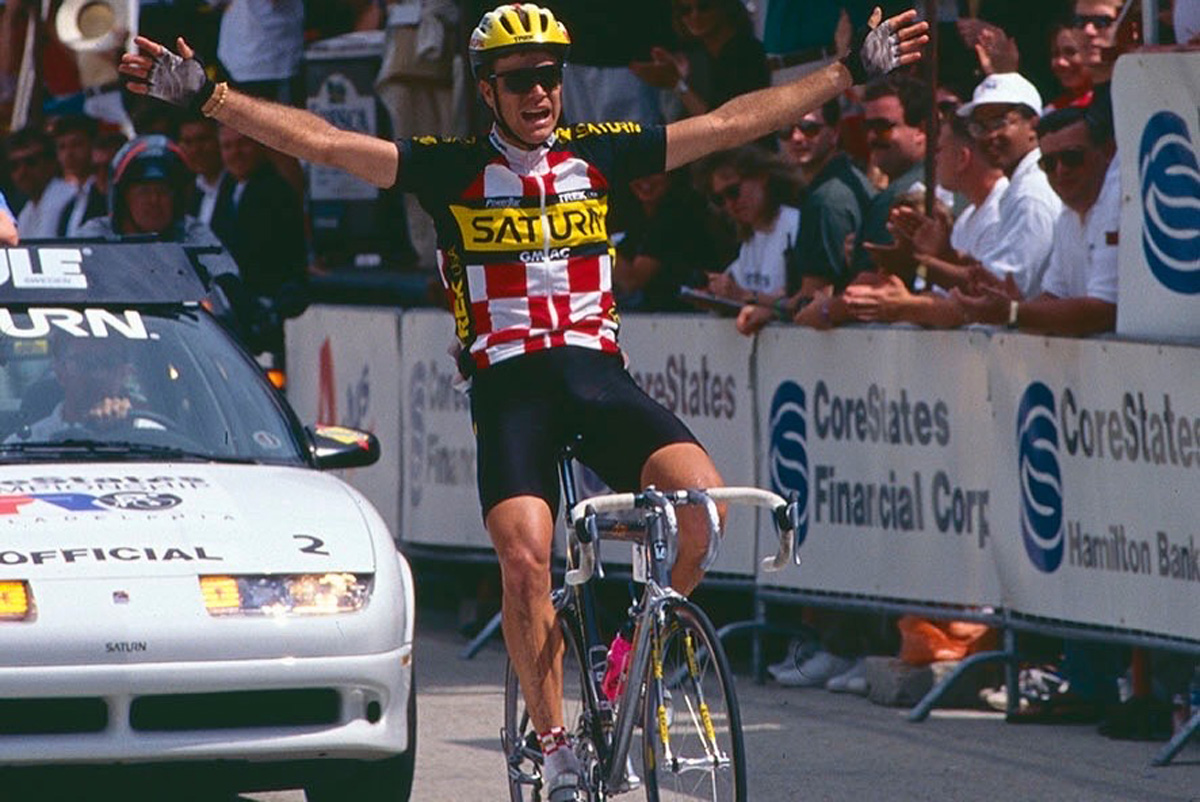
The 1995 US Pro win in Philadelphia was extraordinary. Lance Armstrong won it in 1993, and his Motorola teammate Sean Yates won in 1994—your former team. In those days there were often “two races”: one for the overall win and one for the US Championship jersey. But you won both, beating the Europeans, your former teammates, and Lance. Can you walk us through that race and how it unfolded?
A big part of that race was that my Saturn teammate Brian Walton and I had both ridden for Motorola the previous year and did not get re-signed. We had chips on our shoulders. We also had very good form, as I mentioned, from reduced strain and physical load after coming back to the US and racing domestically.
We were heavily focused on that race. It meant a lot to the team, and it meant a lot to me and Brian personally. As such, we rode with vengeance.
Lance was out front solo—he attacked on the final climb of the Manayunk Wall with about twenty miles to go, just as he had two years earlier. That was actually the best thing for us. He was working hard, but he was alone. We had four guys chasing, including Brian and me from Saturn, and fortunately none of them were on Motorola.
I knew I couldn’t beat Lance on the climb up the Wall, but when we finally started closing the gap, he sat up with about six miles left. Right as we were catching him, I went for it, and he couldn’t follow. It was smart racing and a tactic I still use today. For a long time, I felt like I could have done more and had more success, and finally smart racing combined with good fitness led to that win.
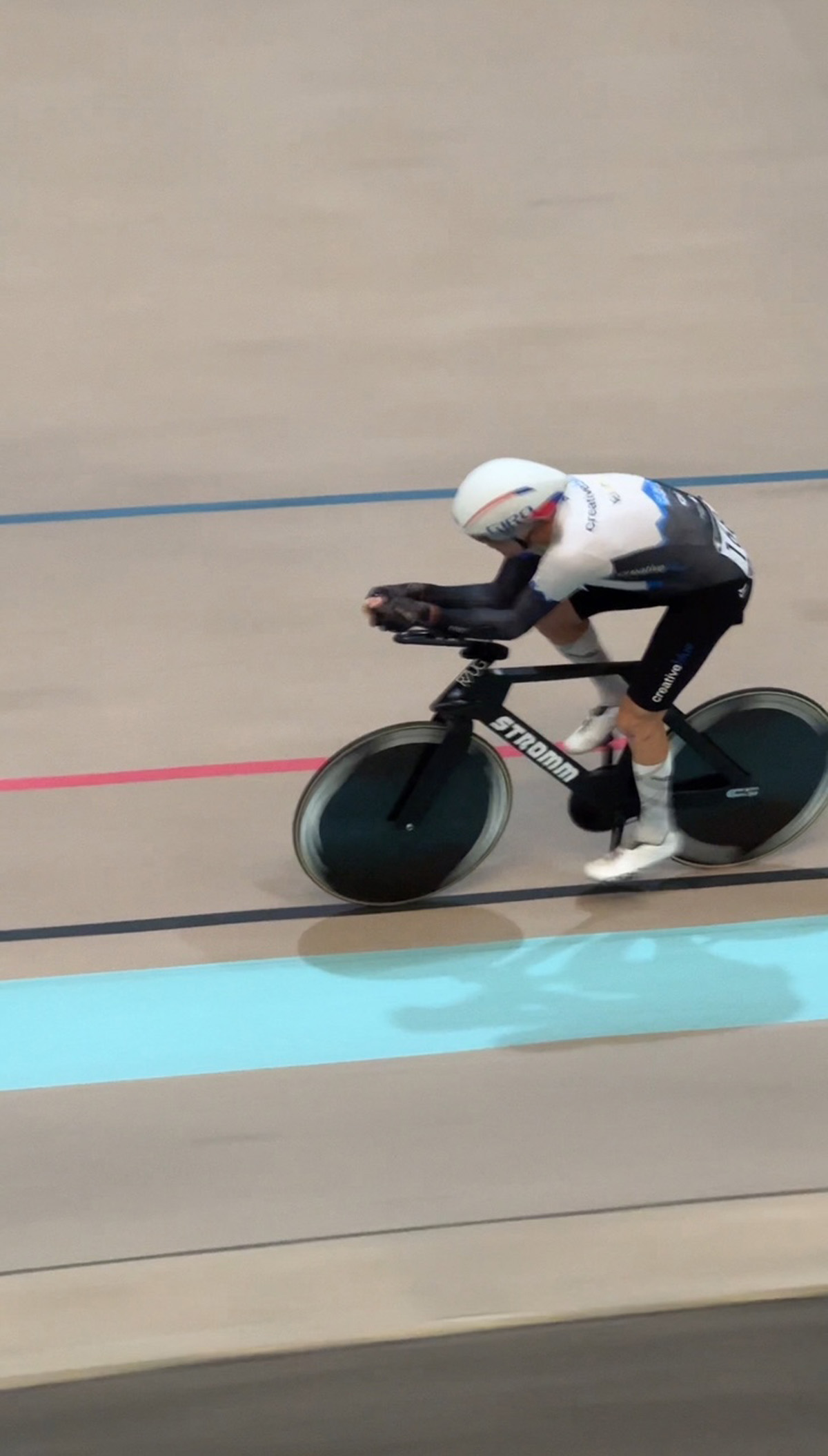
Can you talk about the Hour Record? Eddy Merckx called it the hardest thing he ever did, and you have now done six. Your 1997 US record stood for nearly two decades, and you later set multiple Masters world records that were not far off your professional mark. What drives you to pursue it, and how do you prepare?
Yes, the hour record is brutally hard work, but I enjoy it. I enjoy that I’ve done it as both a pro and a Masters rider. For me, it’s a good measure of my general fitness. My aim is to attempt one in each five-year age category as I get older.
I had a dream of being the first rider over 50 to go over 50 kilometers, but a good local racer, Patrick Warner, achieved that in 2024. My next dream is to surpass my 51.505 km record from when I was a pro, this time as a Masters rider, with the benefit of technological advancements. It hasn’t happened yet, but I’m still trying.
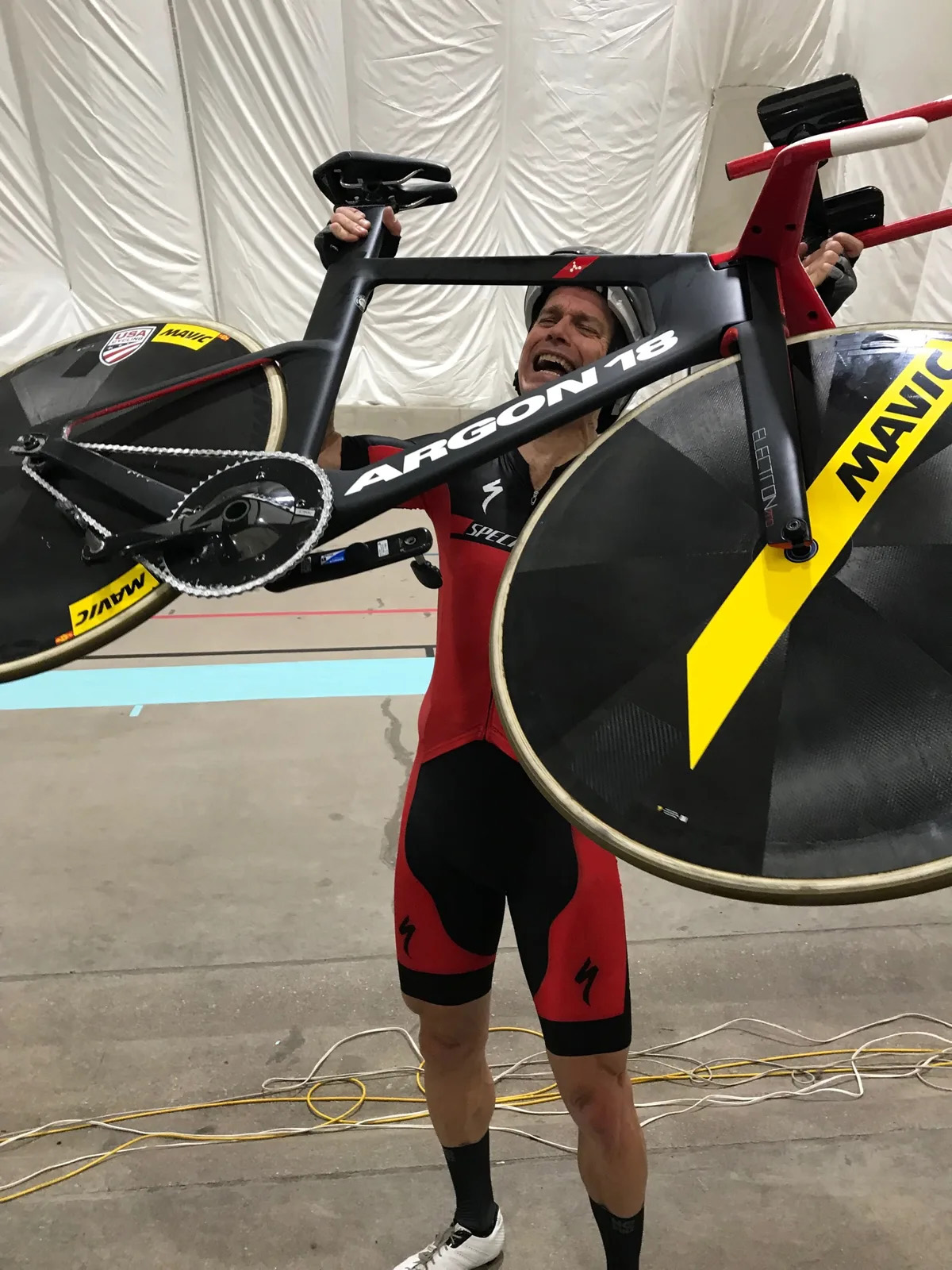
One of the biggest hurdles to successfully training for and achieving an hour record is access to a velodrome. I live just a few miles from the USOCP velodrome in Colorado Springs, but since COVID it has been limited in accessibility for the public. 2025 was the first year it had any sort of training availability. Ideally, one would train regularly on the velodrome for an hour record. I think this is one reason British Cycling has such amazing track racers—multiple velodromes, strong racing across all categories, and a championship culture.
Another hurdle is finding the position where your body can stay comfortable for sixty full minutes in a static posture while pushing maximum power. Training on that edge is befuddling.
What did you devote your time and energy to after leaving professional cycling in 1998?
One of the main things I did was pursue an education. I put a lot of energy into it and a lot of competitive zeal. I earned a double major in finance and marketing while simultaneously earning my CFA designation and starting a new career in financial management. I finished number one in my class and concurrently raised six kids. I was able to start racing again when I found a good partner.
How do you balance cycling with work and family commitments?
Number one: have a supportive partner. Two: recognize that it’s more than cycling—it’s about building health span. Three: teach your kids that wellness is a necessity. And finally, I do a lot of indoor riding for time efficiency.
So much has changed in cycling during your years in the sport. What are some of the biggest and most positive changes you have witnessed? And are there any negatives?
There are always positives and negatives. The most impressive change for me is probably wheels and tires. I also love how technological advancements enable me to ride as fast now as I did when I was a young man and still enjoy the sport.
Doping and cheating will always be negatives, particularly their lasting impact on other racers who will always doubt their ability and talent. Crashing is a negative, too.
What are your cycling plans for 2026?
I still live in Colorado Springs, not far from my first “home” at the Olympic Training Center. I love racing and the freedom the bike allows. Encouraging and inspiring others to ride and race is important, and each year I try to do more in that area—that’s one reason I have my Instagram account.
I enjoy racing the USA Masters Cup. I’m fortunate to have a wife who supports my continuing efforts to race, which allows me to travel. The National Road Championships, Track Nationals, and the UCI Track Worlds are always inspiring goals. I’m sure at some point soon my wife would like a beach vacation that doesn’t require traveling with a bike.
Any tips you would like to share with our readers?
Nothing outperforms hard work and dedication.
(Visited 6 times, 6 visits today)