

Cyclist
Tailfin: Ahead of the pack
Anyone taking part in an ultra-endurance race in the late 2010s would have noticed an odd-looking appendage over the rear wheel of many bikes, one that was all but ubiquitous by the 2020s. This mysterious carbon arch – a world away from the boxy, bulky metal racks that were typical at the time – was the Tailfin.
In 2016, the company announced the launch of its innovative rack via Kickstarter, accompanied by a video of the Tailfin rack being ridden in and around Bristol, still the location of the company’s HQ to this day. At the time, founder Nick Broadbent was seeking £50,000 of investment to get the Tailfin into production. In the end he raised £150,000, and things were very much up and running.
A decade later, Broadbent (pictured right) says that from the start the company’s ethos has been straightforward and design-focused.
‘Like any product designer worth their salt, you don’t try and look for the solution, you look for the problem,’ he says. ‘And back then I had a real problem. I hated commuting wearing a sweaty backpack that was giving me back pain and I wanted to address that.’
As is the case for many everyday riders, Broadbent’s commute was on a carbon road bike without mounting points, and so aside from changing bikes there was no obvious solution. After assessing what was available from brands that would become Tailfin’s competition, Broadbent realised that manufacturers of racks (ie, hard goods) and luggage (soft goods) were almost always separate, making for a raft of compatibility and fit headaches. To Broadbent it seemed like significant advantages could be eked out here.
‘Bikepacking involves so much faff – plus you’re tired, hungry and sleep deprived – so from the beginning we wanted to minimise the micro frictions riders experience and produce every part of the system ourselves.
‘For example, on an old, basic pannier rack it’s only four or so bolts to get it off, but removing it is something you’d never do; once it’s on, it stays on. And that was the birth of one of our key aims for the initial Tailfin product: quick release.’
Universal solution
What Broadbent came up with is a modular rack system that has been through a few iterations now but is based on the same basic concept: a tight arc, like a bow pulled beyond the point of snapping, that accepts luggage specially designed to be rattle-free. But rather than relying on bosses, mounts, eyelets or any number of other frame variables, the design piggybacked on something more or less every bike on the planet has.
‘That was our first patent: the axle mount,’ says Broadbent. ‘By connecting the Tailfin to a thru or quick release axle, we made a seriously strong mounting point that was universally compatible and attached to any seatpost.’
The upgrade from a traditional seatpost bag, famously prone to wagging around like a tail, is marked. The Tailfin rack remains locked in position, immovable even on the most technical mountain bike trails. The design had other things going for it too. Because it came in a choice of either carbon fibre or alloy it was a competitive weight for ultra-racers while being roomy enough to hold a laptop for commuters.
‘No one had made a carbon rack before and we got the geometry right so it didn’t unduly impact handling,’ says Broadbent. ‘We also wanted to make it aesthetically pleasing so it could complement a beautiful road bike.’
So, Tailfin had a good product and a target market, yet key to Tailfin’s success was Broadbent’s first hire, James Atkey, working out that it wasn’t commuters that were seeking the product out, it was adventurers.
‘We got right on the bikepacking train because it was doing by far the biggest numbers,’ says Broadbent. ‘James clocked that that was where we had the edge.’
Not-so-secret admirer
They also had a not-so-secret admirer who helped to move the dial too.
‘It was a pretty wild moment when Lachlan Morton approached us,’ says Broadbent. ‘He’d seen our rise in popularity and got in touch but we said, honestly, we can’t afford you. But he wanted to ride our stuff anyway and that was awesome and a big deal for our visibility.’
Changing how bikepackers and endurance athletes think about hauling their kit around is no mean feat, even if the solution looks obvious in hindsight. But Tailfin is configured differently, focusing as much as possible on the products at the centre of the project.
‘At heart, I’m a product person, not a business person,’ admits Broadbent. ‘What makes Tailfin different is that more than a third of the entire company works in product roles. We spend an inordinate amount of time developing products.
‘My colleagues and I are passionate users in virtually every area of cycling. If you understand the problems your customers encounter, you can create great products.’
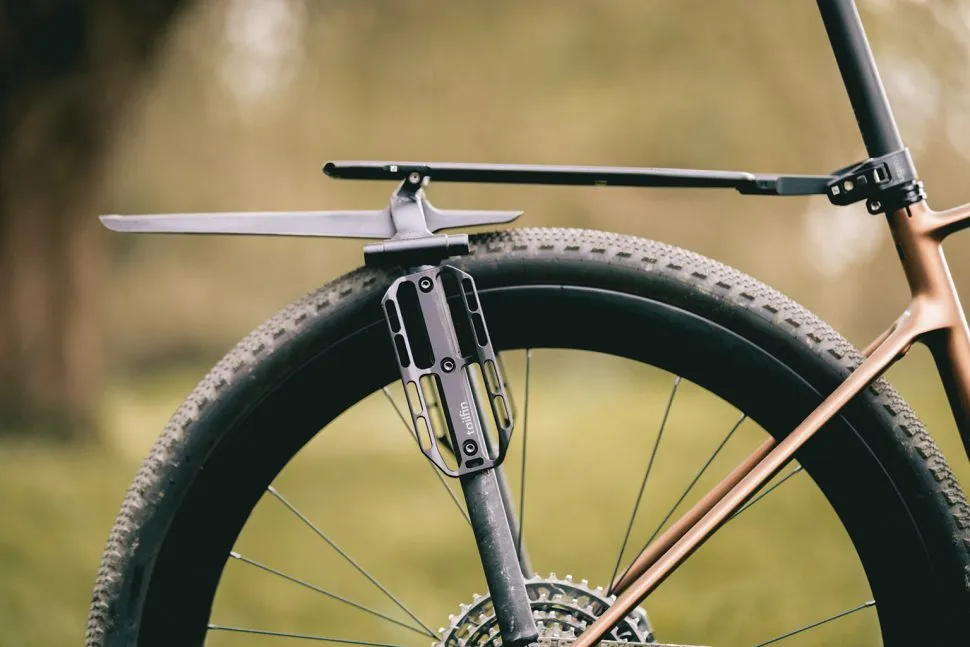
The Journey rack
‘The Journey Rack is essentially our third generation of the original Tailfin rack,’ says founder Nick Broadbent.
‘As a company we’ve amassed comprehensive manufacturing knowledge about how to make the rack stronger and lighter, while equipping it with a raft of different pannier size options, mudguards and light mounts.
‘We have also been able to make it more accessibly priced this time around. I never wanted Tailfin to be a premium brand. I want it to be as accessible as possible, both technologically and economically.
‘To that end we’ve got two price points, one for a product that’s minimalist without pannier mounts that you can even just strap your own dry bag to. And then the other has pannier mounts. The whole thing folds away flat and can be taken off in a matter of seconds.’
To find out more about Tailfin’s range of bikepacking equipment, go to tailfin.cc
The post Tailfin: Ahead of the pack appeared first on Cyclist.