
Gear Ratio
Gear inches: —”
Development: — m
Gain ratio: —
Speed: — km/h
Enter your chainring and cog, then hit Calculate to see the full breakdown.
Ever wondered how fast you’d go if you shifted into your hardest gear and held a steady spin? Or which gear you need to hit 30 km/h without redlining your legs? Speed on a bike isn’t random. It comes from a simple relationship between your gear, how fast you pedal, and your wheel size. Once you understand it, you can dial in the right gear for any pace.
A bike gear speed calculator works out your speed from your gear ratio, wheel size, and cadence (pedal RPM), since each pedal stroke moves you a fixed distance. This tool shows your speed at any cadence for a single gear or your whole drivetrain, using Sheldon Brown’s trusted methodology.
Below, I break down how gear, cadence, and speed connect, what speed common gears actually give you, and the best cadence to aim for.
How This Bicycle Gear Speed Calculator Works
Your speed on a bike comes down to three things: what gear you’re in, how fast you pedal, and how big your wheels are. This calculator takes all three and tells you exactly how fast you’re going.
The relationship is simple once you see it. Each turn of the pedals moves your bike a fixed distance, set by your gear and wheel size. Pedal that gear faster, and you cover that distance more times per minute. More distance per minute equals more speed. That’s the whole idea.
The formula behind it:
Speed = gear ratio × wheel circumference × cadence
The math follows the methodology laid out by Sheldon Brown, the most trusted reference in cycling mechanics. One detail matters here: the calculator uses measured rolling circumference, not theoretical tire diameter. That’s the real distance your wheel travels in one rotation, and it’s the same number your bike computer uses. So the speed you see here matches your head unit instead of being a few percent off.
You can run it two ways. Single gear mode shows the speed for one specific chainring-and-cog combo at your chosen cadence. Full table mode maps speed across every gear at once, so you can see exactly where each gear tops out.
How Gear, Cadence, and Speed Connect
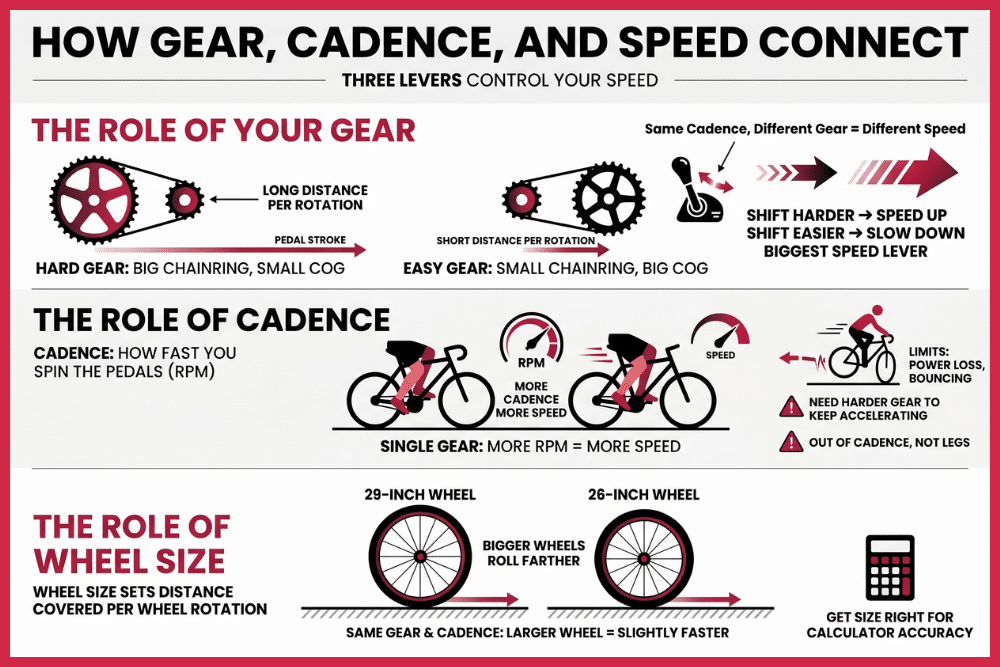
Three levers control your speed. Change any one and your speed changes. Understanding how each works is the key to using the calculator well.
The Role of Your Gear
Your gear sets how far you travel per pedal stroke. A hard gear (big chainring, small cog) moves you a long way with each rotation. An easy gear (small chainring, big cog) moves you a short way.
This is why you can pedal at the exact same cadence in two different gears and go completely different speeds. Shift to a harder gear and you’ll speed up without pedaling any faster. Shift easier and you’ll slow down. The gear is your biggest speed lever.
The Role of Cadence
Cadence is how fast you spin the pedals, measured in revolutions per minute (RPM). For any single gear, more cadence means more speed. Period.
The catch is that cadence has limits. You can only spin so fast before you bounce in the saddle and lose power. That ceiling is why you eventually need a harder gear to keep accelerating. You’re not out of legs, you’re out of cadence.
The Role of Wheel Size
Wheel size sets the distance covered per wheel rotation. Bigger wheels roll farther per turn, so at the same gear and cadence, a 29-inch wheel goes slightly faster than a 26-inch one.
For most riders this barely changes day to day, since you’re not swapping wheel sizes. But it’s why the calculator asks for your wheel and tire size. Get it wrong and every speed number will be off.
What Speed Do Common Gears Give You?
These numbers assume a 90 RPM cadence on a 700x28c road wheel, the most common modern setup. Use the calculator above for your exact gear, cadence, and wheel size.
Easy Climbing Gears
34×32: about 13 km/h (8 mph)
34×28: about 15 km/h (9.5 mph)
These are your bailout gears for steep climbs. They feel slow because they are, and that’s the point. On a tough gradient, 13 km/h while spinning at 90 RPM is a sustainable pace that saves your legs and your knees.
If you find yourself in your easiest gear and still grinding below 90 RPM, the hill has beaten your gearing. You need a lower gear for next time.
Cruising Gears
50×17: about 30 km/h (19 mph)
50×15: about 34 km/h (21 mph)
This is where you’ll spend most of a flat ride. These mid-cassette gears at 90 RPM put you at a brisk, comfortable cruising speed that most riders can hold for hours.
I do most of my flat riding right around here. It’s the sweet spot where the gear isn’t a strain and the cadence feels natural without bouncing.
Top-End Sprint Gears
50×12: about 42 km/h (26 mph)
50×11: about 46 km/h (29 mph)
These are your speed gears for sprints, fast group rides, and steep descents. At 90 RPM the 50×11 pushes you near 46 km/h, and you can spin faster than that in a sprint to go quicker still.
Most riders only touch these gears occasionally. If you’re spinning out your 50×11 on every descent, that’s when a bigger chainring starts to make sense.
What’s the Best Cadence?
For most cyclists, the sweet spot sits between 80 and 100 RPM. That range gives you the best balance of power output and endurance without wearing out your legs or your lungs too fast.
Here’s why spinning beats grinding. A low cadence in a hard gear puts huge force through your legs with each stroke. It feels powerful, but it fatigues your muscles quickly and hammers your knees. A higher cadence in an easier gear spreads the work out. You’re making more, lighter pedal strokes instead of fewer brutal ones. Your muscles last longer and your joints thank you.
Where you land in that range depends on you:
Recreational riders often sit naturally around 70 to 85 RPM. That’s fine. Cadence is personal, and forcing a number that feels wrong is counterproductive.
Trained and pro riders tend to push 90 to 100+ RPM. They’ve built the cardiovascular fitness to sustain the faster spin, which lets them shift the strain off their muscles and onto their lungs.
One thing to watch is spinning out. On a fast descent, you can hit your max cadence in your hardest gear and still want to go faster. At that point you’re just flailing your legs without adding power. That’s the sign your top gear is too small for the descent.
Why Your Real Speed Is Slower Than the Calculator
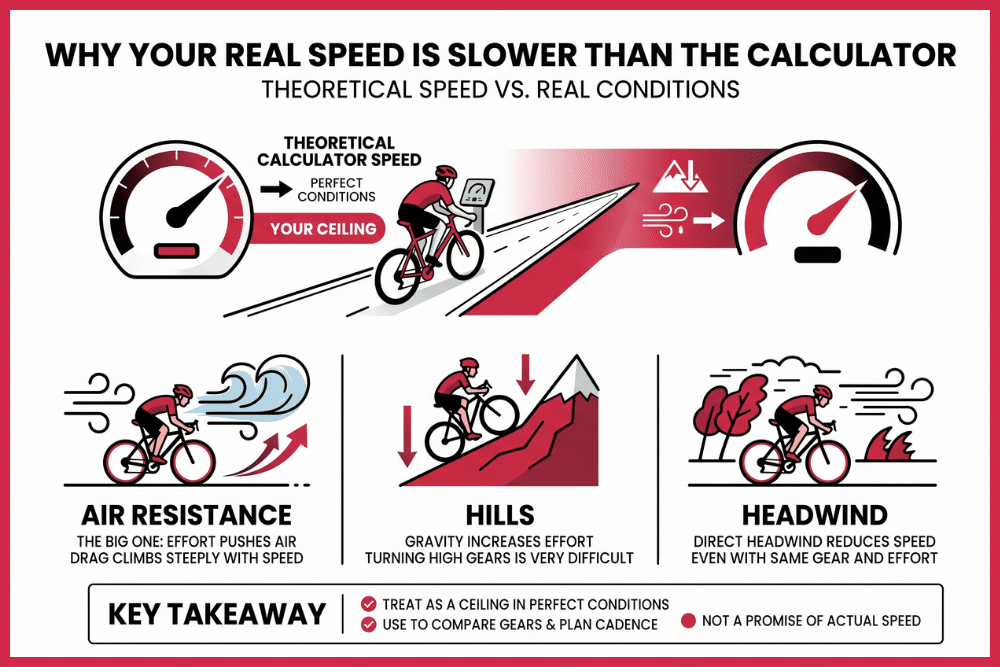
Here’s the honest truth most calculators won’t tell you. The speed you see here is theoretical. It’s the speed you’d hit if you can actually turn that gear at that cadence. Whether you can is a different question entirely.
The calculator answers “how fast does this gear go at 90 RPM?” It does not answer “do you have the legs to spin a 50×11 at 90 RPM into a headwind?” For a lot of gears and conditions, the answer is no.
A few reasons reality falls short:
Air resistance. This is the big one. Above about 25 km/h, most of your effort goes into pushing air, not the bike. Wind drag climbs steeply with speed, so doubling your speed takes far more than double the power.
Hills. Gravity is brutal. The same gear that flies on the flat can be impossible to turn at 90 RPM up a climb.
Wind. A stiff headwind can knock several km/h off your speed in the exact same gear.
So treat the calculator’s number as your ceiling in perfect conditions. Use it to compare gears and plan cadence, not as a promise of speed.
Frequently Asked Questions (FAQs) About Bike Gear and Speed
How fast am I going at 90 RPM?
It depends on your gear. On a 700x28c road wheel at 90 RPM, a 50×17 gear puts you around 30 km/h, while a 50×11 hits about 46 km/h. The harder the gear, the faster you go at the same cadence. Use the calculator above for your exact setup.
What gear do I need to ride 30 km/h?
On a standard road bike at a comfortable 90 RPM, roughly a 50×17 gear gets you to 30 km/h (19 mph). You can hit the same speed in an easier gear by spinning faster, or a harder gear by pedaling slower.
Why do I spin out going downhill?
You’ve hit max cadence in your hardest gear. Your legs can’t spin fast enough to add power, so you stop accelerating. A bigger chainring or smaller cog gives you more top-end gear for descents.
What cadence should a beginner aim for?
Start around 70 to 80 RPM and let it rise naturally as you get fitter. Don’t force 90+ early. A comfortable spin you can sustain beats a “perfect” number that wears you out.