
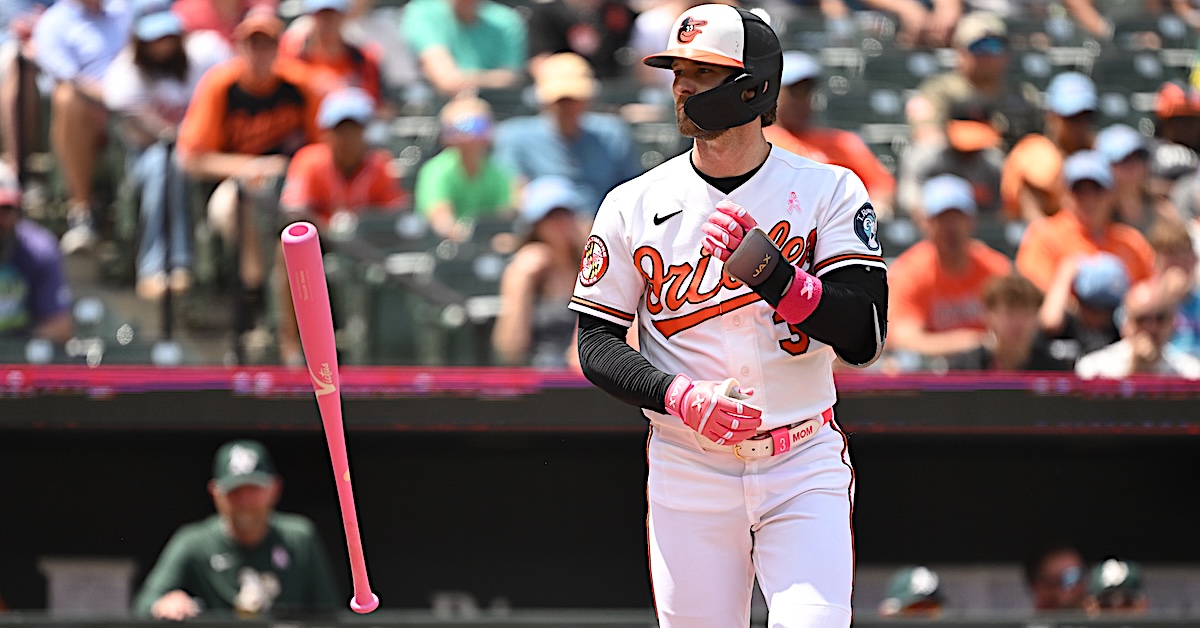
Taylor Ward has made a big league career out of lifting and pulling the ball. Drafted in the first round in 2015, he didn’t find a full-time role in the majors until 2022, but he ran with the job as soon as he got it. Despite unexciting bat speed, Ward consistently ambushed fastballs and tucked them over the left field fence. He clobbered 98 home runs from 2022-25 for the Angels, posted a 119 wRC+, and racked up 11 WAR over the span, one of the team’s best players. Then he got traded to the Orioles this winter with only one year left until free agency, and decided to completely remake his game.
I’m only partially kidding. See, Ward might have made his name as a 25-homer-a-year type, but he’s abandoned that style completely in Baltimore. He’s launched only three long balls this season, and his barrel rate, average exit velocity, and fly ball rate are all career lows. His average bat speed is down 1.5 miles an hour, now in the fifth percentile league-wide. Even when he does get the ball in the air, he’s pulling it at a career-low rate; only 19.4% of his elevated contact goes to left field. That’s why his isolated power has declined from .192 as an Angel to .103 as an Oriole. And oh yeah, he’s having one of the best seasons of his career.
That’s right – Ward might not be hitting for power, but he’s getting on base at a preposterous clip. His 18.8% walk rate is third in baseball. His .403 OBP is fifth. He’s not barely surviving on some weird BABIP spike or doing anything visibly unsustainable. He just started swinging slower and making more contact, more or less, and the results have been downright incredible; his 126 wRC+ would be the second-best mark of his career if he can sustain it the rest of the season.
Sometimes, swing speed is downstream of what has actually changed about a player, or it changes because of factors outside of his control. Different counts and different opposition both invite different swings. If you see a ton of breaking balls, or face a ton of two-strike counts, you might alter your approach in ways that show up in the raw average. But that’s not what Ward has done. He’s swinging slower across the board, in every situation. He’s taking fast swings – 75 mph or harder – at half the rate that he’d achieved in his career before this year. His swing has shortened, he’s squaring the ball up more, and his bat path is flatter and deeper.
I’m not all that surprised that Ward is capable of doing this. After all, even when he was cranking 25 homers a year, he was doing it through guile and intent. Ward has never had even average bat speed. As a prospect, he was a hit-over-power type. He was simply so adept at moving the bat through the zone that he followed the Alex Bregman/Isaac Paredes model, meeting pitches early to both elevate them and aim down the left field foul line. Out of 116 career homers, only 11 have gone to the opposite field. Opposite-field homers are the domain of enormous power hitters, and Ward was never that.
In addition to his excellent bat control, Ward has always had a great eye at the plate. He rarely chases – his career chase rate is 21.6%, one of the best marks in baseball since his debut. Despite selling out, in his own way, to hit home runs, he’s always made contact at a slightly above-average rate, too. He’s just kicked both of those trends into overdrive this year. He’s swinging at only 12.4% of pitches outside the zone this year, the best mark in baseball by more than three percentage points. His contact rate has exploded higher, from 78% to 84%. His zone contact is up above 90%, one of the best rates in the league. In other words, he’s turned into a premium contact hitter with a great eye, the Steven Kwan starter pack.
You Aren’t a FanGraphs Member
It looks like you aren’t yet a FanGraphs Member (or aren’t logged in). We aren’t mad, just disappointed.
We get it. You want to read this article. But before we let you get back to it, we’d like to point out a few of the good reasons why you should become a Member.
1. Ad Free viewing! We won’t bug you with this ad, or any other.
2. Unlimited articles! Non-Members only get to read 10 free articles a month. Members never get cut off.
3. Dark mode and Classic mode!
4. Custom player page dashboards! Choose the player cards you want, in the order you want them.
5. One-click data exports! Export our projections and leaderboards for your personal projects.
6. Remove the photos on the home page! (Honestly, this doesn’t sound so great to us, but some people wanted it, and we like to give our Members what they want.)
7. Even more Steamer projections! We have handedness, percentile, and context neutral projections available for Members only.
8. Get FanGraphs Walk-Off, a customized year end review! Find out exactly how you used FanGraphs this year, and how that compares to other Members. Don’t be a victim of FOMO.
9. A weekly mailbag column, exclusively for Members.
10. Help support FanGraphs and our entire staff! Our Members provide us with critical resources to improve the site and deliver new features!
We hope you’ll consider a Membership today, for yourself or as a gift! And we realize this has been an awfully long sales pitch, so we’ve also removed all the other ads in this article. We didn’t want to overdo it.
If you become more discerning, that means fewer swings and often later decisions – the longer you see the pitch before starting your swing, the easier it is to identify. Starting later leads to lower recorded swing speeds, because a late swing impacts the ball earlier in your swing path, before your bat has had time to get up to full speed. Ward’s average contact used to be angled to the pull side, and with a steep upward bat path. Now he’s catching it earlier in his swing path (but later on the pitch’s trajectory to the plate), with a flatter attack angle, and spraying it the other way.
A new feature at Baseball Savant displays this especially well for fastballs:

That’s Ward in 2025. You can read this from left to right as follows: He generally caught the ball on the barrel of the bat, was on time against fastballs, and hit them from ever so slightly underneath. Naturally, he tended to be earlier against breaking balls and offspeed pitches, what with the way time and velocity interact. That was his plan: lift, be on time or early, collect dingers. Here’s Ward in 2026, which looks quite different to me:

He’s still catching the ball on the barrel, but on average, he’s making contact meaningfully later on a pitch’s trajectory to the plate this year; in other words, he’s catching it before his bat gets parallel to the plate, and hitting it the other way. He’s also underneath the ball a bit less, though he’s still not pounding it straight into the ground or anything. As you might expect, he’s out in front less frequently on secondaries this year, too. His swing is just tailored differently than it was last year.
There’s a strong relationship between swinging more slowly and hitting the ball on the sweet spot of the bat more frequently. Ward’s squared-up percentage, already a strength, is now in the 93rd percentile. Despite swinging meaningfully slower, he’s producing better than ever on line drives, and that’s even as he’s posting his lowest barrel rate on them. He’s not hitting line-drive home runs anymore, but he’s still hitting the ball plenty hard to rack up doubles. He’s also never had a higher batting average, realized or expected, on liners.
Want another way of looking at it? How about our Squared-Up Explorer? Ward’s tradeoff is clear here:

Hitting fewer balls at ideal home run angles is obviously not, well, ideal, but look at all those huge bubbles in line drive territory, around 10 degrees launch angle. That’s actually an excellent pairing with his slower swings; if you’re going to hit fly balls, it’s important to hit them hard enough to leave the park. If you’re going to punch pitches at slower swing speeds, it’s better to hit low line drives.
Even with these benefits, though, it’s not like this tradeoff is good in a vacuum. Ward is running a .364 wOBA on contact this year, down 50 points from 2025. His expected slugging on contact is the lowest of his career by a mile. He’s actually posting below-average results when he puts the ball in play this year, a far cry from his prior form. It’s all well and good to talk about pairing your swing with your batted ball mix, but the math is still pretty clear: swing slower, get worse results on contact.
The reason this is all working is the near-20% walk rate, obviously. That many walks – and a markedly reduced strikeout rate, too – can pay for a lot of weak contact. And Ward is hunting these walks, make no mistake. When he’s ahead in the count, he swings only 31.1% of the time. That’s ridiculously low. Kwan is the only major leaguer who swings less frequently in those situations. It’s not just that Ward doesn’t chase; it’s also that he swings at less than half the strikes he sees. He’s only swinging at 57% of fastballs right down the heart of the plate when he’s ahead in the count.
Again, this is on purpose. Those fastballs are less appealing when you aren’t swinging as hard. And now that he’s making far more contact, accepting an extra strike is less punishing. It’s difficult to strike Ward out, even with two strikes. He’s struck out on only 16% of the two-strike pitches he’s seen this year, which is silly; he was at 20.5% for his career before this year. That’s a massive difference. Before this season, his career rate was in the 36th percentile, which means that he struck out more frequently than all but 36% of batters when he reached two-strike counts. Now he’s in the 90th percentile, an elite contact hitter with a good eye.
Ward’s current production is hardly a stable equilibrium, though. I keep comparing him to a variety of patient, high-contact hitters like Kwan, but none of those guys are walking 18% of the time. Luis Arraez, the exemplar of this style, barely walks at all. Kwan does, but it’s despite pitchers absolutely flooding the zone in an attempt to force him to hit his way on. Ward is still benefiting from pitchers staying away from him. He’s seeing fewer pitches in the zone than that group of comparables early in the count. He’s barely seeing more pitches in the zone than league average. That can’t possibly last. As the new book on him gets out, Ward will have to make a different adjustment – perhaps mixing in the occasional ambush swing that he used to do so well, perhaps simply focusing on keeping his swing geared for line drives so that the decrease in walks comes with an uptick in doubles.
Regardless of how this ends up, though, Ward has taught me something valuable about baseball with this massive change. I used to think that new ideas and strategies were strict upgrades, the clear best way for players to improve. Want to get better at hitting? Lift and pull. Want to get better at pitching? Throw your fastball at a shallower approach angle, or add more vertical break to it. The players who weren’t doing those things, in my mind, were soon to get left behind.
But that’s not really how baseball works, and Ward is a great object lesson in what I mean. The secret sauce to Taylor Ward’s game wasn’t lifting and pulling the ball. That was just how his elite bat control expressed itself. Likewise, the secret to his game now isn’t just the walks – it’s his ability to pair a great batting eye with a new swing to create plenty of contact and plenty of advantageous counts and free bases. Sure, some strategies are better than others. Sure, a mismatch between approach and talent is going to lead to failure more often than not. But anyone can say “lift it and pull it,” just like anyone can say “take pitches, make contact, and walk.” The players on the field still have to do it – and right now, Ward is absolutely doing it.