
From PE teacher to coaching with the England team is some journey, but that is exactly the trajectory Emma Harradine has followed.
Emma has been a PE teacher for more than 30 years, although her love of the sport goes back to when she was a youngster.
She describes her move into coaching as a natural progression from playing and teaching – she took the old ETTA coaching badges in the 1990s.
But it is in semi-retirement from teaching that she has both broadened and deepened her coaching experience.
“I was starting to plan the end of my teaching career and what I do in semi-retirement, and that’s when I turned to coaching and put back into a sport I’ve loved for so many years,” she said. “The more I did, the more I enjoyed it.”
Her journey means she is well placed to assess the differences – and some similarities – between coaching newcomers to the sport and elite athletes.
It has also given her the mindset of continually learning from others and adapting how she delivers sessions across the range of players she works with – a central theme of the Table Tennis England coaching strategy.
Emma coaches a lot of one-to-one sessions in and around Bristol, as well as leading junior sessions and those for women and girls. Sessions in the latter category have been good examples of the power of sport and of the need for coaches to be adaptable.
“We did Saturday afternoon sessions for a group of ladies in Wiltshire, and that was lovely,” said Emma. “A couple of hours learning a bit of table tennis, a cup of tea and a biscuit halfway through and building on that sociable nature that table tennis can be – getting the ladies to talk to each other and build the networks share experiences.
“And then in Bristol, the Civil Service Club wanted me to do a women and girls’ session, and they said it would be for about 20, but more than 45 women turned up! But we made it work – you think on your feet, rip up the session plan and you just have to go with it.
“It showed the amount of enthusiasm and demand there is out there for women’s sessions, so that’s the bit I’ve tried to try to harness, share experiences and knowledge and just give ladies and girls the confidence to play.”
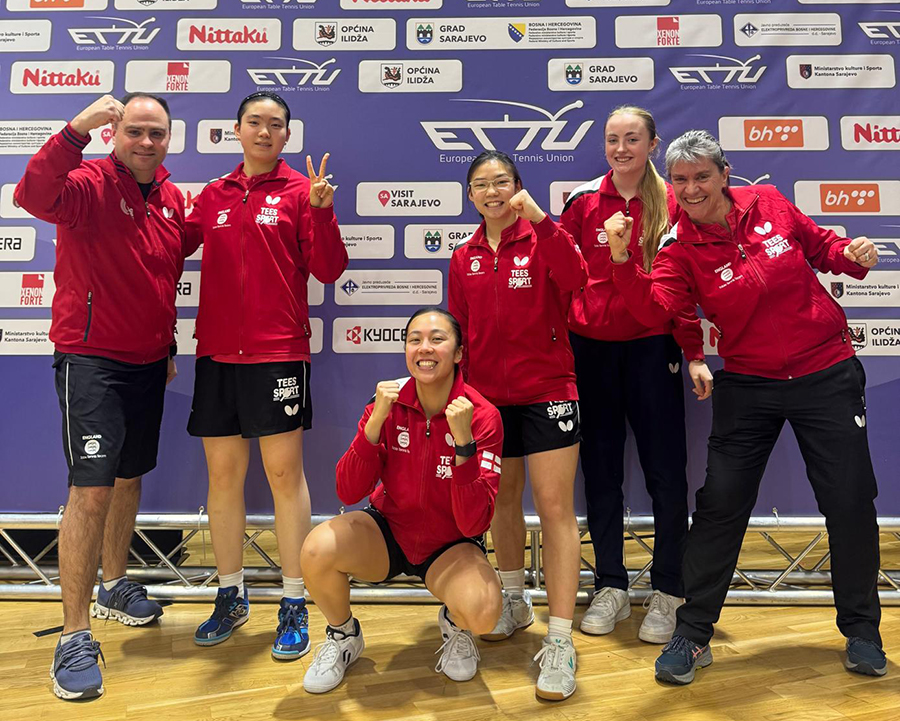
Emma was one of the cohort to get a place on the SHEcoaches programme which began in 2024. That opened the door to travelling with the England women’s team to the European Championships Qualifying Tournament in Sarajevo last year.
The team successfully qualified for the Championships in Croatia last autumn, with Emma also travelling with the team on that occasion.
It means Emma had the chance to see up close what some of the world’s best coaches and players are doing – and how to take some of that knowledge into her own sessions.
“Observing everything that goes on not only within the England set-up but watching what the coaches are doing with other countries, what the drills are . . . it’s a real eye-opener from working with beginners and improving and intermediate players and also trying to learn and develop and put that into my coaching practice as well,” she said.
“The drills and the warm-ups are nothing that local league club players are not doing – the drills are fundamentally the same, but obviously the intensity, the consistency and everything is on another level.”
Whoever she works with and whatever the level, watching players improve is a big motivator for Emma, who added: “I think one of the biggest things is seeing somebody enjoy the improvements and the progress they make over a period of time.
“As I say to a lot of players, I think table tennis is a one of those sports that you’ve really got to invest time in because there are so many intricacies of the game, whether it be speed and spin or bats and rubbers. You’re in for the long haul to see some improvements.
“And when I see the penny drop that something they’ve worked on over a period of weeks or even months has worked and clicked, and they come back to me absolutely buzzing for the fact that this worked, that gives you a real sense of achievement that you’ve actually been able to change somebody’s mindset, or change a technique, or change a tactical bit of something.
“That is really rewarding, and I enjoy it just as much as working with the better players and stronger players.”
Emma believes the structure of underpinning coaching qualifications with Continuous Personal Development will help to elevate standards, both in coaching and playing.
“I think the pathway in that continuous development is really valuable,” she said. “I’m always looking for ways to improve my coaching practice, it doesn’t matter whether I’m supporting other coaches in their sessions or I’m watching at the elite level.
“I’m always looking for what happens with a particular technique, or a skill or a tactic that I can take back and use in my sessions, so absolutely that continuous development I think as a coach is really important.”